BartW
-
Posts
349 -
Joined
-
Last visited
Everything posted by BartW
-
Not with a skillsaw?
-
Thanks guys, both good suggestions. I will probably end up cutting 35mm slivers to top in order to keep alu faces back and front rather than top and bottom thanks! oh, and would it be good to have horizontal battens top and bottom of the wall to give the plasterboard better bedding or would it be counterproductive?
-
Hi, we are nearly ready to install internal PIR in our timber frame walls. The trouble is that out screed to ceiling joist height is 35mm higher than full sheet of PIR. Would it be best to: a) lift boards 20mm off the ground and foam up with expandable foam later? There would be tiles and adhesive later so I guess it would be ok? Then remaining 15mm on top, do the same thing because there will be a plasterboard applied? b) fully plant it on the floor tight to screed and foam up the top? c) install a row of pir boards horizontally, and do 650mm pir cuts from a vertical board, and generate a lot of cutting and waste? what would a self-build-hubber do? thanks! bart
-
Hi, we are midway through our timber frame house. We are now installing internal VCL and (as always) I am checking if all is being doing correctly when it is already done. seeing another post about vcl last night made me think if I am actually doing mine correctly. our wall buildup is as follows feom out to inside: - timber open screen cladding - UV membrane - 25mm horizontal battens - 25mm vertical battens - external vcl - osb - 140mm timber frame - 120mm insulation in between I then installed internal VCL, and aim to cover with 50mm PIR, then service battens and plasterboard. is it non-conventional? most importantly, is it ok? It’s done now…
-
Depending oj the final roof coverings, ventilation may be required. good example is Cedral slate. we too did a 150mm warm PIR roof, fyi. Vented top and bottom.
-
Hi, We ended up with English Brothers. Our next door neighbours went with Vision Development. Of the two of us he sang more praises.
-
Hi, Thanks for the comment. I have finished the wall, but still not finished the edge detail. So not too late. As for the staining, I read it is efflorescence, and can be rid of with vinegar diluted in water. I am yet to try
-
Hi, I ordered these in 30deg pitch: https://www.roofingoutlet.co.uk/products/cedral-fibre-cement-monopitch-ridge-blue-black-525mm?currency=GBP&variant=39700840513607&utm_medium=cpc&utm_source=google&utm_campaign=Google Shopping&gclid=EAIaIQobChMIhauzt5by-QIVkJftCh2CPQ-cEAQYEyABEgIsevD_BwE only to learn a week later they will be 10 weeks leadtime. I can’t work with that, as that would take me into December with weather and top of the roof open and unable to be finished. does anyone know of workable alternatives? thanks! bart
-
This is only going to be a fixed window into the bathroom downstairs. integrated aluminium window cill to extend beyond the wall. It will have EDPM flange bonded to the sides and top to prevent any water ingress through the window. then side cheeks to be clad in charred timber (general scheme all around). I just wonder if there should be some sort of flashband on sides and bottom, or not. the side edges will be finished off with a finishing trim, whilst the top with a head flashing trim. should I consider anything else?
-
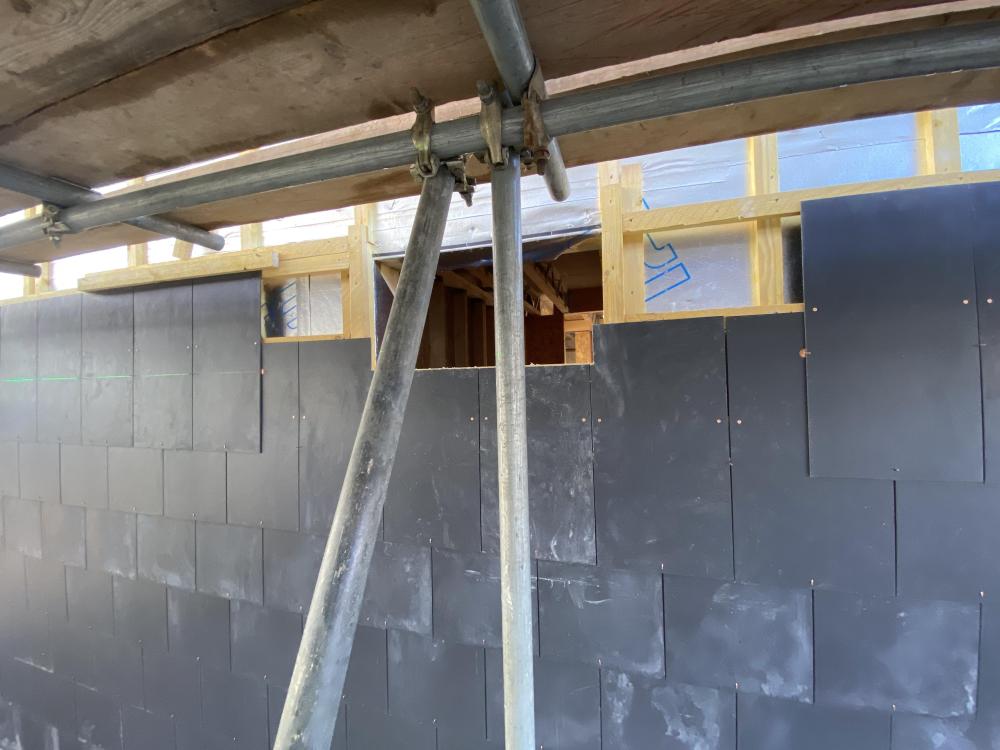
Hi, I am in the process of slating (learning to slate to be clear). The whole task is fairly easy, but I am not sure how to best address around a window opening. I got as far as the below. Rather than suggest how I would do it, can someone please share some knowledge? I have found multiple roof slating videos, just not this. My slates are Cedral Thrutone. 600 x 300 and 100mm overlap. Advice please
-
I was the OP on this thread, and can confirm I went with Powerlon UV120. The manufacturer confirmed they were happy with two layers of breather. Just to be clear, my setup is: - TF house - Thermo TF200 - battens - counters - Powerlon UV120 - vertical cladding We are doing an insect mesh to the bottom, and top for extra ventilation.
-
Hi, I suppose I could not have made it any more difficult that it is... We are to build a flat roof terrace on the top floor, and we have a junction of a GRP roof to timber frame wall. The said wall will receive battens, counter battens and vertical charred timber planks to the face. The wall is currently Timber frame panel with OSB. Key considerations: - if it were to be a standard brick wall, I would use abutment trim and simulated flashing. Job done - but here there is none of that. - I considered running the abutment trim against the TF wall and OSB. I concluded that far in another thread. However... - the said external wall is externally wrapped in TF200 breather. - There will be an aluminium coping on top of it, but before - I plan on running the VCL up the said wall to meet the top of it to create a continuous barrier - nevertheless, this means I will be GRPing against a membrane again. - I fear that if I do not lap the VCL to the top, I would be getting rid of a useful "tanking" Or should I: - run VCL and terminate below the abutment trim - install abutment and seal the top of it with GRP - install breather as planned, and extend to the top / underside of the coping - proceed to installing battens, counter, vertical cladding Am I overthinking this??? Picture below to show what I am mumbling about. Thanks! Bart
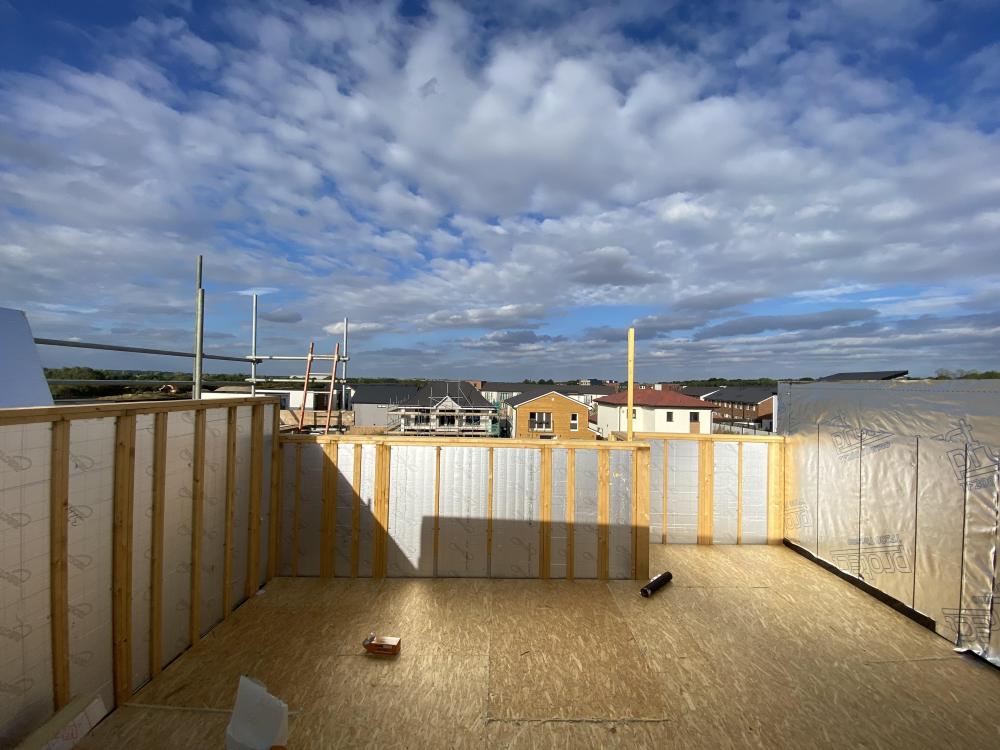
-
Thanks! I will have up to 6m runs, and last thing I want is the aluminium trim spiralling out of shape. So, stick to GRP trims I guess, and the one as per the latter link should be fine to use? Seeing that it is made out of GRP.
-
HI, Namely, as per the top line. These and similar: https://www.ultra-flex.com/trims/ https://www.roofingsuperstore.co.uk/product/ryno-f4-grp-roof-edge-trim-100mm-x-60mm-x-3000mm-black.html?gclid=Cj0KCQjwr4eYBhDrARIsANPywCiWbttvk1z3JWdhnlxmbqZSkfkb5SRJmNuP1rnMaJW7ZzZeaxJfcwYaAiBYEALw_wcB Would they bond well with GRP, or would their expansion rate be a possible cause of delamination? Trying to detail our roofs and standard trims I find a bit bulky. Thanks! Bart
-
Screws are not good for this I am afraid, as they countersink into the trim and if not split it, tend to sit proud on the surface. Clout nails on the other hand are fully flat headed and go like butter
-
Grp trim should be nailed to roof snd masticed to wall to maintain flexibility. Breather draped over it and grp onto is my preference here.
-
thanks, I am being paranoid about water possibly being driven behind the trim if an air pocket occurs or the joint fails in any way. my logics is that it is a neater joint against flat OSB sheet than the draped breather.
-
Hi, silly question probably, but we are to do grp on the roof terrace and that butts up against the wall which has got a TF200 breather on it. It is a timber frame wall with OSB on it (and the said breather). would you: - fold up the breather, install grp trim, install GRP against the wall and above, then fold back the breather and tape on the surface of the finished abutment - or try to run a grp trim against the face of the breather, then GRP against it, and tape on top of it? decisions decisions…
-
My hidden gutter + warm roof + can we simplify...
BartW replied to BartW's topic in Rainwater, Guttering & SuDS
In theory it shouldn't but that's theory. -
My hidden gutter + warm roof + can we simplify...
BartW replied to BartW's topic in Rainwater, Guttering & SuDS
Yes, the plan is to insulate all around the box. Water discharge will be through a set of downpipes either end of the building. Sadly into the warm loft area and out again just outside in the battened void area behind slates. No overflow, but the front of the box would be lower than the back, so in theory it should spill through the outside. Was also thinking there could be a tray made out of EDPM that would tank the underside of the gutter. Still not convinced, as there is so little space. I am basically trying to replicate the Krop gutter system, but compacted, as theirs is 200mm wide... -
My hidden gutter + warm roof + can we simplify...
BartW replied to BartW's topic in Rainwater, Guttering & SuDS
As per the first post, simplified for the purpose of this. The insulation would extend as far down as practical, and there would also be a layer of insulation between the rafters in the cold bridge (non insulated to the top) area. -
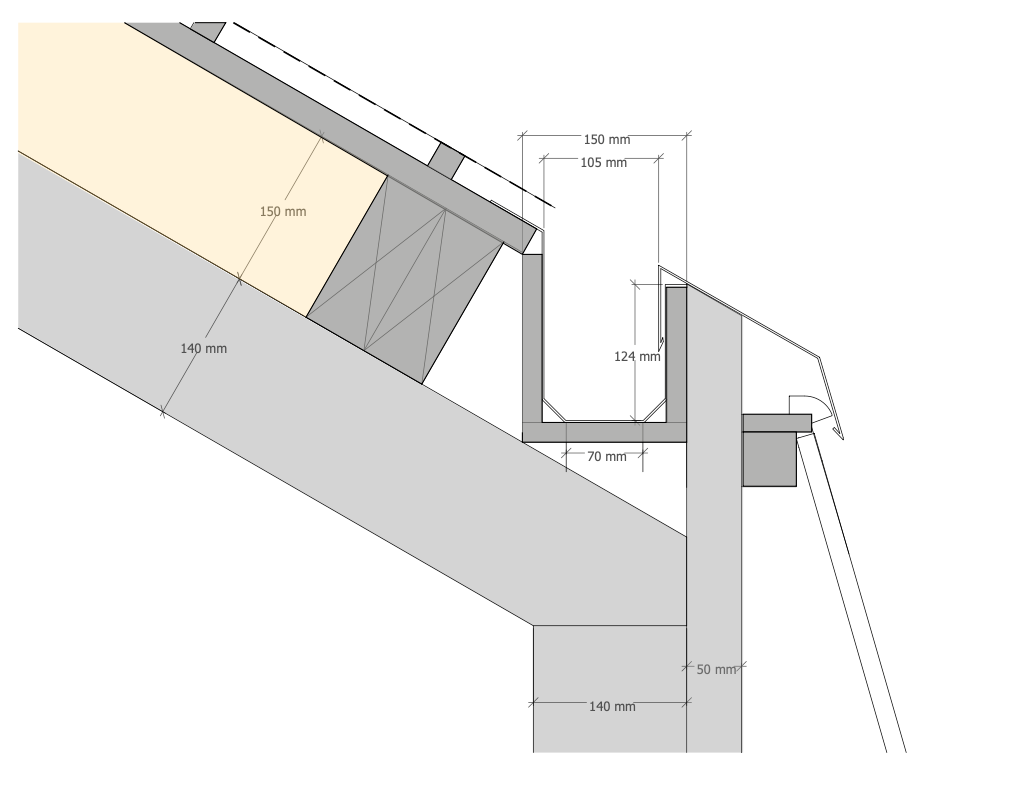
Hi, Many weeks and months later, I have now come up with my iteration of hidden gutter. Drawing simplified for the purpose of modelling below, BUT can I: - get rid of stop battens knowing I will be using helical fixings? - if needed with stop batten, can I have just one? - as the above, do they need to be laid flat? - any other hints? Thanks Bart
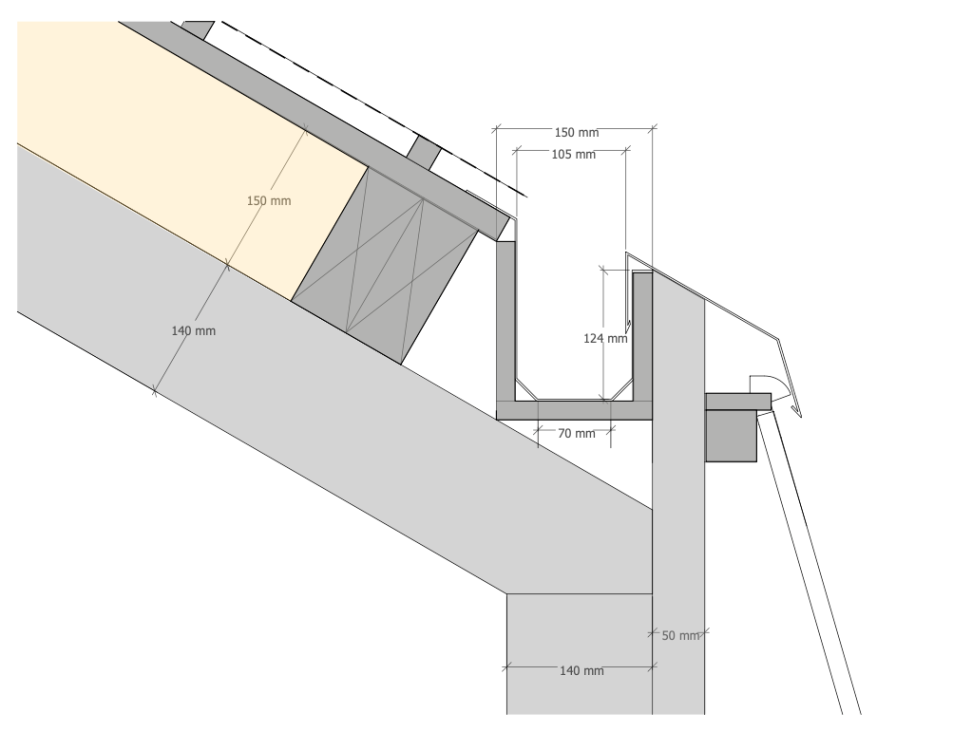
-
Thanks guys, All feedback most appreciated. I am just trying to "automate the job", now that I spent £1300 on a pari of Paslode 360Xi. I want them to earn it now!
-
Hi, Preparing to do slate wall cladding with 50 x 50 battens and counters in the same size. You might ask why. I want to hide a 68mm downpipe from the hidden gutter at the top of the wall (still to design in situ), and by notching the cross batten in one place, I can just about achieve it. Nevertheless, I am querying the fixing size. TRADA book says 2.5 x the length of the thickness of the "applied" material. With 25mm battens this would be 62.5, so 63mm Paslode nail. @ 50mm this would be 125mm. Obviously, framing gun nails only go up to 90mm. Am I destined to spend life applying 4 x 120mm screws on both, or would 90mm be ok? I don't think these would pull off the wall. I kinda know they would never. 90mm RIng shanks is what framers use to put together all TF panels, and other what nots, so I hope this would just about work. Another example is fitting internal 50mm PIR + 25mm battens. Obviously here it's a 120mm screw, right? Or not? How do we establish all adequate penetration lengths? Is there a quick guide somewhere that tells it all? It would be crazy to have to make hours of research to comprehend all fixing lengths per application. Not suggesting it is a wrong thing to do, but the build itself is a lot more complex that just this part. So what would a Self-Builder do? I am guessing many "professional" builders apply a method of "this will do" or "get the longest one". Many thanks! Bart
-
Thanks, I have decided to take a holistic view, and just get a half decent (powerlon and likes) VCL. Not expensive Clima, and not cheap Wickes Thanks again!