


BartW
-
Posts
349 -
Joined
-
Last visited
Everything posted by BartW
-
Anyone to comment please? Also, weirdly, Kingspan suggest 60 over + 60 in-between for the "warm" roof buildup on pitched. Any benefit to having sarking vs no sarking? Would I be better off doing that instead of bulky 150?

-
TF House about to start, and last minute pondering... Insulation...
BartW replied to BartW's topic in Timber Frame
Yeah, I think I will do just that. Better (worse) things to worry about out there! B -
TF House about to start, and last minute pondering... Insulation...
BartW replied to BartW's topic in Timber Frame
I must admit I am looking at economical factors too. hence me considering likes of 25mm pir sandwich + rwa45. Also “horizontal service cavity means services going in that direction or a lot of notching / removing of battens. What about 2inch vertical battens with 75mm rwa45 (tight!) then blinded with 25mm pir and 25mm service cavity vertically? Then osb and plasterboard? -
TF House about to start, and last minute pondering... Insulation...
BartW replied to BartW's topic in Timber Frame
We want to hide all gutter downpipes behind cladding. There may be other ways of achieving this with 1" battens, but I might have to notch / route the back of facade timbers, or create a bespoke downpipe. Sounds like I will be re-evaluating live when at it soon! -
TF House about to start, and last minute pondering... Insulation...
BartW replied to BartW's topic in Timber Frame
I am actually liking this idea. I don't suppose I would get away with a 75mm RWA45 internally, whilst eradicating internal PIR altogether? I appreciate that would re-introduce cold bridges. What about doing 20mm PIR internally, and then 50mm RWA45? I would keep my service void 50mm, but hopefully things like cables and pipes would just squash the insulation a little. Viable? -
Thinking about this again, would I be able to achieve better performance of the pitched roof by doing a 100mm PIR above rafters, and 100mm rock wool between the rafters? Decrement delay and thermal mass come to mind, having read a few recent posts. Also, would it fly with flat "warm roofs"? I.e. 100mm PIR above, and 100mm rock wool between rafters?
-
TF House about to start, and last minute pondering... Insulation...
BartW replied to BartW's topic in Timber Frame
@Icevergethanks for the detailed response. I will study tonight. Changeplan suggested 0.149u value for my buildup with 50mm PIR. -
Yes, falls towards the pitched roof.
-
TF House about to start, and last minute pondering... Insulation...
BartW replied to BartW's topic in Timber Frame
That's how I had it initially. But it adds unjustifiable labour and material cost of about £5k ... -
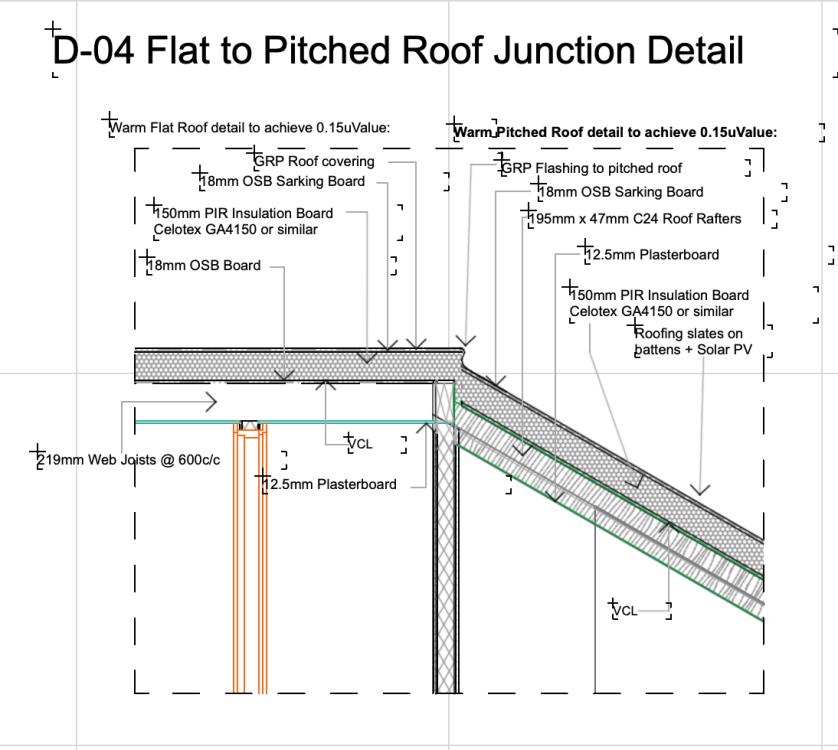
Hi again, Sounds like there will be a lot more of me seeking reassurances going forward.... I have two roofs adjoining: - warm flat - warm pitched Detailed as below: Can anyone see problems with it? It was going to be warm to cold initially, but possible cold bridges and likelihood of failing in such form had me redesign it. Or would an inverted hybrid be better on pitch? i.e. 60mm over the joists, and 60mm inbetween? Thanks!
-
TF House about to start, and last minute pondering... Insulation...
BartW replied to BartW's topic in Timber Frame
Plasterboard on its own is known to have a pull-out strength of paper, and I am likely to have fixtures on the walls, like TV, wall cabinets in the kitchen and so on. To include other things not yet specified. OSB attached to the structural 140mm joists gives no benefit, but just doubles up the bracing role already being taken care of by the external layer of OSB. I am on about me having a single skin of 140mm block with no cavity to hide telescopic vents, and actively trying to find a solution and hiding them. -
TF House about to start, and last minute pondering... Insulation...
BartW replied to BartW's topic in Timber Frame
Thanks Nick off to worrying about exposed floor void ventilation now again 😆 -
TF House about to start, and last minute pondering... Insulation...
BartW replied to BartW's topic in Timber Frame
So, the anticipated build-up from inside out was going to be (does not detail the membranes):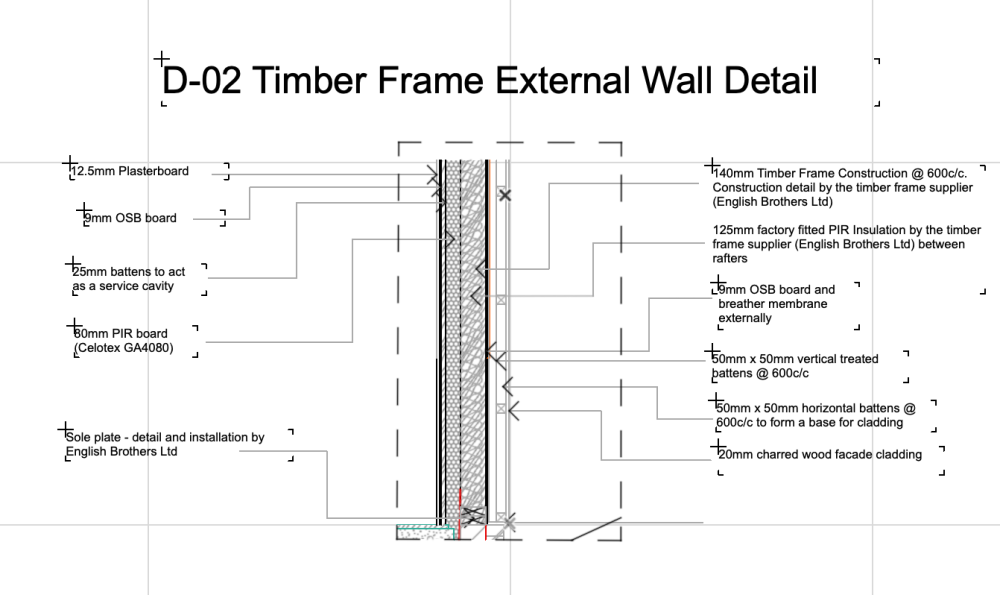
-
TF House about to start, and last minute pondering... Insulation...
BartW replied to BartW's topic in Timber Frame
Yes, I can see where you are coming from, but certain things you have no control over. For me, this being one of them. Yes, there would be the usual VCL internally, and breather membrane externally. Of course, that would have been the assumption on the standard timber frame wall buildup. Would I need to shuffle things up if I go external PIR? -
TF House about to start, and last minute pondering... Insulation...
BartW replied to BartW's topic in Timber Frame
With that approach you would be doing the whole job yourself, to include everything else you won’t be able to see. The chance of them not giving a toss is as big as me doing it wrong (even if I were to commit to doing it in my lack of spare time). Back on topic, is there anything wrong with applying secondary PIR externally, rather than internally? thanks Bart -
TF House about to start, and last minute pondering... Insulation...
BartW replied to BartW's topic in Timber Frame
Yes, unless PIR being done in factory. -
TF House about to start, and last minute pondering... Insulation...
BartW replied to BartW's topic in Timber Frame
Ok, so just to clarify, I have always planned on 50mm internally. That + 120mm in-between the studs would achieve 0.149 u Value. All I was thinking of was to move the internal insulation to sit on the outer surface for the reasons mentioned in my first post. Are you suggesting, this is not as straightforward as I picture it? -
TF House about to start, and last minute pondering... Insulation...
BartW replied to BartW's topic in Timber Frame
Thanks guys, @Nickfromwales I am was meaning to say that I am considering doing external PIR instead of Internal. Is this not a wise move? -
TF House about to start, and last minute pondering... Insulation...
BartW replied to BartW's topic in Timber Frame
Hi, Yes decrement delay has been on my mind some time ago, and ways of mitigating its effects, but economical and other reasons took charge sadly... Studs are 140mm, and PIR between is 120mm. I could technically got more PIR externally, and full fill with rock wool in the studs, but it's sadly too late now, as I have now committed to factory fit PIR, and I would imagine it is nearly in! Is the rest of my thoughts process logical and more importantly correct? -
Hi, We are about to start with the Timber Frame. Shell is in production right now, and is expected to come fitted with 120mm PIR in-between the studs, and osb externally. I have been forever planning on adding 50mm insulation (PIR) internally. But speaking to my neighbour, who is insulating externally, it suddenly made more sense to me: - quicker as no need to negotiate internal studs or floors - more continuous, thus fewer possible cold bridges Most importantly, in view of my recent dilemmas about void ventilation: - I could extend insulation right down "to the ground" - hide the void ventilation telescopes in sections of removed insulation - install cement board across the lower part of the wall, and decorate / render / brick slip it We are cladding open rainscreen. Our timber frame supplier will finish the building by wrapping the whole frame with OSB to the face with VCL. Am I right in thinking I then go: - 50mm PIR - vertical battens - cross battens - vertical rain screen cladding Any downsides to doing it like this? Many thanks! Bart
-
Kingspan TR27 vs Celotex or equivalent for roof terrace / balcony
BartW posted a topic in Flat Roofs
Hi, We are specifying flat roof insulation, and warm deck is the obvious choice. Currently proposed buildup on top of joists is: - 18mm osb - 150mm Celotex XR - 18mm osb - grp Then subsequently: - some areas acting as a standard flat roof, and others being built a suspended decking on adjustable pedestals. I have been looking into ways of simplifying, and Kingspan TR27 seems a good choice, more compact to handle onto the top floor roof, and in theory takes away the need to apply another layer of OSB prior to GRPying. Pound for pound it is a bit more expensive than Celotex + OSB, but obviously quicker and easier to handle. Is it something worth considering? Thanks Bart -
Beam and Block floor and ventilated void vs Timber Frame
BartW replied to BartW's topic in Foundations
It's not, but I find paying extra £6k for that a privilege I can spend money on elsewhere (like "overnight" steel price increases that amounted to that and a bit...) -
Beam and Block floor and ventilated void vs Timber Frame
BartW replied to BartW's topic in Foundations
We are proposing vertical + cross battens, then open charred timber facade. by the way, when browsing I found this last night. I think I will run it passed BC:
-
Beam and Block floor and ventilated void vs Timber Frame
BartW replied to BartW's topic in Foundations
Too late for this. We are where we are. Any other options that work with BB? -
Good morning, We are currently at the point of building a foundation for our next house, and have come to a stumbling point. We previously had an external brick skin to the plinth which was providing a route, and a way of dressing the telescopic vents. We later removed that external skin, as concluded it was costing a lot of money, by not doing anything structural (our timber frame sits fully on top of the 140mm 7kN blocks). This leaves us with a question of how to address the ventilated void. Telescopic vents will have nowhere to be hidden externally, and there will be no way / point to install the vent grilles. How has everyone else been addressing this? One of the neighbours is proposing bollard vent system on theirs, but I find this would be in the way of all things around the property. Any ideas please? Thanks Bart


