


BartW
-
Posts
349 -
Joined
-
Last visited
Everything posted by BartW
-
Installation of Vaillant AroTherm Plus - DIY
BartW replied to BartW's topic in Air Source Heat Pumps (ASHP)
I had done it before I posted. There is no mention of the pump cable. Only ebus @ 0.75mm2. -
Installation of Vaillant AroTherm Plus - DIY
BartW replied to BartW's topic in Air Source Heat Pumps (ASHP)
I make kitchens and other things so will defo have a plinth and some extra depth. Muchos grazias! -
Installation of Vaillant AroTherm Plus - DIY
BartW replied to BartW's topic in Air Source Heat Pumps (ASHP)
Hi Both, Fair point. If I work on average SCOP @ 3 then this would be merely just over 2kW. So way less. Another thing to check, I could literally half the run if I run the cable / comms / pipes low level internally through the house behind the kitchen cabinets. Of course pipes would still get lagged, but they would otherwise be exposed. This would give me a pretty straight run with no elbows, bar one at the pump itself, which could be a sweeping bend. Good idea or bury it in the ceiling? -
Hi, I am currently embarking on the installation of the heat pump, as part of the rest of the process of building my house A couple of questions for checking if I may: - single phase power supply is being planned to be a 6mm2 T+E. Total wire run is 13m. The pump is 7kW. THat's 30.4 Amp. Various sources stipulate different methods of measuring, thus establishing the cable size. I have been forever confused why installation method impacts the max cable Amperage. - In view of the above cable length, Vaillant suggest the T+E and Ebus cables should be separated if more than 10m in length. Would this be due to the main cable magnetic field that might affect the comms between the pump and the control unit? Anyone put this to the test and managed to get it trouble free when over 10m? - I am running all pipes in PEX (and variations of). 98% of the run is inside the building with only 200mm being outside (and inside the insulated Vaillant pipes). I have few bends to overcome. Are there any no-nos when it comes to using 90deg elbows? I suppose it would ideally be a single coil run, but I am not sure how easy a 32mm pex pipe would bend where needed. - anything else I should pay attention to, other than the obvious? Many thanks Bart
-
UFH controls - conventional or home automation?
BartW replied to Hilldes's topic in Underfloor Heating
Ok, thanks for explaining. Did you absolutely need zone valves? I would imagine particular UFH floors would not push any water through with their respective pumps “in the way”? I have also still not made my mind up as to the vaillant heat controls for heat pump vs loxone. kinda being greedy here. Wanting to use loxone pure switches and their sensors to tell UFH what to do, but then Vaillant seems to be doing this with ease as well. Totally confused… -
UFH controls - conventional or home automation?
BartW replied to Hilldes's topic in Underfloor Heating
Hi @Hilldes , This is very useful diagram, but I am struggling to understand where (and how) the auto balancing actuator is sitting / how it is installed. Surely they are made to be installed by way of screwing on top of a manifold port right? But if all your ports are open (actuators off), then where does it sit? Also, did you need the zone valve per floor? I read it was not necessary? Many thanks! Bart -
Thanks, @Nickfromwalesdo I need weather compensation? I don’t know how the algorithm works, so not entirely sure…
-
Hi, Quick question: One of the bedrooms and a double height living room will sit below a "warm loft", which is fully insulated for walls and pitched roof to 0.15u Value. Would you add any insulation both from the sound, or heat insulation below the said loft? Sound insulation properties are of no value here, but heat? do I want to keep it in the room? Similarly, another bedroom will sit below an open terrace. The said terrace is also insulated to 0.15 u Value. Whilst it is "it" from the heat perspective, is there any added (real) value in having RWA45 between the joists here? Thumping noise will be fairly well reduced by the 150mm PIR buildup and decking on pedestals on top. Leave with nothing else then? Thanks! Bart
-
Sorry I am having a blonde moment... Water closet in a passive house? Whisky Coke in a pot of honey? I can go on, so please enlighten me 😆
-
Hi Nick, thanks. so am I reading this correctly? - GF once balanced actuators off - SensoComfort to control GF heat and feed weather comp info - upper floors on stats. In which case they will just feed back to loxone relays and I will pick up temp readouts from Pure switches. this way upper floors heating will be conditional, i.e. only ever on once there is heat demand downstairs. Which somewhat makes sense?
-
HI, Apologies for yet another thread, but I am still unsure what to do about UFH zones. A lot of valid comments have been made here: My dilemmas and some facts now: - there will definitely be UFH on all 3 floors. Even if the upper floor UFHs are likely to get little to no use, I want them there for peace of mind. - the biggest thing that I need to resolve is Vaillant Sensocomfort weather compensating programmer, or ditch that and control via UFH stats (and loose the benefit of weather malarkey) The challenge in my head: - Sensocomfort will operate downstairs - First floor could get VR92 controller. This is essentially a £100 rather big thermostat with some fancy controls connected via Ebus to the rest of the system. If location be Hallway on FF, then its basic function would be "call for heat", and that would start the HP and open a bunch of actuators (assuming running as a group rather rooms), and start the circulating pump. These would connect to a local wiring centre, which would then connect back to the VR71 wiring centre (essentially a relay box with inputs and outputs and Ebus for comms). Does this sound like doubling a number of wiring centres? - Top floor would have its own VR92 as above. This is to be run off the same manifold as FF. - each floor level can call for heat, and make all room temps to rise up to the level dialled in on the VR92s. But with some rooms being smaller than others, am I going to be constantly under / over heating? - part of me would want to control temps in the rooms, and maybe omit the local wiring centre, and get Loxone to open actuators. But as discussed, this would cause a lot of clashes. "who" calls for heat, when do we switch off, etc. So simplicity is key, and I get it. In which case, do I need all actuators on the manifold? Do I manually balance the flow and leave it? I am sure many have done this before, I am just not seeing the obvious. Any thoughts would be, yet again, most welcome. Bart
-
Zehnder Q350 + ComfoPost CW12
BartW replied to BartW's topic in Mechanical Ventilation with Heat Recovery (MVHR)
Thanks for the replies gents. I am due to take a delivery of the equipment next week, so will try to cancel the CW12 altogether. I feel I should have researched this in more detail a lot earlier. thankfully, my “smart home quest” helped rule this out, so thanks again to all involved! time to move on to the next query (surely lurking somewhere in my head) -
Zehnder Q350 + ComfoPost CW12
BartW replied to BartW's topic in Mechanical Ventilation with Heat Recovery (MVHR)
That was exactly me. Same Summer! I have my order pid and ready to come to me, but sounds like I will be cancelling the cw12 and the duct wraps. -
Zehnder Q350 + ComfoPost CW12
BartW replied to BartW's topic in Mechanical Ventilation with Heat Recovery (MVHR)
I would rather ditch the comfo post completely if it is likely to make zero difference, make CoP shit and cost extra gubbins to make it work... -
Zehnder Q350 + ComfoPost CW12
BartW replied to BartW's topic in Mechanical Ventilation with Heat Recovery (MVHR)
Hi, This is UFH + Comfopost on all three floors. Flow rates, let's see...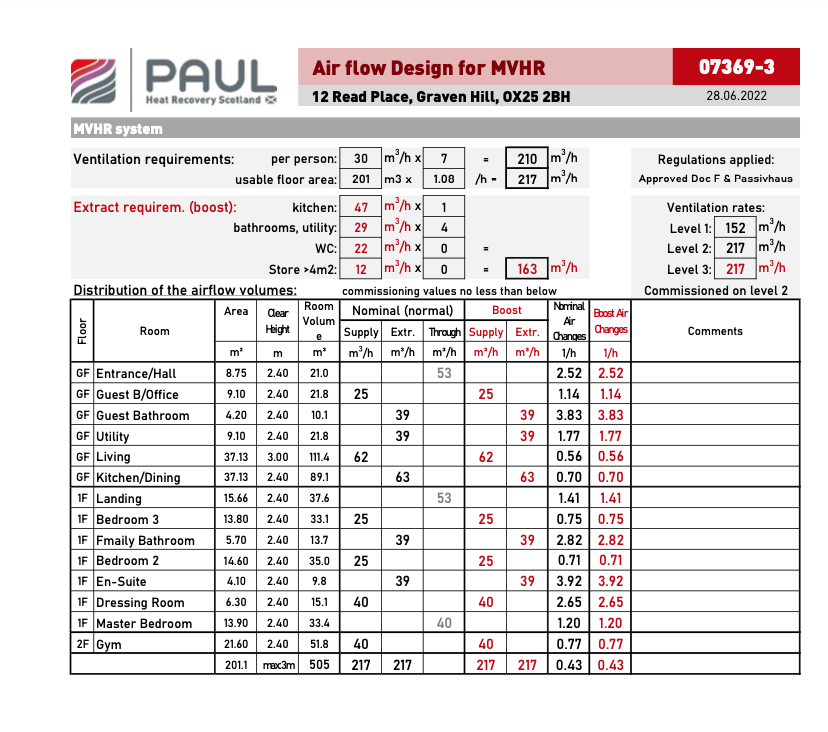
-
Yes, idea waa to bury two per bathroom with one being spare “for later”.
-
Zehnder Q350 + ComfoPost CW12
BartW replied to BartW's topic in Mechanical Ventilation with Heat Recovery (MVHR)
Hi, yes ufh for cooling too. Comfopost for the whole system, both heat as well as cool. flows attached.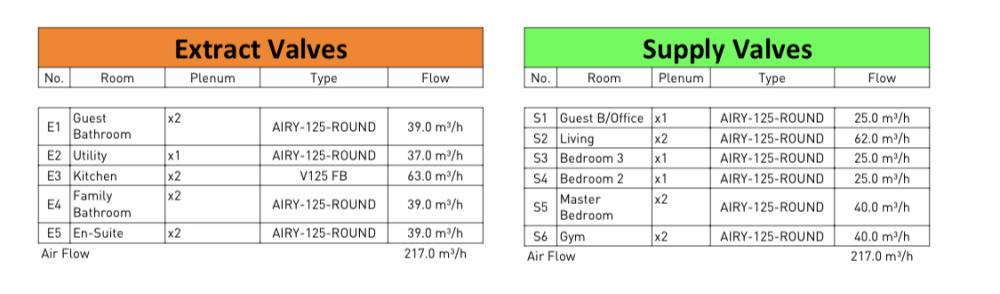
-
Zehnder Q350 + ComfoPost CW12
BartW replied to BartW's topic in Mechanical Ventilation with Heat Recovery (MVHR)
Thanks Dan Sounds like you have been there and done that. I will quiz the supplier tomorrow and maybe change that bit on the order or ditch completely… -
Ok, great I will do some digging, but sounds I might be somewhat set for the first fix wiring at least in these areas.
-
Zehnder Q350 Lan C + Options Box
BartW replied to BartW's topic in Mechanical Ventilation with Heat Recovery (MVHR)
Sounds great and tempting. As you rightly noted, option box is nearly £300 and so is Lan C. Raspberry being less that £150? -
Zehnder Q350 + ComfoPost CW12
BartW replied to BartW's topic in Mechanical Ventilation with Heat Recovery (MVHR)
CW12 is designed for 550 m3/h->. Max airflow for Q350 is 350 m3/h, but if you are using this unit then I assume you design flow rate is actually more like 250m3/h? In this scenario IMO CW12 is just bigger and more money and not going to improve heating/cooling power. You know to expect very little heating power from Comfopost and significanlty less cooling power from Comfopost, right? Also, that all ducting shoud be insulated? Yes, all ducts are to be insulated. I need to check the calcs that PHR provided, but the assumption was the bigger the CW unit the more heat it was going to put through regardless of flow. Yes, I was not expecting for Comfopost to provide too much of a difference, although I was hoping it would “help”. am I being naive? -
Thanks, So I was initially thinking 1-10V input, but I don't seem to be finding any. Equally, Loxone tree temp/humidity/CO2 sensor could surely pick up the data I am after, and allow me to configure the algorithm? Then just a simple on / off on relay side?
-
Zehnder Q350 Lan C + Options Box
BartW replied to BartW's topic in Mechanical Ventilation with Heat Recovery (MVHR)
Thanks, I actually considered building a complete KNX lighting infrastructure, but ended up tipping towards a much simplex Loxone setup (with its limitations). Lan C and Options Box connect through a four wire cable to each other, and then back to the Q350 via the same. Humidity and CO2 are going to be read by Loxone sensors. It was only the ability of using them as triggers and boosting the MVHR that I was trying to work out, but it sounds like Loxberry would give me total control over any functions / speeds. -
Zehnder Q350 + ComfoPost CW12
BartW replied to BartW's topic in Mechanical Ventilation with Heat Recovery (MVHR)
Hi, So, I am doing the whole thing myself. Design included. Yes, I saw Vaillant list a part that attaches directly to UniTower, and that is designed for totally separate zoning. I think it comes with a built-in own pump too. One of these? (part ending 507,8,9). As for the CW12 being big, it was not flagged up to me that it was going to be too big for the unit. Paul Heat Recovery have done the design for the MVHR on this one.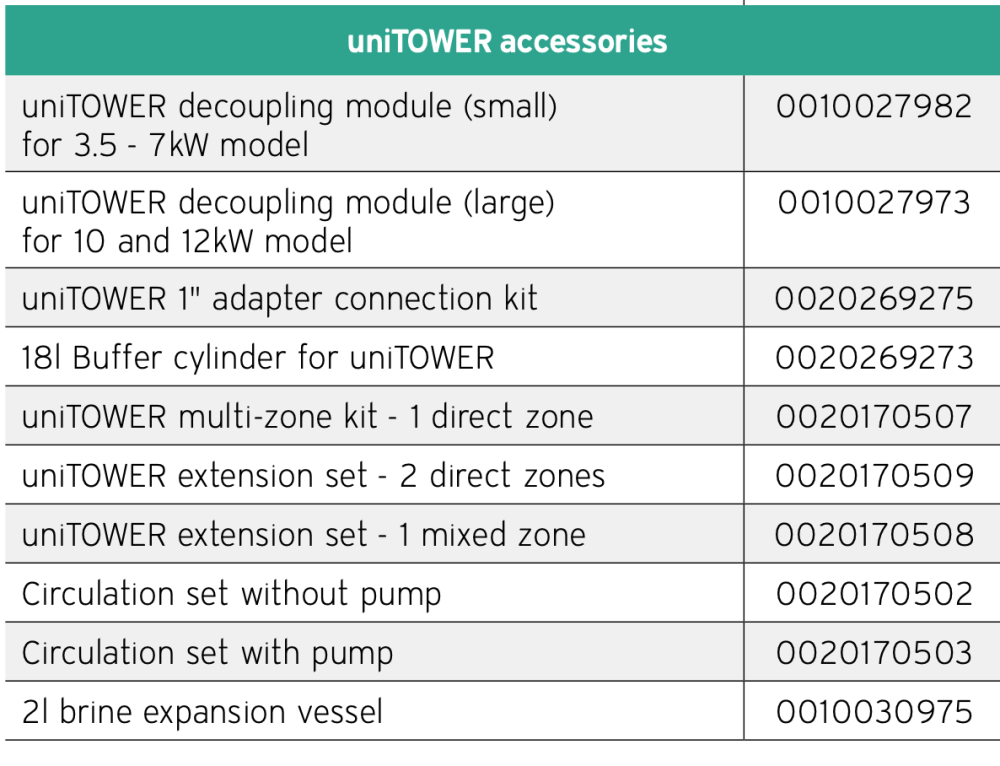
-
Zehnder Q350 Lan C + Options Box
BartW replied to BartW's topic in Mechanical Ventilation with Heat Recovery (MVHR)
Thanks Dan. I read this article, too. I am guessing I would need RaspberryPi in order to be able to run this? Is it not false economy? Ok, I assume the Raspberry is cheaper than the options box, but does this not add another layer of complexity?



