


S2D2
-
Posts
437 -
Joined
Everything posted by S2D2
-
Rethinking the mindset for mass retrofit - a provocative idea
S2D2 replied to JamesPa's topic in Air Source Heat Pumps (ASHP)
How much did it cost for planning if you don't mind me asking? If I install an A2W it will also be a second outdoor unit. As others have said, for PD I considered following the MCS requirements that were relevant to planning (noise, visibility from street) to be all that's required. System performance is not within their enforcement remit. Someone could test that with a certificate of PD if they wanted a watertight guarantee. I remember some concern about the wording including MCS Contractor, here is the definition from their standard: I.e. distinctly different from a certified MCS Contractor?
-
Use either the current immersion power or the forecasted solar generation for the rest of the day as your blending coefficient. If you want to get really fancy model the current energy in the tank and the current loss rate.
-
We can't trust energy companies
S2D2 replied to Radian's topic in General Self Build & DIY Discussion
It's possible both energy companies got overruled, the process is very convoluted and they are bound by it: https://octopus.energy/blog/secret-life-opening-meter-reading/ If your usage has dropped before switching that may have been the reason it's so high. Either way both companies use the same reading so you wouldn't pay twice. The process should be much simpler with smart meters and it shouldn't be described as an "actual read" when it's not, only one of those is in the hands of the energy company though. -
Yes, but you have to be on Flux import too, so the cheapest you can buy it in is 19.67p. You can still profit of course, just a smaller gain.
-
£17.04 in export payments for the previous three days, £3.06 in gas hot water usage. Important to remember it's an unusual few days and not get tempted into investing in a divert system based on the "worst" case, it's the argument solar installers use to sell more unnecessary batteries too.
-
Can't speak for other manufacturers but the Solax portal is only updated every 5 minutes, so useless for export logic. There is a local REST API that can be called to get live data though, I call mine every 10 seconds to log the values so much better for control systems. Your Arduino can then call this rather than querying a separate CT clamp.
-
Check if your inverter has a local API you can call via HTTP, then you can get your export power reading for free.
-
This is optimal PV divert benefit
-
There's no exit fee so unless someone has been refused I don't think they'd have an issue with switching every six months. That may get more complicated soon as fixes start coming back in, I wasn't with octopus when they did them for the smart tariffs but I believe it was a one year fix? Flux is probably the first test of this heavy seasonal skew and it still may not be worth switching depending on usage, so I don't think they'll be plagued with an annoying amount of customers switching often.
-
There may just be a good reason for this but you might find a quick call/email will hurry things along, Octopus are quite good for that. Think they estimated five weeks when I set up a new export and it was done in five days. 15p export skews the sums significantly, I couldn't really justify a few hundred for the divert so you're probably just looking at one of the good cheap suggestions mentioned in the thread rather than anything more significant.
-
I take it export payments are not an option? I'd be tempted to ignore the issue even if not, 3kWh/day is a reasonable input and everything will change if you switch to ASHP when the gas boiler dies, I seem to remember you thought it might not last much longer in another thread?
-
There's also nothing to stop you switching away to a different winter tariff once the boosted export is no longer relevant, I need to do some calcs on cosy to see if it's worth having a summer/winter tariff split.
-
Something I didn't achieve at 26.5 as the boiling point would have still been around 50°C, whoops. Probably a complete waste of time unless you know your hand pump can hit 30 then!
-
Personally, I think highly of them because they are leading the industry in reducing ROI on renewables. The tariffs are complicated and massively usage dependent, but can be modelled and produce benefit for the grid (shifting usage) and the consumer (decreased bills). Assuming PV lifetime of 25 years and battery 15 years the amortized cost of my install is £383/year. In the last four months it has saved me £253, the majority of which is since moving to Flux a month ago. That is a vast improvement from a few years ago before Octopus shook up the export rate market. I do believe a small battery is financially viable for many if installing a new system (not replacing inverter etc. in an old system) and Octopus are helping make that argument. The problem I see is very rapidly diminishing returns as battery install costs increase which leads to people getting stung when installers insist they will need 5kWh+ capacity. I have 2.8kWh usable capacity, any more would have made it financially unviable. @Bosi I've had no issue with the Solax hybrid but there isn't an easy way to schedule a force discharge if that's something that matters to you. I've had to do it through a python battery control program running on a raspberry pi.
-
Where is your PV inverter? Reluctant to put them in house...
S2D2 replied to Carrerahill's topic in Photovoltaics (PV)
Integrated garage for mine. As above I would expect them to manage excessive heat by reducing output rather than just catch fire. Either way unwanted behaviour so anywhere the air temp won't be too high for the passive heatsink. Follow manufacturer instructions for outside if needed, though any batteries would get too cold outside imo. -
You also need the DNO response letter which your installer will also provide. If there is any outstanding balance, hold it back until they've provided these as they're very valuable documents now that export pays a sensible amount.
-
Thanks, I think I'd seen your recommendations on those before and tried to get one but there seemed to be a complete lack of stock of the cheaper electric pumps when I checked at the time, not sure why. The hand pump was probably not worth the hassle given the manufacturer has instructions for an install without pump. It'd be interesting to know the effect on performance to know whether the electric pump is worthwhile or not but the manufacturer doesn't provide any clues.
-
Replacing some gluedown LVT tiles - cutting them
S2D2 replied to canalsiderenovation's topic in General Flooring
If it's the really rigid boards you can just score with a Stanley knife as deep as you can then flex the tile along the line and it will open up the cut and snap cleanly. I only did this with straight cuts though, not a c shape. Pliers help if it's just a small piece needs snapping off depending where the score line ends up on each tile, grip the waste piece as you will damage it. -
Isn't the main concern with this approach ground gasses with the missing airtight layer on retrofits?
-
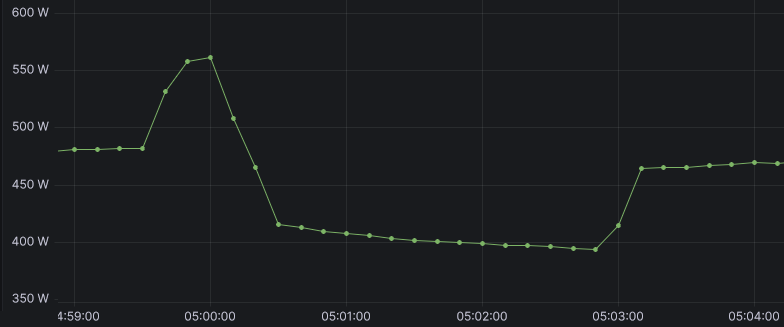
I had considered this but it's not responsive enough without a huge buffer to avoid import - it certainly couldn't guarantee no export. The start up from cold cycle takes about 15 mins where it runs things harder to get everything up to temperature, but even a change of temperature of 1 degree whilst running takes about 30 seconds to a minute to stabilise on the power graph, here's a change from the boost temperature during Flux cheap hours to the normal temperature: Note also three minutes later the temperature sensor must have dropped a degree and it modulates back up, so very fine control is not possible. Coarse modulation between 400-800W should be possible as a function of several variables but as the CoP stayed above three and I have a small battery I've never looked into it further as everything just works. It runs 2-5am on boost, then 5-13 on the morning Flux battery charge + PV, 13-16 on boost before turning off for the 16-19 peak period and back to normal operation with the last bit of battery after that. It also plays a little jingle when you change a setting (fine for larger time periods, but every second?) so that'd need locating and removing! No problem, good luck with your unit, I'd be interested in any performance figures but maybe we're a little late in the heating season now.
-
Yes I covered it in this thread: See the second page for my experiences and performance data, my aim was to offset as much gas usage as possible with a single DIY install unit. Let me know if you have any questions.
-
I fitted a 3.5kW unit, it will modulate down to 400W power draw before cycling (not specified on data sheet) and would be cycling an awful lot in a 12m room as that's still about 1600W heat output. One thing to remember is that the CoP will drop at the lowest temps so it will be sized for that. Often this is not specified in any detail on the datasheet either. Even still, that sounds overspecced. Ask to see their calculations and compare them to your own assumptions.
-
Some data on the install now that I have 32 days worth, for those interested: Modelled heat demand for that period was 1518kWh. This probably has a 10% error margin as it's just a multivariate regression of heating data before the ASHP went in Actual gas usage in that period minus estimated hot water usage was 475kWh. If anything the hot water estimate is likely to be pessimistic ASHP usage in that period was 200kWh So on average every 1kWh the ASHP used offset between 4.5 and 5.2kWh of gas 65-70% reduction in gas heating usage from the install of a single minisplit unit Assuming 90% boiler efficiency that gives a CoP estimate of 4.1-4.7, which compares well to the data sheet SCoP of 4.2 Minimum daily CoP estimate of 3.1, maximum of 6.1. There's been a good range of temperatures over this period to see behaviour over a real heating season, though obviously performance will be lower in winter months: Daily mean: 7.0°C Max: 10.9°C Min: 1.2°C. Lowest reading -4°C That's probably all the data I'll get for this heating season as we're getting into large solar gains from the conservatory which invalidates the heating model. Since moving to Octopus Flux everything the heat pump has used has effectively come from PV due to the import/export symmetry. So we've had ~1MWh of free heating from the solar panels, which sort of blows my mind. That's effectively paid back ~18% of the installed ASHP cost in one month. I couldn't be happier with the results of this little experiment, they've lined up perfectly with expectations. For balance, a few downsides of going with a cheap unit: The indoor unit housing is cheap and plasticy, but not offensively so Horizontal fan sweeping is manual only and no fancy occupier avoidance features like on the pricer brands Only the low fan speed is very quiet and the auto mode tends to have weird peaks of high fan speed when starting up etc. The outdoor unit has a slight vibration resonance in the housing, I have it well out the way so not an issue but I may add some damping pads at some point to eliminate it The Tuya wifi integration is a great little bonus and I have a control system written with the Python bindings for much finer control on scheduling which makes best use of the Flux tariff.
-
PIV vs sound insulation within the apartment: can't have both?
S2D2 replied to Garald's topic in Ventilation
The usual advice is to take 10mm off the bottom of the doors otherwise the rooms with a closed door are a bit of a microclimate. This does transmit sound as it's an open path for air (exactly why you're doing it). Following with interest for an ingenious workaround as I don't see a way around it without ducting both intake and extract to each room which is not practical. -
A small battery helps to make the most of this tariff, but it is entirely usage dependent as to whether it's financially worthwhile. As an update, my total billed electric cost (excluding standing charges) since switching to Flux 3 weeks ago is £0.78. Not bad at all considering I've also been running the heat pump which has offset around £63 of gas usage over the same period. As heating demand disappears I'm realistically going to have to change my direct debit to ~£0 over the summer as the export will easily cover hot water and standing charges. It's a great summer tariff.



