Gus Potter
-
Posts
2155 -
Joined
-
Last visited
-
Days Won
26
Everything posted by Gus Potter
-
Unvented Expansion Vessel Pre Charge
Gus Potter replied to Mattg4321's topic in Boilers & Hot Water Tanks
Yes thanks for the offer. xxx -
To question (a) correct, (b) first part .. yes they can make the thermal detailing easier depending on what level of insulation you want to achieve. Sometimes it's cheeper and most effective to go for a simple strip found that a local builder can do in their sleep and add a bit of extra insulation elsewhere in the easy places.. this can be called the compensatory design approach to insulation for example. Design is often about making educated compromises on some details so you end up with a better job performing and buildable job at the end of the day. It's surprising what you can get a raft to sit on in terms of ground bearing capacity. I've done some whacky ones with an allowable soil bearing capacity of 30 kPa in soft SAND near the coast... a nice value is normally around 100kPa about ten tonnes a square metre. But that is not all of the story. A low bearing capacity soil can also be a CLAY soil where is swells and shrinks. This makes things more tricky as while the soil may carry the load ok it keeps wanting to move up and down over the seasons. You can do rafts down to quite a depth at times. Down to 1.0m is perfectly doable at times but beyond a 600mm depth of hardcore the NHBC want the fill to be specified and designed by an SE say. Sometimes (you need to be brave and get your sums right) we dig out the heavy soil and replace with insulation and a less dense material so the soil at the base of the excavation does not "know" we have popped a house on top. Here is an opportunity to use say Foamglass Geocell as it is light weight, good bearing capacity and has a quantifiable U value.
-
Yes. A reason is that on self build you have much more control. Mistakes will get made, people won't turn up on site when the should and so on. The Kore stuff may fit on the draiwng you give them but you'll need to pay for a good site survey. Also say you start digging and you hit a soft spot in the ground.. what do you do.. phone Kore or a friend? Hey, if English is not your first language your get a prize for putting me on the spot! (calling me out) You starting point is to get some base prices from say Kore, and so on. Then run it by your SE and see how you value engineer not just the foundation but also the superstructure. For all we know if you get prices from different folk their interest is not yours! They just want to sell you stuff! A lot of people on BH are their own worst enemies. They want the cheapest price for everything, but in the heat of battle they end up loosing money... as they don't know when to pay for some professional advice. It can be done and you can drive down the build cost a if you take time to identify what you want and then negotiate with builder.
-
My objective is to save you money. It's not often I start a new topic but here are some of my thoughts. Please excuse the spelling and grammer as I'm a bit dyslexic and off duty from my day job. Bit of narative first to let you know I know my stuff! Over say the last 10 years I've seen a lot of enthusiasm in the self build market for insulated rafts in one form or another. I got into this as an SE and developed the design calculations for the biggest supplier in the UK of cold formed steel industrial buildings, about 750 to 800 descent sized buildings a year. These are lightweight buildings with low floor loadings, like a house.. that sit on a big thick layer of squashy insulation. an insulated raft. I had a loads of fun at Capital Steel Buildings (CSB my employer), Gary Watson, their CEO, his directors in Australia not least put their money (a lot of 500k plus) and faith in me. Gary Watson the CEO who lives in Dalry, Scotland! So this is not some abstract concept for me! He lives just down the road pretty much, stuck his own money behind me and we sold a lot of buildings in the UK. Many thousands! I know a bit about this insulated raft malarky in terms of structural and geotech design! That said if anyone wants to engage with me on the theory then I would be delighted. It is a bit of a dark art, coupled with plastic and yield line theory design. I really push the boat on it but am always safe. Serviceablity needs discussed but I know the maths! For all the corners of a slab tend to be the bits that are hardest to get to work. For any curious SE's lurcking in the background. I took TR34 as a basis and then developed from first principles.. there is no "funny FE " software used! It's all verify able by excel! For all in some ways the design of insulated domestic rafts is very elegant and often cost efective. But get it slightly wrong and you are in trouble! But make no mistake we were doing this stuff in a hard and competetive commercial market probably before Kore rafts etc and Tanners design became more main stream in the self build market. For me I'm delighted that self builders are getting on board with insulated rafts and the whole passive house thing. Aside I wish I knew about this stuff when I did my self build, with hind sight I made some mistakes. Ok here is the rub. There are folk now jumping on the badwagon that I and others developed 15 years ago but they don't actually know what they are doing! Manufacturer's are creating insulated formers that come at a premium cost and claim they are at the cutting edge.. they are not often in terms of buildability! I know this as I as above developed lean desings. These folk are there to sell you insulation and their building system. *Kore etc are there to sell you insulation! *MBC et al are there to sell you timber frame! *You as self builders want to get an SE or Architect at the same price as a washing machine engineer. My advice is to look at simple stupid alterantives that you can get off the shelf! that can be a bit of PIR insulation cut up to avoid waste and perfom the same function. Example: someone pitched up the other day wanting to use a space frame. Someone said oh Kore do a thingy that can support the outer leaf. I think why as an SE can you not just specify a couple of braces in the frame so you don't need that complex outer "thingy" detail? Ask me if interested. Now folks I hope you have found my rant informative or just funny / daft. Design should be fun. The design process.. well if you don't like what I've written then you can rule it out.. Design is often about ruling stuff out and that lets you focus on the things that matter. To finish. As an SE I love, and it is a challenge to explain to a lay person how stuctures work. I have Man bag, in that is ruler. I pull that out to explain how buckling of a beam works. There is a soft rubber and my hard plastic measuring tape. I use these to show how the different layers of an insulated raft work.. the rubber is less stiff than the tape when you put one on top of the other..this lets folk see that the insultation is the critical design layer. The maths are complex but the Client immediately can grasp what we need to do, why and the raw cost implication.
-
Unvented Expansion Vessel Pre Charge
Gus Potter replied to Mattg4321's topic in Boilers & Hot Water Tanks
Good thread. But you do know this varies over the day? Stop being wanky and go back to basics! Your taps and flow valves will wear over time.. I piss myself laughing at you all talking about 0.1 bar pressure, static or dynamic..oh and a couple of rough bends in the pipe and it bollocks! I can tell you that your qualitative values are complete pish in terms of long term performance. In a sealed system 0.1 bar can be lost by a mugfull of water weaping from a joint! Yes I'm the philistine.. We have been using direct cylinders for at least 30 years, well I remember it was about that long ago that I fitted one, it is not rocket science.. just needs common sense. My prediction is that your plumber will part company with you. To avoid this identify what you can live with.. start by asking the other members of you family... as good design is for all. I'll say this again. There are folk on BH that are trying to make UFH and a hot water supply into a complex subject. Yes in a big hotel say it matters a bit but for a self build.. get a grip! You are off your heads! I have been into UFH and the like long before most of you were born! @nod are we of the same age? and sometimes the elegance lies in the simplicity, low maintenance and reliability costs! I leart my skills and design skills from the Scandinavians and industrial sector, the UK self build market were late to the UFH game, ICF and insulated rafts. Funnily I was doing a lot of this stuff before the self build market got a foothold. Why! 1/ In one or two years time the valves will get sticky / pumps will wear, the boiler will wear and things will start playing up. You just can't seem to see this folks! 2/ Your average plumber will have no clue how to service all the shite you have installed. 3/ If you sell the house how on earth are you going to run this by a surveyor. I could go on. Keep it simple folks and it will save you money! Maybe test you flow rate on the incoming service pipe. Open the pipe, get a bucket and let it flow free. Time it to get the delivery of a quantity of water. Do this in the middle of the night at 4.0 am, at 7.00 am and at 4.30 pm when the kids come home from school. Do this over a couple of months or so.. the water board get leaks and muck about with the water pressure! Check between winter and summer flow delivery. Then you may realise how your calcs are a not applicable! Is that it? You probaly need to fit another £ 5.00 automatic air vent from screwfix! -
Good post. To provide a bit of context. I'm an SE and Architectural Designer. Everyone is trying to cover their arse. It's not that they are bad folk, most are great designers and know their subject.. but the insurer's are going nuts. The fire stuff has major implications. I've spent lots of time negotiating with my SE insurer about what exposure I need for fire safety. @ETC how is that going for you? I'm trying to explain to Buildhub folk how this works.. can you reciprocate? Next you have building control sheading all liability in terms of anything to do with fire. You have bit it of a journey ahead of you. Best thing you can do is post good constructional details on BH. A word of warning.. if you want good advice then post all the info you have. I'm like many other folks on BH here that are willing to give you a bit of pro bono advice. If you make me guess then I will bin you.
-
How to know how much materials to order?
Gus Potter replied to OldieNewbie's topic in Project & Site Management
This is a bit long winded and a bit of a read! But I hope there plenty nuggets in here for the self builder to chew over. For the budding young person who wants to make a carear in the building trade.. I start with an introduction. 40 years ago I came out of college with an HND in Civil Engineering, went to work for Wimpey and got sacked because I was a prick.. I then went self employed and my first job was tiling a bathroom for a neighbour. I worked out the cost of the material, my time and overheads. I then build a business in Edinburgh and employed a few folk. I met the girl of my dreams and we bought a plot in the Scottish Borders and did a self build. I employed an Architect that used to shove me a lot of work to do my design drawings. I got up every morning and built the house which took me three years now we expected and planned for that so we priced that in. Me working for free but no tax to pay. We lived in the garage and a caravan. Looking back I'm very lucky to have been able to do that, few folk just don't get the chance although many are more than capable. We had no kids, a German Shepard and that was it. To cost it I worked out how much materials I needed by measuring off the drawings and added on a percentage for waste (stock lengths of timber, lorry load deliveries of sand etc) and the mistakes I would make. About 10 -15%. I worked out how long it would take me to build the house, just by myself. I took me three years as above but I was young, fit and had my experience. As I built the house, it was near a road, locals stopped and asked.. see when you finish Gus will you come and build our house. I did that and ended up being one of the biggest employers in the local area. Now to price these jobs I still broke down all the material cost elements, I know how long each building task takes roughly so I can apportion a labour cost to that. I know what the business overheads are; running vans, sick pay, cost for apprentices and staff training, contractor insurance, plant replacement cost and so on are. I used a spread sheet to work all of that out and then apply a profit margin. Now a spread sheet can be a dangerous thing! A mistake could cost you your livelyhood (for self builder.. put you money at risk) and put your employees jobs at risk. I used to do a second qualitative check to make sure I didn't loose my shirt and pants.. which was based on.. for a standard self build the labour cost should be about 1/3 of the base cost. In other words materials are about 2/3 of the cost. This is a good way of getting a good figure of labour material cost ratio as it tends to be inflation proof.. it's used as a qualitative check on the basic envelope and then you add in the big ticket items.. doors, heating etc. All the time you are looking at the different ways and methods of costing. Most are qualitative but even these give you a feel for what looks right and what is not. Next was to look at the square metreage. At that time it was a lot less but say at the moment 2.0k a square metre. Do not use this value yourself, I've picked the number as it is easy but you can again do a check. This is the third check. Now I was a building contractor and I wanted to make some money. Personally I don't gamble, don't but a lottery ticket. I still run a business as an SE / Designer and want to make a profit. The last bit that goes into the price is based on how much profit your want to make, for me now it's often about how interesting the job is and how you hit it off with the Client. I've picked up the odd job on Buildhub, the profit element is often very low but see the enjoyment I've got out of it working and learning from loads of you clever folk here! Jumping forward a couple of decades or more I'm now an SE and Architectural designer. I still use the same rules and techniques when Clients ask me for a budget cost. In some ways because of my background I'm actually doing what a professional Quantity Surveyor (QS) does but in a rough way. Some of the builders I work with use a QS to price all their jobs.. but that comes at a cost. Others adopt old school pricing methods coupled with modern techniques like I do. Some small builders go on the internet and look up what the internet says and add 20 -60% or just double it.. if they get the job then they know there is so much profit there they can afford to figure out how to do it once they have collected your deposit. In terms of pricing self builds, professional fees and contracts. Often I get asked by Clients what kind of contract they need. Now my opening gambit is that you should have an industry recognised contract that it tailored to what you want to do. Could be a minor works, JCT or NEC type. But all these need some element of extra professional input that comes at a cost and that cost can at times be 80% of the original design fee, do you know how much a Clerk of works costs! Simplistically if you want me to do this then I am responsible for your money and authorising payment on your behalf. If I cock up you have a perfectly clear run to to sue me for your losses. To be clear If I authorise a payment to the Contractor you have to pretty much cough up like it or not! Now this is a Self Build site. Most folk do their own deal with a builder. For many it works out well, there are a few casualties but that is the risk you run folks. I'll stop here but Build Hub is a great place to learn. I learn all the time! -
Agree. I neglected to think about an in situ slab, sorry about that. That is probably beyond the realms of reasonable investigation as you say. Now for all. From time to time we encounter buried asbestos. One great place to find it is obviously on industrial sites but also in and around farm buildings.. steading conversions are a good example. Made ground is common and also things farmers call a dead hole..to put dead animals in. Now often we find old asbestos cement roofing sheets, broken up in the ground. The first thing to do is to ask.. how well compacted is it? The stuff does not rot away, cause ground gas so can we just leave it in situ, isolate and build over the top? As an SE if it has sufficient ground brearing capacity then what is the problem? In other words we can just treat it as some form of compacted inert material. There are plenty precedents for leaving contaminated ground on site and isolating it but you need a convincing and logical arguement to do so.. A good way of stopping asbestos getting airborne is to keep it wet. Hence if mixed with clay soil with a high water table.. all good news. On big contaminated sites we look at the risk to local communities of carting the stuff away ( dust etc escaping from the lorries say ) on public roads cf leaving it in situ. The same principles can be referenced to convince say BC that you are doing the right thing by containing contamination on site. I make reference to a job I did recently but I only found out as the designer after they had spent a pile of cash digging the stuff out. For all if you find asbestos stop work.. don't panic as this can often make things worse, think and make a plan, seek professional advice even if just to reassure.
-
Yup.. just happened to a Client of mine, simple extension on a listed building that had been extended in circa 1960's and then altered again. Asbestos roof cladding found buiried under the extension foot print. This is a risk. Do you pay for a more indepth site investigation (would have uncovered it) or take you chances? As an aside I've a project on where I'm taking down part of an old extension / conservatory and retaining the foundations and floor.. about a 25k saving. The thing has moved a bit so have settlement tell tales on it.. story for another day. It has a felt roof and I've seen the original specification. There is mention of a roof felt called "Astos".. the clue lie in the name. It's low risk but does contain asbestos thus needs to be dealt with and the risks managed. Inevitabley there is extra cost but this is non negotiable for safety reasons.
-
One more to go by the looks of things. @CemCet I'm sure there will be folk happy to do a follow up interview. For all. Gathering raw and real life data can be exceptionally difficult at times for a researcher / someone studying for a masters or doing a thesis. A lot of the manufacture's for exampleclam up when you ask for the numbers behind say their load span tables.. commercial confidentiality and so on. You start with your subject.. get enthused, funding in place and acceptance onto the course and then find that there are an awful lot of uncharitable folk in the real world.
-
barn conversion. SIPs or stick build ?
Gus Potter replied to mattp22's topic in Structural Insulated Panels (SIPs)
That's a cracking pad! I've done a few of these over the years, hope this helps a bit. a) SIPS. Too tricky and you invetitably make changes as you uncover and discover more about the old structure as you go. The secret is to have an adaptable / flexible design. b) IFC. My own view.. not suited for this application. The problems will start in the ground and work their way up not just structurally and dimensionally but in terms of insulation, condensation risk, detailing and finding a contractor that can get their head around even some of that. c) Stick building (some can be structural some non structural timber panels) is ideally suited to this. Often you want vaulted areas of roof.. that suits a cut roof with the odd steel. Elsewhere you can use standard prefabricated trusses, can be standard finks or attic trusses. I can't see any problem getting a stick build signed off in Scotland as this is the sort of stuff we do a lot of. @saveasteading knows plenty about this, has hands on practical design experience and a great eye for keeping costs under control. As an aside.. see on your rear elevation there is a slight arch over the two cart doors. This is fascinating.. how does it stay up? Well one way is that you have a good bit of masonry butressing them each side. Have a look at this and appreciate the art. Keep this in mind.. if you mess with this too much you could introduce unwanted cost and movement in the masonry. Keep us posted when you can. -
One secret of self building is to work out where level and dimensional tolerances really matter and where they don't. You want to keep you options open in terms of what your local trades can deliver. Looser tolerances can drive down the build cost. Work on 65mm for now and your life will be a bit easier. Beam and block joists have a camber due to the prestressing but the camber is not even! The precast folk cast the joists on a long line and cut them to size after curing. The prestress in the cast line varies from end to end so some joists have diferent levels of prestress and thus different amount of cambers.
-
Architects, ballooning fees and estimates
Gus Potter replied to Drellingore's topic in Costing & Estimating
To be blunt you both (wife and you) seem to know what you are talking about. But there is no mention of getting a cost aware SE involved that has 30 -40 years experience of knocking Architects into shape. Forget the QS idea. and don't even try to take the Architect on in terms of their design delivery drawing wise and so on. To win this you'll have to show they have been negligant. Your Architect will want to get the job done..they don't want you reporting on social media... maybe they just need a guiding hand. You too probably need a bit of tough love and some impartial advice that a good SE with a wide range of Architectural Design experience can provide. Don't forget folks that SE's get to look a Architectural designs all the time.. we kind of know what works, how details can look good, what is expensive and not buildable at practical cost. You mention that the costs rocket at stage 4. The blame for this lies with the Architect unless you have moved the goal posts? . This is a small project and needs to be treated in a different way, particularly on a project like yours. That said don't fall out with folk until you have exhausted all the avenues. So long as you are still talking to each other a compromise can often be reached. -
Fair comment and accepted. For the avoidance of doubt my core qualification is my Masters Degree in Civil Engineering. I specialise in Structural Engineering but have now wondered ( it's a natural progression for me) into the Architectural design side. The key here is the word "Civil". My underlying responsibility lies to the public first and foremost.. not the Client who may be paying my fee. Now like many other Civil Engineers @saveasteadingwho may say design a dam we have to carry a burden of responsibility. If we get it wrong we can kill lots of folk. This moral, not least, responsibility comes with the job. To be frank sometimes the job keeps me awake at night! Have I got it right, have I done something daft that could fall down and kill folk? The job I do is massivley creative and rewarding but there is a price to pay for the privalge. I think engineering should be fun.. it becomes particularly rewarding when you have the skills to design from first principles.. which my education has taught me to do. What makes it even more fun is when you sit down with a self builder and value engineer their build / get initial prices from builders and get involved in the finance side of things. For me I then get to see all of the picture and feel part of the design team. But yes the internet is faceless and sometimes humour does not transfer. I'm a bit deaf and lip read a bit so know all about that! Fair enough. Your approach is pragmatic in that you know you need to manage the loadings. Hope the Wolf Design guide gives you some food for thought. Be careful if you want to muck with the roof bracing.. you may be tempted to alter this?
-
Frameless Glass Balasturade and Building Control
Gus Potter replied to murat's topic in Windows & Glazing
Get an SE to design this properly. That is a long span for a quasi cantilevered glass. I think you know you are trying to find a way to bypass the ethos of the building regs. Stick you hand in your pocket and do it safely. Yeees I know you are maybe trying to stick to a budget.. but I think about the family you may later sell the house to. Now that is a bold concept! Remember though that the door frame has to transfer the balcony load to the structural frame. I smell shite mate! -
This is something I look at even in Scotland. An area of glazing facing south to south west can increase the room temperature fiendishly in a well insulated structure. Now I've made my simplistic and practical design approach to UFH many times on BH. I'm doing a design at the moment and warning the Client about over heating and the costs of mitigating that. It's old sckool stuff but we have a thing called a North Light roof window. This was commonly adopted in 1950 -1960's drawing offices where you want indirect light / maximum light in the winter.. hence it was called a North Light window. In profile the roof looks like the cutting edge of a wood saw blade. Over the last couple of decades I've seen this drive for open plan spaces. But they are noisy not least. In some ways, it's like fashion clothes design. While there will always be a desire for a bit of open plan space I think the massive ones will go out of fashion.. mainly driven by the rest of the clothes / lifestyle industry. What that means is that we will have smaller rooms that need to be lit in traditional ways which can potentially mitigate some of the overheating issues.
-
For all I've attached a handy design guide (old but still provides inspiration) to trussed rafters. Page three has all the shapes of common types that can help at the concept design stage. It's well worth a look at as it will familiarise you with the terms that say MBC, Pasquills etc use. It is a mine of information with good diagrams. @marshian.. So glad you have taken note of my dramatic laymans guide and found some inspiration. From time to time I use a bit of drama and real life examples as Engineering etc should be fun! On the face of and taking your calcs at face value this leaves about 25kg (the BS design load) less your 16.2 kg = 8.8 kg distributed load per square meter. That includes you standing and moving about. Do you treat that as a point load or not.. I'll leave it up to you to decided for now. Just because you had a certain amount of load on the trusses before does not mean you can use this as a benchmark. You have to understand what the original design loads were. You also have to know about the different design codes. Are you working to the Eurocodes or the BS. In your case your trusses are probably designed to the BS code. Ok but if something goes wrong then it is your neck on the line don't forget. As before I've attached an old design guide from Wolf Systems that has the BS truss loadings on page 4. Have a read of this for your own piece of mind. You may want to review you calcs.. if you need to make changes then don't be embarrassed about it.. this is part of the normal design review process. Trussed-Rafter-Tech-Manual Wolf.pdf
-
Self building.
-
Yes but you would normally have clayboard on one or both sides of the founds as well. Each case needs to be deisgned for the site ground conditions.
-
First fix of point-to-point plumbing PEX
Gus Potter replied to CurvedHalo's topic in General Plumbing
Good points from all. But the houses you all seem to be talking about have more than one bathroom. For all self builders that just have a small house the above probably does not apply to you. -
My SE is recommending I do NOT embed the UFH in the insulated slab...
Gus Potter replied to zzPaulzz's topic in Foundations
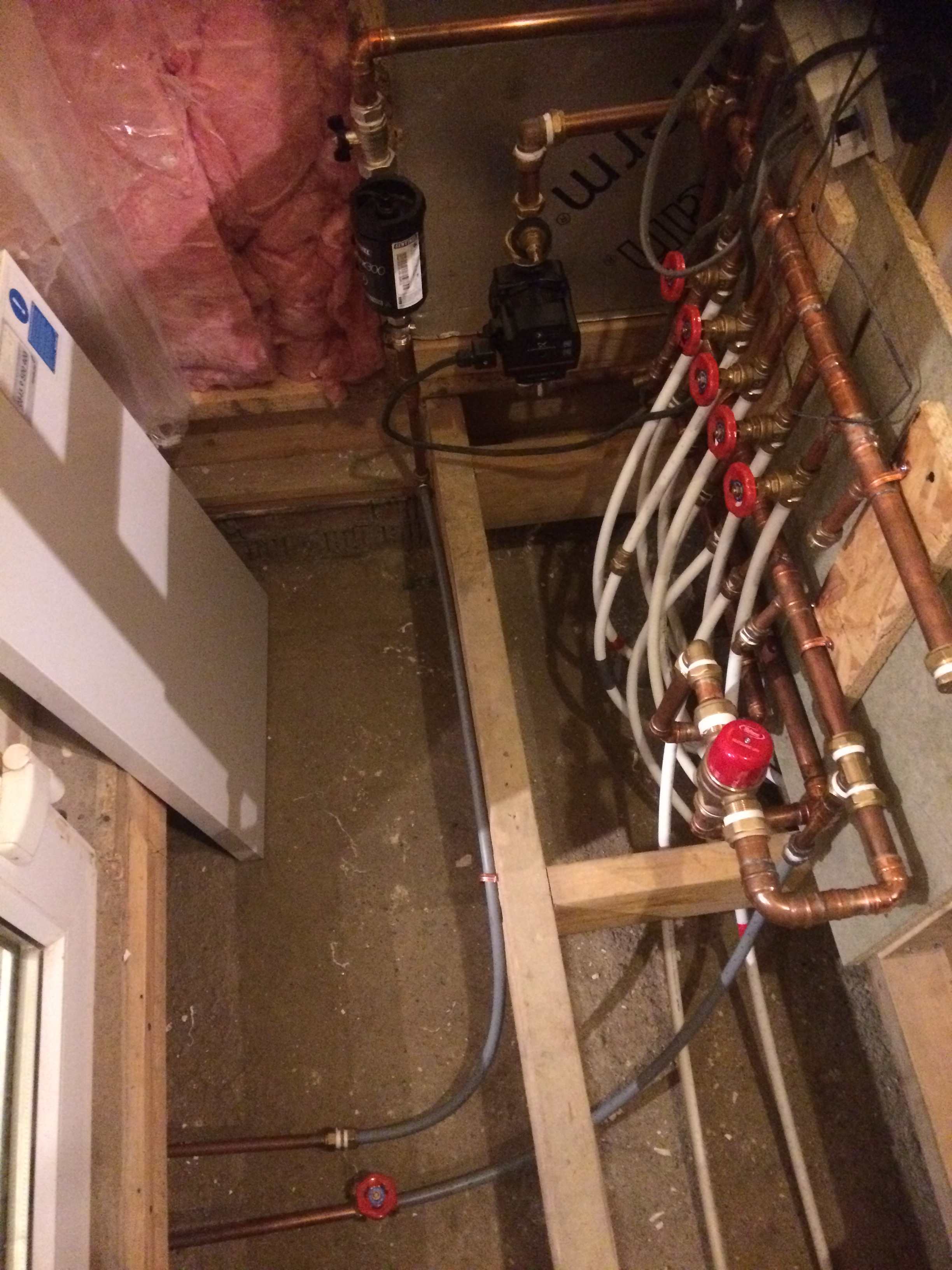
Hey Nick you know I'm a bit of a philistine, old skooool. Below is part of my temporary UF manifold I knock up 4 -5 years ago or say (yes compression fittings and so on)! Still working. Also I designed my first UFH system 30 years ago and have done a few other designs since then. I look after a big house (500 m sq) that has 16 dia pipe. It makes maintenance harder and more expensive. Folks. Stick to British standard 15 dia pipe. Yes you'll get less flow in the pipe.. but see in a few years time when you come to look at the maintenance costs.. you may think.. that philistine Gus had a point! 17 mm dia.. I just smell shite.. sell it cheep and bump up the part replacement costs. Folks.. a good plumber will cost you £250 to £300 a day maybe plus vat. Now if they have to get in the van to find 17mm dia replacement parts they are going to charge you for their time in addition. Just to lay this on a bit thick.. for the unwary. My wife likes to put a rug on the floor which insulates it. We also have some big furniture that traps the heat from the UFH. UFH needs to be designed with a broad brush approach and pragmatically to compensate for how we may change our life style. For the unwary.. say a valuer comes round to your house and asks.. does your heating perform if we have big furniture and want to lay down some rugs? That could be a bit of a bummer? They may also ask if you have a maintenance contract and if so the quarterly cost. I can tell you from experience that you can get UF to work with a 15 dia BS compatible pipe. In fact now that the insulation regs have got more stringent the challenge is less than it was before. As an aside.. a larger dia pipe delivers the heat in a more concentrated way.. now look at the acceptable temp range of say an engineered wood flooring! You actually have a better chance of meeting the flooring guarentee requirements with a 15 dia pipe at closer centres than a larger dia pipe. For all UFH comes with challenges! From time to time you just can't meets all the manufacturer's requirements and you just have to take in informed view.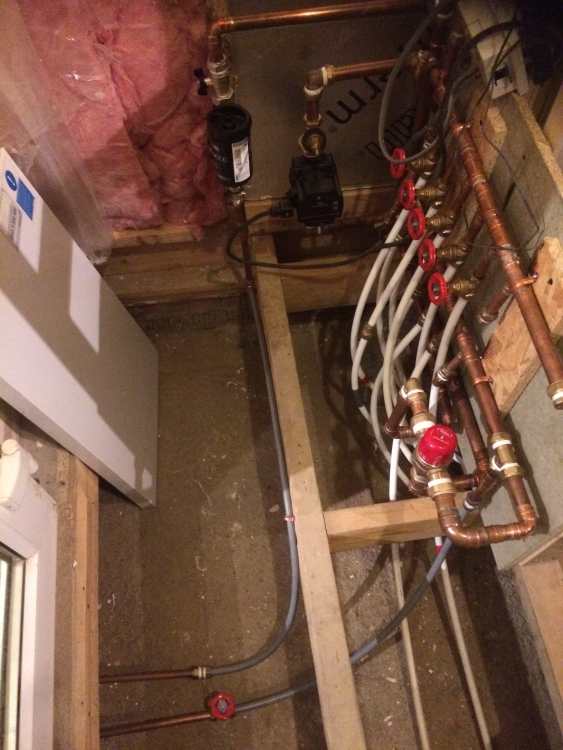
-
My SE is recommending I do NOT embed the UFH in the insulated slab...
Gus Potter replied to zzPaulzz's topic in Foundations
Yes they are a good personable team. In fact I'm working with them on a project. I also have found Hilliard and his team very approachable and willing to engage to date. My outline SE brief from the Client is to coordinate a Hilliard basement design with a superstructure. In some ways my brief is to act as the overall supervising Engineer for the project. I'll spot check say 10% of Hilliard's calcs and make sure their stuff makes sense in terms of overall stability and performance.. everyone has a boss / someone watching over.. even Tanners! For all .. Nick mentions a " passive raft" this tends to be a structrual concrete slab and by my previous post you would expect that to have no movement joints. But you can also do passive house design with a direct ground bearing slab on insulation and this would often have movement joints. We make these thin as we can with minimal anticrack reinforcement or use concrete with fibres to control the cracking.. @saveasteading has implemented this approach. @Nickfromwales I think we are both singing from the same hymn sheet here.. practical and buildable design! -
Have replied. I do this as a day job but feel free to PM me and will be happy to spend a bit of time having a chat with you on the phone. Have included my tel number in the survey response. Text me first as as I oten filter my calls. All the best. I know that geting hard info / evidence for a PHD is challenging to say the least.
-
My SE is recommending I do NOT embed the UFH in the insulated slab...
Gus Potter replied to zzPaulzz's topic in Foundations
Hope this helps a bit. The following is general but this is the way I do it... the following is simplistic and I mess about later on technically..to value Engineer where I can.. but roughly.. If you want to cast your UF into the structural slab (think of a structural slab like a wide reinforced concrete beam.. you don't put movement joints in a beam). By definition this would be a continuous slab with no crack /movement joints. To design a structural slab for strength, shear and deflection etc I would take the effective structural depth as being to the underside of the UF pipes. The bit above that is neglected... just like a screed. But in this case you just cast the slab to the full depth. If you have say a ground bearing slab with movement joints then each bay gets it's own UF loop that does not cross the joints. UFH design is much based on common sense and past experience. To my mind there are too many folk that are trying to make wet UF seem like an exact science. This I can tell you from forty years experience.. it is NOT!.. well it may be for the first year or on a calculation sheet (if you get really lucky) but after that when the controls start playing up and no one has a clue about the design philosophy / how to operate and maintain it. Then you actually need to look at how the stuff gets installed on site which can blow any theory out the water any way! In the heat of battle on site I would challenge most folk to stick to drawings! Cut yourself some slack. There is no point in paying for a UF design you can't deliver practically on site. I see this all the time... folk just waste their money. I'm a massive fan of UFH and have put these systems into my own self builds and renovations. But I always go for the simple stupid.. like they do often in Nordic Countries. Now simple stupid does not mean the system is uncontrollable. But it needs the home owner to be aware of how their house warms and cools,that is you weather compensation! @zzPaulzz Go back and have another chat with your SE. It seems like you are working at cross purposes. -
how to discern which walls are load bearing?
Gus Potter replied to apricotandpearjam's topic in Building Regulations
Good to see you being innovative. With my SE hat on when making alterations to flats I always ask to see the flat below not least and if mid floor the ones above. That means gaining approved access. Two main reasons are: 1/ I want to get some record photos of the condition and any cracks. This helps protects you not least. 2/ I want to check if any in unrecorded (illegal) alterations have been made that the council etc may hold not record of. This happens a lot! In summary you need to know what has been going on down below and in cases flats above if a mid floor flat. To explain a bit.. often "non" load bearing walls can be taken out on the floors below and your higher up flat may be serving to provide sideways and wind restraint restraint to the external walls say. If you remove another floor's worth of sideways / wind restraint that can be very dangerous. My advice is don't buy a flat hoping you'll make money by knocking out walls. If you really want to do it then you should stump up the cash for an SE BEFORE you buy.