


JohnMo
-
Posts
13306 -
Joined
-
Last visited
-
Days Won
200
Everything posted by JohnMo
-

Clean Heat Market Mechanism to incentivise heat pumps
JohnMo replied to LnP's topic in Air Source Heat Pumps (ASHP)
Easy to set up badly just like an ASHP. To set up well is the same as a heat pump. All boilers should be WC and not on an S or Y plan. They should be getting seasonally efficiency of over 100%, the energy saving would be staggering from 80 to over 100% in millions of homes. No insulation to do, keep the same radiators, customer just keeps money in the pocket. -
You need insulation to stop noise transfer. Otherwise every step upstairs will be amplified. It's also a requirement of building regs. UFH in bedrooms is rubbish. We have it and it's never the correct temperature as the response time is so long. Either nothing and electric points for electric heaters (if required later) or radiators. That would be my advise.
-
Clean Heat Market Mechanism to incentivise heat pumps
JohnMo replied to LnP's topic in Air Source Heat Pumps (ASHP)
I would say to get a high SCoP install is quite straightforward. You eliminate any input from 3rd party controls. You run 1 or 2 zone maximum, but zone volumes must be larger than the minimum acceptable for the heat pump, otherwise a single zone. Heating system isn't hydraulically separated from heat pump. Radiator systems are allowed to run load compensation as well, in houses where solar gain is an issue. The system is correctly balanced and has the correct WC curve installed, prior to installer being given the grant money. All setting are behind an installer password. 3rd party verification, can remotely look at house temperature, input and outputs to confirm install is acceptable (grant money release tick box by 3rd party). Home owner can close the remote access after 31 days via a simple switch. I would think all the above should come into play if you want a grant, if you don't have the grant do what you want, it's your money. -
Disabling Weather Comp during mid winter?
JohnMo replied to Andeh's topic in Air Source Heat Pumps (ASHP)
Interesting. -
Clean Heat Market Mechanism to incentivise heat pumps
JohnMo replied to LnP's topic in Air Source Heat Pumps (ASHP)
Think the stepping stone is really hybrid heat pumps. Almost nothing to do to heating system, combi boiler and 4kW heat pump, no cylinder to find a home for, high flow temps, 80 to 85% of the heating from the heat pump. The above plus more sensible energy pricing. Anything else really is wishful thinking. -
I too still have mine, from when I started my apprenticeship in 1979, it's not even rusty. No idea of the make, but heavy empty.
-
Have had a thermal store and now have UVC, UVC wins hands down, way more usable hot water for the quality of water heated.
-
LG Therma V mono block Air Source Heat Pump
JohnMo replied to ProDave's topic in Air Source Heat Pumps (ASHP)
I hope not - as that exactly legal, they should extract and reuse or send for recycling. Then fill with new. -
Clean Heat Market Mechanism to incentivise heat pumps
JohnMo replied to LnP's topic in Air Source Heat Pumps (ASHP)
Think that's the crux of the issue. Driving gas and heating oil prices up and electric down per kWh makes the market move in a different direction. People start to insulate first, then look at different technology second. -
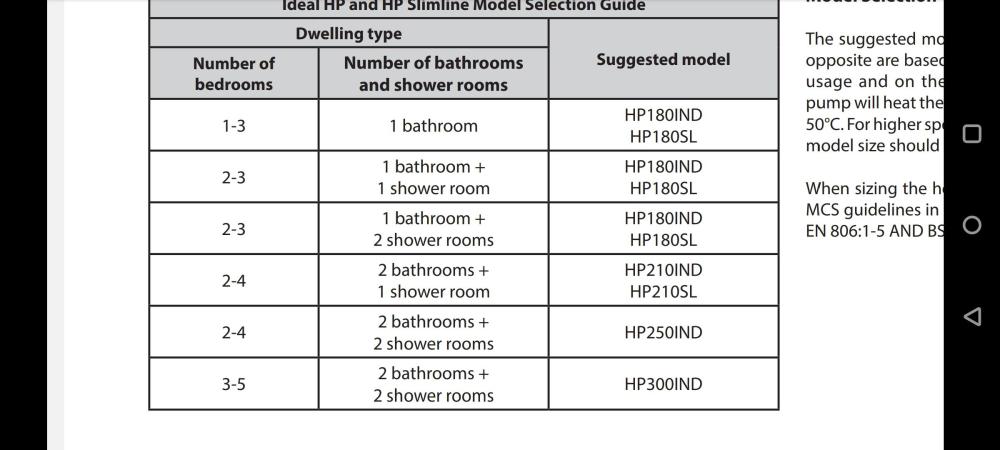
Sizing for heat pump cylinders, the number in model number is size in litres
-
Think the heat capacity is nearer 7 than 12, looks like it can do 12kW if the brine is close to 20 degs, which is unlikely without geothermal.
-
It's GSHP and cylinder in a single container, not a gas combi.
-
Installers just see ASHP as a good reason to overcharge you, not sure it makes much difference what country you are in. Replace your combi unit with a heat pump cylinder, Ideal sell ones that are good and generally a low price. You only really need a 6kW ASHP. They can be picked for £2k or less. You need a 3 way diverter valve. A plumber for a day or two. Or you may be able tap the ASHP into the water circuit of your combi, so can utilise the cylinder and buffer, but control the 3 way valve by the ASHP.
-
Why not download the instructions? Primary bypass is important, with a buffer you need a balanced flow either side of the buffer, without a buffer you have to maintain a minimum flow to keep the heat pump happy. Primary bypass in a min flow valve. Secondary is how much mixing occurs between incoming hot water and return water.
-
My view is keep things simple. Never really seen the point of ducted ASHP pipes, when you can simply come through the wall then clip pipe to wall and insulate very easily. You seem to devote two rooms to plant, consider merging into one room. Do the MVHR inlet and outlet on the same wall otherwise you encourage a mismatch of pressures and unbalanced flows depending on the wind. Consider a combined directional grille, if it simplifies duct routing. You need drainage for the MVHR unit as well. Not sure why you need a radiator in a plant room, when you have the UFH manifold and cylinder in same room. Consider bringing inverter inside Don't buy into the put the ASHP on the south side, they consume so much air it's ambient air temp they see and half their life its dark anyway.
-
Lessons learned from last ready - getting ready for cold snap
JohnMo replied to Conor's topic in Air Source Heat Pumps (ASHP)
That's why you CoP isn't great, you need to start to reduce that flow temperature, ideally set up weather compensation. Start by dropping the flow temp a couple of degrees leave for 24 hours and note down what if any has changed and outside average temp, keep doing this until the house temp drops a and doesn't recover back to 21, then add a degree back on. Your flow temp will be more likely be in the mid 30s than 50. -
Or a simple Willis heater if easier to hook up.
-
Maybe check the temperatures in a hour or soto see if things change.
-
In normal operation you shouldn't hear bypassing water, as the UFH starts to close down, it should start to open. The valve volume increases as the valve is just about closed, then goes silent once completely closed. Sounds like your pump setting was ok.
-
Welcome, not good about the builder. Post your question the appropriate area, keep each question to the point, otherwise you will get a lot of varied responses.
-
3.8m.is .38bar, plus piping pressure losses, so it's likely the pump is just pushing the bypass open. You should be able to here it passing. Get everything up and running and slowly increase the setting until you cannot hear it passing. You should also adjust pump speed, reduce setting until flow rates at the UFH drop a little.
-
Sounds like a typical 4 port buffer, with a decent mismatch in flow rates, so plenty of mixing going on.
-
Realistically you need a 6kW heat pump, not sure a 4 kW would be big enough. With that size (6kW) heat pump and a 210L cylinder we are basically heating it once per day and it takes 45 minutes. There is plenty of capacity to do heating as required. A bigger cylinder a couple of heats a day would make the heating times short enough. We are using a 6kW on a smaller heat load (smaller house) and it just stops and start as required, generally runs for about 10 mins on and 10 to 15 off on a mild day, may run a few hours when cold. Our ASHP ramps up and then down, no issues. Just plumb exactly the same as your gshp was.
-
So the way the buffer is supposed to work. Hot water from ASHP goes in to top port, and out the other side pumped by a pump, return water from heating system go in to the bottom port, the heat pump pulls the water from other other bottom port. In a ideal world the flow either side of the buffer is equal and supply and return water never mix. The temperature in the centre of the buffer should see the mean temperature of the flow and return. Some mixing of the flow and return will move the reading temp up or down. The more unbalanced the flows either side of the buffer the more mixing that occurs, this requires a higher flow temperature from the heat pump than is delivered to the heating system to compensate. Resulting in a drop in CoP.
-
Lessons learned from last ready - getting ready for cold snap
JohnMo replied to Conor's topic in Air Source Heat Pumps (ASHP)
How do you operate at the moment?


