


JohnMo
-
Posts
13306 -
Joined
-
Last visited
-
Days Won
200
Everything posted by JohnMo
-
To change the energy diverted by the floor, you adjust the flow rate to the loops. The flow meter is on the manifold, so increase heat output you increase flow rate. Increase the bedroom loops 1 l/m and see what changes. We found our bedrooms UFH is also rubbish, mainly due to carpets. If we want the bedrooms warm we just open the doors. Your flow temp is too high. Extending the curve to -3, from 0, will lower the flow temperature generally. But the 35 degs looks way to hot. Try leaving it with the -3 change, then tomorrow if still bouncing of the thermostat drop the 35 to 33. Then reassess.
-
They can take an external thermostat and recommend them doing cooling. Think you need 0-10v thermostat and they are generally hard wired connection. We have a iVector in our summer house and it is supplied with water from the heat pump based on the house WC curve and just have the fan speed fixed at its lowest setting. Which works pretty well. Our summer house although insulated has a very different heating characteristics to the house but seems to cope well, so in a bedroom it's an easy job. But with a heat pump, do you need any smart controls? For UFH you definitely don't and they really are a waste of time and money, due to the time lag involved, with the mass of the floor and low temp heating.
-
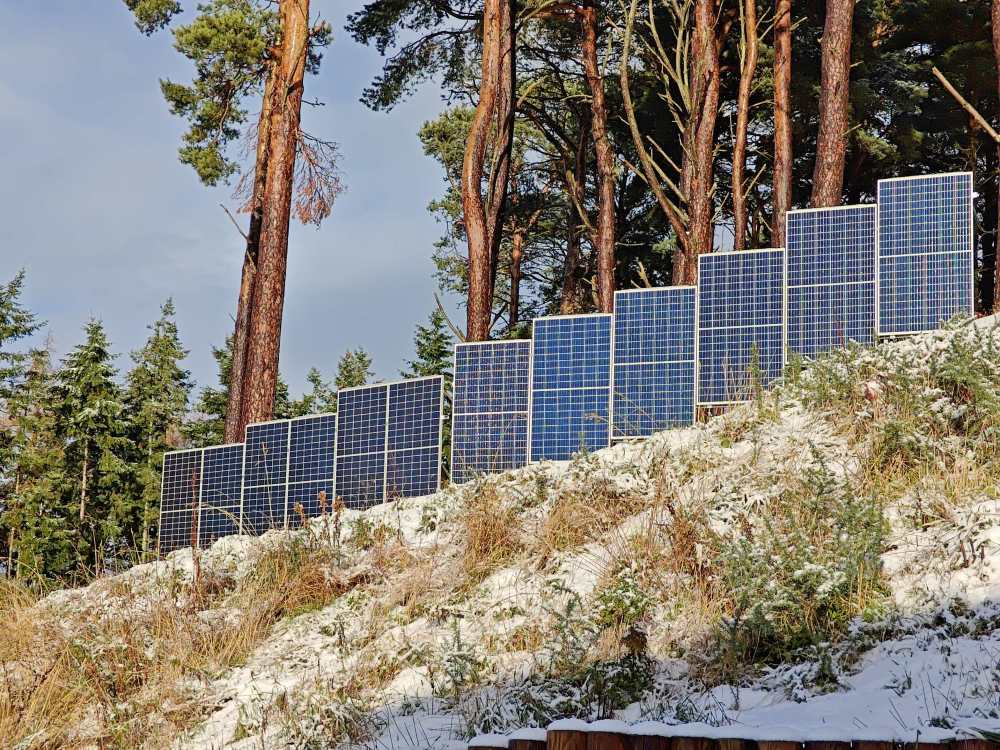
Our hill vertical panels. No snow Currently generating 2.4kW
-
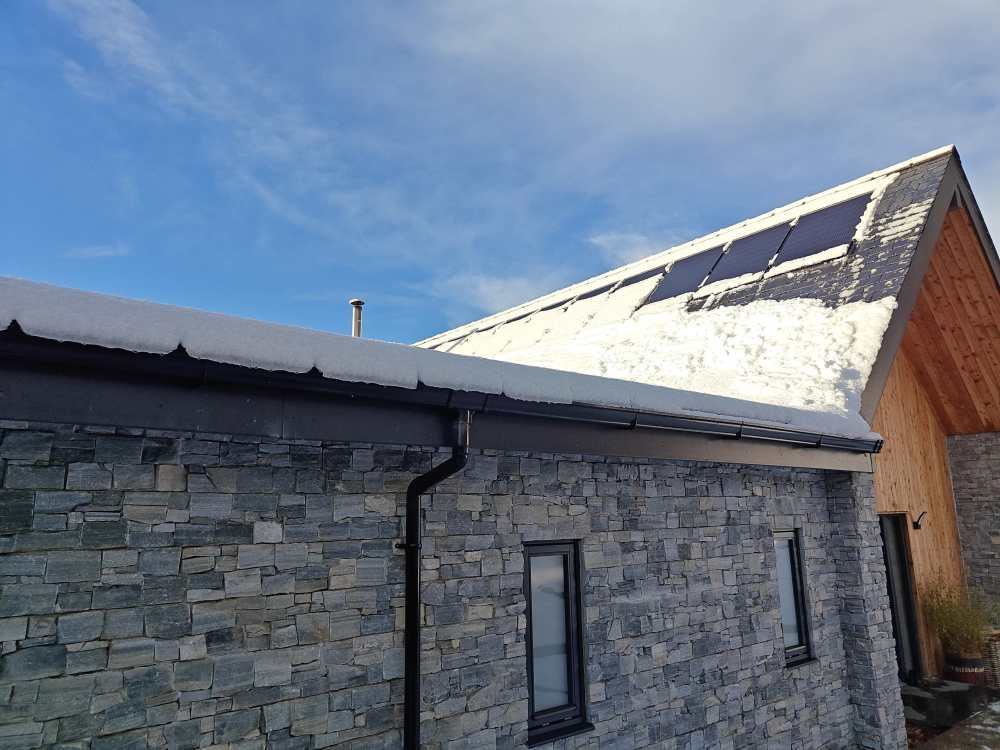
Our roof is 45 degs had a few days of snow and cold weather. Best part of no generation.
-
So an average of about 18p kWh? My E7 works out at at 25p so don't go there without a battery or time shift heating. Many tariffs out there you just need to calculate the best average for you. If you come home and have the oven on for two hours and electric hob on all during the expensive period you need to consider this also.
-

Any one have grant aerona HP settings they could copy
JohnMo replied to andyj007's topic in Air Source Heat Pumps (ASHP)
That's a strange one. Normally wouldn't start to defrost until below 3. Defrost settings are normally factory set and cannot be altered. The only thing that makes it frost prematurely is running flat out and very high humidity levels. I have attached to original manufacturers manual - Grant bypass a lot of settings, to make installer proof. But you should be able to do a compare to factory setting and hopefully make some sense of what is our of place settings wise. Chofu-Operating-Installation-Manual-R32.pdf -
Any one have grant aerona HP settings they could copy
JohnMo replied to andyj007's topic in Air Source Heat Pumps (ASHP)
You may better listing which settings you have issue with or would like clarification on, to get a response that is meaningful. Asking for a list of 30 to 40 setting most of which are never changed is a big ask, asking for a couple of settings is easy. -
Use -3 as you low outside temp then, you can always move it later
-
Change the zero for your lowest outside design temperature.
-
Some basic HP questions for those in the know
JohnMo replied to Gordo's topic in Air Source Heat Pumps (ASHP)
A lot of heat pumps can be operated via 0-10v and ratiometric thermostats. So mine if connected will alter flow temp via a settable curve similar to weather compensation. So in effect I could have weather compensation plus have a variation of flow temp based on thermostat output. Pressure mine would not be the only one, as nearly all A2A are controlled in a similar way.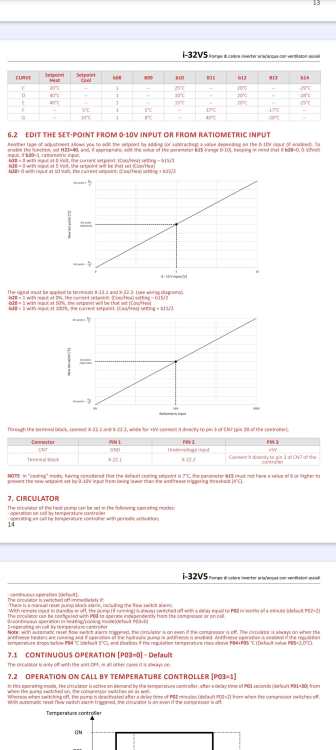
-
If you have zero intention to run during that period you should set your thermostats low to switch the HP off. Then you get a realistic operation and suitable WC curve. If you start with them at 22.5 to 23, if you are hitting that temp move the low outside temp of the curve, down. Basically except during the tea time period when you have no demand.
-
I would start at a lower temp than the 35 to 40 Something like 25 to 35 may be better. You need to wind your thermostats out the way, especially downstairs and fine tune the curve based on the house just being warm enough. Leave your house to stabilise 24 hrs before making adjustments. Not a fan of thermostats with WC as it's really designed to run 24/7 and drip feed energy into the house. If your stop starting, go with Panasonic recommendations.
-
What does this +5 do to water law, Samsung ashp
JohnMo replied to Andeh's topic in Air Source Heat Pumps (ASHP)
That sounds about correct and is exactly what I see if I let the floor get too cold. Your heat pump controls dT first and slowly working up to target flow temp. So if the floor is cold your return temp by default is also cool. Last year I did an experiment set target flow to 35, never got above 32, after nearly 12 hrs of running. Your floor is a huge mass to heat, they have massive inertia. Simple answer is it isn't a gas boiler, you need to run it almost constantly in cold weather. Add to this you will be defrosting on a regular basis, which fights against short running regime. -
For me we have UFH in bedrooms and as soon as you add carpet it becomes rubbish. I would use fan coils in bedrooms, you get responsive heating and good cooling in the summer. You would just run the same flow temp as the UFH and the fan coil control would do the rest. You can also use the bathrooms. Seems expensive at first. Here is a selection (many different makes available) https://coolenergyshop.com/collections/radiators-fan-coils Ditch the UFH in bedrooms. One of the issues with wet rooms and UFH is the proportion of floor space taken by baths and showers and fitted furniture, so is never the most effective, unless you go really tight pipe spacings. So in bathrooms add wet UFH if you want, but you need to add a heated towel rail also, you can these so they operate on water and have an immersion inside to boost output when needed. You could look at IR panel heating in bathrooms? Or fan coils again
-
Some basic HP questions for those in the know
JohnMo replied to Gordo's topic in Air Source Heat Pumps (ASHP)
I wouldn't go that far, some do have a fixed flow rate, some don't. Don't confuse house temp and heat pump target temp. The heat pump has zero care about what happens in the house, it's just a heat generator. It looks after it's self. The target temp referred too is heat pump target flow temperature, the heat pump is always trying to get to that temperature, while also managing dT. It manages dT first to protect itself from damage of the refrigerator circuits. WC just takes reference to outside temperature only. Doesn't care about inside temperature, just simply follows a straight line curve based on outside temp. You adjust the curve so it coincides with a house temp you like. You have variations of the above, like load compensation, which does take references to house temp, these work well with radiators but not with UFH. -
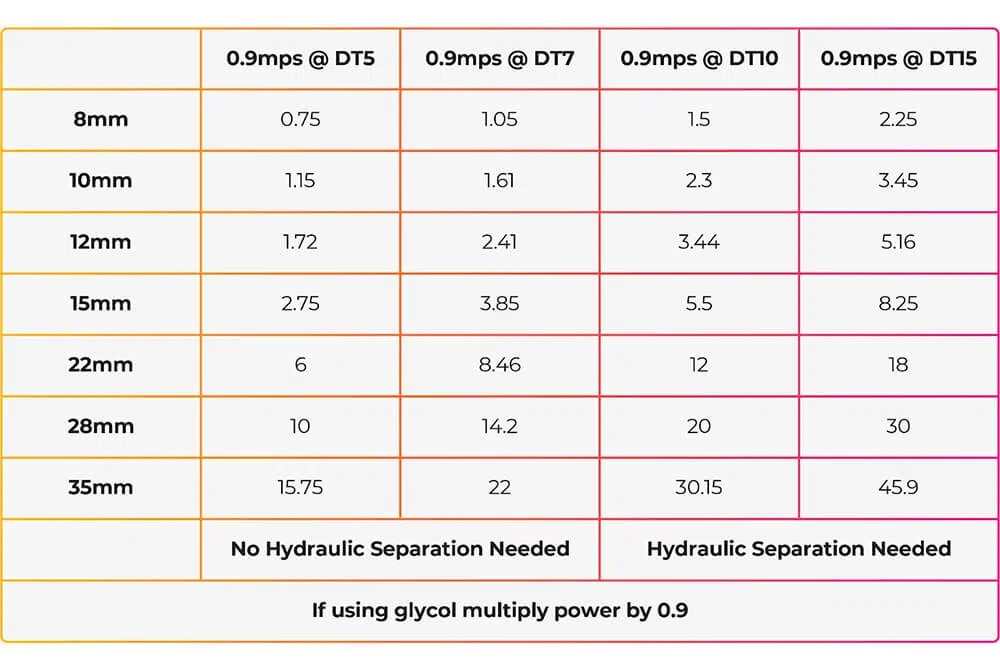
This is something heat geek put out there for pipe sizing, you will be looking at a dT of 5. So as you thought you need 28mm. The pipe your plumber is specifying is thick wall so closer to 22mm. I would have alarm bells ringing as he isn't doing the basics.
-
You can take a guess at it, but the only real way is Install a heat meter in the water pipes from or too the heat pump, this will have tappings in to the flow and return to measure water temperature. This then calculates kW and logs the data, to give kWh. You then need an electric meter or two, depending on how power is derived for the package, any external pumps and if you use an immersion. All these numbers are logged instantaneously and calculated to give kW and kWh. They will also give CoP and rolling SCoP in the software. SCoP, is function of running CoP and standby CoP. More time you spend on standby, the worse the SCoP. I can get a CoP of 6 when running at 7 degs outside, but spend quite awhile on standby also, so will end of with a daily CoP nearer 4. That's running full WC, but it's also a function of heat loss rate and heat pump over/under sizing. Lots of things at play. Really look to get the system performing, so it keeps the house warm first, log what's happening so you understand what the heat pump does and doesn't do. If a thermostat is switching on off in the house, your system needs to tweaked.
-
How big is your heat pump? Is the heat pump connected to a buffer, if so how far between the HP and buffer? If no buffer how far to cylinder and heating system? If UFH does include or not include a pump?
-
Our calculated heat demand triples from 10 Deg average temp outside and 0 average outside. By the time it's -5 the heat demand is around 4 times that used on a 10 deg average day. But in reality it's more than that. As background heating from fridge and general stuff proportionally gets way smaller. So at 10 degs if you needed 1kW of heating and general stuff in the house gave you 200W you only need to supply 800W of heating, on day where you need 4kW, the general stuff still gives you 200W, so you need to supply 3.8kW. So 4.75 the heating input is required. The more heat leaky the house, the steeper the heating curve. We are are on an average daily temp of -0.5, our coldest so far. But looks to dropping to -6 on Friday
-
Weather Compensation for Radiators only and UFH only
JohnMo replied to John Carroll's topic in Underfloor Heating
If you just installed fan coils you could run a fixed flow temp of 30 to 35, depending size of fan coil. -
Weather Compensation for Radiators only and UFH only
JohnMo replied to John Carroll's topic in Underfloor Heating
Yes they can, because they are just flow temp rise influenced by outside temp. But unlikely a house with UFH would have the same curve as a house with radiators because design flow temps are unlikely to be the same. -
That's how long is this piece of string question, depends on the workloads and that varies day to day from company to company and area to area. But 4 weeks sounds quite quick, I was waiting for 2 months for my first single phase, and that didn't work, nor the second or third.
-
Are you running constantly or cycling the heating on and off? The above would indicate on/off, based on Cosy time periods. Those low flow temps for a couple of hours at a time will do nothing heating wise via UFH. I have said a few time that Cosy is really a battery tariff, but can be used to reduce heating costs. Running UFH on off for short period needs high flow temps to work, not low ones more suited to continuous heating. You may need to think of Cosy differently - the cheap periods are just that, cheaper periods, the other periods except the high priced one are normal costs (not expensive). You setback the heating temp during the expensive evening time and all the rest of the time operate normal WC. 26 deg flow temps will never feel warm underfoot, nor will 30.
-
Some basic HP questions for those in the know
JohnMo replied to Gordo's topic in Air Source Heat Pumps (ASHP)
Just reread Meant to write And as way of example - mine does modulate the circulation pump and I cannot change that. Others will have external pump(s) or some like Grant have an internal pump that runs at a fixed speed, the speed is adjustable, but remains fixed after that. -
Some basic HP questions for those in the know
JohnMo replied to Gordo's topic in Air Source Heat Pumps (ASHP)
Some will modulate flow don't. Basics are Target flow temp, dT, max and min flow temp (hysterisis). So compressor starts, at min flow temperature, once started tries to establish dT at minimal flow temp, as dT decreases, more flow temp is added, up to target flow temp. Once there different manufacturer do different things, but it's all about power input, to maintain dT and flow temp. WC is just a variable flow target temp based on outside temp.





