


JohnMo
-
Posts
13299 -
Joined
-
Last visited
-
Days Won
200
Everything posted by JohnMo
-
Just giving information based on doing that and paying the huge bills while understood what was happening. Been there, got the tee shirt. Big zones good, small zones bad for the bank balance.
-
Sounds like work, to make more work.
-
Back to my original post, looks like someone has stopped the boiler being called for heat, just to satisfy UFH on purpose. Looking at your photos of the UFH manifold the only loop with flow is the lounge. So assume each room with UFH has its own thermostat also? If so your boiler will just short cycle (use bucket loads of gas with little or no heat being delivered), if you do get the wires sorted to fire the boiler with just a single UFH circuit calling for heat.
-
A modulating boiler needs to have hit it's target flow temperature before modulating down. Many boilers do not modulate well on thermostatic control, they try to get the thermostat to meet heat demand as quickly as possible. But may not be in condensing mode depending on flow temp and return temperature. A long run time helps stabilise the whole boiler and maximise efficiency. All modern boilers (since the 1990s) have been designed to condense. This extracts the latent heat from the flue gas, by using return water and flue gas heat exchange. The condensation of the flue gas adds to the energy balance. You need a return temperature of 53 degs or below, and the lower it is the better the efficiency gain.
-
@James Logan why not post a drawing or sketch of your system, showing what you currently have. Low flow could be a number of reasons, but should be easy enough to sort out. Can you drain down some of the fluid being circulated through heating system, what does it look like?
-
Definitely does not reverse flow water. The refrigeration 4 way valves moves from heat to cool mode effectively. Putting hot refrigerant into the condenser instead of cold. UFH defrost cycle looks like this Note the timescale, nearly every heat pump does the same. Looks dramatic but whole defrost is about 3.5 mins.

-
There is zero need to bring DHW in to play. You then bring the thermostat for cylinder into play, it does defrost, cylinder cools. Heat pump heats cylinder, goes in to defrost, cylinder cools repeat. Zero advantage lots to loose. If you are concerned (no need to be) you add a volumiser.
-
Nearly S plan, but S plan is just one flow temp, so S and Y plan, becomes W and X plan.
-
 But your sad, the rest of us are just dull and boring and like to watch TV.
 -
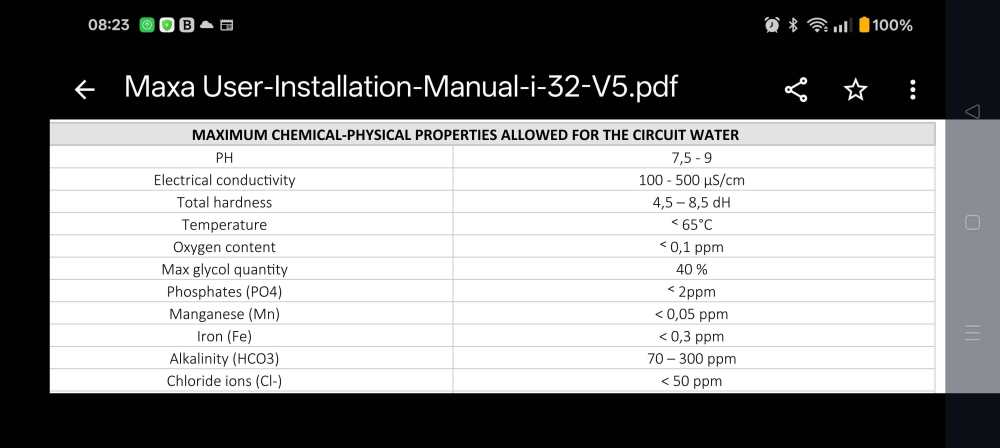
You may need to get the conductivity up a bit, I think it needs to above 100 for a few reasons, heat geek VDI 2035 mentioned a few. This is what my ASHP manual says for the spec.
-
PDHW allows boiler to run at different temperatures, one for cylinder heating, and a other for central heating. Weather compensation allows boiler to run at the lowest practical temperature for long periods. Running S plan boiler runs at a set temperature, which is generally not ideal for either cylinder or central heating. The analogy being, you cruise down the motorway acceleration is very gentle, etc, your fuel consumed very good (PDHW). The alternative is you only run at high revs and at full acceleration and then slam your brakes on, accelerate... (S or Y plan) You get to the end of the journey at nearly the same time, one uses lots of energy the other uses way less. Low boiler flow temperature can increase efficiency by 10s of percent. S plan is lucky to get 80% efficiency well set up PDHW and WC is nearer mid 90s. I actually dropped my consumption by closer to 50% year on year. If you are worried about wasting energy insulation and airtight are the way to go.
-
These should all be detailed on your drawings, otherwise you have no idea what you are going to get. Not even sure why you have planning without this level of detail? If this level of detail is not being used to quote against, then everything will be a variation and you best have a huge contingency fund. Stop the process get proper drawings of what YOU want. More details you put on the drawing, the less stress you will have and the less wiggle room for being wrapped off.
-
Sorry to say - why? Seems a bucket load of work and cost. If you have a gas boiler, just get an UVC with big coil (heat pump one) and do PDHW (priory demand hot water) and weather compensation and top up with the stove as needed.
-
Are we targeting ASHP's at the wrong market?
JohnMo replied to ProDave's topic in Air Source Heat Pumps (ASHP)
There are certainly some bonkers rules with respect heating. Should be 20% now in UK -
You need to sort the losses from ventilation really also. You would also size for 21 in the main rooms and 18 I believe in bedrooms under MCS install. Not 18 to 19 overall. But sounds like a 6kW unit not an 18kW. So a big miss match of information. Are you sure you have not missed something in the handover of information. Wall, floor, roof and windows buildup? Do you have an air test certificate? MVHR?
-
Expansion Vessel losing pressure... but where from?
JohnMo replied to MJNewton's topic in Boilers & Hot Water Tanks
Do you have depressed the UVC depressed and therefore the EV? Prior to pressuring the EV? Maybe the bladder is at the end of its life, allowing air across but not water? -
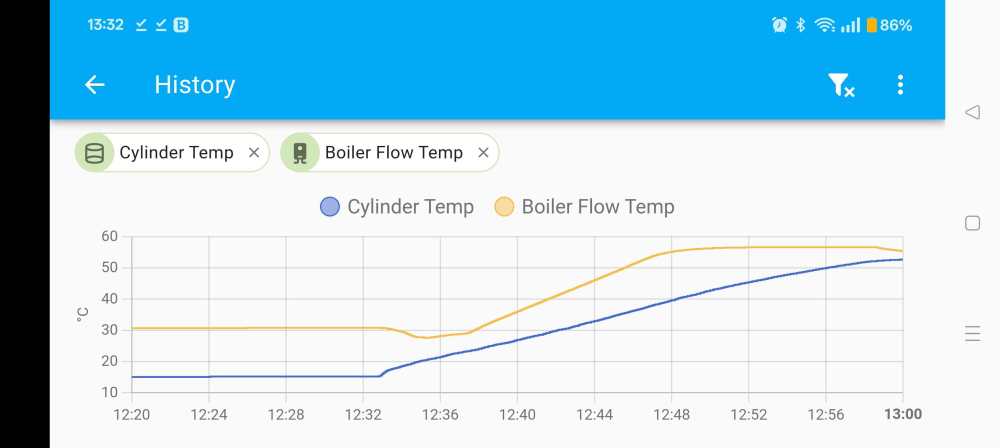
For anyone scratching there head about gas boiler and heat pump cylinder, this is a plot of one. Note the boiler temperature, the dip at the end is the heat cycle going off
-
Undersink terrible plumbing and water damage?
JohnMo replied to puntloos's topic in General Plumbing
Unless you have cold water running continuously, you do not get much condensation. What does form just evaporates off when the cold is switched off. The main pipe coming in to the house (blue plastic) never seems to even get damp, as nothing really runs long enough. Haven't even bothered to insulate our pipes and very unlikely I ever would. -
I would The above with you new lower temp radiators means your heat pump ready if you wanted at a later date. Or a combi with inbuilt cylinder. But at a later date if you did change to heat pump, you need to replumb for cylinder.
-
So has ours, currently sat in a 6m high lounge. Average height of other rooms 3.5m. Think my ventilation rate at the moment is about 0.2ACH, based floor area x 2.5m. And I am looking reduce that. Do you monitor CO2 and humidity? I would be careful you aren't over ventilating. Low humidity isn't good, skin and chest issues for two.
-
But only say distributing the flow proportionally by volume. The volume flow is generally 0.3l/s per m² or how many people wet rooms etc which ever the greatest. Trouble with the regs you either over ventilate or under. There are 2 plus dog in our house, turned the flow rates way down and still in winter the humidity is on the edge of over ventilation after a couple of cold days. If the regs didn't say I had to balanced supply and extract ventilation, (Scottish rules for airtight better than 3), would have just installed demand controlled MEV. Would have had self actuating inlet vents.
-
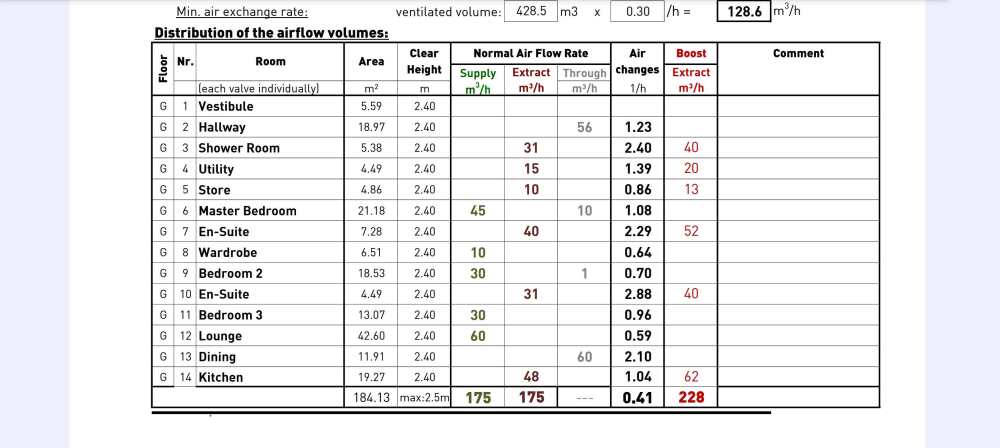
Have you attached the correct document, nothing mentioned volume. You can demonstrate via "through flow". The alternative is to under ventilation of bedrooms. You can demonstrate exactly the same way as PIV system. Unless you are getting really good airtightness, why waste your time and money on MVHR. This is a design done for my house per building regs, by Paul Heat Recovery. Notice the volume Though m³/h column.
-
It doesn't Granted, but will not give you anything without solar as well. £250 at 5p (without a smart meter) is 5000kWh of export. Or at 15p (with smart meter) is 1666kWh. 5000kWh represents 1 whole year of generation for me. It's not effective to pay £250. 1.6kWh escaped today and less yesterday. Would rather put into hot water and into floor via ASHP (23kWh of heat into floor today at a CoP of 4).
-
But don't need to include heights generally, English regs are based on floor area, Scottish floor area and height upto 3.0m, Passivhaus I believe floor area and height up to 2.5m. A very good summary is linked below https://www.paulheatrecovery.co.uk/information-on-domestic-ventilation-and-mvhr/mvhr-info-for-architects-and-designers/
-
Have you changed settings on the thermostat/timers since moving in? I would suspect when they tried to commission the system, they would have short cycling issues (boiler only running for very short periods) when only trying to heat 5 loops of UFH, via a mixer. So they may elected to leave the radiator thermostat in charge. So all on or all off. I would be tempted - assuming you have radiators TRVs to set the thermostat to run for long periods, let radiators rooms be regulated by TRVs, and under floor managed by mixer flow temp. I would also set towel rads to run for the same times as the radiator thermostat is set. To give boiler the best change of staying away from short cycling. Underfloor water temps are alway fairly cool to touch.





