Annker
-
Posts
219 -
Joined
-
Last visited
-
Days Won
1
Everything posted by Annker
-
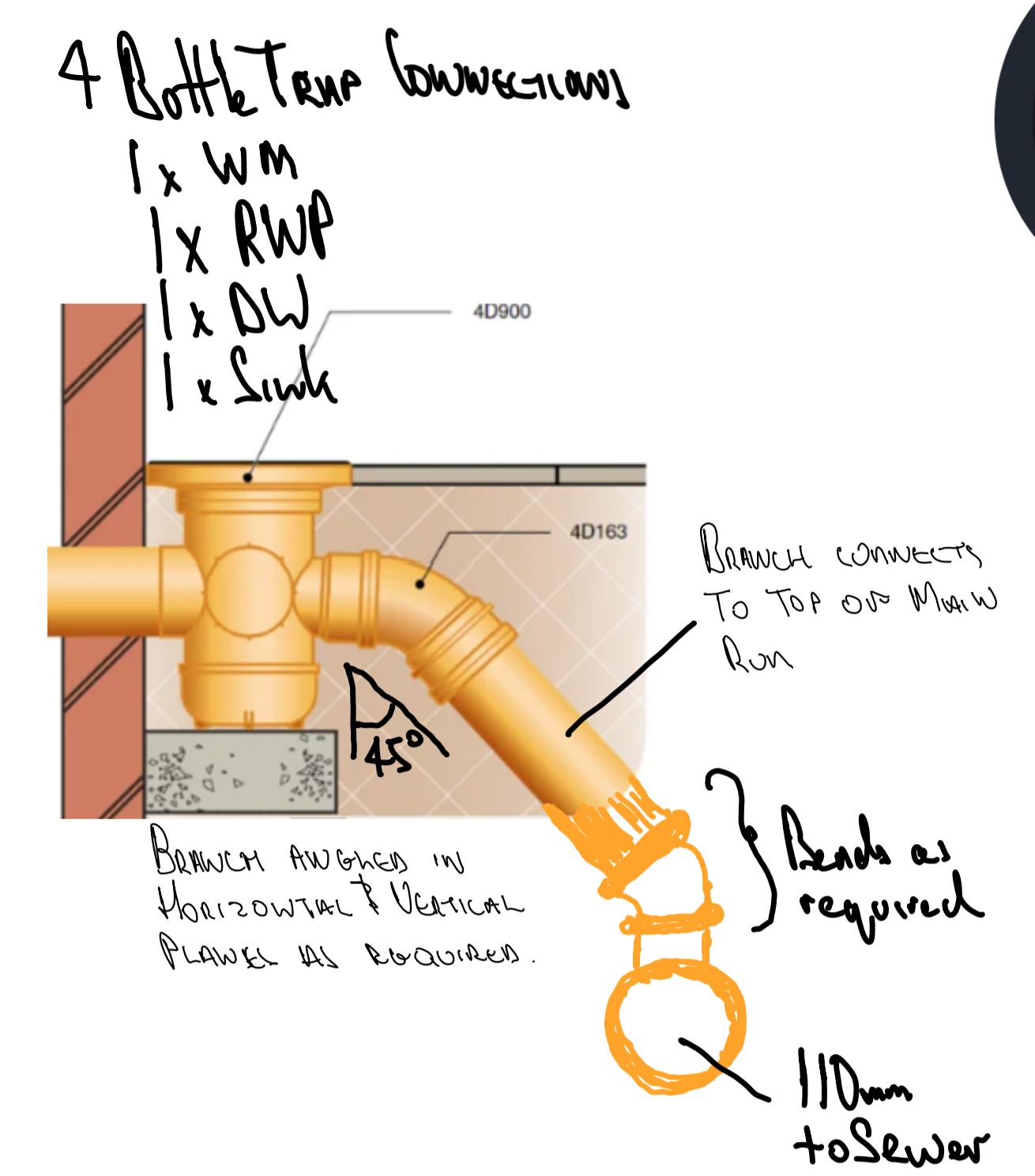
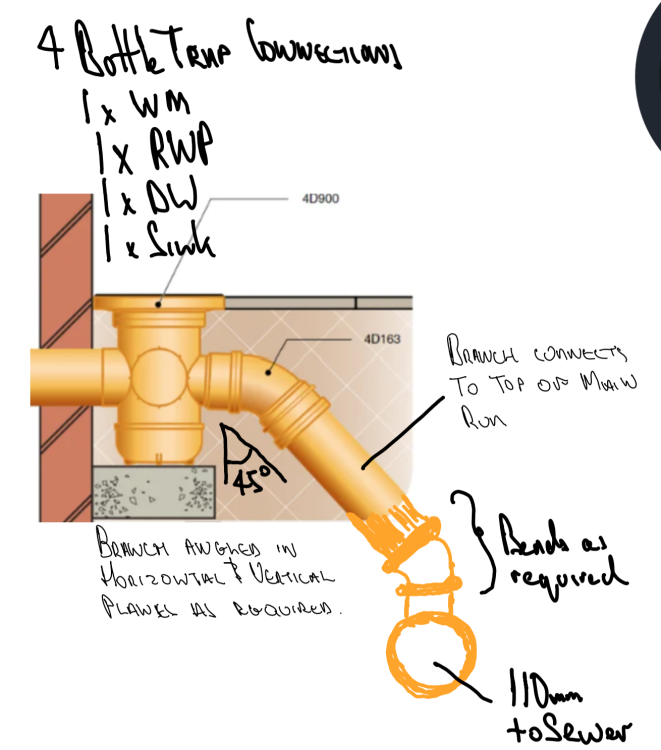
Looking to do a sanity check on the drainage arrangement above as its one I'd like to use in my current project. Do I understand correctly that the domestic waste traps (kitchen sink, DW and washing machine) can be directly connected to a main sewer run via a suitable sized reducer on to a 110mm branch? I imagine that the reducer provides a sealed connection and the trap on the domestic waste prevents foul gases escaping?
-
I will have a browse through AD H, I'll be running my plans, once firmed up, pass my BCO as well. My reasoning for angled the branch in both planes was purely if needed to make the connection given the narrow spacing I have to work within but as you rightly point out it probably would be beneficial in terms of aiding flow regardless.
-
As part of my renovation work I am installing a new 110mm sewer run with various connections to an existing manhole. The most upstream connections (2x WCs) have been made and now the run routes down a side entrance to meet the existing manhole. Being a side entrance the width of ground I have to lay pipework in is limited to ~800mm, however along this section of the run I have to pick up a RWP and the usual domestic wastes (DW, washing machine and kitchen sink) The current plan is to use bottle traps to connect these various wastes onto the main sewer run. (Edit to add the current system is combined and BC have ok'ed combining all wastes) The narrow width combined with a relatively deep invert level (~700mm), means I think the bottle traps branches would have to be laid inclined at a 45 degree angle downwards (certainly in the vertical plane and possibly in the horizontal plane) so they can connect to the top of the main sewer run; as opposed to a side entry connection I'm unsure if that top entry connect is typically done or if it could be a problem, hence I'd appreciate any comments or advice on my plans. TIA Sketch below to help illustrate how the connection may be made:
-
Fine tuning my IWI Solid wall (Warm Batten) design
Annker replied to Annker's topic in Heat Insulation
@jayc89 Thanks for your reply, your comment here and on previous threads have been very helpful I will be plasterboarding and beading the entire house myself (I'm a carpenter by trade). I'm doing this as I want the plasterer on the job to solely focus on skimming, which will hopefully result in a good finish. As such I will be dot and dabbing plasterboard to the internal walls, I suppose I can integrate the Contega PV behind that D&D boarding, sealing the tape to the wall by pasting board adhesive on and over it. With the hemp plastering, am I correct to picture that you ran the PIR down/up to the top/underside of the joisting and then applied the hemp plaster between the joists? That seems like a neat solution, my only question though is doesn't the hemp introduce a vapour open surface among a vapour closed solution? (I believe you had a similar query in your own thread) Also, you had considered applying boron to the pocketed joist ends, did you do so? I google finds this product which seems suitable however I'm unsure how effective application can be as the joists ends, which are most in need of protection are buried with the walls. Regardlesss perhaps just applying over the first couple of inches of the joist within the room will help. -
Following on from my previous thread I'm planning to start IWI installation on my victorian renovation in a couple of weeks time. My proposed buildup: Existing Solid 9" brick external wall 60mm foil backed PIR (Will serve as VCL) 35mm timber battens/service cavity. (Fixed to brickwork with concrete screws) 12.5mm plasterboard Gypsum skim coat I'm generally confident this arrangement will perform in my particular situation, however there are some junctions where ensuring vapour/air tightness is maintained at the VCL will be tricky. For example the VCL will be repeatedly penetrated by the batten fixings, furthermore the battens being fixed plumb may not be tight against the PIR along the entire length of the batten; my solution: Foil tape all batten edges to the PIR. However there are some interfaces jumping out as needing attention that I'm not certain how to best deal with: external wall to internal cross wall junctions: I imagine there is a tape by Siga or a similar manufacturer for such junctions, appreciate if anyone can recommend such a product? bottom of external wall this will be somewhere within the cellar (I will be running the PIR down below GF joist level), again probably will seal the PIR to the wall with a suitable tape top of external walls here I'm sure if I should just terminate the PIR/VCL at the roof wallplate, (perhaps taped to the wall plate) or should it be connected to a VCL installed to the bedroom ceiling joists external wall to intermediate 1st floor/ceiling. I don't believe any addition VCL is required here as I have re-joisted much of the house and stood the joists 70mm of the external walls where they run parallel to them, to allow the PIR run unbroken from cellar to roof. Any comments or critique greatly appreciated.
-
From reading here I know some people are fans of BIGT. Perhaps I don't fully understand their function but doesn't the BIGT still have to connect to the main drainage run via an Inspection chamber? I understand the BIGT provides a trap but is it not easier to provide the trap internal of the sink waste?
-
I suppose that helps that rodding and resulting wastes is outside the building.
-
Opinions please on this quote for substructure & drains.
Annker replied to Tony L's topic in Foundations
On the face of it I wouldn't think that price is hugely off the mark, there is a significant amount of work and materials. Have you other quotes to compare against? I'd also keep in mind that costs reliant on ground conditions should only be considered an estimate. Be prepared for the BCO, on inspection of the dug foundations, now requiring 1.5m foundations and 1m of concrete, or such & such. You need a contingency set aside for groundworks. -
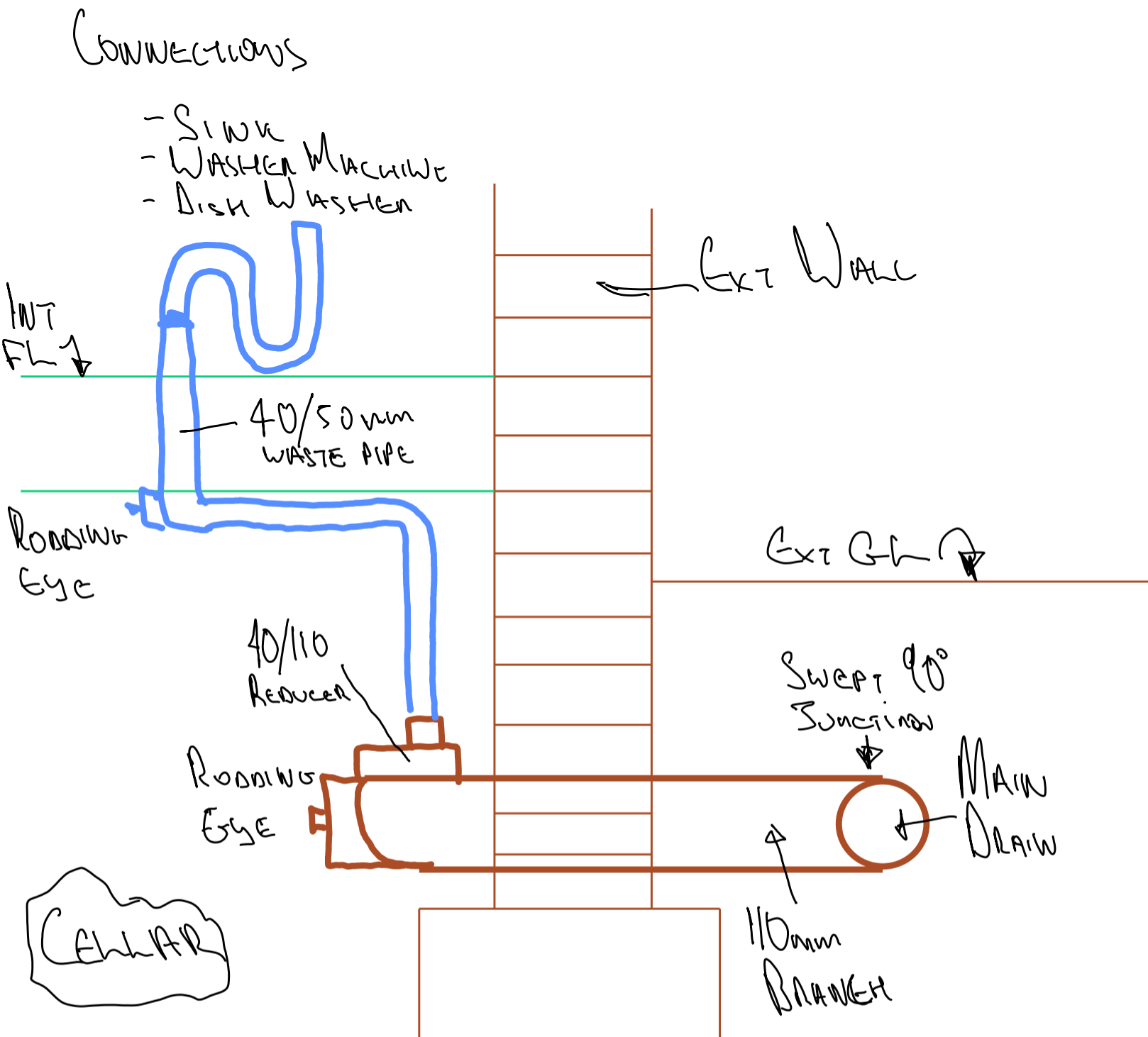
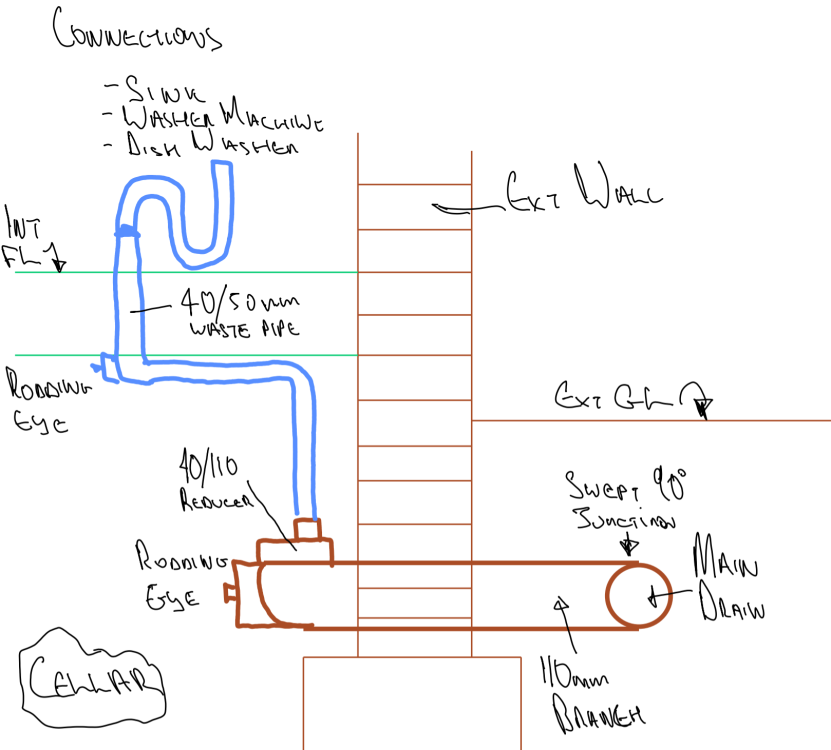
Looking for some design feedback. I have serval waste connections to make at ground floor level. Kitchen sink, disk washer and washer machine. Previously (many years ago) I would have just ran the 40mm waste through the external wall at high level (~1m) and then connected to the main 110mm drain run via a gully trap. I understand this arrangement is currently considered old school but regardless it is not suitable on this current job as I cannot have external surface fixed pipe work at this location. Reading previous topic I have came up with the design below. I'd appreciate if anyone can critique or suggest improvements. TIA.
-
Block and beam over ground beam
Annker replied to AdaminCymru's topic in General Construction Issues
Respectfully, I don't think that your builder or this forum are qualified/positioned to answer "is this ok", this should be raised with your SE and BCO. They will propose options which I'd then ask for the opinion of builder/forum. Nonetheless without knowing the specifics of the structural design I would doubt that the B&B floor has been designed to have the internal leaf blockwork (and its associated loads) built on it in that particular location; in practical terms it may be structurally sound however you may be committing the act of "not built to manufacturers specifications" so be aware of the risks that may bring. Was the builder responsible for forming the ground beam incorrectly, because that is a silly mistake, and not something I would consider fine. It is a big f up plain and simple. -
@Mr Punter and @Marvin, thanks for the comments. Yes I did have the thought that separating the shower wastes from the WC branches would be a better arrangement although I also thought that with them being at more or less the same level as the WC their respective junctions on the SVP would clash with one another. One way avoid that clash would be to put a 90 deg elbow on the shower wastes after they penetrate the wall and them return them into the SVP at a lower position. That would introduce another 90 deg bend in their route but perhaps it is still a preferable arrangement to having them T into the WC branch, which as pointed out may not be possible in any case.
-
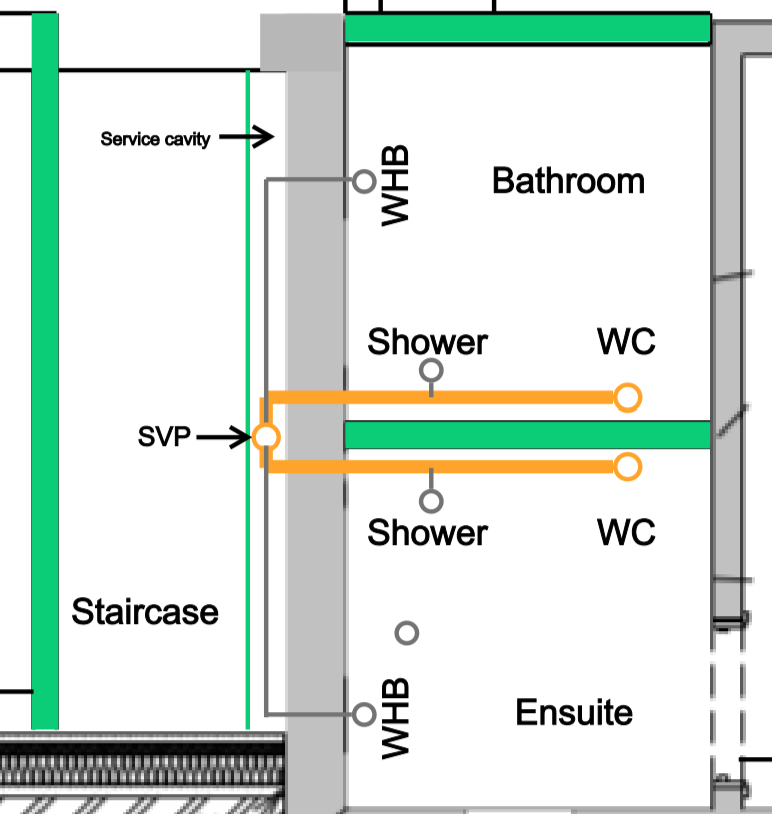
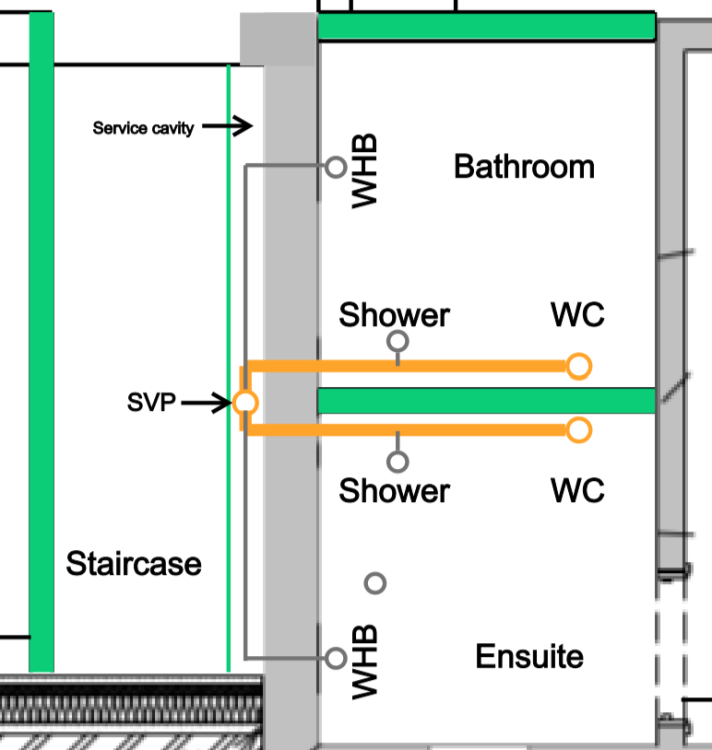
Spent the better part of the day researching many post here and I think I have figured out some more detail to the design. To try simplify the things I have separated the downstair WC and WHB from the upstairs sanitary waste; both will join into the inspection chamber through individual inlets. This also build in some redundances into the house, should blockages occur The upstairs draining is the more complex and I would appreciate any feedback offered to my sketch below. The WC's will be "back to wall" with a "P" type trap. A 90 deg rigid pan connector will join the pan to the 110mm branch pipe which will pop up through the floor. I also have the shower waste connected into this branch pipe, unsure if that is ok, in theory any whether it is possible in practical installation terms either? The 110mm branch pipes will penetrate through a brick wall into a created service cavity. Both branch pipes will then both connect to a single SVP via a double branch. I then have the WHB's exiting their respective bathroom in 50mm waste pipe and connecting to the SVP via a double boss branch above the WC double branch, my understanding is this is a preferred arrangement. Any feedback greatly appreciated!
-
Dear all, I would appreciate some help with designing a bathroom, ensuite and WC waste drainage layout in my renovation/extension project. As illustrated in my markup I will have a downstairs bathroom (WC & WHB), bathroom (WC,WHB & shower) and ensuite bathroom (WC,WHB & shower) all located on the other side of the existing wall. The plan is that all waste drainage will penetrate this wall and go to GL within a created service cavity, within the (yet to be built) extension block. At GL the drainage will be ran underneath the extension suspended timber floor, and exit to a new chamber. My question is can these various wastes all join into a single main drainage stack (which will be vented through roof level) and a single drain run to the chamber, or should each bathroom have its own stack and multiple drainage runs into a distribution? chamber. For simplicity have not included ~2 RW downpipes which were originally combined into the sewer drainage. I'm unsure if BC/Bregs allow combination of RW and sewer in renovation work but I will confirm with my BCO. Extension drainage schematic.pdf
-
Great, thanks for the tip!
-
Thanks for the response, I dont seem to get any notification of responses, not even the bell icon above. Anyway I provided my local merchant with my timber list for the project. I'm not sure should I call them a TM who also stocks building materials or a BM who specialises in timber. Their online trade price for 18mm b/bb CE2+ hardwood ply is an eye watering £52/sheet, hence me starting this thread. However, when presented with my timber list (value ~£4k of timber) they can supply the ply at £36/sheet. I need ~40 sheets of ply, They are a good yard and competitive with sawn timber so I'm happy at that price.
-
Just wondering if anyone has made a saving on a bulk order of plywood/osb? I need ~100 sheets so imagine there should be a saving to made if I shop around. Its so expensive wondering if anyone had any success in making a saving procuring sheet material from alternative sources to BM's?
-
Should we put a sink in the island or against the wall?
Annker replied to CalvinHobbes's topic in General Plumbing
Thanks for the prompt. Actually I do recall now that indeed they work plainly awful. -
Should we put a sink in the island or against the wall?
Annker replied to CalvinHobbes's topic in General Plumbing
I've to make the same kitchen design layout choices myself in a few months time. The recirculating hob/MVHR combo is a tidy solution but I have a vague recollection of hearing that it (recirculating extraction) isn't that effective, so for me dedicated hob extraction to the outside is my default as I know that works. -
Should we put a sink in the island or against the wall?
Annker replied to CalvinHobbes's topic in General Plumbing
The issue with having the hob in the island is it makes extraction a more of a problem.. You will either have hood extraction hanging from the ceiling potential ruining slight lines or an expensive downdraft extraction which will require the ducting to be buried under the floor. Secondly the route the extraction ducting will take will be longer and more torturous vs having the hob on an external wall. -
Solid wall Internal Wall Insulation (Warm Batten) design
Annker replied to Annker's topic in Heat Insulation
I have considered a parge coat. Given I've ~130 sqm of walling to cover, it would be a significant addition cost so I am debating if it is required Firstly, the internal face of the walls are plumb floor to ceiling but there are discrepancies in flatness. So a parge coat would fill out those discrepancies and hollows that otherwise may exist and I imagine could provide space for moisture to gather. Secondly, as you say a parge coat would fill any brickwork joints, and there are a few joints that aren't fully filled. However is the parge coat required to provide an airtight barrier? Going down the vapour closed route the PIR layers, and their perimeter, will need to be meticulously sealed, that is critical for the system to work. I need to ensure that provides an airtight layer. I wonder if I can consider a parge coat would optional second line of airtightness defence that I dont need to spend money on, or perhaps I should consider it as a critical component. -
Solid wall Internal Wall Insulation (Warm Batten) design
Annker replied to Annker's topic in Heat Insulation
The existing internal wall lining on the externals wall is lath & plaster, all of that will be removed so the proposed IWI will be on to barefaced brick. -
Solid wall Internal Wall Insulation (Warm Batten) design
Annker replied to Annker's topic in Heat Insulation
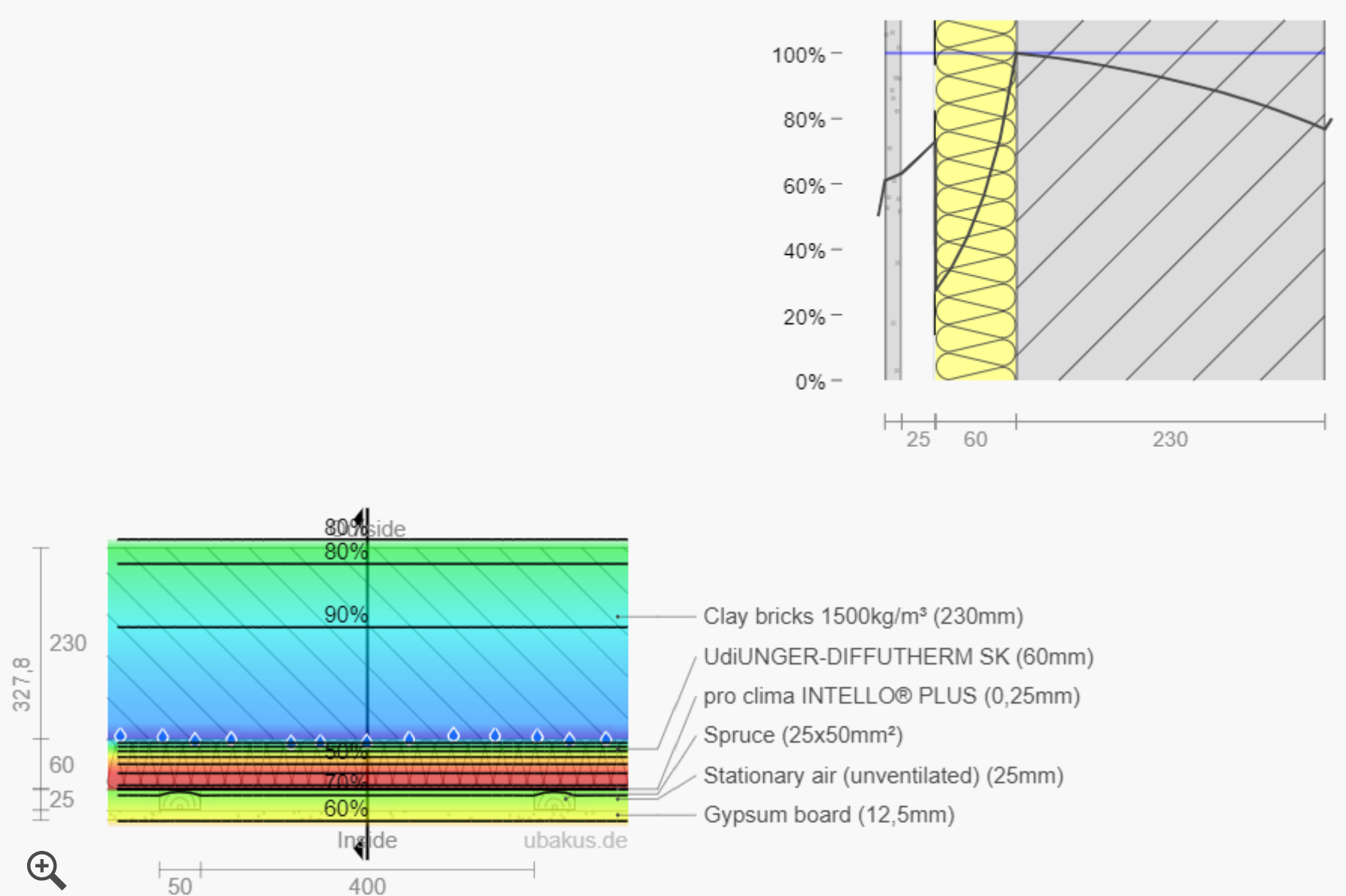
@Mike Yes I agree that a vapour open system put together with natural fibres fairs better should significant amounts of moisture penetrate the external brickwork. My hope is that that favourable site conditions (well sheltered semi-d, lime pointed brickwork, floor levels ~300mm to 900mm above external GL) and a conscientious install of the VB should eliminate or at least minimise moisture levels within the wall being raised to a level that will cause issues. I have read elsewhere alright that Ubakus is not that comprehensive. I played around with the outside temp & humidity values to somewhat compensate for that. It was interesting to see that with the outside temp set to -10 degrees the model with 60mm PIR remined condensate free. However condensation was indicated in the model with 60mm wood fibre (screen grab below) Not sure if that observation has any validity/relevance.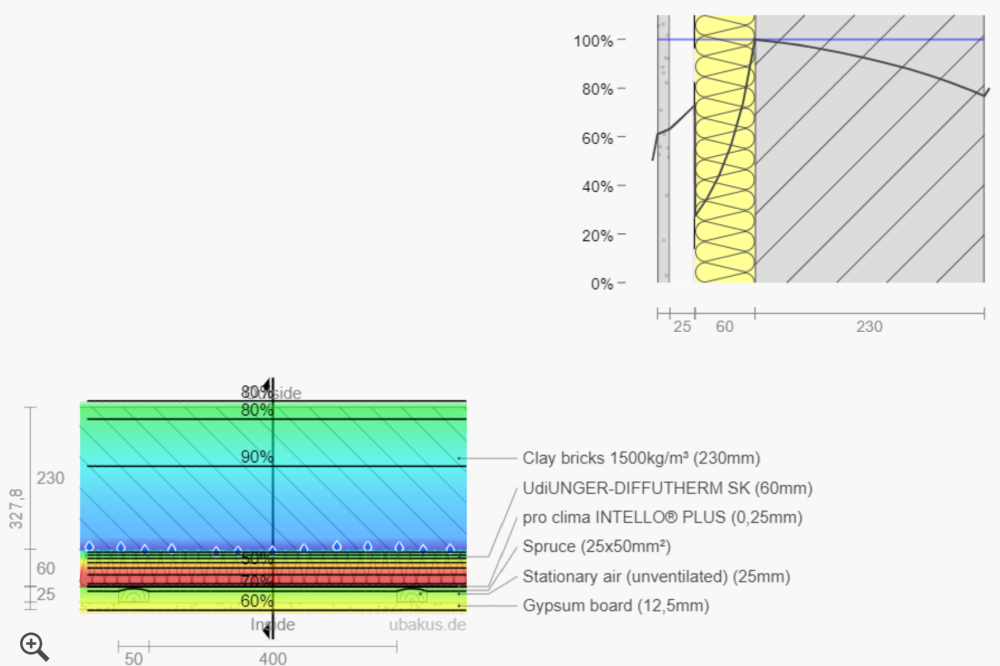
-
Warm batten internal wall insulation mitigations
Annker replied to FrankHouse's topic in Heat Insulation
@FrankHouse Understand this is an old post but if you get the @ notification I would love to know if you went ahead with the IWI as outlined in your post and if so how it has performed? -
Solid wall Internal Wall Insulation (Warm Batten) design
Annker replied to Annker's topic in Heat Insulation
Thanks for the response @Iceverge I am fortunate with regard workmanship/QC as I am a carpenter by trade (consider myself to have an eye for detail) and I will be doing the work with my own team. And I also have an appreciation for the level of attention that correct installation of an airtightness membrane requires. As my original post I have endlessly read every facebook group posts, forums, etc in researching IWI options. PIR got eliminated for consideration early on, almost entirely due to the absolute contempt the heritage/lime community have for it. Obviously they have a bias but it can be hard to ignore. That led me down the path of vapour open/breathable system, however not being a die hard conversationalist I still wanted to integrate the buildability of modern solutions into the mix. I also follow a house renovation channel on youtube which recently uploaded a video of a hybrid system called SWIP, and that in short is how I ended up with the bastard solution above with a foot in each camp if that makes sense. There is so much conflicting opinion regarding IWI that I'm ready to pull my hair out with analysis paralysis! . I personally have not had, or seen a PIR IWI cause damp/mould, and it is a system I would prefer. I feel there is too much broad strokes when discussion the various systems. The only differences debated are of the systems themselves; relevance of where (location, orientation, aspect) and how (workmanship) is ignored. So I must say its a relief to hear some experienced hands form this forum give a vote for PIR! I have modelled the PIR solution on Ubakus, and to me it looks ok. Humidity doesn't approach saturation point which I imagine is the most important thing.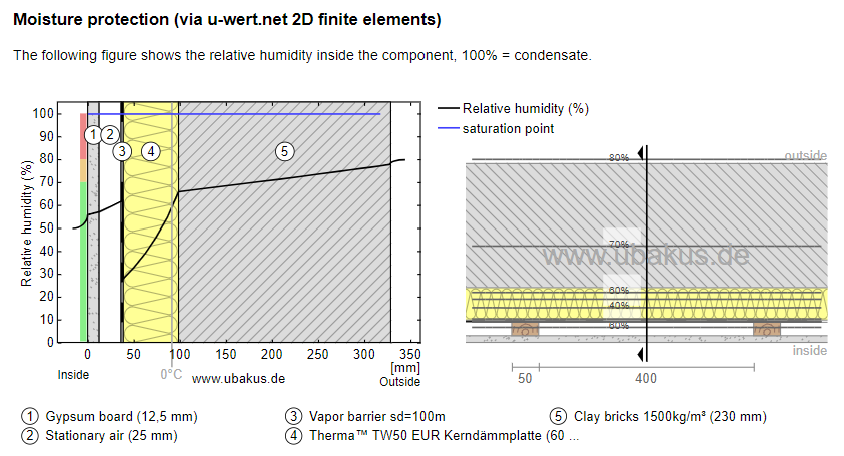
-
Removing wall bricks ready for RSJ
Annker replied to Bladders's topic in House Extensions & Conservatories
Typically needles penetrate the building in the room above the room where the steel is being installed. Yes they are disruptive and result in more remedial works but they are a significantly more robust and safer method of providing temporary support vs strongboys particularly in wide openings such as yours. No doubt strongboys and back propping joisting is used also by some, ultimately it's your call.