


Stewpot
-
Posts
193 -
Joined
-
Last visited
Everything posted by Stewpot
-
The idea of HSE, really, is to stop people exploiting the safety of those they employ or have other control of. Things have improved enormously for factory workers, and other labourers in the past 100 years. But that's not what we read about. I reckon much of the HSE stuff we hear about - from the local Round Table not being able to do their annual fireworks display, to the local council insisting upon hard hats being worn when inspecting the pavement - is largely insurance driven. IF something happens, and somebody makes a claim against them, then the insurance won't cover them if they have not followed the terms to the letter. Mean time: https://www.youtube.com/watch?v=Yd_FMM8FPAU
-
This stuff: https://www.atlantictimber.co.uk/flexible-plywood.html The idea is, you take two sheets of it, and glue it back to back, bending and clamping it to your desired curve. Once the glue has dried, it becomes surprisingly rigid, though it probably won't do as a structural element - I doubt it'd take a screw very well. And you'd have to experiment to see if it can deal with the small radius you have in mind. I've seen the stuff made of pure plywood, rather than MDF with a thin plywood face. But it is certainly possible to make your own out of plywood, or even solid wood, if you have an accurate table saw. The closer the kerfs, the tighter the radius. Maybe cut a drainpipe in half length ways to use as a former to clamp this into. And plenty of glue - you are aiming to glue all the thin strips together, as well as the two sheets to each other. Alternatively, you can get especially flexible plywood, but by its nature, it doesn't have a lot of stability to it without support.
-
Some units (especially of the flat-pack variety) depend upon the wall they are screwed to for their structural stability. If you use these sorts of units away from a wall, you often find you have to rigidly fix a back panel to them. If the back is to be removable, make sure the unit is rigid enough without it.
-
+1 I think it sounds awful.
-
In my experience, dealing directly with a lender can be a problem. A good broker is worth his (or her) weight in gold. The broker will act as a go-between between you and the lender, and if he is worth his salt, then he will take your side and help you with the best approach to the lender. He will also know about specialist lenders, ones whose lending criteria are suitable, and ones you never get to hear about otherwise.
-
I wonder if he'd like to come and spend 15 minutes digging my foundations?
-
I've been looking into this (speculatively, at the moment), and there seems to be no end of argument about what is the 'right' way to do land drains. A popular version (or at least my synthesis of it) is: 1) dig trench 450mm x 450mm+ deep[1] 2) line it with an unwoven ground fabric 3) 100mm gravel, leveled in the bottom of the trench 4) perforated pipe[2][3] 5) more gravel 100mm+ over the top of pipe 6) fold ground fabric over the top 7) replace top soil [1] Some people go deeper and use more gravel - may depend upon how much water you're trying to drain out of the soil [2] Some say the pipe should also be wrapped in a fabric sock, but few say use the sock without lining the trench as well [3] If the pipe is only partially perforated, there is argument about whether the perforations face up or down
-
I'm trying to work out the forces in the frame elements of a geo.dome. The spokes of the topmost hexagon will all be in compression. The rim of that hexagon will be in tension, constraining the compression forces of the above. But my brain can't get further than that at this time on a Sunday morning. Intuitively, I feel that your main problems are going to be as a result of the weight of frame elements that are made of concrete. Consider the apex: the weight of all that concrete is trying to move vertically downwards; the angle of the apex elements is small (to the horizontal), so the tension in the restraining rim of that hexagon will be high, and you will have very little scope for movement (free play in the joints, lack of rigidity, error in manufacture, etc.) before the apex collapses. Have you considered that the rainwater pipe alone may be adequate for the job? Things would be so much lighter that problems like that due to weight would be practically eliminated. Why not build the top hexagon out of empty pipe, and see how it is? If it seems strong enough, complete the build. If it's not, you can still try out your concrete plan.
-
You don't say much about the geo.dome - is it for residential purposes? How big is it? Does it have to pass any building control regulations? I haven't really much to contribute, but I thought geo.domes were intended to be made with lightweight structural elements - heavy frame elements at the apex of the dome and it might require some sort of additional vertical support. I would guess that your idea is going to end up with some pretty heavy frame elements, particularly if they are long enough to need steel reinforcement. If the frame elements are short, then I would have thought the plastic pipe would have added significantly to the integrity of the concrete. If it was me, I think I would be looking at alternative fillers - maybe PU foam - to create lightweight frame elements with your drainpipes. Some trial pieces first would be a good idea, testing them to destruction.
-
I was wondering if one of those braided fexi-connectors could be used to make the link between old and new - they are available with various fittings on each end and in various lengths, but it'd be as ugly as an ugly thing.
-
Council Tax
Stewpot replied to dnoble's topic in Self Build VAT, Community Infrastructure Levy (CIL), S106 & Tax
Ah, but Council Tax doesn't depend upon whether anybody is living there or not, just whether it's habitable. -
I guess it will all become clear in due course - I've just instructed a solicitor to formalise my offer for the plot.
-
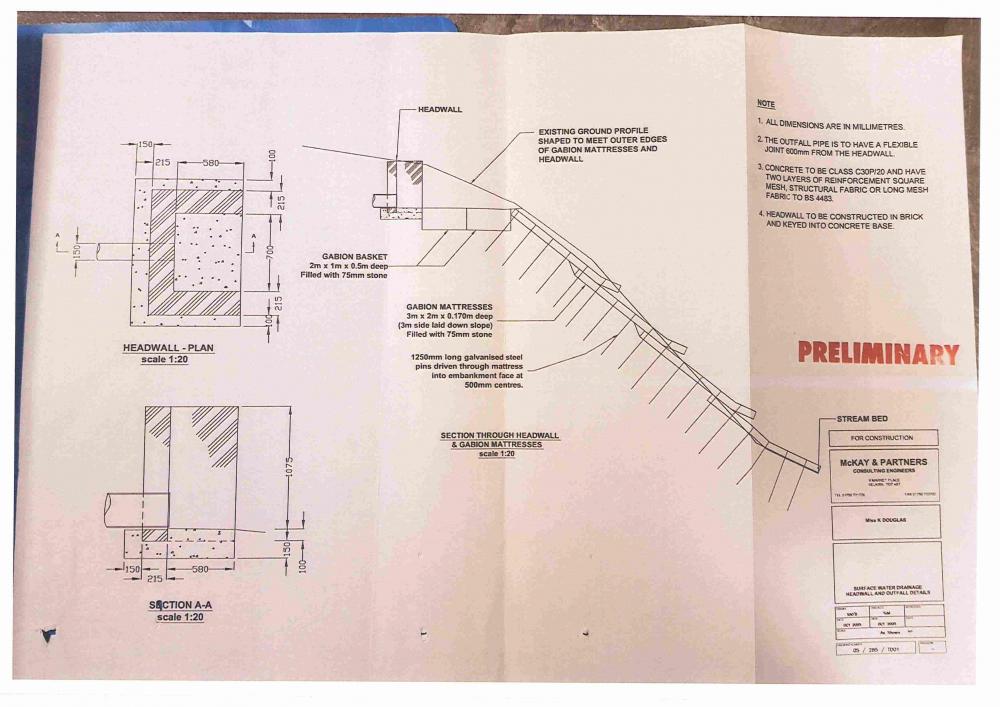
It's basically a flat version of a gabion that lies on the ground. But I am puzzled by it's use here. What purpose is it serving? Any water flowing over the top of the mattress will surely run to the underside of the mattress and make its way down the slope along the ground underneath. Over time, a natural watercourse will simply form under the mattress, and it becomes irrelevant. If there was an impermeable layer specified to lie under the mattress, that would make more sense, but there isn't. The report says: "The direct discharge to the burn will be difficult to construct due to the steepness of the valley slopes. It may be easier to allow the discharge to run through/over a series of gabion mattresses which have been laid down the face of the slope rather than try to install a piped outlet to the watercourse."
-
Stop Press! A minor miracle has happened. I've just received an email from the estate agent; the vendor has found a copy of the engineer's report. I need to spend more time with it, but on the face of it, it answers most of my concerns: The gabioned outfall for both surface water and treatment plant is simply a gabion mattress down the bank to the burn. And that's only a suggestion, instead of a piped outlet. So the gabions aren't required to shore up the bank, which was my fear. Load bearing capacity 85kN/m2. Foundations "would most likely take the form of conventional strip foundations." I must say, I had been anticipating piled foundations of some sort. In fact, I may actually prefer them, given the nature of the site, but I'll deal with that in due course. This is my bedtime reading sorted out for a while. Thanks for everyone's input.
-
The part of the site where the house will sit is made-up ground on the side of a half-acre slope leading down to a tree lined burn. Lovely and idyllic. Apparently, the site was at one time the dumping ground for spoil from a nearby small quarry. I doubt the quarry has been active in living memory, and historical maps show it in existence in 1858 or earlier. Local information suggests the ground was leveled, possibly as long ago as the 1960s. Mature trees around the edge of the leveled area would support this and would suggest the made-up ground is now well consolidated. But it is very wet. In my estimation, the wet conditions are the result of two things (at least): 1) the made-up area is obstructing the natural flow of surface water down the slope to the burn 2) there is a ditch on the opposite side of the lane that deals mainly with seepage from the adjacent sloping field. At some point in history, this ditch has been culverted under the lane and outfalls directly onto the made-up ground, saturating it. When I've been on site, I would guestimate there is a flow of a gallon or more per minute. I would also guess that the culvert existed before the ground was made up, and would originally simply have formed a trickle down the bank to the burn below. I would have though it was fairly straight forward to form a gully under the outfall from the culvert, and pipe that underground toward the burn, away from the building area. And also tread the remaining area similarly with land drains. A domestic treatment plant should be all that's needed to deal with foul waste. But apparently, the LPA are thinking in terms of gabioned outfalls, and without knowing the details, I fear this has the potential to make the site unviable for my purposes.
-
It's very overgrown, so photos, at this stage don't really show the lay of the land very well. It is also a curving shape that tucks round a bank, before dropping steeply down to the burn several meters below, which makes it hard to get into a snapshot. I can post pictures of brambles, shrubbery and mud, but I don't think you'd gain much from seeing them. Also, at the pre-contract stage of things, I'd feel it would be unwise to identify the site too closely on a public forum. Later on, maybe, if things work out, I can try.
-
I'm not nearly that good looking.
-
Thanks, Temp. I think it would be 2) or 3). I don't think there has been a previous potential buyer, and there seem to be no special conditions relating to this. It's this last point that puzzles me, really. The vendor isn't being overly helpful on this matter (which may be legitimate - I think she has just inherited the site, and so probably knows little about its planning history). But I worry that a copy of the engineer's report wasn't kept with the approval documents; this suggests it may have contained bad, rather than good, news. I think my concern really is the mention of a gabioned outfall that would need to be designed by a specialist - 'gabions' suggest potentially unstable land, and 'specialists' suggest unreasonably large bills. On top of which, installing gabions at the foot of the bank may be difficult - access would be a problem. On the face of it, dealing with surface water (even quite a lot of it) shouldn't be too difficult, should it? Especially as there is a burn running adjacent to the site. However, this is made-up ground on a slope, so I worry about long term stability of the ground. I have asked the LPA to check their archives, but they say it will be January before thay can get back to me.
-
Apparently so. From an unpublished anthology: It was a wild and storrrrmy night And the wind did blow, giving us all a very terrrrible fright It blew east and west, I do surmise And the roof blew off, giving us all a surprise So if you good people should e're build a hoose o' ye're own Make sure the roof trusses are supplied by a company of renown.
-
You clearly have no idea of the sort of person I am... Burns and Shakespeare - Pah! McGonagall had style.
-
Also, what about council tax? Do you pay CT on 1) a caravan that has temporary PP as residential accommodation 2) a caravan sited to provide temporary accommodation for workers on building or engineering sites (as per my post above)? Further to my previous post - there no longer seems to be a link to download the leaflet I referred to, but there is now a web page (scroll down to near the bottom to find the paragraph referred to).
-
Thank you all for your warm welcome. It's hard not to be inspired by your comments and achievements. I hope, soon, to be in the position to ask you no end of questions. The practical building work doesn't (yet) cause me concern - it's the formalities that have to be complied with first; my brain seizes up when I see a form that need completing. And I'm going to inscribe that McGonagall quote over my front door, when it's all done.
-
Thanks, all for your replies. I, too, have wondered why the plot has been available for so long. It was very over priced, which may have been a large part of it. I managed to negotiate a 40% reduction in price, which makes the site very much more attractive. But I'm wondering if this structural engineer's report indicates that something more serious is afoot. So, the immediate issue I'd like to understand more about, is how the structural engineer's report impinges upon the PP. All I know about it is the comment made in the 2009 officer's report, and the implication is that the engineer's report contains recommendations which make the site viable. So, is the PP (and all subsequent renewals) in some way dependent upon the SE's report - eg. without being able to produce the report, getting further plans approved will fail, or, without implementing it's recommendations, the build will contravene planning (or BC) conditions? In other words, is any development on the site locked in to the SE's report? Or is it more the case that the planning department has been shown an example of how the issues may be addressed (other solutions may also be possible), and that has enabled them to grant PP? The site is in the Scottish Borders area, by the way.
-
I'd be grateful if someone could help me get a better understanding of some planning matters. I'm looking at a plot in Scotland which has had Outline Planning Permission (and more latterly, Permission in Principle) since 1997, or possibly earlier. However, I can trace few documents earlier than the 2009 renewal - neither council, nor vendor seem to have archives going back further. However, the planning officer's report that accompanied the 2009 renewal contained this paragraph: "This site has had outline planning permission for a house in 1997, and again in 2004... During the processing of the 2004 application, the biggest difficulties have been related to the ground conditions and addressing satisfactory drainage. A structural engineer’s report was received which has answered the concerns of Building Control and SEPA, basically resulting in a gabioned outfall to the adjacent burn which will have to be designed by a specialist." I cannot locate a copy of this engineer's report, but I have got the approval document for the 2004 application, and all renewals since. None of them make any reference to the report. Given the nature of the comment above, do the recommendations in the report somehow constitute a part of the approval? If so, will it be implicitly applied to all subsequent renewals? Also, is it odd that the 1997 approval did not seem to depend upon an engineer's report, when the following renewal did? It took over two years for the 2004 renewal application to be approved, so I would guess there were site conditions that were a major stumbling block until the report recommended solutions to them. I won't go into too much detail, but the site does have a major surface water drainage issue, and possibly ground stability, too, it being made-up ground on a slope (though seems to have been like that for several decades). I am not trying to find a way to avoid the work required to address the issues, but I am trying to understand how the engineer's report fits in to the planning process.
-
Just to add my couple of penny's worth - I found a leaflet from Wyre Forrest Council addressing the issue of caravans on site. The leaflet is AL14_Caravans - A Planning Guide to Caravans. The guidance it contains is presumably applicable elsewhere. It contains this: "Building and Engineering Sites. Land may be used as a caravan site to accommodate people taking part in authorised building or engineering work on the same or adjoining land. This covers workers camps on large scale projects, like bridges, roads or dams, as well as small scale building projects, like self build housing. The caravans shall only be used to house workers and not workers’ families. The caravan(s) must be removed immediately once the building or engineering work is finished." The leaflet is undated, and I can't remember when I downloaded it (maybe 5 years ago), so perhaps the law has changed. But if not, this would seem to cover the lone builder.


