


MortarThePoint
-
Posts
2294 -
Joined
-
Last visited
Everything posted by MortarThePoint
-
Crazy Rafter Roll insulation cost
MortarThePoint replied to MortarThePoint's topic in Heat Insulation
One thing I wonder though is if Rafter Roll has controlled expansion to ensure it doesn't expand up and touch the roofing membrane. There's supposed to be a 50mm gap left. SHould have gone the counter batten route, but too late now ? @ProDave your FrameTherm didn't look to puff up whereas @Thedreamer yours did. Any thoughts on that? -
Thermal Time Constant
MortarThePoint replied to MortarThePoint's topic in Energy Efficient & Sustainable Design Concepts
Adding in plasterboard and timber takes that time constant to 113hours, so 5.7hours to loss 1C at dT=20C or a temperature half life of 79hours. -
Wax (PCM)
MortarThePoint replied to MortarThePoint's topic in Energy Efficient & Sustainable Design Concepts
Interesting to see the tank temperature. The wax plasterboard won't do anything for you up until it starts to melt and then it should clamp the plasterboard, and therefore likely the room temperature too, until the wax has all melted. After that the temperature would continue to rise, but it's a lot of heat by then. -
Thermal Time Constant
MortarThePoint replied to MortarThePoint's topic in Energy Efficient & Sustainable Design Concepts
I've got some grand plans in this area, but would use mains voltage compliant wiring etc everywhere so that it could be swapped back to mains if needed (e.g. future house buyer). -
Thermal Time Constant
MortarThePoint replied to MortarThePoint's topic in Energy Efficient & Sustainable Design Concepts
I'd accept 300K on a warm day I'm seriously considering having a 48V lighting system in the house because I think I should be able to design and install it myself all outside of part P and have better efficiency than OTS led lights, as well as use a 48V DC battery charged off Economy7 or solar. -
Wax (PCM)
MortarThePoint replied to MortarThePoint's topic in Energy Efficient & Sustainable Design Concepts
As a comparison, just a panel of plasterboard behind massless U=0.2 insulation would heat up at a rate of dT/dt = 4W / (10kg * 1090J/kgK) = 3.6e-4 C/s gives ~1hour per degree C. -
Thermal Time Constant
MortarThePoint replied to MortarThePoint's topic in Energy Efficient & Sustainable Design Concepts
64kWhr per degree C is a lot. That's a Tesla per 2C. If you could effectively retrieve electricity from thermal heat, we'd have some pretty cheap solar batteries. -
I never thought I'd spend so much time considering wax as a constituent building material. It's all to do with the latent heat of fusion being so high in comparison with heat capacity and that waxes can be chosen to melt at useful temperatures. There are two places it has occurred to me to use it: In a ASHP buffer tank - during off peak electricity hours you could heat a buffer tank to just above the melting point of the wax within it. For example, if you had a total of 100kg of wax in capsules inside a buffer tank, melting that wax would take about 2MJ of heat or 5.6kWhr. A wax that melts at the temperature you want to run your UFH water at and so as the wax solidifies it will give a constant temperature. You wouldn't have to heat the floor itself whilst you are running the ASHP or run the ASHP when you are heating the floors. Has anyone done this? Shouldn't be particularly expensive. Underneath rafters in a loft space - lofts can get too hot. If you had wax under the rafters below the insulation it would stop the plasterboard getting hot. As an idea, if the under tile void is 20C higher than the wax's melting point and you had U=0.2 of insulation, 4W/m2 would pass through the insulation into the wax. If you had a 1.1mm layer of wax it would weigh 1kg/m2 and absorb 200kJ in the process of melting. That would take 14 hours so never actually melt unless the average inside temperature went above the wax's melting point, averaged across about a day. You would choose a wax at a comfortable upper limit to the room temperature. I have seen that Knauf produce a plasterboard (ComfortBoard) with beads of wax in on this principle. I think it is very expensive though. Has anyone used that or done anything similar? Useful information of paraffin wax as a phase change material (PCM): https://www.intechopen.com/books/paraffin-an-overview/paraffin-as-phase-change-material
-
Thermal Time Constant
MortarThePoint replied to MortarThePoint's topic in Energy Efficient & Sustainable Design Concepts
Yes effectively I have also found this paper which has more detail and shows my thinking wasn't entirely crazy. https://www.osti.gov/etdeweb/servlets/purl/20203120 -
Thermal Time Constant
MortarThePoint replied to MortarThePoint's topic in Energy Efficient & Sustainable Design Concepts
To factor in timber, pine has a heat capacity of around 2500kJ/kg, much higher than concrete which surprised me. Time Constant in hours =(1000* (insulated mass of concrete equivalents in tons) + 2500*(insulated mass of timber equivalents in tons)) / 3.6*(heat transfer coefficient in W/K) https://www.engineeringtoolbox.com/specific-heat-solids-d_154.html -
I've been thinking about rafter insulation and diurnal temperature considerations. This has lead to to consider what the time constant of the whole house is. Calculate the sum of insulated mass heat capacity and divide it by the total heat loss rate. Q = (SUM[ A.U.dT ] + SUM[air change heat loss]) / SUM[ m.c] dT / dt = Q / c.m dt = (c.m / Q) * dT Considering a simplified example system of: (I know the proportions are silly, but its helpful to keep the numbers simple and the aspect ration about right) Cuboid house 20m(l) x 10m(w) x 10m(h) --> total A = 1000m2, A_walls = 600m2, A_floors = 400m2 (ignore heat capacity of ceilings) Average U of 0.20 W/m2K --> 4kW @ dt=20C (note thermal bridges rolled into this) PIV or MEV dominated air leakage of 100l/s --> 2.4kW @ dt = 20C Total heat loss at dT = 20C is 6.4kW Floors: Assumed concrete floors (inc screed) 300kg/m2 --> m_floors = 400m2 * 300kg/m2 = 120t Walls: Assumed blockwork inner leaf (inc plaster) 140kg/m2 --> m_walls = 130% * 600m2 * 140kg/m2 = 109t (-10% windows, +40% for internal walls) Concrete, c is around 1kJ/kgC = 1MJ/tC SUM[ m.c ] = 229t * 1MJ/tC = 229 MJ/C = 64 kWhr/C, so takes 57 kWhr to change the temperature by 1C [3.6MJ = is 1kWhr] The time to loss 1C at dT = 20C is 64kWhr / 6.4kW ~ 10hours. In exponential terms, the time constant is 200 hours since dT/dt = T/200. This yields a 'temperature half life' is 200*LN[2] = 200*0.693 = 140 hours. This is going to have a large impact on how the temperature changes during the day and night as the outside temperature and the heating change. For example, if you wanted to only heat your house using economy 7 electricity and only have a 1C temperature change in the dead of winter you'd want the thermal time constant per 1C at dT=20C to be about 17hours. You can approximate it quite easily from your SAP and knowledge of floor and wall materials (e.g. screed, blocks and plasterboard order). The SAP has a figure in it called average "Heat transfer coefficient, W/K" which is (39) in a STORMA 2012 Version generated SAP. Time Constant in hours = 273 * (insulated mass of concrete equivalents in tons) / (heat transfer coefficient in W/K) [(1,000,000J/MJ) / (3600s/h) = 273] Our design looks to be around a time constant of 90hours, so 4.5hours to loss 1C at dT=20C or a temperature half life of 62hours. This is obviously a rather simplistic approach, but I think it is useful. Would be better to include mass of timber as well.
-
Did you mean to add a £ figure to that? Oh that's interesting, I didn't know there were issues with annhydrite and floor coverings? Is that the laitance?
-
Was that for >300sqm then or did you get the eBay price even lower than £4.75/sqm+VAT?
-
Crazy Rafter Roll insulation cost
MortarThePoint replied to MortarThePoint's topic in Heat Insulation
Interesting and very helpful, thank you. The whole pricing thing is really opaque and leaves me permanently thinking I'm left paying over the odds. I'd prefer greater transparency, but the closest I can get to that is SPONS and that has never been more out of date than under the current climate. I can remember when I first got my trade account at Jewson, I walked up to the counter with an arm full of plumbing fittings and the woman at the till punched in some numbers and gave me the price that was over double Wickes. I said that and she said that it was Osma fittings etc and that's much better than Wickes, though she would take a look and it came straight down to a bit under the Wickes price. I had naively hoped that having a trade account meant the end of the haggle, but how wrong I was. -
Crazy Rafter Roll insulation cost
MortarThePoint replied to MortarThePoint's topic in Heat Insulation
FrameTherm sounds like a good choice, I've also seen FactoryClad is a lot cheaper, but may be difficult to cut to width. I'm taking a look at Actis Hybris which I have to admit to being a bit sceptical about. I need to understand it a bit more, but I might be being a luddite. -
Crazy Rafter Roll insulation cost
MortarThePoint replied to MortarThePoint's topic in Heat Insulation
Have to taped the batten though? -
Crazy Rafter Roll insulation cost
MortarThePoint replied to MortarThePoint's topic in Heat Insulation
@ProDave What's this bit?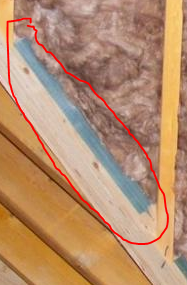
-
Crazy Rafter Roll insulation cost
MortarThePoint replied to MortarThePoint's topic in Heat Insulation
Thanks. I have seen the long lead times but thankfully none of it is urgent. -
Crazy Rafter Roll insulation cost
MortarThePoint replied to MortarThePoint's topic in Heat Insulation
It is for between (and below) rafters. I haven't had a price yet for FrameTherm but hope it may be my saviour. I spoke to a merchant a couple of years ago who said lots of people staple Loft Roll between rafters ? I don't think that's a good plan -
Is Mineral Fibre rafter insulation always so expensive? I've been quoted £18/m2 for 100mm Knauf Rafter Roll 32 and that just doesn't make any sense: Same seller sells 100mm Dritherm 32 for about a third of the price per m2 (£6.70/m2). That's a performant self supporting product as well. The same seller lists 100mm PIR which is 50% more performant for £12.91, so cost per performance, that's less than half the price of the Rafter Roll. You'd expect to pay a premium for the thinner more performant product. All other applications, Mineral Fibre is considerably cheaper than PIR I have spoken to Knauf Technical and they can't comment on pricing. FrameTherm is also recommended for the rafter application so I am looking into that. Isover Metac seems to be similarly expensive. I don't want to use PIR or XPS due to the chemical content. I know that divides opinions, but can anyone recommend a sensibly prices alternative to Mineral Fibre.
-
Sorry I confused now. You had 1m3 for £900 and 2.3m3 for £444. Those aren't per me prices are they?
-
That's a good price as most companies I have spoken to have a minimum price (aka 'get out of bed price') much higher than that . The companies I am talking to (nationwide, I'm near Cambridge) have an things along the lines of 'Initial charge 2m3' of £1200 and then a per m3 price on top. Are you using a small independent contractor? That price is remarkably good.
-
Gulp! You've a commendably philosophical outlook @oranjeboom
-
Did the mesh get pulled up then or the pipes detatch from the mesh?
-
Still living through this nightmare. I wish I'd gone with a pipe with an Aluminium layer as they seem to flex and hold better rather than coiling back up. Is that correct of 16mm Pert-Al-Pert? I can use screws upstairs where there is no gas barrier, just the green sheeting. Downstairs I can't though. Nu-Heat sent a decoiler but it doesn't really help. Does Wunda's 16mm Pert-Al-Pert pipe flex and hold?

