MortarThePoint
-
Posts
2294 -
Joined
-
Last visited
Everything posted by MortarThePoint
-
There are loads of companies that sell front doors and make no mention of Part Q compliance. I expect many BCOs turn a blind eye, but not mine. My BCO pointed me at Part Q - Appendix B about making a bespoke door that will be deemed compliant. When I first read this I understood the <=230mm panel width dimension of B.5 to mean that there had to be <=230mm between structural timbers of minimum 44mm thickness, but looking at the example door below, the manufacturer's description says it has 6 panels and so each is well less than 230mm. The whole central portion is about 22mm thick and the distance between the outer stiles is about 500mm or so. What do we think, compliant because Appendix B doesn't insist on <230mm between stiles and mullions/stiles? Has anyone had success in this area and is able to share some tips? Generic Door anatomy/glossary:
-
We've some rooms that are to have engineered oak flooring and others to have laminate flooring. I'm trying to plan the order of works. Should it be: lay floor fit skirting and architrave paint ceiling, walls and skirting+architrave OR paint ceiling and walls lay floor fit skirting and architrave paint skirting+architrave OR fit skirting and architrave paint ceiling, walls and skirting+architrave lay floor with scotia or cork edging I feel cork edging or scotia looks less neat. Laminate may in the future (5-10 years) want replacing with carpet, but the engineered oak should be permanent. If I have the laminate going under the skirting I expect I still wouldn't need to replace the skirting board as carpet plus underlay (9mm + 10mm) is a little thicker than laminate plus its underlay (10mm + 3mm) or am I kidding myself.
-
Plasterboarding a hip
MortarThePoint replied to MortarThePoint's topic in Lofts, Dormers & Loft Conversions
Turns out you can: https://www.british-gypsum.com/products/metal-products/gypframe-ga6-splayed-angle#standards
-
Plasterboarding a hip
MortarThePoint replied to MortarThePoint's topic in Lofts, Dormers & Loft Conversions
Here's the corner now. I've linked the horizontal battens but really need something following the hip line. This is needed for two reasons: 1. VCL taped join needs to be supported 2. Supporting the plasterboard joint I'm trying a piece of batten up one side behind the horizontal battens. I'm going to put in sections of batten to fill in between the horizontal battens and screwed to this vertical batten. It would be so much easier if you could get a bit of metal frame that was like L-channel but had the necessary hip angle.

-
Plasterboarding a hip
MortarThePoint replied to MortarThePoint's topic in Lofts, Dormers & Loft Conversions
That photo is before the insulation went in to fill the rafters up to the black straps (leaving 50mm ventilation under membrane). -
Plasterboarding a hip
MortarThePoint replied to MortarThePoint's topic in Lofts, Dormers & Loft Conversions
Here's where I mean. Photo prior to battens
-
Plasterboarding a hip
MortarThePoint replied to MortarThePoint's topic in Lofts, Dormers & Loft Conversions
These are external corners aren't they, so what you'd have at a valley rather than hip. -
Plasterboarding a hip
MortarThePoint replied to MortarThePoint's topic in Lofts, Dormers & Loft Conversions
Internal corner. So would you cut a v-shaped trench in a piece of timber and attach it to the hip rafter? -
What sort of costs are involved? I'd take it on the chin and pay to fix the whole stack with their agreement, but being clear it's not because you believe it was damaged by your builder but because you understand it's important to your neighbours. Chimneys can add character so may be important to them from an aesthetic stand point. That requires some trust in you neighbours to not try to take advantage of you down the line on other things, but all this sort of stuff is best discussed in person over a cuppa.
-
Loft conversion - rotten timber?
MortarThePoint replied to Firsttimereno's topic in Lofts, Dormers & Loft Conversions
Looks fine from what I can see. What span are the joists, what size timbers and what spacing. Looks like it may be 47mm x 145mm or 47mm x 195mm at perhaps 400mm spacing. You can then use the tables here to check all good: https://nhbc-standards.co.uk/6-superstructure-excluding-roofs/6-4-timber-and-concrete-upper-floors/6-4-8-timber-joist-spans/ You may find if you look up the next size down in the table, so allowing 25mm for that defect, you are still fine. As an example, if C24 on a span of 4m, spacing 400mm and timber 47x195 then 47x170 timbers would still be OK for that. That would allow the whole lot to be smaller, so just one would be super OK. In the photo, the defect doesn't look as deep as 25mm, but check by eye. -
Is there an easy way to secure plasterboard at the hip line of roof rafters? I have mineral wool insulation between and below the rafters. That means I have battens running perpendicular to the rafters which the plasterboard can be screwed to. But at the hip corner the plasterboard joint will need supporting. I can think of cutting a v-shaped trench in a piece of 4x2 and attaching that to the hip rafter, but that's a bit tricky. I'm hoping there is a simpler solution. This product could help: https://mat-plasty.com/profiles-beads/profiles-for-plasterboard/universal-corner-profile Otherwise just some plasterboard corner tape could help.
-
Note, China's standard is GB/T 39600-2021. The ENF rating limit (0.025mg/M3) is 2.5 times the Finish M1 and French A+ ratings limits (10ug/m3). https://www.yalongwood.com/gbt39600-2021/
-
Wall tiles out of level / not flat surface
MortarThePoint replied to MortarThePoint's topic in Wall Tiles & Tiling
Conversation with tiler went OK so that's now closed. I'll need to find another one though. Thank you for everyone's support! -
Wall tiles out of level / not flat surface
MortarThePoint replied to MortarThePoint's topic in Wall Tiles & Tiling
He just did dabs onto the tiles and then stuck them, so far from what I'd expected. No it was bagged (Nicobond Standard Set Flex Pro S1) After removing the tiles I rechecked the walls with a 2m straight edge and they are perfect. Lots of effort was gone to by the plasterer to get them like that. -
Wall tiles out of level / not flat surface
MortarThePoint replied to MortarThePoint's topic in Wall Tiles & Tiling
Took from about 7pm to 3am to take the tiles off and clean them and the walls. Back up at 6am for the kids school run. On fumes and a tricky conversation in about an hour. The weekend is almost here! -
Wall tiles out of level / not flat surface
MortarThePoint replied to MortarThePoint's topic in Wall Tiles & Tiling
Taking tiles off
-
Wall tiles out of level / not flat surface
MortarThePoint replied to MortarThePoint's topic in Wall Tiles & Tiling
What would you do nod, relax or pull them off? -
Wall tiles out of level / not flat surface
MortarThePoint replied to MortarThePoint's topic in Wall Tiles & Tiling
Sorry, I have now steered the thread to a new issue which is some dot and dab tiling -
Wall tiles out of level / not flat surface
MortarThePoint replied to MortarThePoint's topic in Wall Tiles & Tiling
I phoned the tiler (he is a dedicated tiler and not cheap either) and he says that he has dot and dabbed them and that's the only way to get them flat. He's "been tiling for 40 years and never had tiles fall off. They will never fall off" -
Wall tiles out of level / not flat surface
MortarThePoint replied to MortarThePoint's topic in Wall Tiles & Tiling
As it's all still wet should I pull the tiles off and if so how best to clean to save some and the walls? -
Wall tiles out of level / not flat surface
MortarThePoint replied to MortarThePoint's topic in Wall Tiles & Tiling
From the BAL website: "BS 5385-1: 2018 advises: “Tiles with a surface area of less than 0.1 m², but which weigh more per square metre than 70% of the background’s capacity to carry the weight, should be solidly bedded e.g. the maximum weight of tile that can be supported by Gypsum plaster = 20 kg; whereas 9 mm thick porcelain tiles, which weigh approximately 18 kg/m², weigh more than 70% of 20 kg (14 kg) therefore, they should be solidly bedded regardless of their size”" -
Wall tiles out of level / not flat surface
MortarThePoint replied to MortarThePoint's topic in Wall Tiles & Tiling
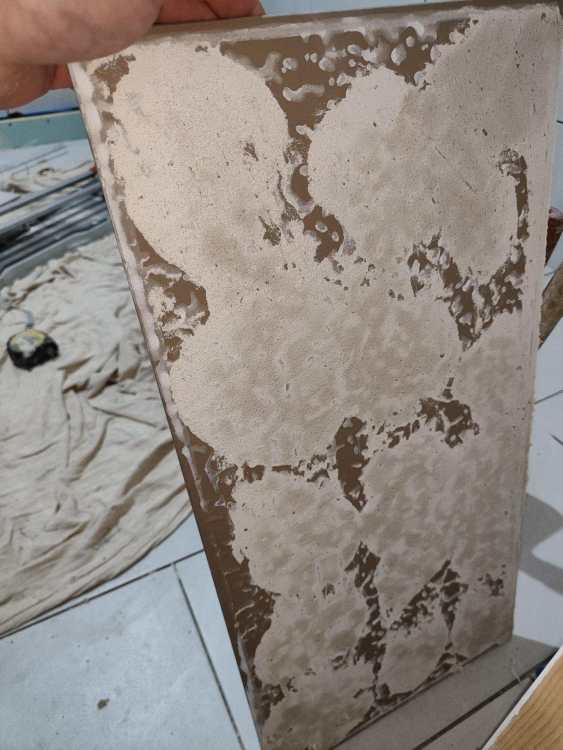
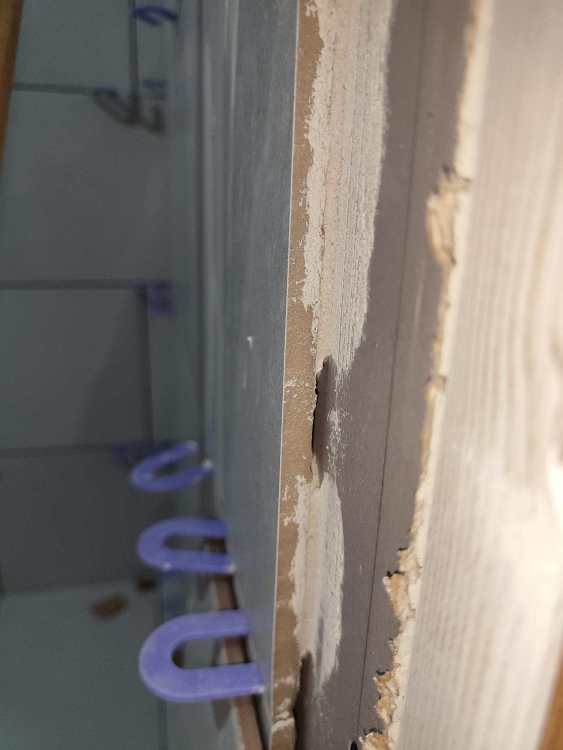
I didn't watch over him today and he was laying walls in 600x300 porcelain tiles (3.27kg each so 18.2kg/m2) and it looks like he has used a dot and dab method. See pictures below. I noticed this because I stepped into the room after he left and the whole room is making a bubbling/fizzing sound. The photo of a tile back is one that was lent against the wall. The other photos are taken looking at the edge of the tiled area. The tiles are 9mm thick. Half the room is plasterboard, the other half is rendered blockwork. @Nickfromwales @nod urgent advice please 😱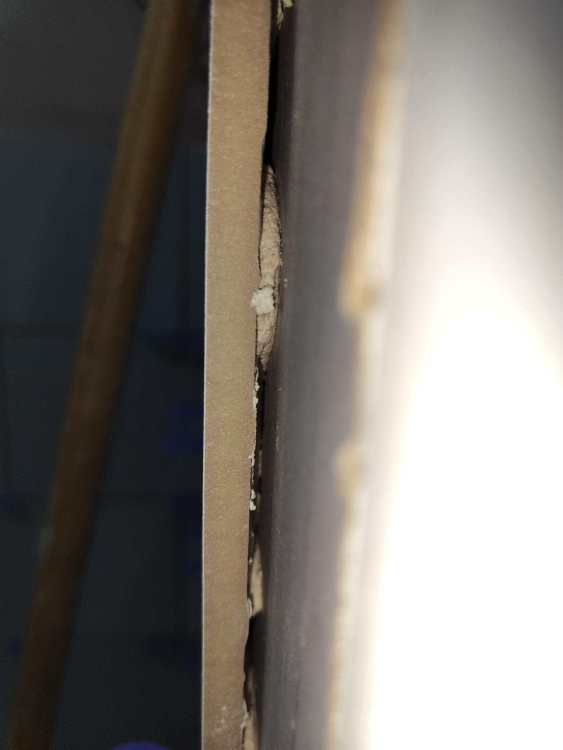
-
Wall tiles out of level / not flat surface
MortarThePoint replied to MortarThePoint's topic in Wall Tiles & Tiling
Well that conversation could have gone better. I said he didn't need to replace them to which he said he wouldn't be happy knowing they are there, but he'll finish up where he has already started and step out on the rest of the job. A shame as I think he's a good tiler and normally seems like a nice bloke too. No raised voices on either side and I approached it as being a tad apologetic to raise the issue. I've a big area (72m2) of hard to lay tiles that I need to have confidence in and if I can't talk quality with the tiler it's an issue. -
Wall tiles out of level / not flat surface
MortarThePoint replied to MortarThePoint's topic in Wall Tiles & Tiling
The substrate was bang on flat. Blockwork was good, but then the plasterer rendered. The plasterer fixed beads at top and bottom of the wall with adhesive making sure straight with a straight edge. Then when he rendered, he ruled/'screeded' the wall between the two beads. The worst section of wall is half height tiled. If I put a 2m straight edge on the skim coat above, it's bang on and that would be worse than the underlying render as the skim wasn't ruled/'screeded' between beads like the base render was. -
Wall tiles out of level / not flat surface
MortarThePoint replied to MortarThePoint's topic in Wall Tiles & Tiling
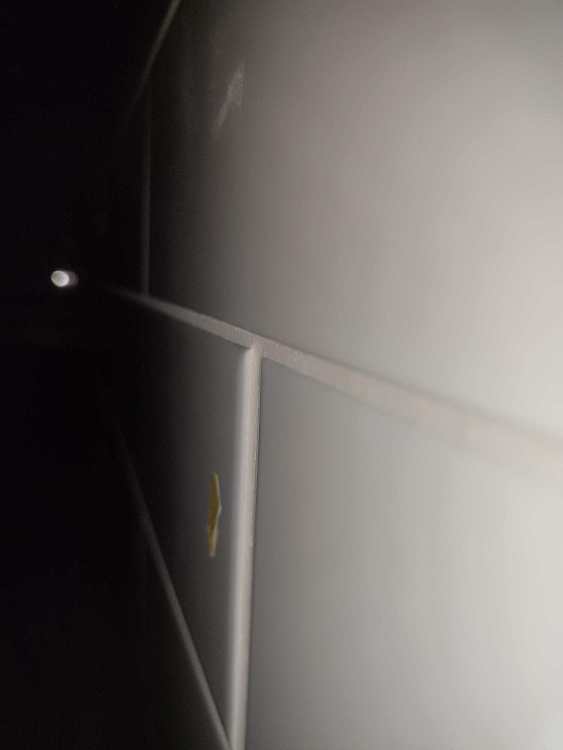
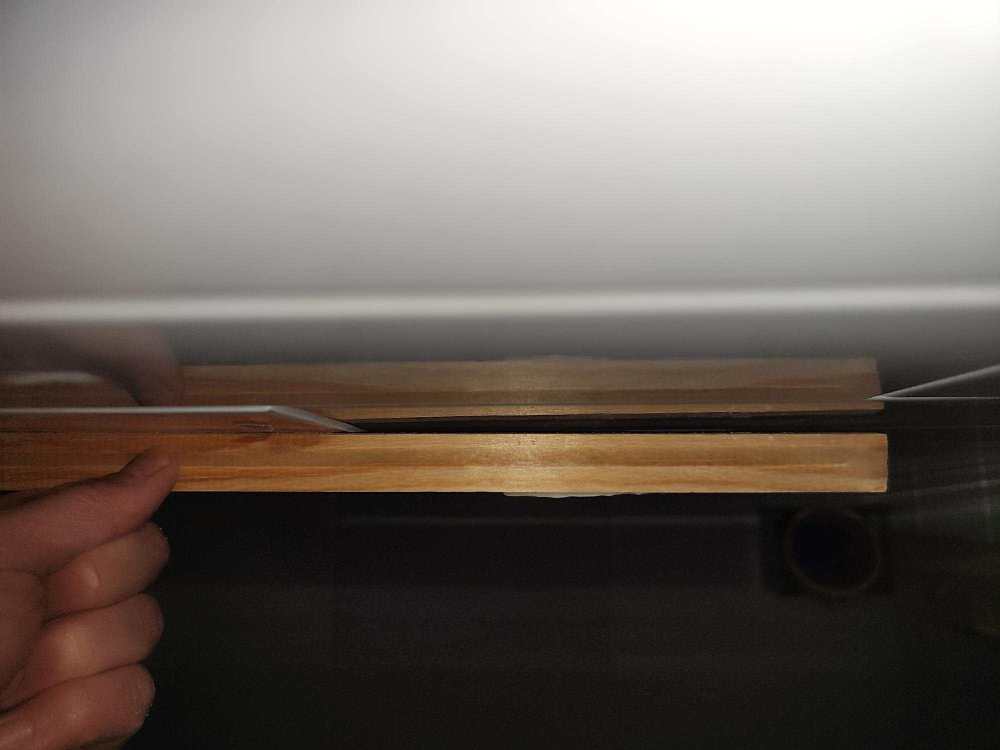
It's hard to get in a photo. Tiles are 300*100. In the second photo below (with short straight edge) the right tile is reflecting the straight edge and the fact the reflection doesn't touch the actual straight edge makes it more obvious.