Thorfun
-
Posts
4891 -
Joined
-
Last visited
-
Days Won
36
Everything posted by Thorfun
-
Rainwater harvesting tank
Thorfun replied to Happy Valley's topic in General Self Build & DIY Discussion
I thought these tanks were sized according to the roof collection area? at least ours has been. it has to, apparently, be sized so that it overflows occasionally so as to 'recycle' the water some times so you can't size it too big. I got quotes from rainwaterharvesting.co.uk and Rainharvesting Systems Ltd and both were pretty comparable in price but I prefer the look of the F-line tank gravity system from rainwaterharvesting.co.uk so will, probably, end up going with them. haven't bought anything yet though so cannot comment on the company but have been very helpful during the quote stage. both suggested between 4,500litres and 5,000 litres systems for our roof size. Also, as we've got sedum roofs we have had to keep the drainage from that out of the RWH tank as well as any water from ACOs. hope this helps. -
Congratulations! and I hope that there was some popping of corks. ?
-
resin bound is permeable (we're planning to have it for our driveway which is SUDS compliant) assuming you have a permeable sub-base that is. it won't be permeable if you put Type 1 underneath it though surely. I can't answer the DPC question really either but logic dictates that it should be no different to any other patio surface.
-
week 2 has finished and the perimeter of our basement has been dug down to the sandstone and it is now obvious how bloody massive this thing is going to be! it really didn't look that big on the plans.....honest! ? we were hoping for more hands and heavy plant on site this week to speed things up but Monday and Tuesday came and went and still the one man and a digger. on Wednesday a second digger came! woo-hoo! but no extra help so we now have one man and two diggers. It seems to have made him more efficient as he doesn't have to get the one digger out of a big hole to load the lorries. Anyway, here's the video of the second week. I hope you enjoy. we did get the 9.5 tonnes of steel delivered for the reinforced concrete and the waterproofing membrane so it gives me confidence that the basement contractors will be starting soon. we just need to get the hole dug and the hardcore/blinding down and the insulation down first. so not much to do then in the 4-day week next week. One thing the video doesn't show is the huge amount of sandstone that has been dug up already and it's only been half the basement. we're hoping to store it all on site and use it to build a stone wall post-build as part of the landscaping. I think it'll be amazing to have a wall built from stone dug from our own land. here's a picture of the current pile of stone excavated. And here's a small piece I have rescued and cleaned up. it is really lovely stone. Anyway, that's about it for this week. fingers crossed this rain that's here as I type doesn't do any damage to our excavations and it clears up for work to start again on Tuesday. As always, thanks for reading.
-
Multiple SVPs to single IC....good idea or not?
Thorfun replied to Thorfun's topic in Waste & Sewerage
I can't do this as it's just a partially dug big hole at the moment! basement contractors are coming in a week to start building the basement so I need to get these details sorted before then. -
are you sure? I thought about 50mm was the minimum for a liquid screed and 75mm for sand and cement
-
I did some research on different brands and ended up deciding on Warema, I then used their website to source local-ish suppliers and got quotes from them. then researched each company and made a choice on that. I can't tell you how they are yet though as we only broke ground a couple of weeks ago. but I'll be happy to review them once they're in, probably about 6 months away.
-
welcome! hopefully with your background you can being a wealth of knowledge to this already knowledgable forum.
-
Multiple SVPs to single IC....good idea or not?
Thorfun replied to Thorfun's topic in Waste & Sewerage
so, I think I'm going to revert back to the original plan that was designed by the civil engineers rather than do as the architectural technician has suggested. I understand the reasoning to reduce the number of penetrations through the basement wall but as there are already 7 ducts I don't see the issue with having one more. but I will have to check those penetrations with the structural engineer anyway. and I kind of agree with @Oz07 in that it feels a little unnatural! I can't put my finger on why though. BUT.....just to counter that, back when we were going to have a foul water chamber and pump the civil engineer did design something like that as all the waste was going through one hole in the wall to the foul water chamber. e.g. so it is obviously a legitimate thing to do otherwise the civil engineers wouldn't have designed it at one point, right? I'm really confused and not sure which to go with. before I tell the AT on Tuesday to revert I wonder if I could get the expert opinion from @Nickfromwales on this one please? in the immortal words of Princess Leia....."Help me Obi-wan-@Nickfromwales, you're my only hope". ?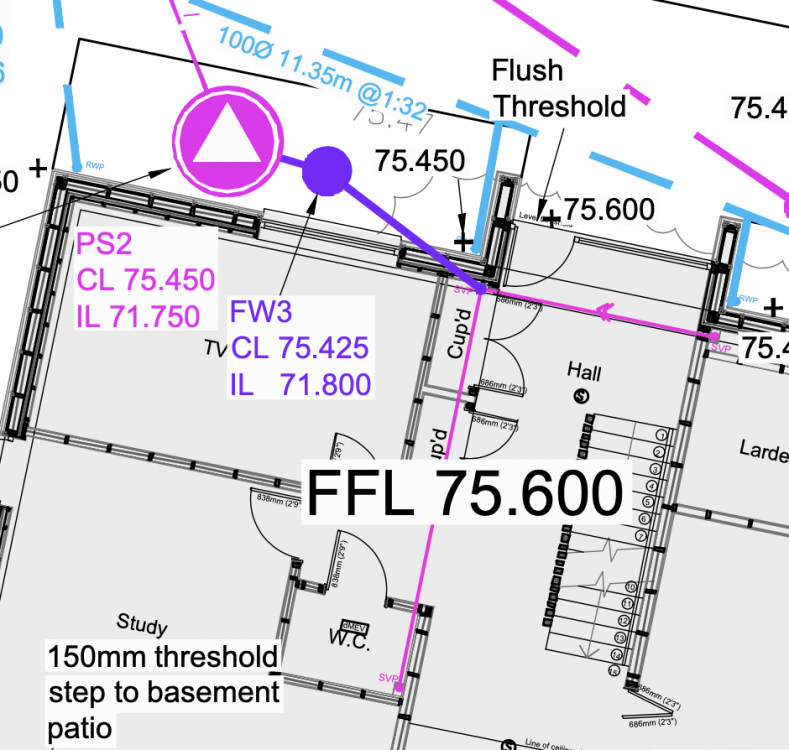
-
Can a slab be too thick to have UFH pipes in it?
Thorfun replied to Thorfun's topic in Underfloor Heating
I am planning on using the conduit. but was going to put them in the conduit before the slab is poured to save doing it later. then I can just fit and forget until I'm ready to wire them up. -
Can a slab be too thick to have UFH pipes in it?
Thorfun replied to Thorfun's topic in Underfloor Heating
5 x 3m 3wire 1-wire temp probes ordered from eBay and delivered ready for installation! thanks. I've told Wunda I only want the pipe for now and they were ok with that. thanks Rob but I've already ordered it. I could probably cancel it but it's done now and I'm on to the next thing to organise. -
Multiple SVPs to single IC....good idea or not?
Thorfun replied to Thorfun's topic in Waste & Sewerage
thanks. it's definitely an option. -
Multiple SVPs to single IC....good idea or not?
Thorfun replied to Thorfun's topic in Waste & Sewerage
tbh I don't know! architects have covered themselves with the NOTE in the drawing but I think the WC foul waste duct will need to be bigger than 150mm if I'm going to slot a 150mm waste pipe through it. I'll need to speak to the groundworkers and basement contractors to see what they say about it all.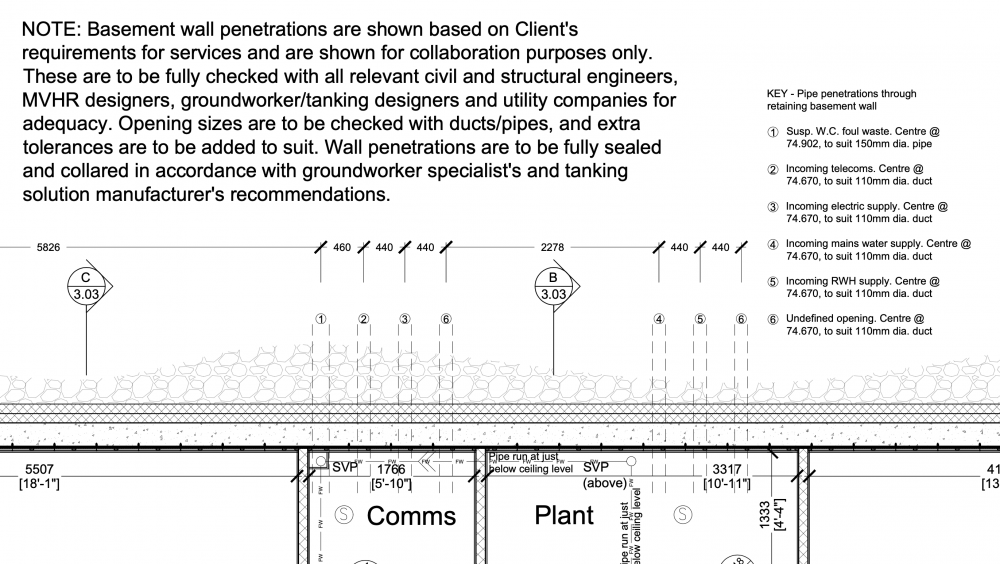
-
Multiple SVPs to single IC....good idea or not?
Thorfun replied to Thorfun's topic in Waste & Sewerage
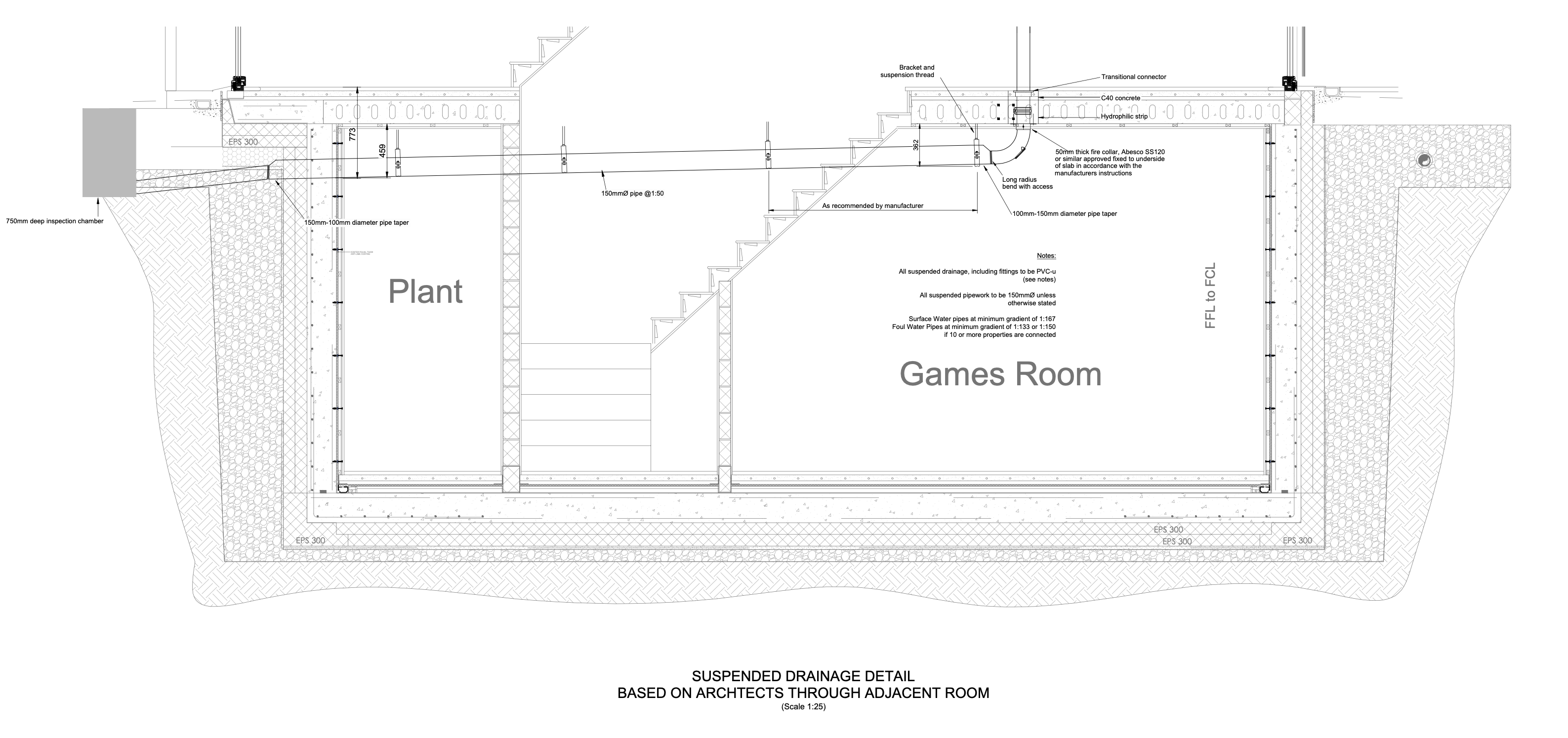
this is the detailing of the pipes going through the basement ceiling and out through the wall. maybe this helps to answer the rodding questions. the ceilings in the basement are 3m high so we do have a bit of room to play with but the level of penetration through the basement wall is dictated by the invert level of the inspection chambers.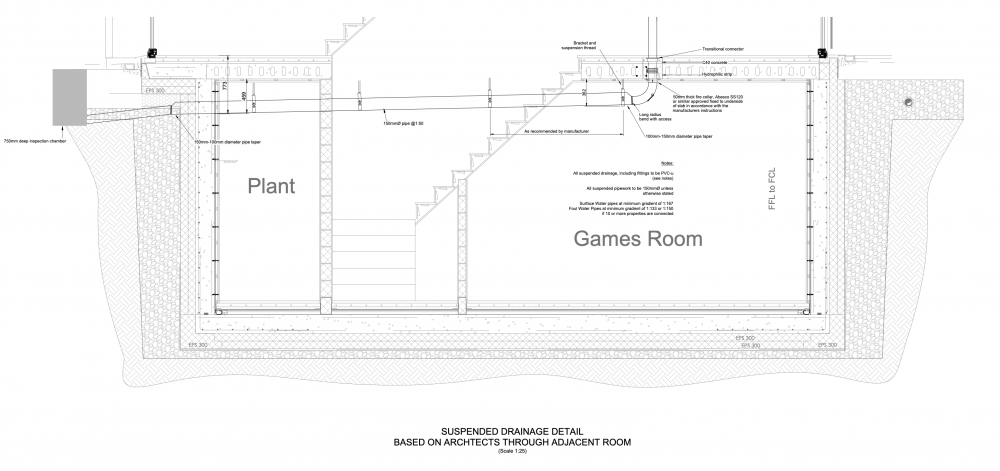
-
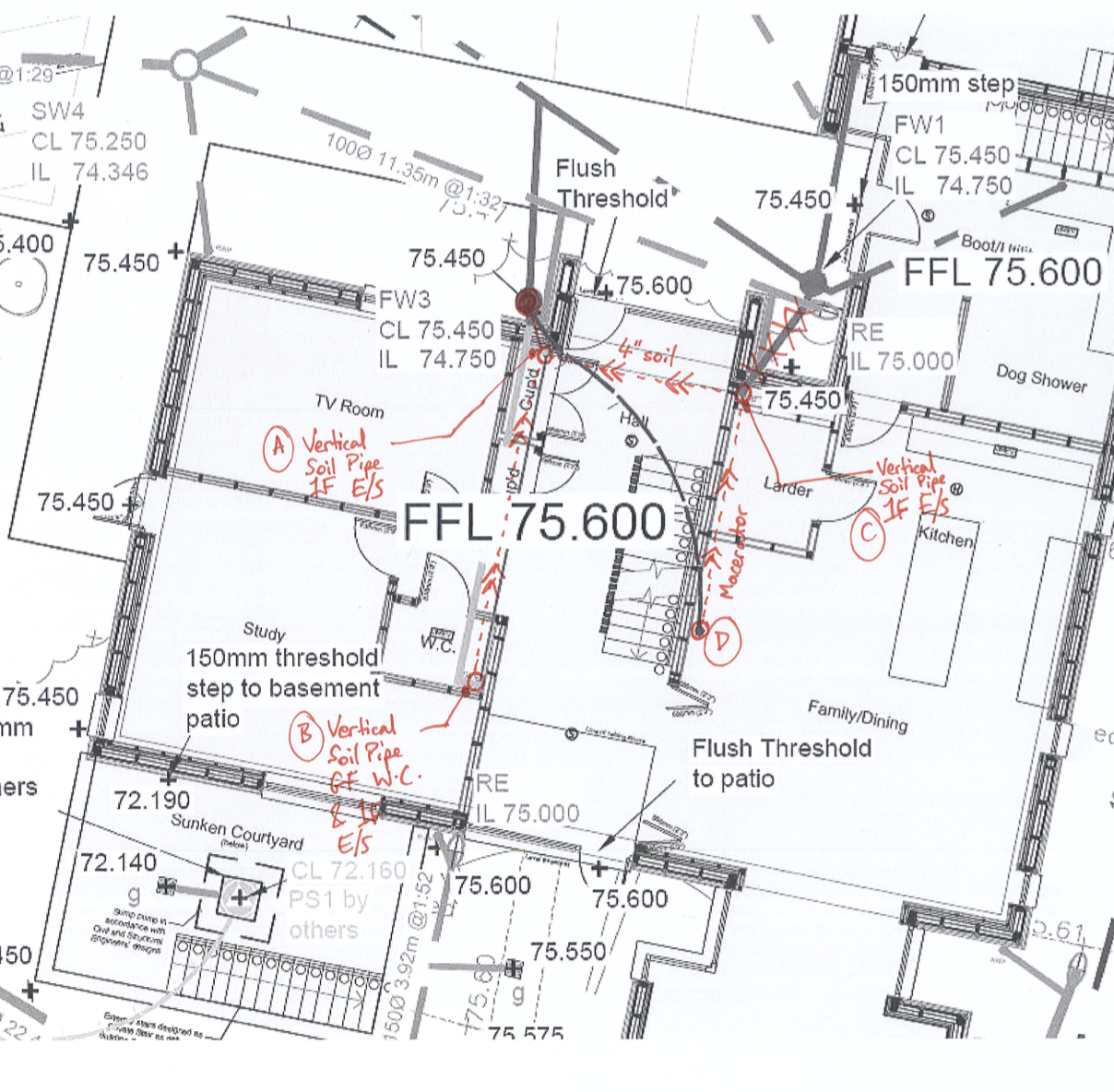
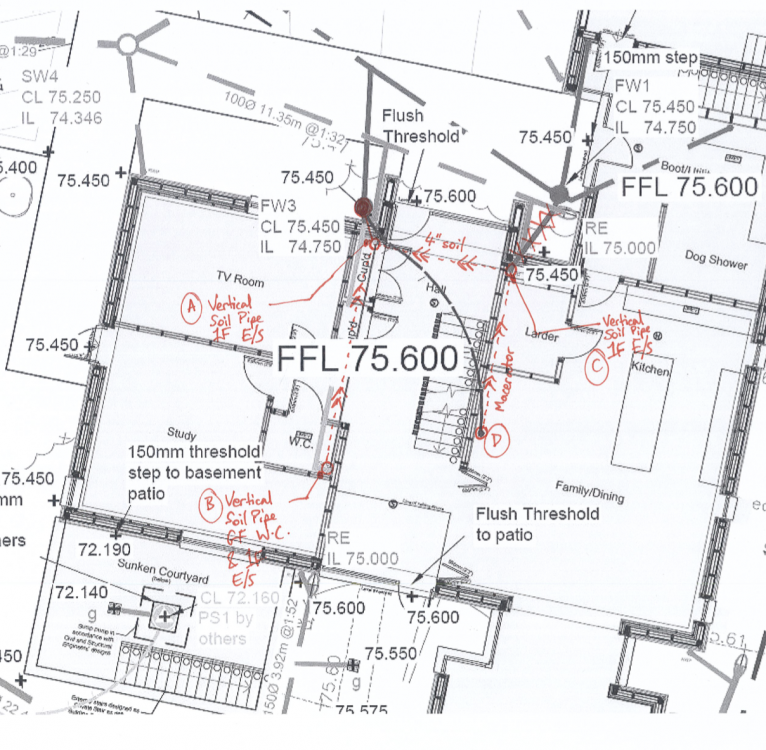
Hi all, just finalising the penetrations through the basement walls and we originally had 2 x foul pipe penetrations to different inspection chambers outside. But the AT has suggested removing one of the penetrations and running all the SVPs to a single IC. was just wondering if this is a good idea or not? it seems ok to me but as I haven't much of a clue about stuff I thought I'd ask those that do. ? Here's a sketch of what's being proposed. hopefully the sketch is pretty self-explanatory but I'll use words anyway. soil pipe A comes straight down from an en-suite above and soil pipe B comes down from another en-suite and then goes through the floor and along the ceiling of the basement to join with soil pipe A. Soil pipe C comes from an en-suite and down through to the basement and was originally going out through the basement to the IC coming from the dog shower and shower room above the garage (the squiggly red line denotes that connection being removed) but now it is going along the basement ceiling where it's labelled 4" soil to join up with soil pipe A. the macerator labelled D is from the WC in the basement which will get pumped up to join soil pipe C as shown, it was previously suggested to pump to soil pipe A. So all of those pipes are now being sent out through a single penetration in the basement to the IC coloured in red. can anyone see any issues with this? or should we revert back to soil pipe C having it's own exit from the building?
-
when we were looking at a corner opening sliders we went to take a look at Solarlux Cero range. they are stunning! but also extremely expensive. We also looked at Reynaers, or rather we looked at rebadged Raynaers from ODC (https://www.odcglass.co.uk), and they are also very nice but I had concerns about the PAS24 compliance iirc. ODC also do Solarlux so it was great for us to visit their showroom as we could see both next to each other. in the end we decided that the cost for the corner opening just wasn't worth it for us and we ended up with having a corner support pole. it will save us many thousands of pounds and I'm sure it will still be lovely.
-
a couple of comments on this thread as I've done a lot of research for our basement that's being dug out as I type.... 1. sounds like you're only having 1 form of waterproofing and that's Type C (Internal membrane and drainage channels). Although that is possible to adhere to some BS number that I can't remember for a habitable basement you require 2 forms of waterproofing (although I believe @Bitpipe only has a single form so it is obviously doable). We decided against ICF for our basement as we feel that RC is easier to get waterproof as you can use Waterproof concrete and see the pour when the formwork is struck (Type B) and we're also going for an external tanking system (Type A) to get the two forms. When the basement was originally planned it was with Type B and C waterproofing but our groundworks company said that the Type A and B system is perfectly good and they're offering a 25yr warranty so I'm happy. also means we don't have to worry about internal drainage and gain a small amount of internal space (not that the basement is small) without having to have that drainage channel in the walls. having said that, the Type C waterproofing is highly regarded and for ICF it should work nicely. 2. our civil engineer also specified a foul water chamber for our basement toilet. this would've had to be 4.5m deep and the cost for just the chamber and pumps was over £5k and then there was installation to consider! after I found that out I asked them to redesign the foul water to make it all gravity fed and the toilet in the basement will have a macerator. a LOT cheaper! and macerators can also be fed by showers so maybe this would be another option for you instead of a deep chamber. one thing you didn't mention is if the basement is open on one side or fully underground as if it's open to one side then you should be able to use gravity as you'd be on a sloping plot.
-
I've just ordered one from these guys as well. the UKPN surveyor suggested them as they're a lot cheaper than other places.
-
?
-
Getting ready for the big start!
Thorfun commented on Thorfun's blog entry in West Sussex Forever Home
£7k. that's Southern England prices (not sure where you are based) and also includes a culvert strong enough to take lorries and cranes. so a normal crossover should be a lot cheaper than that. -
Can a slab be too thick to have UFH pipes in it?
Thorfun replied to Thorfun's topic in Underfloor Heating
I did think about this but the obvious route is under the stairs and as I'm not sure what the stairs will be or how they'll be fixed to the floor (if at all) I didn't want to take the risk of pipe penetration. there's an MVHR extract in the comms room anyway so that should help to remove most of any heat produced. but I'll definitely see if I can figure something out. -
Can a slab be too thick to have UFH pipes in it?
Thorfun replied to Thorfun's topic in Underfloor Heating
so, when it says 'Gym' what it really means is a golf studio. I'm definitely not a gym person but I do like to swing a golf club so the plan is to have a net setup so I can practice during the winter etc. your point is also valid for the music room as when the band rehearse in there it will also get a bit warm with the amps running etc. as such, I am tempted to zone the basement and pretty much just turn off all the rooms except the games room as the equipment/activities in the other rooms will heat them. Also, as previously mentioned, the pipe is about £500. even if I never use it that's a small amount to pay for peace of mind. interesting. hadn't thought of this. will take a look (although not sure how to do it in LoopCAD as I've only been using the standard auto-layout feature!) and see if I can figure it out. -
Can a slab be too thick to have UFH pipes in it?
Thorfun replied to Thorfun's topic in Underfloor Heating
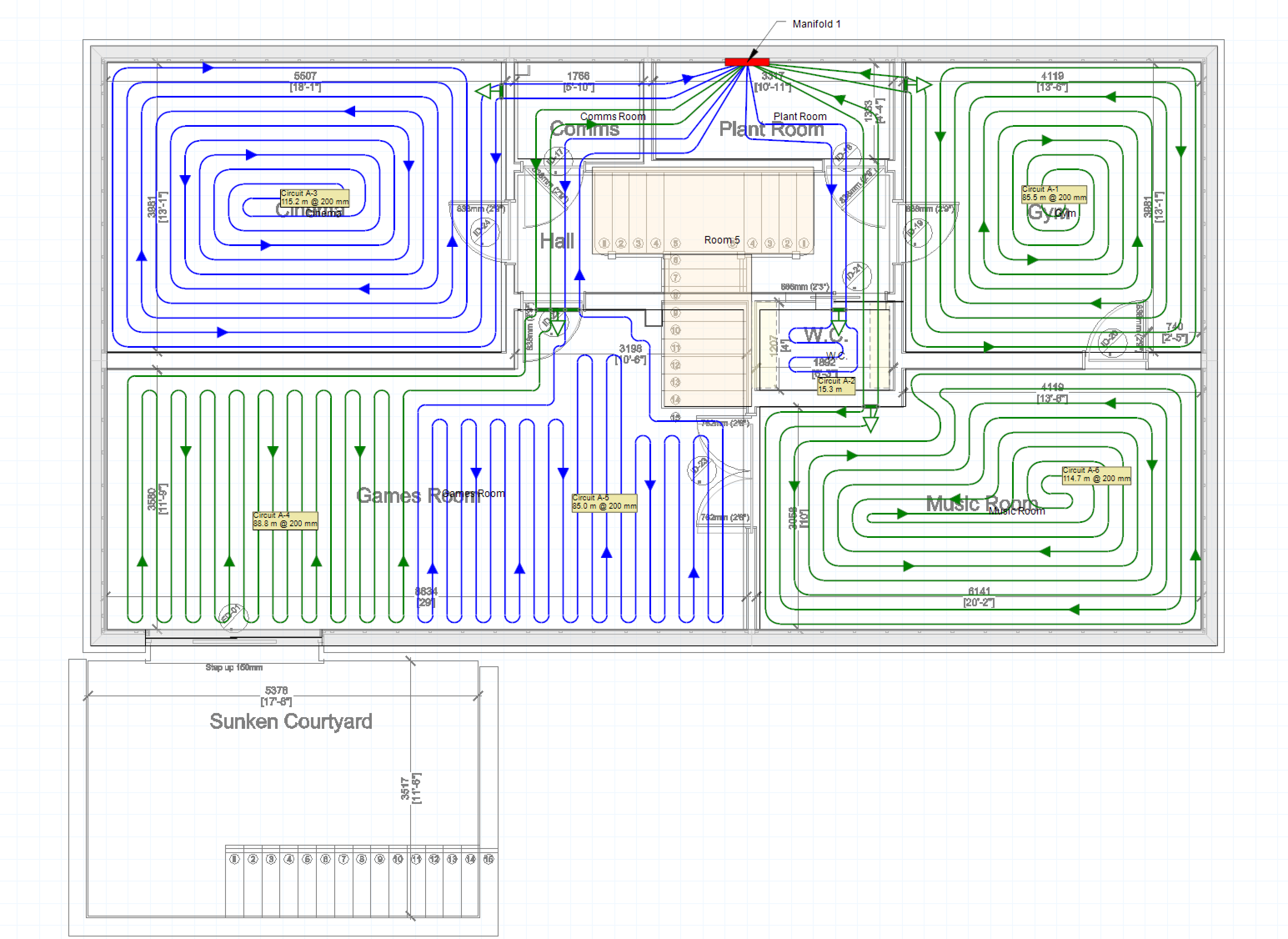
put my plans in LoopCAD and came up with this: I'll see how it compares to Wunda's design but I'm pretty happy with what I came up with. doubt I need that loop in the WC but I figured what the heck! was going to put 1 x temperature probe in each of the 4 main rooms just in case I decide to zone the basement. I ordered 5 of these at 3m length. it'll do me for now. ps. all the internal walls are block so no penetration of the slab is required. which is why I'm comfortable running pipes under the walls in places.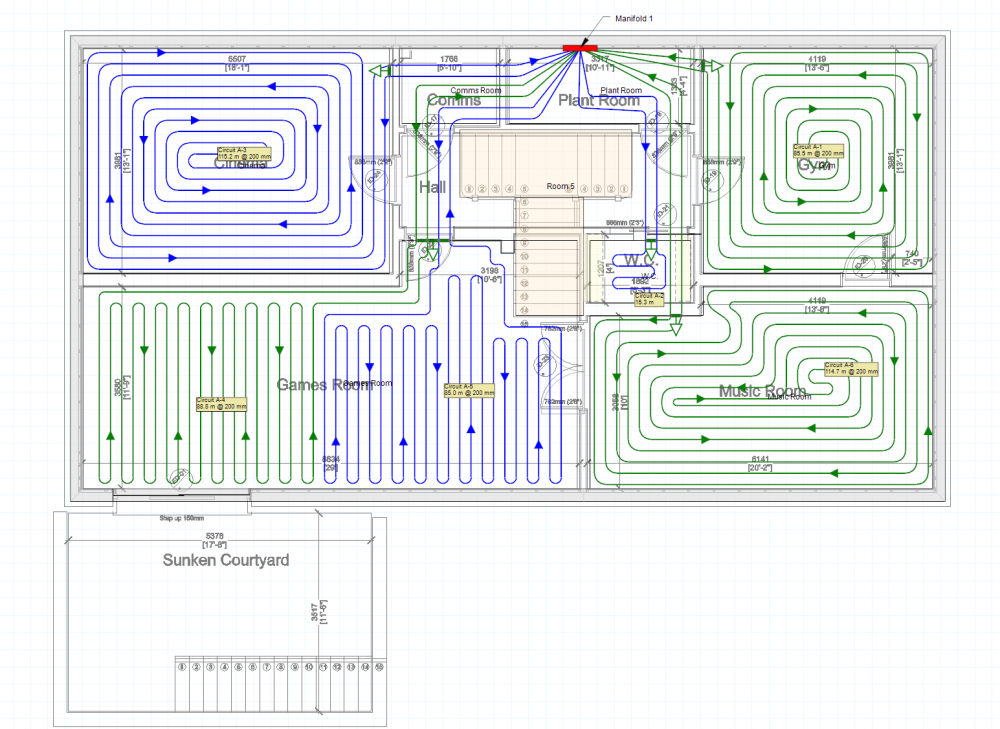
-
Can a slab be too thick to have UFH pipes in it?
Thorfun replied to Thorfun's topic in Underfloor Heating
so after reading this article https://www.best-microcontroller-projects.com/ds18b20.html it seems that the benefits of using parasitic power is that you only need 2 wires for the sensors but it says you need a pull-up resistor but I presume that the Loxone 1-Wire extension has that all covered. so using parasitic power requires on one twisted pair on a Cat6/7 cable leaving the rest spare for other uses but using separate power means you have to use another wire from another twisted pair. the article does mention about delays when using parasitic power due to during a strong pull-up action no other communication can be made over the one-wire bus. so maybe if you have the spare twisted pair in your cable then separate power is the way to go. -
Can a slab be too thick to have UFH pipes in it?
Thorfun replied to Thorfun's topic in Underfloor Heating
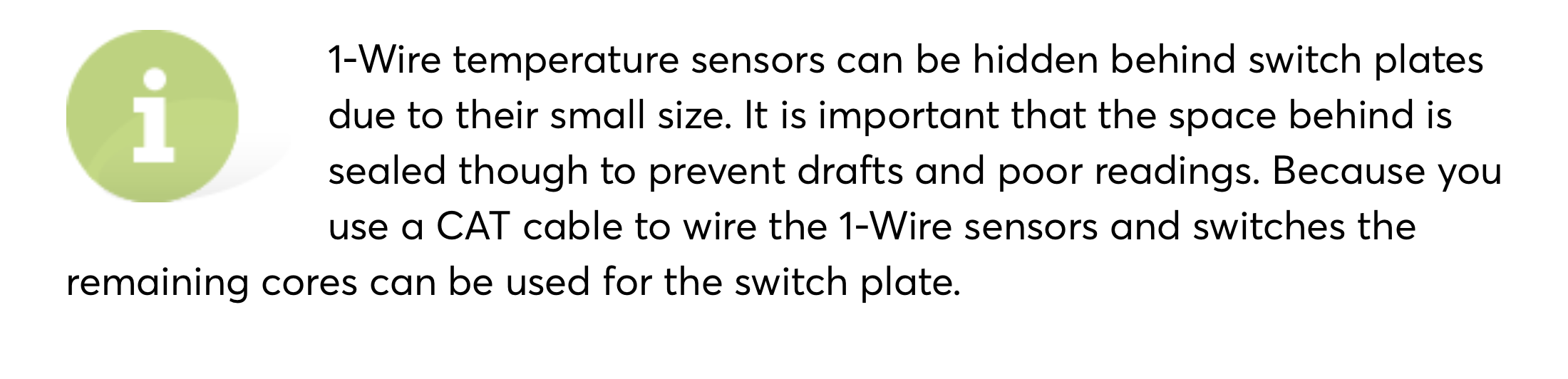
thanks @jack. I did see those ones on Amazon but they're only 1m cable length which seems a little tight to me. It's interesting that you mention powering independently rather than parasitically helps. I am just doing more reading on 1-wire and was interested to know the benefits of one over the other but I've yet to get that far in my reading. I think I'll go for the approach of bringing a conduit near to a wall with back plates. those back plates could always be switches and Loxone seem to say that you can then use the other pairs of the CAT 7 cable for the switches. from https://www.loxone.com/enen/kb/wiring-1-wire-devices/ that @Dan F linked previously.... so was thinking of running the probes to the location where the switch plates would eventually be. seemed quite a sensible idea.