Thorfun
-
Posts
4891 -
Joined
-
Last visited
-
Days Won
36
Everything posted by Thorfun
-
thanks. I'm still thinking about using the airtight board instead of fabric to be honest. the architect has detailed for the airtight board as I said I was going to use it but I can easily swap it out for normal OSB if I choose to go with the membrane instead. will need to run the costs in a spreadsheet for that one but will definitely have the membrane between floors.
-
thanks, that's good to know. it seems that airtight membrane all seems to do a very similar job and it's hard to know if the really expensive Proclima stuff is worth the extra cost over the cheaper alternatives. more research is required!
-
I found this https://passivehousesystems.co.uk/product/scrim-reinforced-airtight-membrane/ online. this seems like the right thing to use around the block and beam and the stats show a much greater tensile/tear strength. anyone used it?
-
@Bitpipe qq. do you remember which airtightness fabric you used?
-
this is what my Groundworker said. he said if you're having hollow core then he'll go around after and core the openings as they're never in the right place in his experience. if you want a job done properly....do it yourself. ?
-
thanks and there are many other things I can lose sleep over. ? we are having an extra layer of insulation internal to the timber frame. planning on 140mm mineral wool between the timbers and 80mm PIR internally all covered in VCL/airtight membrane. seems to be a pretty standard make up for self-build TF these days.
-
sounds like my own company "Bodge-it and Leg-it Ltd"
-
it's more the tools required to create those holes rather than whether the holes would be allowed for me.
-
I'd rather over-engineered than under-engineered! plus, I'm not an engineer so unless I then pay for a second SE to double check the work of the first SE I have to trust the engineer. and I chose a very well respected on this forum SE and I am very happy with their work and support.
-
I've made the decision to go for block and beam instead of hollow core slabs now. Reason is I just know I'll make a mistake with the openings/penetrations and will forget something and the thought of drilling through the slabs fills me with dread. at least with block and beam I can remove a block to run pipes and cables I'm hoping block and beam will be cheaper as well.
-
I did ask if EPS 300 really was required as @Bitpipe has EPS200 and the answer was a resounding yes from the SE so we have done as designed. some form of render board might be a possible solution, also some on here have used metal of sorts (iirc) but as that detail is a long way off it's quite a way down in my list of things to research! it is a very long list.... ? our design doesn't have that stuff shown outside on the MBC twin wall system as we're not having a twin-wall system. simple open panel timber frame for us but still sitting on an insulated slab.
-
the groundworks company we're using have subcontracted the basement build out to a construction company that specialise in basements and they've brought their own formwork to site. it's all under a fixed cost so I'm very hands off on this part of the build.
-
dense under the slab as designed by the structural engineer and normal outside the walls as they're not taking any compressive loads, again as designed by the structural engineer. I assume you mean the small amount that is above ground? if so, I'm undecided on that one as yet but I believe there are many ways to do it and I'm pretty sure it comes down to personal taste (or planning requirements if they've mandated something).
-
200mm EPS300 for me. after calculating the U-value when taking the depth below ground in to consideration I decided that 200mm was enough. we also only 250mm thick walls. it's interesting how similar builds can have such different structural calculations! exactly what we're doing except we've got EPS100 on the walls. don't know why not EPS70 though before you ask. ? the membrane covering our flat EPS300 is part of the total waterproofing system which wraps the basement underneath and up the walls.
-
didn't realise you had the twin-wall system. also, you have timber joists between the basement and ground floor so the airtightness fabric wouldn't take as much of a beating as it might with block and beam so would be less likely to be damaged during the joist installation.
-
yep. just the spacers at, I presume, 600mm centres. so very much reduced cold bridges. I'm also interested as to what the stuff outside the envelope is for! no worries about the basement, I'm very happy to have people challenge/question what we're doing as it's good to have extra eyes checking for stuff. ?
-
I had a quote from Rhys when I was considering ICF. went to a site to see his work and it was impressive and the quote was pretty good as well. in the end I decided on RC rather than ICF though.
-
could save a lot of money doing it yourself! I thought about it, hiring a big digger and digging the hole but when I saw what 4m deep dig actually is I'm glad I left it to the professionals. I'd say digging that deep is definitely not for the faint hearted. and then I didn't want to be responsible for the main structure holding up my house so, again, decided that this part of the build should be left to those that know what they're doing and that's before I consider the time it would've taken me and the wages I would've lost as I'm self-employed so, all-in-all, I'm very glad I'm not doing it myself.
-
it's actually tough to separate the basement from what the foundations would've cost without it. but total cost for all foundations and basement is £180k. I actually think that without the basement the foundations would've been about £40k - £50k as we'd have to dig down 2m to get to bedrock anyway so I think the basement bit is coming in at about £1k/m2.
-
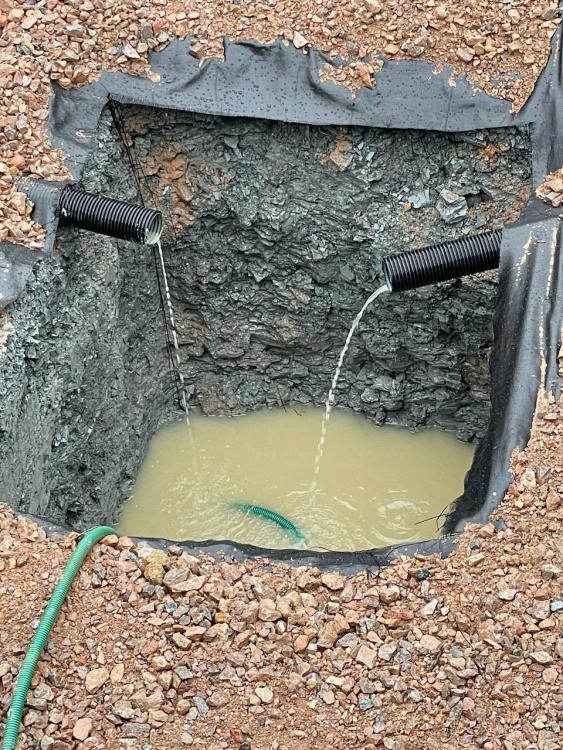
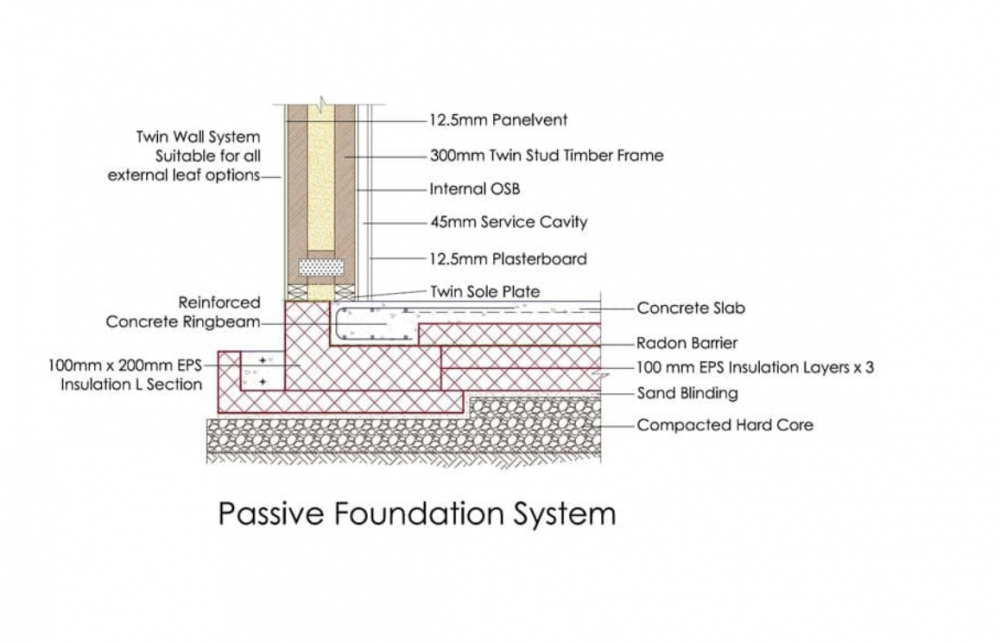
assuming you're talking about the MBC twin wall system? if so the inner sole plate takes all the load from the house and the outer sole plate is there for the outside of the wall to hold all the cellulose insulation. quite a few on here have this design (and not all from MBC) and it does work. There isn't a cold bridge at the sole plate either as the entire space between the outer and inner sole plates is filled with blow cellulose. personally, if I had the extra money I'd have gone for this over the open-panel system with me fitting the insulation in a heart beat but I just couldn't afford it. yep, lots of waterproofing. 2 types in fact. Type A external membrane and Type B waterproof concrete. There's also a land drain around the perimeter which is working well and filling the sump we've dug constantly. here's a photo of it working. also a tonne, or rather 9.5 tonnes, of steel in the RC slab and walls. it is on the drawing but I removed the text detailing it as it wasn't pertinent to the question I was asking and didn't want to confuse matters!
-
thanks for this. I'll definitely investigate it further never heard of Wufi before but a quick Google has told me what it is. Every day is a learning day! ?
-
thanks and glad it's not just me! I could potentially bring the insulation up past the sole plate but it'll have to somehow have a cutout for the osb. I'll have a think about it and what it might impact and, maybe, speak to the architects. but maybe it's just a detail too far. ? standard external detail tbh. frame, osb, breathable membrane, battens, cladding.
-
thanks and it's starting to make more sense and I certainly wouldn't want decay on the sole plate. but I'm confused as I'm sure I've seen lots of sole plate details on here and, iirc, they're all the same as the one in our drawings. even the MBC passive slab and twin wall detail has the outside sole plate in the same way as mine. so, what is the solution here and are loads of timber frames soon to be the victim of decaying sole plates?
-
can you supply a bit more detail about this please as I don't fully understand what you mean?
-
there is a land drain around the basement , I just excluded it from the drawing when I took a screenshot! the external EPS goes all the way to the sole plate. are you suggesting that the sole plate should sit partially on the EPS? thank you. I will research rubberised VCLs