ToughButterCup
-
Posts
11716 -
Joined
-
Last visited
-
Days Won
98
Everything posted by ToughButterCup
-

Sooooooo close, so very close.....
ToughButterCup replied to ToughButterCup's topic in Roofing, Tiling & Slating
On the building, firmly strapped down. Yes, it'll take a few heaves and swear words to shift it, but four of us.... and a few beers and the job'll be a good-un. -
@Hecateh, in every build there's one or more 'Oh Dear' moments. And often money is the core of it all. This was ours. At this remove, its hard to say anything constructive because whatever we write it could easily sound vacuous or trite to you. But we can say with complete accuracy, you have all of us listening, and looking for practical ways in which we might help. Debbie and I have in part recovered from the shock of our hiccup, but the knock-on effects of it have taken us not far off nine months to process. We have had to adjust our expectations and look for ways to soften the blow. Now, when we think back to what happened, we just grizzle a bit, shrug and go down the pub. There will be a way of getting through your hiccup: it'll take time to see it. Keep posting, keep in touch.
-
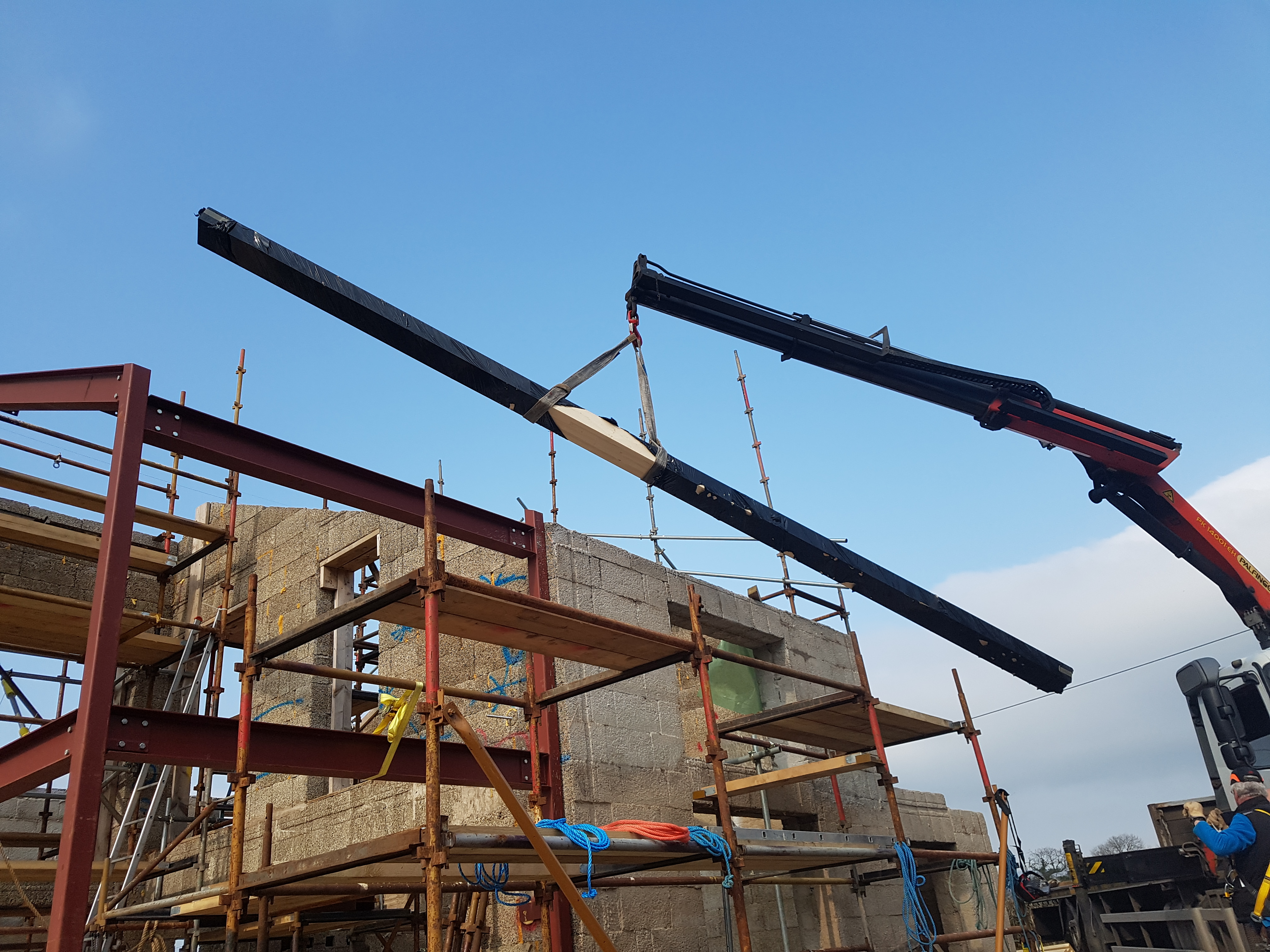
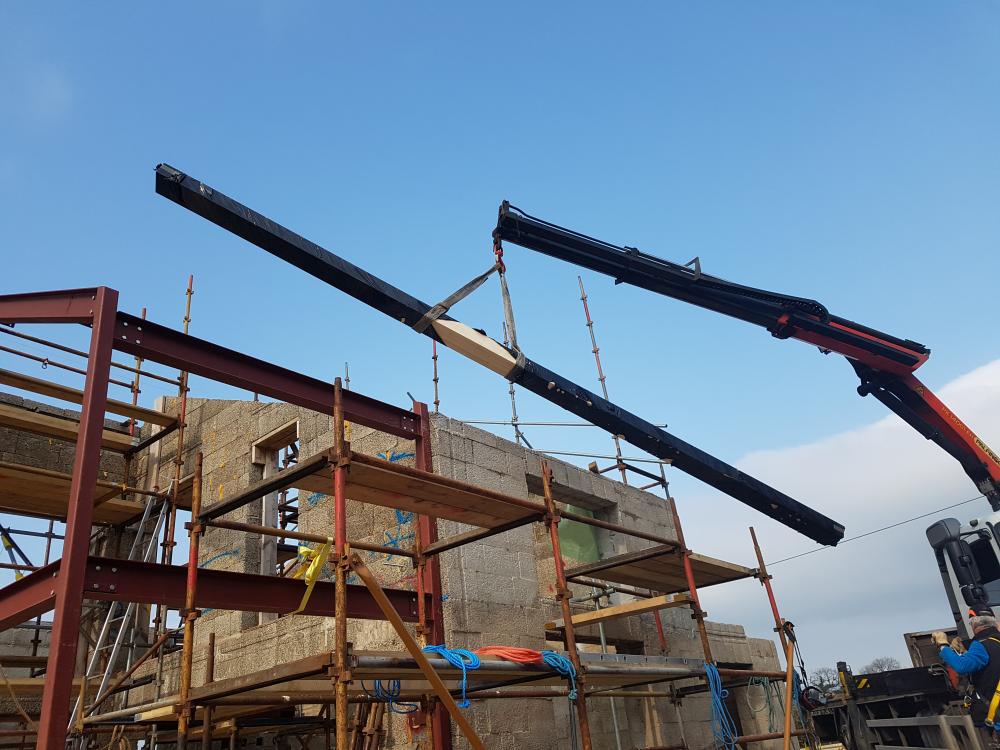
Jeff, from Haldane Fisher, Garstang did his best, his very best, but.... He got the beam to within a meter of it's seating , but just couldn't manage the last bit. Know the feeling? Me too. ( @Onoff, shut up) So there it rests for the night, a meter or so from it's sweet spot. Ahhhhhhhhhhhhh. Here's the twist. "If ya 'adn'ta put that stoopid scaffold in't way lad, that'd a got it reet. " Said the HIAB driver. That'll teach me to prepare for the worst and put a scaffold up just in case we couldn't find a handy crane. Just exactly where Jeff didn't want me to put it. Foxtrot. Hats off to you Jeff, from Haldane Fisher! You did your best
-
Specifying our roof; cement board and OSB3
ToughButterCup replied to ToughButterCup's topic in Roofing, Tiling & Slating
Oh foxtrot. -
Specifying our roof; cement board and OSB3
ToughButterCup replied to ToughButterCup's topic in Roofing, Tiling & Slating
@HerbJ, @Russell griffiths, @Alexphd1, @Pete; it's a matter of fireproofing. We are having shakes for the final roof covering: (not the shakes ! ) and they will be treated with Non-Com Exterior fireproofing. From the email; ' .... Just to confirm that [the BCO ] has looked through the Non-Com Exterior fire certification and has confirmed that the use of it on the shakes/shingles along with 6mm fibre cement board would be satisfactory for for fire resistance. ...' Ours is an open, vaulted roof. The space between the rafters ( they are 9 by 2s ) is fully filled with (yet to be decided) and underlaid by a further 82.5mm of insulation, and then skimmed to finish. The thing is: given that we need to put cement board just under the counter battens, aren't we going to have to seal the gaps between the cement board ? -
Specifying our roof; cement board and OSB3
ToughButterCup replied to ToughButterCup's topic in Roofing, Tiling & Slating
Thanks Pete, Which type of cement board? We are using 400mm centers. Sorry to be so thick.... -
Specifying our roof; cement board and OSB3
ToughButterCup replied to ToughButterCup's topic in Roofing, Tiling & Slating
Fire-resistance. From the OSB3 up 6mm cement board counter battens some form of breathable membrane battens shakes The cement board is for fire-proofing. I'm at the bottom of a very steep learning curve on what cement board can and cannot do. There are many questions; for example can cement board be fitted ' as is ' or do I have to waterproof the fixing holes ? Does cement board need special fixings? Do I have to seal the gaps between the fitted cement boards? If so, with what? Which cement board should I fit: water resistant, or waterproof or ' normal ' ? Which brands of cement board have we (BH members) commonly used? -
New member, looking forward to building first house
ToughButterCup replied to Youngredders's topic in Introduce Yourself
Welcome to the 'club. We are building our forever home too. We are about 4 years in to the process; we recently needed to remind ourselves of the level of enthusiasm you have. Hang on to it. A self-build is a marathon. Nobody on BH knows everything. And I think it's fair to say that the less you know, the more help you get here. Just ask away, the more targeted the question, the easier it is for us respond. Good luck ian -
Slowly the specification for our roof is emerging from the mist that seems to swirl around at that level. It has been suggested ( in the words of the architect, ' ... or similar...') that we use 11 mm OSB3 and 6 mm cement board. That's easy I thought, look up what it costs on Tinternet and buy some. Well Stanley, here's Another Nice Mess (steep learning curve) I've Gotten Myself Into. Partly caused by the usefully ambiguous architect's phrase 'or similar' 2 hours in to digging around on YT, Google and other murky bits of the Internet I realise; OSB3 is water resistant - but what does that mean (it needs covering during boarding if it rains) OSB3 ' ...or similar...' could mean what? cement board can also be waterproof or water resistant : have you seen how many types of cement board there are! Which should I get? I have learned the hard way that architect's specify top-performance stuff. OK, fair enough. Could you help me specify something sensible in terms of 11mm OSB3 or something with the same performance, and suggest a sensible 6mm cement board, please? Yours, Semi - Irritated of Lancaster.
-
Doors and windows fitted. A few issues.
ToughButterCup replied to Nestor's topic in Windows & Glazing
Have you paid the installers yet? -
Isolated Houses in the Countryside
ToughButterCup replied to ToughButterCup's topic in Planning Permission
And the decision (judgement) focuses precisely on that issue. The Learned Judges make the point that planning decisions should not be pernickety, seeking to parse every word. ' ... the court must avoid the mistake of treating the policy in question as if it had the force or linguistic precision of a statute – which it does not – and must bear in mind that broad statements of policy do not lend themselves to elaborate exegesis. ... ' which I see as a sensible decision. Very down to earth. Further ; ' .... Nor will [the court] engage in – or encourage – the dissection of an inspector’s planning assessment in the quest for such errors of law. Excessive legalism in the planning system is always to be deprecated. ...' To use a risky term, the court appears to have delivered a healthy dose of common sense. And thus a chink of hope for those who have been frustrated by LPA decision makers who take refuge in dissecting the meaning of key words - often to their perceived advantage. Take the word sustainable for example. -
25mm, an opportunity or a problem?
ToughButterCup replied to ToughButterCup's topic in Heat Insulation
Thanks for your help folks. I feel a conversation with the architect coming on. And it doesn't help that sarking means different things to different people -
Mindful of the fact that there are a good few on BH who have yet to obtain planning permission, I'd like to draw attention to a well written synopsis of a recent judgement concerning isolated dwellings in the countryside. The author , Martin Goodall , has a particularly readable written style, it is well worth reading in full. The meaning of the word isolated is important, The LPA had challenged an Inspectors decision : he had allowed an appeal against the LPAs decision to refuse permission. The decision hinged in part on the interpretation of the term isolated. The LPA and Inspector understood the term to mean different things. The LPA took a more functional approach relying on map data, the Inspector sought to examine more than simple map evidence. ' ...Lindblom LJ’s observations on the boundaries of a settlement are particularly interesting, and clearly envisage a more flexible approach in this regard than the rigid adherence to designated settlement boundaries that LPAs commonly seem to adopt. ...' (Goodhall 2018, downloaded April 2018) (Emphasis added) I understand that locally (the Fylde Coast) appreciable numbers have been refused, at least in part, on the grounds of isolated development. To those affected, the article, and perhaps the full judgement (reference in the article) bears careful examination.
-
25mm, an opportunity or a problem?
ToughButterCup replied to ToughButterCup's topic in Heat Insulation
Sloping sarking. We have a flat roof too, but one roof at a time will ding dang do for me.... -
Our rafters are 225 mm by 47mm. The insulation specified is 200 mm of Kingspan K7 between the rafters (underlayed by 82.5 mm of K18 ) Hence the 25 mm issue. And the 82.5 mm issue I suspect. Architects are like that aren't they? I have 225mm of rafter to fill: should I leave an air gap? (I bet the answer is No) should I fill the gap : 100, 100, 25 and then underlay it all with 60 mm K18 (not 82.5 mm as above) Or do something more intelligent? Which is where you come in.
-
What he really means is; Put them in my skip please.
-
Preparing to lift the roof beam without a crane
ToughButterCup replied to ToughButterCup's topic in Roofing, Tiling & Slating
Give the driver some well-used notes -
Preparing to lift the roof beam without a crane
ToughButterCup replied to ToughButterCup's topic in Roofing, Tiling & Slating
Swallows arrived today: it's all going too well, innit? -
Preparing to lift the roof beam without a crane
ToughButterCup replied to ToughButterCup's topic in Roofing, Tiling & Slating
Of course, it helps greatly when, during a delivery this morning, the driver of the 20 tonner with a HIAB, from the local timber firm (PM for details - a large well known national company) mentions casually ............ "When we deliver yer wall plates on Wednesday, I'll pop that beam on the ridge for ya, mate" If there were an emoji for the Hallelujah Chorus I'd use it. -
A sense of humour.
- 13 replies
-
- 2
-

-
- specification
- wish-list
- (and 1 more)
-
What is an acceptable standard of skimming
ToughButterCup replied to AliG's topic in Plastering & Rendering
And We all need to know a @nod, who knows a Russian taper, who knows a ..... and so on and infinitum. For me part of the issue is having the guts to be and the knowledge skills to spot poor work in progress. And the balls to draw it to the workman's attention. "And what the Hell do you (I) know about it?" -
Preparing to lift the roof beam without a crane
ToughButterCup replied to ToughButterCup's topic in Roofing, Tiling & Slating
We intend to raise the beam up the outside of the tower with the digger and put it on the top working level. Yes, the tower will be tied into the house with separate bracing scaffold and or two-tonne strapping. We intend to make a series of vertical holes in the concrete , each the diameter of a piece of rebar. As we raise the beam (as you say) Alaskan style, we'll drop in a piece of rebar so that it's held fast by it's own weight. As to needing a winch from gutter level, ..... we have an internal scaffolding tower (on casters) so we can lift the beam by hand and meter or so each time, dropping a piece of rebar behind it in a series of pre-drilled holes. Planks are at the ready as a skid. -
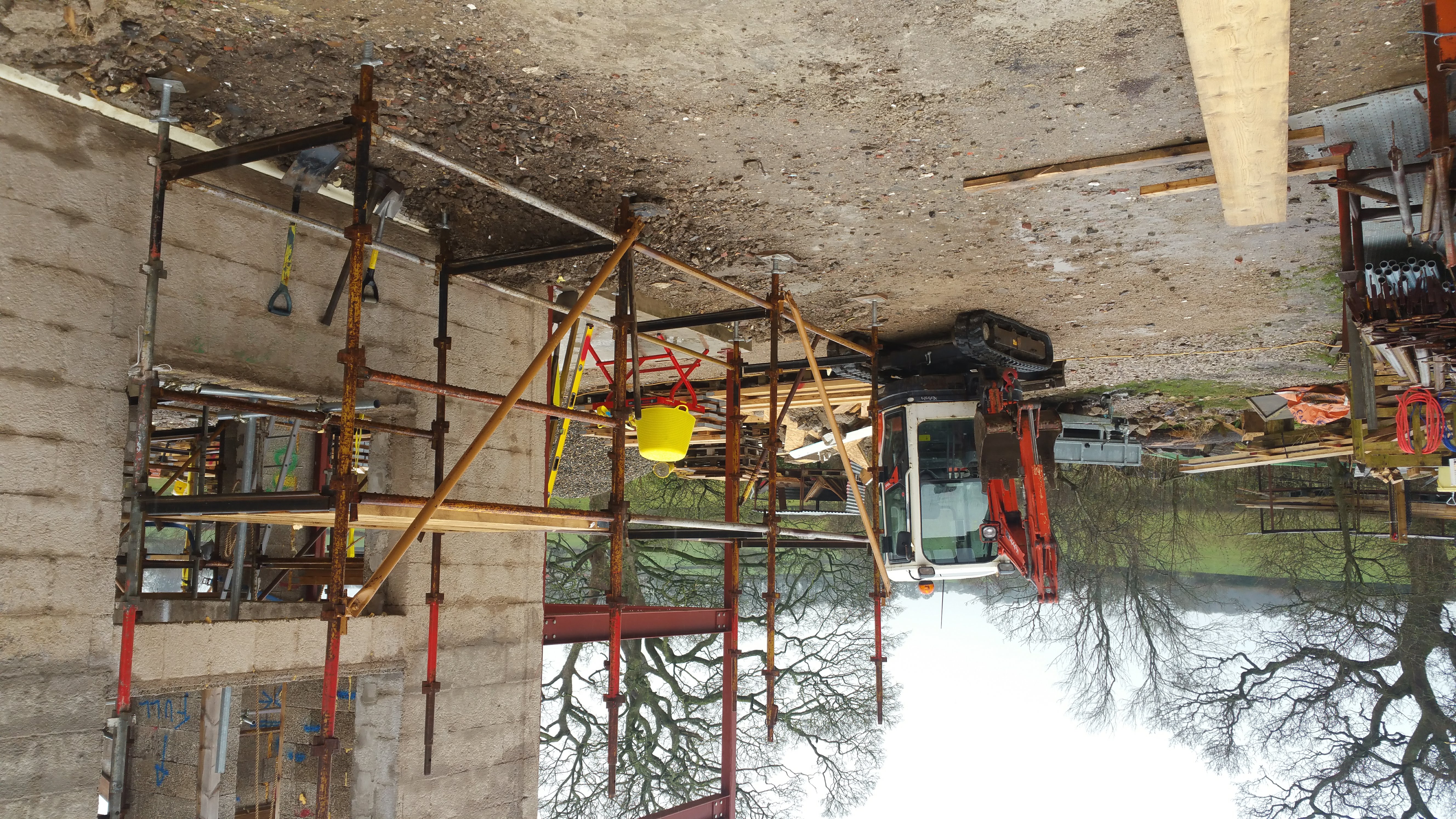
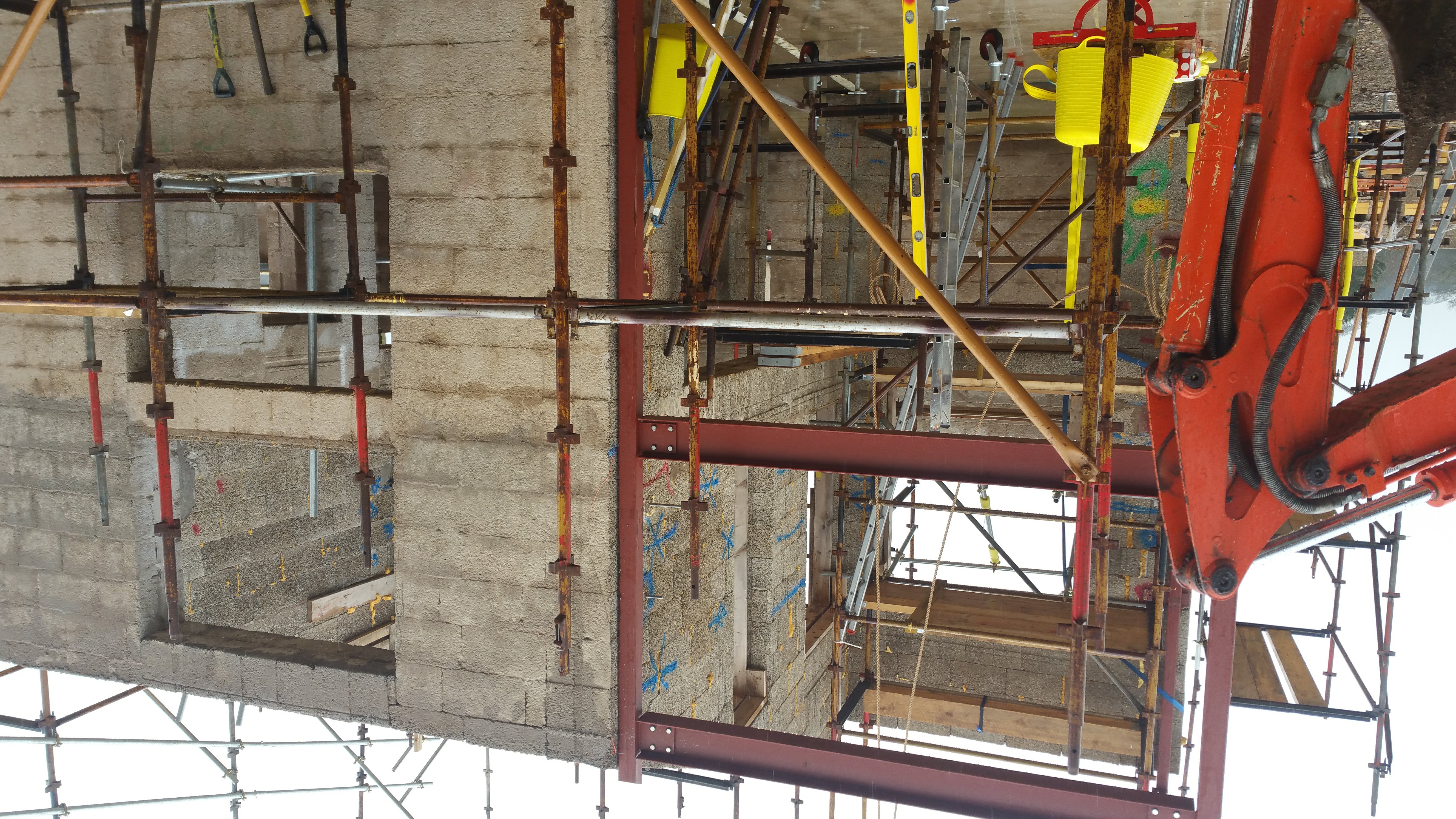
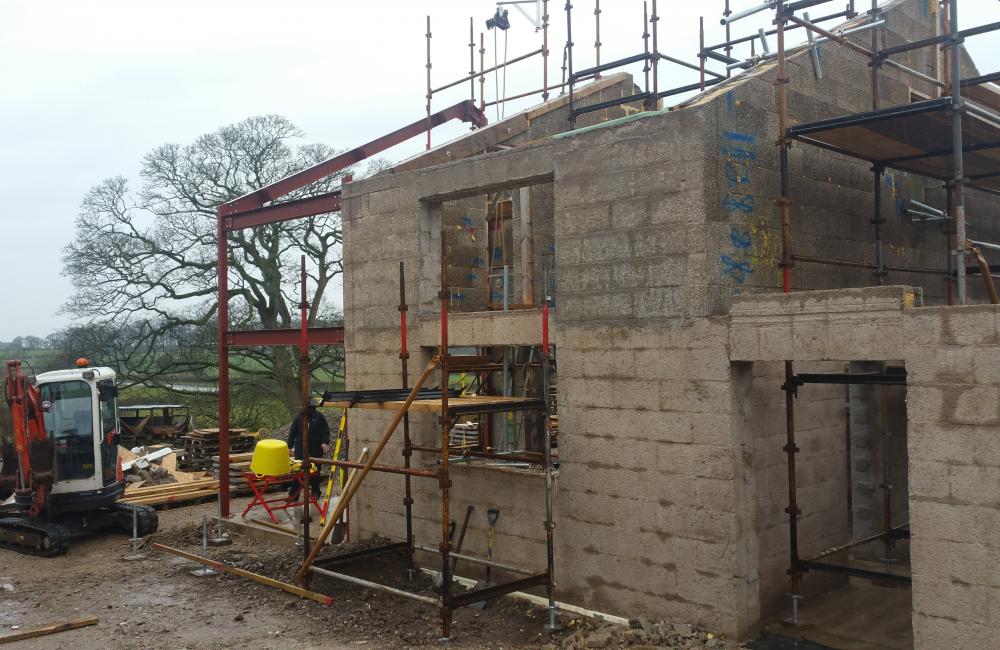
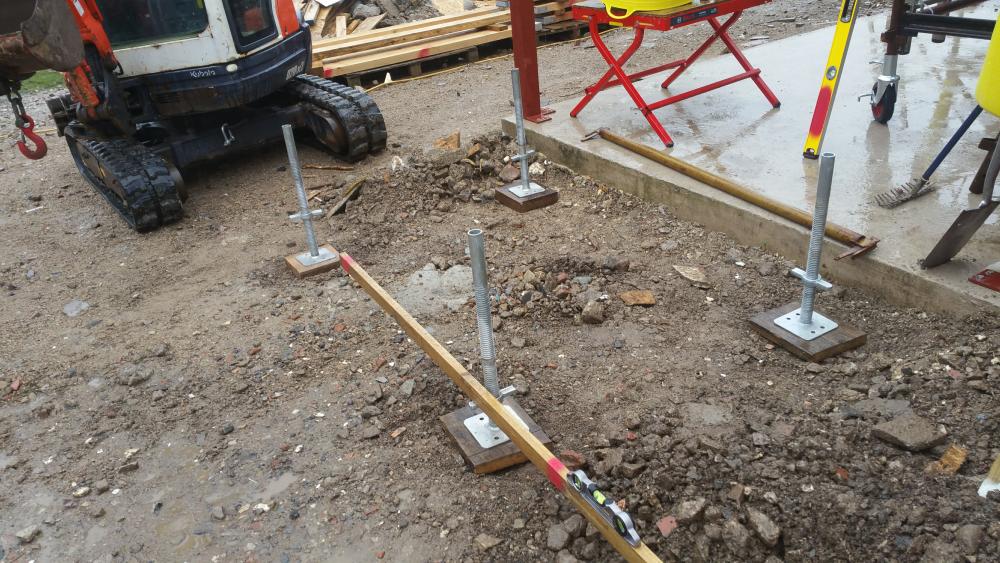
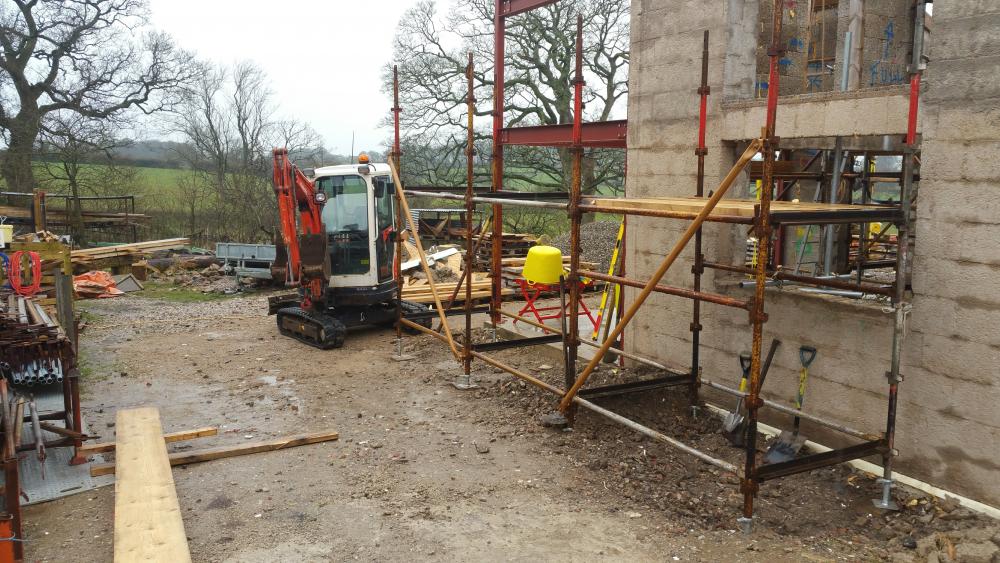
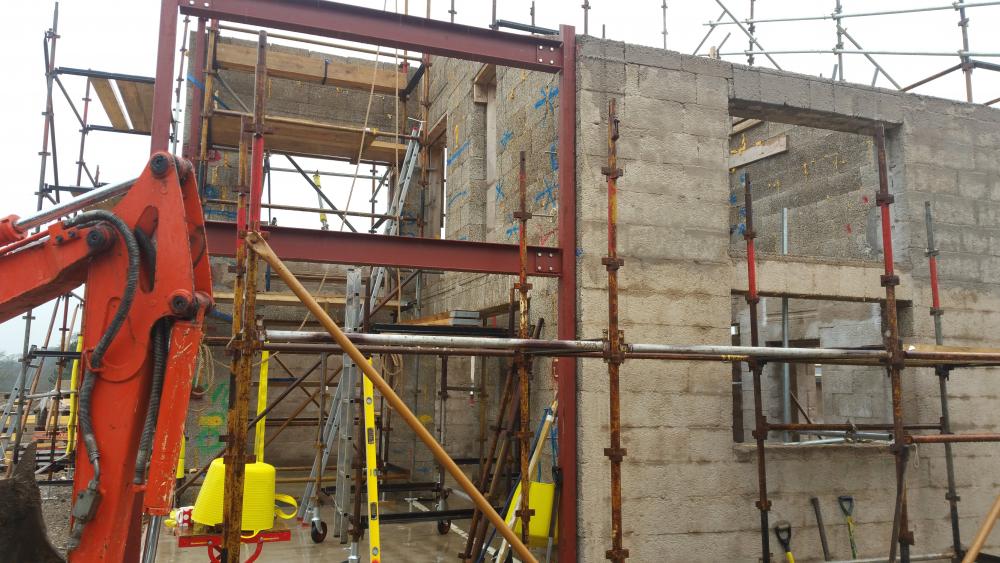
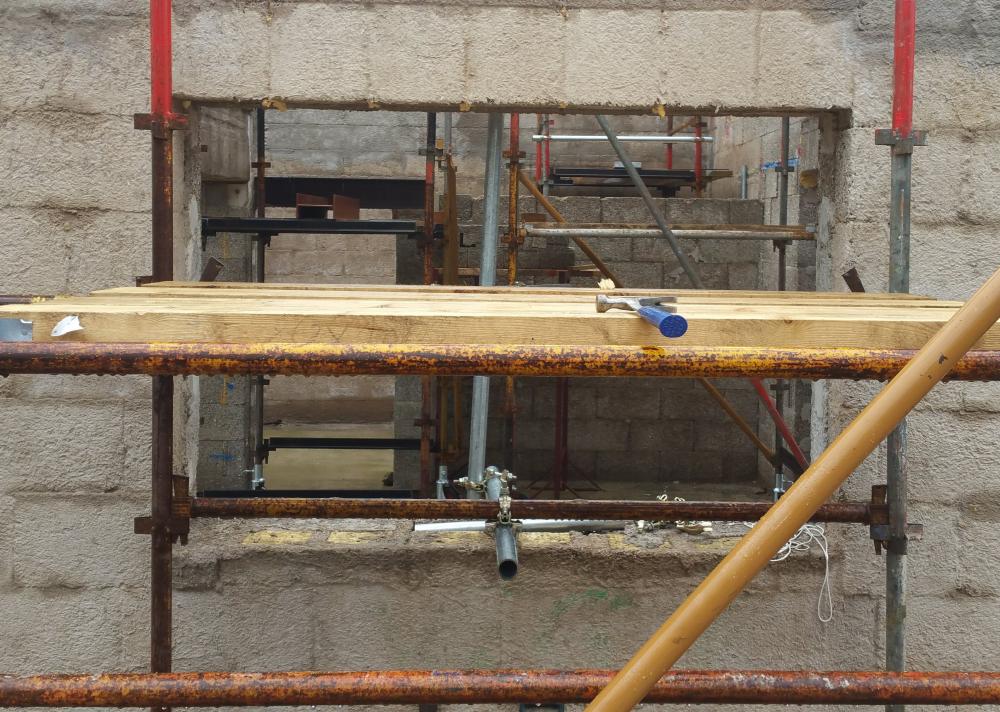
Our ridge beam is a glulam, about 7 meters long and weighing 160 kilos: not that much as far as beams go, I would think. The sensible answer to problem of getting it up to the ridge is to hire a crane and a guy who knows his stuff. Cost £500. In the current context, that's a bit of a problem. This thread will simply document what we did, the problems we came across and how we sorted it out. We would not have considered doing this had we been richer, not had a digger, and not had some form of scaffolding under our direct control: in this case Kwikstage - other types are available. Our aim is to do this exercise in a completely safe way , lifting it, one small bit at and time such that one person can lift it on their own, and lower it to a position where the beam is completely safe. Your comments and criticism is more than welcome. In fact, it's part of the process. The 7m beam hasn't been delivered yet: I want to trial the whole process with a smaller 5 meter beam first. The 7m beam will stretch from the ridge peak at the top right, to the peak you can see on the left - the steels peak. This is a general view : first we need to lift the beam from the ground up to the level of the guttering This first photo shows the first of three bays of Kwikstage being lined up carefully outside the house. I found that setting the feet level across the entire 'installation' with a batten and a level helps greatly if you do that before putting in the standards. The construction process is greatly helped by putting in the diagonals before tightening up the pegs. (It also helps greatly to do this when you aren't tired) ( ) Doing a quick check just before coming in for lunch -luckily- I noticed these...... Notice the pegs (at an angle at the back of the staging) not hammered home. It's so easy to forget one or two: I always forget at least one. Now I touch each peg before finishing any section of the build. More to follow later this afternoon, and subsequent bits of the experiment. PS I would have used the digger to hold the standards while building the staging, but Debbie popped out to help.
-
The tree stump from Hell
ToughButterCup replied to ToughButterCup's topic in Landscaping, Decking & Patios
An obvious first answer - Lack of access is the issue @RichS Off to buy some potassium nitrate. As so often, thanks @JSHarris -
The tree stump from Hell
ToughButterCup replied to ToughButterCup's topic in Landscaping, Decking & Patios
It has to be removed..... part of the roots are cuddling the manhole access to a sewer.....