andyscotland
-
Posts
633 -
Joined
-
Last visited
-
Days Won
1
Everything posted by andyscotland
-
Replacement of domestic steel gas pipe between gas meter and kitchen
andyscotland replied to DaveAF's topic in Gas Pipework
Presumably you have the bells and whistles policy that covers leaks etc from the pipework as well as the boiler itself? And presumably the existing provider will still cover the boiler/controls/radiators etc if it breaks down, they're just saying if the steel pipe fails they won't fix that? And there's no particular reason to think the steel pipe will fail now - there's no obvious corrosion or damage - the insurer has just made a blanket change to their terms? If all that is correct, I would personally probably just stay on the current policy and accept that length of pipe is not covered. If it does fail, you will have to get it repaired / replaced at your cost - but that would probably not be much different to the cost of doing that now. And my gut feel (not a gas plumber, perhaps steel pipes are riskier than I assume) is that is probably quite unlikely anyway, if there's no history of issues. Seems to me there's 3 possible scenarios: * You pay now to replace it to keep it insured, your brand new copper pipe is very unlikely to need insurance work in the near future, so might as well not be insured. * You leave it, nothing happens, no cost. * You leave it, it fails in future, cost to repair/replace when it happens probably not that different to what it would cost now. The only one of those that costs you more is upgrading the pipe now, for no real benefit. And it likewise doesn't seem worth paying £400 a year more for a policy just to cover that length of pipe. I would put some money in a savings account and deal with it if it becomes a problem, or when you're doing other work e.g. changing flooring / decorating (making good could be a big part of the cost if you do it as a standalone job). -
To contract or not to contract
andyscotland replied to Jimbo37's topic in New House & Structural Warranties
My advice would be that you & builder are both right. Contracts (of any kind) are often "not worth the paper they're written on" in so far as it can be very challenging to enforce them if a relationship falls apart and usually in that situation the only winners are lawyers. So they're not a substitute for research, references & (justifiable) trust. But the process of agreeing a contract necessarily flushes out a lot of the uncertainties and assumptions on both sides. Even if some are just acknowledged as being details/costs to be agreed at some future point, with a basis for when that needs to be decided and what the process will be. It is very often uncertainties and assumptions that lead to a relationship breakdown, so the more they can be eliminated or at least documented, the better. So as a tool for making sure everyone is on the same page and the relationship is starting off with the best chance to succeed, contracts are extremely useful. And of course there are still some times when a contract is vital, particularly if things go so wrong that insurers get involved as it needs to be very clear which insurer is liable to avoid a situation where they all decline the claim. In terms of templates, yes there are several common building agreements (some which assume a qualified/neutral arbiter e.g. architect as part of the day-to-day relationship). The details of those are beyond my competence to give an opinion but I'm sure others will be along to advise. -
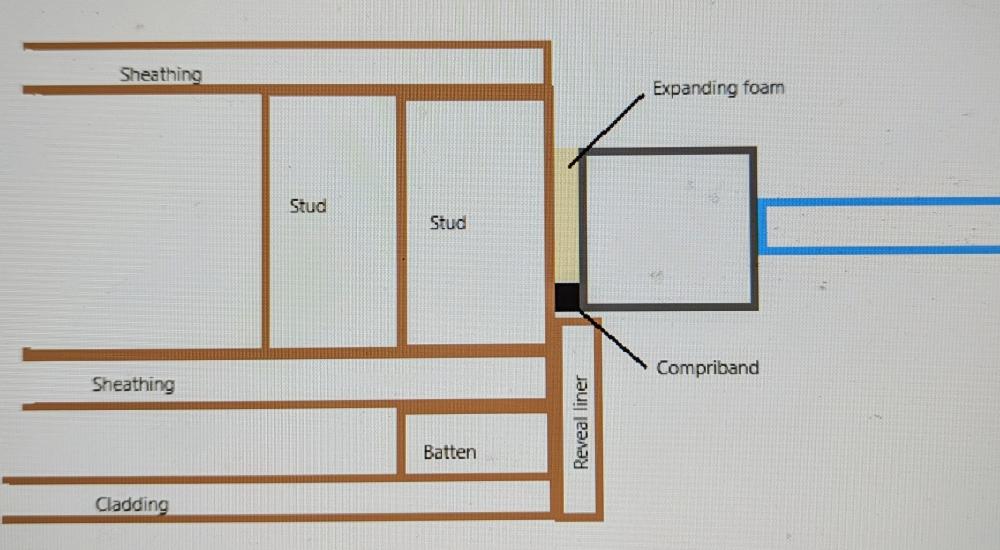
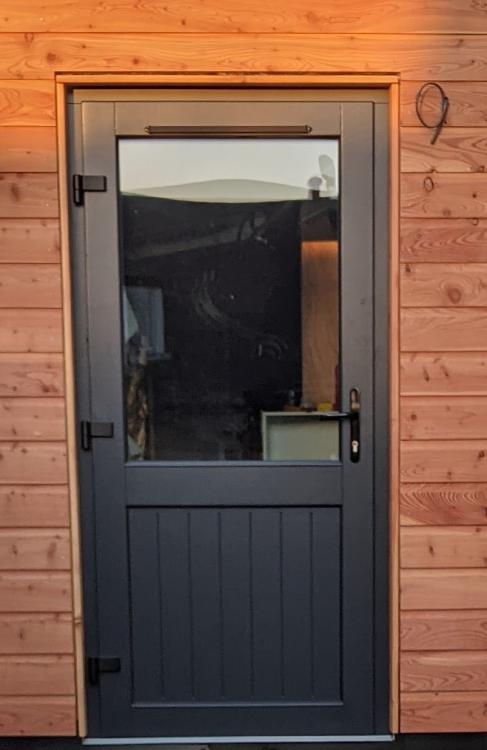
Exactly. I didn't draw the inside but basically the same thing, airtightness tape from the door/window frame to the VCL and then a piece of insulated plasterboard to cap the expanding foam & line the reveal on that side. Obviously this detail wouldn't work with very thin-profile frames - I was actually cutting it a bit fine with the door hinges on mine as you can see in the photo, but there was just enough space.
-
Mine is like this quick & dirty sketch (no CAD on this machine 🤣) End result looks like this:
-
As @Mieksaid, better flexibility & movement and especially if covered by the reveal you want something essentially maintenance free. I went with reveal against window (with a few mm expansion / shadow gap) for a few reasons: * To my untrained mind it felt more like a Scottish "check reveal" with an extra layer of resistance to weather, though I think compriband is pretty bulletproof either way. * Visually it reduces the number of materials at the junction - you just see timber reveal & window frames, no visible sealant/compriband line which I thought was more attractive. Especially if there's any risk of tolerance gap being uneven/not exactly square/not exactly centred (I'm realistic about my woodbutchering skills 🤣) because that gap is hidden so you can finesse & pack the cladding batten/reveal liner a little bit as required. * My hunch was the cladding might need maintenance sooner than the windows & doors, especially around sill area, so useful if the reveal liner is just a cover plate that can come off rather than trapped between window & wall. * Things here happen veeeeery slowly, my way let me get windows into the structural opening, compriband & foam so fully weathertight and then faff about with cladding & reveals later. Of course if you have some brick & some timber you may want the visible joint at the reveal for consistency. I've seen plenty done like that so I don't think there's anything wrong with it per se.
-
Are your windows actually in line with the cladding? I think more common is the windows are set back a bit in line with the structural opening (and the insulation), behind the line of the cladding battens. Then you can just compriband between the window and the opening, and if you like put a thin piece of timber to line the reveal and cover the compriband. That's what I did.
-
Builder asked could we employ him?
andyscotland replied to CalvinHobbes's topic in General Self Build & DIY Discussion
Frustrating but as you say probably for the best, better to happen at this stage than halfway through. -
Builder asked could we employ him?
andyscotland replied to CalvinHobbes's topic in General Self Build & DIY Discussion
As per all the above plus you would also need employer's liability insurance. I can't see it being a viable option. Banks infuriate me too. I still remember in about year 3 of my current business they wouldn't lend on my income (which had been stable & growing & we had long term contracts in place). Worse, they wanted to reduce my wife's income - which was lower than mine - as I was classed as a "dependent" along with the kids. I only just managed to persuade the underwriter that if the business went under we wouldn't need childcare till I got another job, so in either scenario we could at least have her full wage. Worse still, a couple of months earlier my only employee got a loan offer based on 3 payslips from me and not a single question about the age/financial security of the employer - our underwriter agreed that was ridiculous given the employee would go first if we hit any trouble, but "it's just the rules, I'm afraid". 😡 -
110v versus 240v at start of project
andyscotland replied to Drellingore's topic in Tools & Equipment
Oh, and good call on the 110/240 question, heaven help any future reader that arrives here looking for that one! 🤣 -
110v versus 240v at start of project
andyscotland replied to Drellingore's topic in Tools & Equipment
@Drellingore fair enough. You will always have more knowledge of your situation than anyone here, and those facts may of course make yours a valid approach in your specific circumstances. Most of the criticisms stem from the fundamental question of why you can't save all the hassle and have HoldCo lend the money to you personally. I did look back over the thread before I posted last night and I'm pretty sure you haven't addressed that. No requirement for you to do so, but given that seems an edge case - it would be unusual for a lender to be unhappy to lend to an individual but happy to lend to an individual's LtdCo given the much higher risk of default when lending to a company with no assets - it is not surprising that people have made assumptions as to what might be going on. Particularly also because as you've acknowledged there are tax & overhead costs to going your route that wouldn't exist on a direct loan, so prompting the question of what costs/risks/problems you are avoiding to make that worthwhile. And of course even if your intent & situation is entirely above board, HMRC may still turn up one day and ask the two questions I asked last night. So there's no need to answer them here, but I'd make sure you have a solid answer to each - ideally documented as part of the original decision making so that the intent of each company is clearly evidenced. But as I said some posts ago, not my circus, not my monkeys. One last comment is that you'll often find on BuildHub that we reply both for the benefit of the poster and also for future readers. If you feel people have taken unfair assumptions, it may just be because those are natural assumptions to make purely because of what's been written (and not written) in a thread. And we want to protect a future reader from making the same assumption and thinking "oh that's a great idea, I could do that" without the detail of your specific situation and without thinking through the ways an idea could go wrong. So please don't take anything as a personal criticism, or a pressure to share more justification, I am quite happy to accept you & your accountant with all the facts in front of you may have a plan that works. I just think it's unlikely it would work for many people, and should be approached with extreme caution. -
110v versus 240v at start of project
andyscotland replied to Drellingore's topic in Tools & Equipment
There are a few exceptions to the self-build scheme, including as @saveasteading said things like plant hire (unless it comes with an operator) and professional fees (architect, engineer etc) which you cannot reclaim on the self-build scheme, but your SPV could reclaim as input tax in the course of "business". So arguably you would be a bit up on where you'd be as an individual. But it doesn't sound like your SPV is to isolate financial risk, from what you've said it seems it's primarily about being able to funnel money from another company rather than borrowing from the bank? A normal SPV would be e.g. to allow you to borrow from the bank / investors with limited liability if the project went downhill. But in your case if the build goes over budget you'll just have to find more money somewhere and pay it into the company? So you have said that the main benefit is to be able to take the cash from your holding company instead of getting bridging finance. But you haven't said why you have to have this convoluted setup to do that, rather than just having your holding company lend you the cash direct. My assumption (and I suspect @saveasteading has also read between the lines the same way) is that you are a participator or Director in the holding company, and potentially it's a close company, and therefore taking a personal loan from the company would trigger a substantial tax charge. And so you/your accountant have come up with this structure to have the company invest in an SPV so that you are "not actually borrowing yourself". This is getting beyond my detailed knowledge, but if that's the case then I think you have a potentially major problem if HMRC decide to "look through" your chain of transactions, particularly if the SPV is also a close company under your control. Factors that may be of interest to them would be: Why has the holding company decided to lend money to the SPV? Is that a genuine investment in a trade? The fact that there is no plan for the SPV to ever design & build more than one building would suggest not. So perhaps the loan is only being advanced because the two companies are under your control and it would suit you to have the money temporarily leave your holding company without taking it as a distribution. CTM61570 - Close companies: arrangements conferring benefits on participators may be relevant here, as it covers situations where participators are "extracting value out of their companies in untaxed forms which did not ... amount to loans ... within the meaning of [the rules for loans to participators]". Why has the SPV decided to extend you such generous payment terms (full balance due on the completion of the building)? That would not be normal for a design and build contract on a commercial basis - a normal contractor would expect stage payments as work progressed (probably including some amounts ahead of construction). If a company is incurring direct expenditure on a client's behalf but offering the client extensive time to pay that in itself can be a form of loan depending on the circumstances. If the company is close and the client is a participator then again that could meet the definition of a loan to a participator or the Targeted Anti-Avoidance Rule around "value extraction" above. If I was a tax inspector in a bad mood who thought you were trying to be too clever, I might even try to argue that there should be a tax charge on the value extraction from the holding company and another on the value extraction from the SPV - it might be the same money, but there are two separate legal entities each making non-commercial decisions that benefit you. As earlier in the thread, if your accountant has advised this strategy and knows what they're doing, all well and good. Just bear in mind there are plenty of accountants who've ended up on the HMRC "too clever for their own good" list - often for schemes involving extracting value with loan-like structures. And plenty of their clients who have ended up with hefty penalties as a result of following their accountant's advice. Probably at least worth making sure they have good professional indemnity insurance and you have their advice in writing... From what I can see it looks like you've now got the VAT stuff correct. I'm also curious why you're comparing your model to bridging finance (which I agree would be pricey) rather than a normal self-build mortgage? They are usually a bit more expensive than other mortgages but would be a lot cheaper than a bridging loan. And because you draw down the mortgage as each stage of work is complete, you are borrowing some of the money for much less time (particularly if you then remortgage to a standard mortgage on completion) so you are not paying interest on the whole build budget from the day you start. Also in your list of costings there you don't mention: Dividend / income tax on the final distribution of profit when you wind up the SPV, or on the interest income in the Holding Company. Depending on your income tax rates and how much profit / interest you're charging yourself, those could also be reasonable-sized numbers. Professional services - accountancy and filing fees for the SPV, advice on the loan agreement between HoldCo and SPV? Insurance - you may well find that liability & build insurance for a LtdCo with no track record is more expensive than if you were to get a self-build policy as an individual. True, though if you end up getting zero-rating and are primarily hiring labour & materials contractors to do the work that may prove a marginal benefit. Not sure there's much of a saving there, typing them onto the self-build reclaim list isn't that much more time consuming than typing them onto whatever electronic system your SPV would use for its VAT returns. Surely you can use whatever software & processes you like regardless of whether the funds are sitting inside your SPV or in your bank account? -
110v versus 240v at start of project
andyscotland replied to Drellingore's topic in Tools & Equipment
I hit that day about 15 years ago and have learned a lot more about VAT since then 🤣 Congrats on your first BuildHub "hmm, I got that wrong" post. You are not alone -
0% vs 5%
andyscotland replied to sameulepapi's topic in Self Build VAT, Community Infrastructure Levy (CIL), S106 & Tax
To a point but I'm pretty sure that all comes out in the wash. In normal trade I invoice on 19th Jan, HMRC don't know anything about it till I send my quarterly VAT return in April and I pay them a month later. However my client's input tax recovery will be reported around the same time, and that will reduce their HMRC bill by the same amount. There is a bit of cashflow timing because you can pick your VAT quarters, but that can work both ways. Eg my client might actually reclaim it in March, before I've even reported the sale. Not to mention that there isn't really any concept of "cashflow" in government funds in the same way as for normal people, and any marginal gain from VAT will be eclipsed by the fact Corporation & self-employed income tax is paid anywhere from 9 to 20 months after the income that is being taxed. -
0% vs 5%
andyscotland replied to sameulepapi's topic in Self Build VAT, Community Infrastructure Levy (CIL), S106 & Tax
This is correct. However some people have found that contractors/suppliers don't understand the rules and want a piece of "evidence" to justify zero/reduced-rating their supply. Some are happy with a letter, others know enough to know that there's a more official looking HMRC "certificate" but not enough to know it's completely inappropriate to use it in this scenario! But in practice if it gets the supplier to apply the tax treatment they should have been applying anyway, HMRC are not going to challenge the fact that the certificate was issued incorrectly because they can only raise an assessment if the actual amount of VAT charged/reported is incorrect. -
0% vs 5%
andyscotland replied to sameulepapi's topic in Self Build VAT, Community Infrastructure Levy (CIL), S106 & Tax
It is to do with the flow of input & output tax along a chain. In most cases as you say, the 5% charged by the contractor can be reclaimed, either by a VAT registered business that is converting the builder for sale (through the normal VAT return process), or by a private individual that is self-building (through the self-build reclaim scheme). In similar vein, you could ask what's the point in my business charging 20% VAT on my services when I know all our clients are VAT registered and will be claiming it back. However there are a whole range of cases where the client cannot reclaim- they may not be a UK VAT-registered entity, they may have onward plans for the building that prevent recovering input tax (e.g. they are not planning to use it in a way that creates/supports any VATable revenue). There is also a host of complication about the difference between supplies that are 0% rated (you can recover the input tax) and supplies that are exempt or out of scope (you cannot recover input tax). So basically as a rule of thumb, output tax (VAT you charge your customer) is based entirely on what you are supplying. And input tax (VAT you can reclaim) is based on who you are and what you're doing with the thing you bought. Those figures may balance, or they may not. This is why VAT is possibly one of the most complex & technical taxes! The self-build scheme is an anomaly, it's I think the only time where a UK consumer can reclaim the VAT they have paid on goods and services. I believe it was introduced to "level the playing field" because it was felt unfair that a self-builder should have to pay VAT when they wouldn't if they bought a house from a developer. -
Extractor fan out through wood cladding
andyscotland replied to health mechanic's topic in Ventilation
Which could be pretty small. 100mm duct has an area of roughly 78.5cm2 . So a 10cm square (40cm perimeter) would only need to stand out about 2cm to get the same gap, if it was open all the way round. I guess the change in direction/turbulence might impede airflow slightly so probably better to go a little bigger. Probably want it bigger anyway so the duct end is fully hidden when you look from an angle. A small cone/dish on the back might also help to guide the air "round the corner" and out to the sides. -
Extractor fan out through wood cladding
andyscotland replied to health mechanic's topic in Ventilation
I used these https://www.spares-2-go.com/products/steel-air-conditioning-wall-air-vent-external-hooded-non-return-flap-100mm-4?variant=37920077775021 And yes, an inline fan with a rigid duct through the wall. My layout is similar to yours, without the steel. So the bathroom just has a wall terminal, then rigid duct to utility, inline fan in the top of a utility cupboard, rigid duct to the outside. I installed the exterior duct before the cladding to allow me to seal it properly to the breather membrane. -
Extractor fan out through wood cladding
andyscotland replied to health mechanic's topic in Ventilation
Oh now I love that idea... Wish I'd thought of it! -
Extractor fan out through wood cladding
andyscotland replied to health mechanic's topic in Ventilation
I assume you mean to make it work visually/aesthetically? I have used these stainless steel cowls on my extension, they're functional but I think they look acceptable. Or there are quite a few places round here that use the bullnose version: To be honest I think I prefer the bullnose as they're a bit smaller. But I had to put two vents beside each other and so the square ones looked the least worst. If I had my time again I would have made sure the duct outlet lined up to the cladding spacing a bit better, maybe centred to a board, although it'll never be perfect due to the mismatched size. But in real life when you're looking at the whole wall they look smart enough that you don't notice them.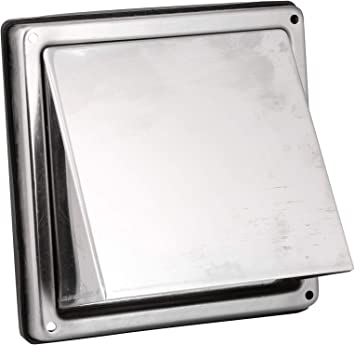


-
Broadly speaking (there are always exceptions!) taxable profit is on turnover less direct running expenses for the year. If the business buys/invests in anything long-term (whether a car, factory, wind turbine, etc) then the cost of this is spread over the accounts and tax deductions for the next several years depending on the expected usable life of the asset. This does usually come out in the wash eventually (including you can end up getting a tax rebate in a future year if turnover/profit drops but you're still "paying off" the asset you bought years ago). But it may not balance when tax rates change or windfall taxes come into play. And in the short term you can definitely have a situation where a company theoretically has a huge taxable profit but doesn't actually have cash in the bank because they've invested it all in long-term assets. Of course I doubt that applies to energy companies! And if the government was actually concerned they could always add a capital allowances rule to enable a company to set 100% of renewables investment against tax in the year it was incurred. There are already different allowance rates to incentivise investment in particular types of assets - e.g. electric cars & goods vehicles.
-
Chat GPT for building regulations - insane!
andyscotland replied to GaryChaplin's topic in Building Regulations
I usually just make one up (unless it's for an SMS account recovery code). There's basically no way to validate a phone number other than it has the right quantity of digits. Whoever actually owns 0131 123 1234 must get a lot of spam calls. -
Chat GPT for building regulations - insane!
andyscotland replied to GaryChaplin's topic in Building Regulations
There was an interesting write-up last week of someone who put ChatGPT through some of the accountancy/audit exams https://www.accountingweb.co.uk/tech/tech-pulse/ai-chatbot-falls-just-short-on-accounting-exam It actually did relatively well and got quite close to a (low) pass on the paper with the more policy/wordy questions. However on some things it was very wrong. His conclusion was that at the moment: "On this assurance topic, I’d compare ChapGPT to a very recent joiner at an accounting firm – someone in the first few weeks of their contract. Unlike a new joiner, however, ChatGPT gives answers with an air of confidence even when it’s completely wrong. It’s not afraid to give a garbage answer and back it up with garbage. It’s like having a fresh-faced junior who’s always convinced they’re right, so users need to approach it with a degree of caution.” -
VAT on Polish imports?
andyscotland replied to KTB's topic in Self Build VAT, Community Infrastructure Levy (CIL), S106 & Tax
This is all quite concerning, although there is always still a chance there is some honest misunderstanding going on. Brexit has opened up many cans of worms for small companies trading cross-border. That said, none of it is particularly new now and most firms have figured the basics out. Is this your fitter's first time working with the Polish supplier? In my experience tho, sudden requests for extra funds / bringing forward expected payments are more usually to do with cashflow issues than any external pressure... As @Temp said, if you haven't paid any of the bill by credit card then I would start thinking about how to protect your position just in case, and insist on paying some by card if you do agree to pay anything further. It's actually more surprising for this to arise for an import because as above, so long as they do the paperwork right, they do not have to ever actually pay any VAT on the supply. They just put the number in one box of the VAT return, and the same amount in another box, and it ends up at zero. So the cashflow challenge that would normally arise on a self-build (pay supplier 20%, bill customer 0%, be out of pocket until the next VAT return) does not exist. Unless I suppose something has gone wrong with your supplier's VAT registration and HMRC have refused to allow them to use the postponed accounting method, but I'm not sure they have the power to do that. I just double checked the guidance again at https://www.gov.uk/guidance/check-when-you-can-account-for-import-vat-on-your-vat-return and it would seem literally all you have to do is be a VAT registered business importing for business purposes, and then on the import declaration tick a box to say so and provide your VAT registration number. -
VAT on Polish imports?
andyscotland replied to KTB's topic in Self Build VAT, Community Infrastructure Levy (CIL), S106 & Tax
A few questions: * I assume your supply/fit company is registered for UK VAT? * Who actually has the contract with & is paying the Polish company? * Are you being asked to pay Polish VAT or UK VAT? I'm not fully up to speed on post-Brexit import VAT for goods but my understanding is: * The Polish company should not be charging any Polish VAT as there is no VAT due on goods for export from the EU. * There will be UK VAT to pay when the goods arrive in the UK. Freight agents commonly charge this upfront. Assuming your supplier is the importer and is VAT registered then they can opt to use postponed VAT accounting for the import VAT. With this: * They provide evidence of their VAT registration to allow the goods to come in without paying any import VAT at that point. * On their next VAT return they declare the import VAT and simultaneously reclaim it as input tax. So they never actually pay anything out. * They would normally then charge you VAT when they sell you the windows, but in this case as a new build supply and fit they can zero-rate that. So in theory assuming your fitter is technically speaking buying the windows and reselling them to you and is VAT registered then no VAT should need to change hands from anyone although I think there may well still be import duty. However if your fitter is not VAT registered or is acting as your agent (and you are paying the window supplier direct) then there will be UK VAT to pay before the goods can clear customs. Which presumably you would eventually be able to reclaim from the self-build scheme like any other goods-only purchase. -
Welcome to the forum. One thing to watch is that just because services are close doesn't automatically mean they will be cheap/easy. I've seen people on here over the years discover that - particularly for electric - the supplier wants a big fee to upgrade the local network to add capacity for an extra connection. So once you've seen the plot it may be worth getting a connection quote before you commit to buying it / price. If you like the plot then a short session with a local specialist Planning Consultant may be a good investment before you commit, they should have a good sense of what may / may not be allowed and what sort of costs/timescales may be involved in getting permission