puntloos
-
Posts
1575 -
Joined
-
Last visited
-
Days Won
1
Everything posted by puntloos
-
 Fair point, no it's actually 15mm.
 -
Can you give me a guess? The far run that the heatguy suggests to make the dedicated loop for is 12m or so, but the rest is 8-5m My calculations say that for 8m distance, 22mm pipe, 10L/minute flow rate - https://www.sensorsone.com/volumetric-flow-rate-and-diameter-to-flow-velocity-calculator/ Not ideal. Sounds wasteful too. Not sure, will ask ?
-
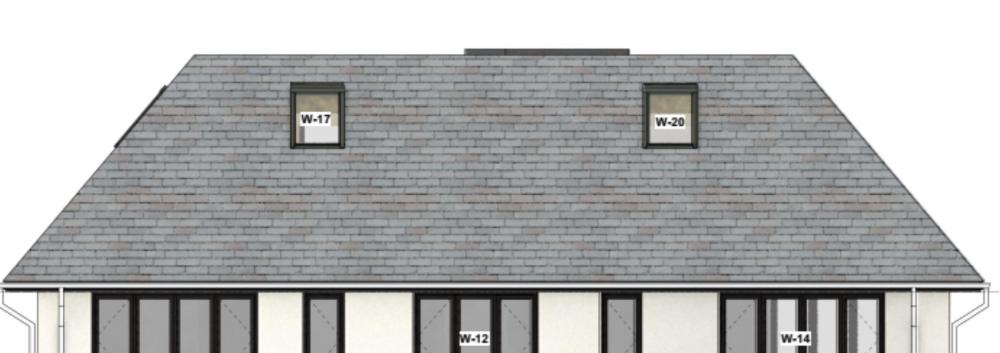
Was wondering about this. With in-roof, I would imagine you effectively have "trays" for standard panels, no? Or is it a totally different system? My sun-facing roof section has windows in it, I somewhat worry that trying to fit panels on it would leave lots of spaces, but I imagine in-roof would, if anything, be worse?
-
One quick update - I'm still debating the full hot water return (past most, or all of my relevant hot water taps) or only hot water return with a presence detector actuated pump. Pro: hot water everywhere in under a second But the cons: - Some extra design/material cost I guess - balancing of the circuits. Most plumbers don’t really understand balancing hot water circuits, so all of the water tends to circulate around the shortest circuit and water won’t circulate around the furthest branches. If anything changes the circuit goes out of balance and causes problems. Plumbers never use proper globe type balancing valves either which makes balancing even more difficult. Excessive hot water circulation creates more unnecessary complexity. - Max pipe length is about 6m. Hot water will be available at all taps fairly quickly. (how quickly?). - If the pump is only running when hot water might be required, the circuit will not be wasting heat and will not be disturbing the hot water stratification in the cylinder. This maximises the Delta T in the cylinder improving the heat pump COP. (but frankly as we debated elsewhere the stratification thing isnt too crucial) - Once the pipework is in it can’t be just switched off by closing valves. If you do shut off branches it would create ‘deadlegs’ which are against water regulations and would cause a legionella risk, the pipework would need to be removed. If the circuit is made more complex all of it must circulate equally. Basically - is balancing of the circuits hard?
-
Welp, we were outbid. That was exciting. This house market is crazy, but given the weird tenant stuff maybe it was for the best. Back to our regular program of me trying to research myself into weird corners
-
How would you play that? <ding dong>, Hi, I'm puntloos, interested in buying this house from, I believe, your current landlord. Can I ask the inside scoop from you, hidden problems with the house, perhaps give you 25 quid for your trouble"? Who could help me with this? Would the conveyancing sollicitor be able to give me solid advice?
-
I was actually somewhat planning to speak to the tenants anyway, asking if there's any unseen downsides to this house. (While it is by no means cheap, the asking price has a "fairly low" cost per sqm for the area. ). Good idea? bad? Just in general, normally tenants have max 6 month break clauses so surely they can be legally evicted if the process starts today? Sure, there's rare cases where tenants become 'combative' but given that I'm currently renting I'm not super stressed about that particular- and presumably fairly small - risk. I certainly agree that "vacant possession" is desireable but I suspect I'm a slightly less desireable buyer so accepting the 'tenant exit in august' might be okay. Or would the seller be fine to exchange in August? Perhaps supersticiously, I just worry that the seller pulls out in a month or two, costing me a ton of headache. I would certainly prefer to have the contract signed-in-hand, and then wait for a while until I get the keys (while being 'certain' I will eventually get them). Of course being more chill about losing the house is better but we have been monitoring the local housing market for 4 years and this is a fairly rare find...
-
You'd think but https://www.samconveyancing.co.uk/news/conveyancing/can-i-pull-out-after-exchange-of-contracts-370 says: We are often asked “Can I pull out after exchange of contracts?" and the answer is yes, however if you do pull out then be prepared to bear the costs - Click here to see the costs of pulling out after exchange of contracts." where it lists the seller costs as: * Costs of estate agents fees and any others related directly to the marketing of the property * Costs of conveyancing * In principle, any additional costs which might be incurred because of any delays to an ongoing purchase contract which a seller rescinding had entered into. which is almost nothing, maybe a few thousand? At least the buyer pulling out nets the seller 10% of the sale price (or whatever downpayment).
-
While as some of you know I've been working for quite a while on designing a home, a bit of a 'strange one' - a house came on the market that might just be even better so I find myself at least considering taking a very different path, but trying to work out a few things, comtemplating sunk cost etc. but..: The seller haven't accepted our offer, but looking to complete in normal timeframe (4-6 weeks?) and the house has tenants until August (so that's quite a time for them to be 'alone with their thoughts'). My question: after exchange of contracts, what stops a seller from withdrawing anyway? For example if they start regretting the agreed price, can they bail? They will politely return my deposit and wave goodbye? Many websites say the exchange is 'legally binding' but I don't see what actually happens if they "illegally" walk away? Crucially I don't want to be left with no house of course. - What's the downside for the seller other than feeling bad? Can I sue them for damages? (e.g. if I sell my current house, abandon my work on the design and then don't get 'their' house.. - how damaging can I claim that is?) - Do they get criminally charged because breaking a legally binding thing is, well, illegal? - Can I put some specific wording in the contract that will make it less appealing for them to bail out? - Should I put my own completion date for selling my house in August as well, and if the seller flakes, can I use that as a fair reason to cancel the sale of my house? - Can I just 'inherit' the seller's tenants and complete right after exchange? How does that work? Tx!
-
Interesting point, but is that fact reflected in the BEIS prices that @Dave Jones quoted? It's all well and good if the "sawmills" have increased their prices by 21%, but if this one shop that actually has the wood raises their asking price far beyond that since desperate builders will pay it.. is the real price more like 30% extra? Or is that 21% the effective price after all the theoretical 'gauging' that happens?
-
Ha so this is one of the golden moments where some potential client should come to your table dressed in rags and looking desparate, hide the rolex watch Seriously though, 7.5%, while selfishly I'm not a fan, I can't really fault you for it. Do you somewhat agree with the other side of it? 20-odd% for materials overall? If you tendered for 500,000 last Jan, and the client put things on pause for a year, what would you ask today? 333,333 * 1.215 + 1666,6666 * 1.075= 404,999.595 + 179,165 = 584,184 (17% increase)?
-
Interesting. And what % of build cost is materials? I imagine 66%? So if build 2020 is 500,000 then that would be 333,333 materials, 166,666 for labour -> build 2021 333,333 * 1.215 = 404,999.595 + 166,666 = 571,665 - that's about 15% Of course there's always some generic inflation etc, but I can probably keep it under 20% then?
-
One builder told me it has always been that way anyway (pre-covid), material costs vary a ton, but there's always one (group of) things that is unusually high. I'm sure covid raised the 'overall price' by more than you would expect (which is my question - 15% then?), but I think we're behind the big peak.
-
So, we've gracefully exited 2021 now. Was wondering as the title says: How much did build cost estimates go up over 2021? (e.g. tendering 'today' vs tendering 'last year', everything else being equal) And are there any outliers? E.g. "wood went up 300%, while the rest of the prices are only 5% more"?
-
https://www.lamilux.com/skylights/solutions/smoke-and-heat-exhaust-ventilation-shev/smoke-and-heat-exhaust-ventilation-units/flat-roof-window-shev/smoke-lift-glass-skylight-f100.html has an U-value of 1.. might work? I think so.. indeed I still can't quite figure out if a chimney would be able to cool a network hub properly but indeed house air coming in from the bottom and a vent at the top. I guess one thing I don't quite understand about convection is that I always assumed you need a loop, it doesn't work nearly as efficient with just a pipe. So either the vent is 'always open' which is not ideal, or it's closed and the cooling would be insufficient. - but that's just my gut feel.
-
Why not simply have the shaft going straight up to a dedicated vent or skylight in the roof? How would this fan be connected to the shaft if it has no cap? Why would you need it if it vents naturally through a vent at the top of the shaft. We should probably avoid holes or vents in the shaft at first floor level but provide a relatively large vent near the floor in the hall, this vent would help the rising hot air to move using its natural buoyancy by introducing relatively cold air at the bottom of the shaft. I was wondering how well 'natural convection' would work here - can we enhance the convection that would occur naturally using displacement ventilation (cool air in at the bottom, hot air out at the top). If the shaft is open to the MVHR it may be counter-productive and wouldn’t work well? I think @SteamyTea or @jack spoke about this somewhere but I can't find it anymore Actually the automatic opening vents (AOVs) are more or less standard thing but are they are normally opened by a smoke detector rather than a thermostat. AOV or smoke vent shafts are shafts with an automatic opening vent (AOV) at the top and vents at each floor level to clear smoke from staircase landings. They are used in blocks of flats to let the smoke out of the staircase in a fire. Many companies make equipment for these shafts for example https://www.kingspan.com/gb/en-gb/products/smoke-control-systems/natural-shaft-ventilation. The shaft could have a velux window instead of a louvre if you prefer. The AOV would need to be opened and closed by a small electric actuator controlled by a thermostat but that seems pretty simple to me. Obviously you would need it closed in cold weather and when there was no heat build up, but that is easy to achieve. I guess I don't care too much for the (plant room in the) loft. If it's truly smouldering we can open the skylight, or stop pulling heat from the network closet (and open the door) but that must be an emergency
-
The 'heart' emoji goes out to the solution I was thinking myself roughly. I bounced between simplicity ("if hot then blow it out a hole in the roof") and elegance ("keeping the precious heat away from living quarters, but doing helpful things with it"). Maybe recover, maybe put towards cold places, etc. Not to mention that somehow using an FCU, running power to de-heat the heated air, feels distasteful vs just venting it. But indeed the brains of the smart home will at some point gain sentience and kill us all so .. hm.
-
I actually asked exactly the same thing to my heating guy. I don't know. To be clear the riser was designed with my explicit instructions to pay attention to that, and my arch assured me his design was made to comply with them... so the riser minus the network closet is fine.. but I don't know if that closet changes things.
-
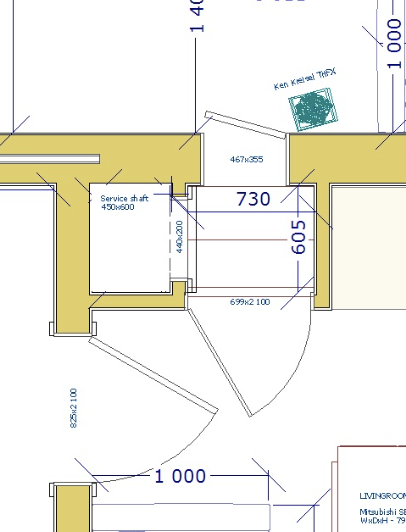
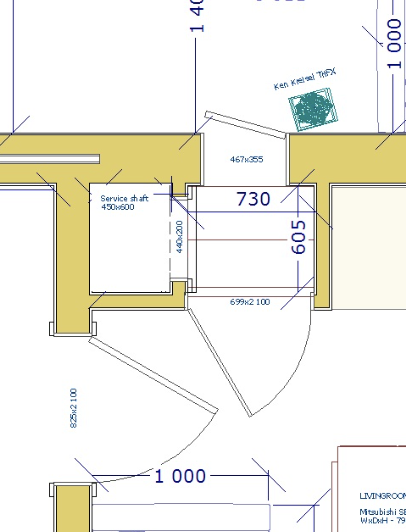
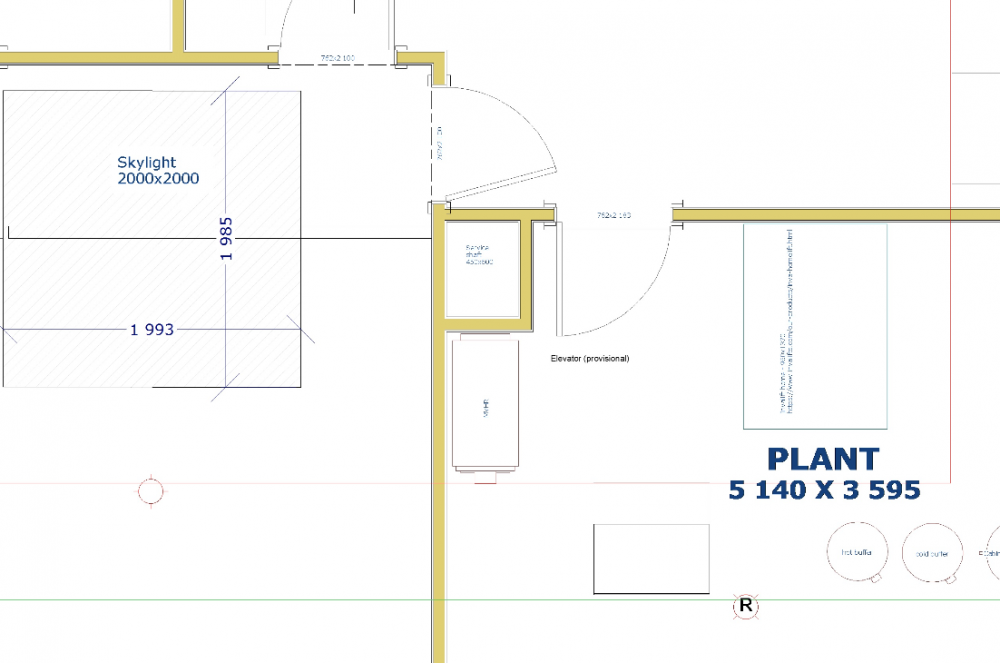
Small update, but my heating guy came up with a proposal: 1/ merge the network closet with our service shaft. (so our service shaft is straight above the gear) 2/ Attach 20L/sec MVHR capacity to this shaft for normal operation 3/ Separately, use an AC infinity fan and temperature sensor to detect peak heat and turn on the tornado. E.g. the 100L/sec inline fan (to be clear: not into the MVHR, this is a separate run) Will I run into balancing problems if the 100L/sec effectively starts pulling at the same air the 20L/sec MVHR inlet also tries to grab And then: 4a/ Duct the 100L/sec directly outside, possibly up through the shaft, or maybe even at ground floor level concerned about adding a hole in my roof, cold bridging etc. 4b/ Duct the 100L/sec into the loft, then if the loft gets too hot, open the roof window To my layman-self this feels more elegant, and we could even do the 20L/sec extract in the loft itself, so fewer conflicts (as above) 4c/ Duct the 100L/sec into the loft, which has slots into the hallway, and the hallway has a skylight we can then open? Perhaps the most elegant, using my entire hallway as a chimney. Which one would you do? Or an alternative option/ As.a reminder. Ground floor- but integrating the network closet rather than right-next-to (not a huge diff really, but it would draw fresh air from the hallway, whole-house!) Loft: (which has its own skylight, or we could open slots high up the plant room, or even powered ventilation, and open skylight if things get toasty..
-
OK, but can they run in parallel? I took from your point it's one or the other? Either way, I think I'll stick with modbus. Like yourself I prefer to be mostly non-cloud
-
This is a great list actually, thanks Is this a vaccination story where I need to build up an immunity to microplastics? ;)
-
Yep, thanks for.. visualizing.. that for me. Good to connect those dots. Ha, it's worth keeping in mind. But yes, I think even a simpler M&E install (such as just A2W with a water fancoil or 2) probably would benefit from a good team setup with a clear person holding the bag. But on the plus side, people can inspect in detail what they're tendering for. If they don't understand it they probably shouldn't tender.. Hmm strange. So while buying gear we'd have to pick one or the other? Or can I switch at will, just not use both? Indeed modbus would then be the way to go.. Swimming pool, you say.... ? - maybe I can start considering those industrial 4-pipe ASHPs... j/k But you're right, it's certainly possible that they figure they can add a bit - but they'd still be tendering against a few others. But hopefully the way we frame it ('this is the intended design but we probably initially only will do A2W, just making sure that A2A can be plugged in easily' - something along those lines..)
-
Thank you Dan. I certainly will do the exercise around making the things you just listed 'optional'. It's one of my crucial design principles that - if somewhat cost effective - I at least make it easy to add upgrades later. But I'll have to say, the extra cost for 1st floor UFH and ground floor fancoils are pretty low if I have everything else anyway. It adds up I guess...
-
Yep that's where my question stems from, the loft is intended to be 'noisy', so I prefer to put the fans there...
-
One errant though that I can't quite square with the whole extraction thing is that a device like this Needs zero fans. if 'effectively' the network closet would be like this, with a large-sized pipe straight above it, wouldn't the heat simply drift up into my loft where I can "handle it" separately? Why do we need fans anyway? Obviously the device gets a lot hotter inside than you'd want.. Another simple question perhaps: - Does it matter if I have fans suck on a pipe, or push air into a pipe? Meaning, do I need the fans in the network closet or can I put the fans in the loft and pull on the pipe?