Dan F
-
Posts
1431 -
Joined
-
Last visited
-
Days Won
2
Everything posted by Dan F
-
Putting in a backup on the first floor in case you find you don't like FF a couple of degrees colder than GF is a good idea. Some people allow for future radiators, but UFH is probably a better solution (albeit more expensive) given it's hidden. That said, given you have fan coils in first floor rooms, you already have a solution for taking off the chill on the first floor, and therefore I'd argue that you don't need both UFH and fan coils. So I'd personally definitely save the money and not install the UFH in this case.
-
Auto-balancing. They work with cooling as well as heating, but I'm not sure exactly what they do in practice, have just let them do their thing.
-
We used this calculator http://wrcpartgcalculator.co.uk/Calculator.aspx You fill it all in, ensure it passes and then print to pdf and give it to building control. Shower output itself isn't directly restricted I don't think. it's more about the sum of all usage. The calculator bakes in various assumptions (defined in regs) that you can't change e.g. how many times a week you bathe vs. shower.
-
Fancoils are going to a better approach for cooling than UFH though, especially on the first-floor and given carpets.
-
They'll get damp at higher than 12, depending on humidity. A question though; if the majority of pipework is insulated, pipes don't go inside walls/ceilings (where dampness could be an issue) and floor surface itself doesn't get cold is there a concern?
-
Normally runs at about 17C I think. I cool the slab to 20C on hot days, and 20.5C on less hot days. Room temperature follows slab temperature roughly (depending on temp outside), but I don't try to get it any colder than 22C. My UFH is in the slab itself and I have automated shading, so don't need to cool the slab much to make a difference. (of course, cooling the slab 1C takes about 6hrs though). The Vaillant controller has automatic dew-point monitoring and will ensure that flow temperature doesn't go beyond this (if enabled), but given floor surface is never below 19C this is a non-issue.
-
If your pipework is insulated and it's fan coils you are using I'm not sure you need dew monitoring. Do your fan coils have drainage for condensate?
-
Nice! I'm still waiting on an ebusd adapter still (I never ordered one early on as I was holding out for a Vaillant solution). Once I get it though, I'll be very keen to get this set up and may give you a shout. My main issue is the current Vaillant-based controls is that the response time from cooling the slab is so slow, that the room thermostat isn't really suitable. Instead, it'd be much better to calculate a desired slab temperature based on room temperature + weather forecast and use this. via loxone+ebusd to control ASHP. What is your control strategy?
-
Well, it's not quite directly from Loxone if you are using a DMX channel. For anyone that doesn't have DMX channels (or similar) in their cabinet then you'd need a digital output of some sort, and it doesn't make sense to use a 16A relay to control SRR to then switch a max 10A load (especially if trying to avoid anything mechanical for PID control). The other approach is a proportional SSR using 1-10v control but this involves a more expensive SSR and Loxone AO are seemingly £80/output!! Not using something proportional for this, or you can avoid that given you have a battery as a buffer?
-
I can see PID is technically better, but for most people simple hysteresis is good enough and easier to implement. In my case, I'd have to buy SSRs and add also add PWM dimmers to implement PID. which I can't really justify.
-
I run mine at 25C with a fairly tight hysteresis using a standard Loxone relay output. The goal isn't to heat the bathroom, just to take the chill off in the morning in the winter. Looking at the stats from earlier in the year: - It takes 30min to heat the bathroom floor from 21C to 25C at 6.30 am in the winter with (I think) a 150W mat. - Overshoot is max 0.4C (floor temp, not room temp). So, in practice, is there any real reason to introduce proportional control here?
-
Maybe, but if it's on a thermostat doesn't really matter if it's 50W, 100W or 150W, 150W will simply be on less of the time. Unless you plan to trigger it to heat up when you turn on the shower or something, in which case a higher W might be advantageous.
-
A lot come with temp sensor and controls, try to get one that's just the mat. Enhabit recommended "rayotec 150w/m2" in our m&e spec.
-
To be honest I never really understood how these work. I primarily installed them as others recommended them and they seem to working. I haven't tried to compare slab temperatures in different zones to try to assess if the auto-balancing nature of them works well because in practice this is going to depend on the positioning of the temperature sensors so might not be that fair of an assessment anyway. In terms of the delta-t, my understanding is that, while they target 7K, at lower temperatures this delta is reduced. They work just as well with cooling as with heating, but I haven't tried to observe what they are doing and if they are actively trying to keep delta-t up/down or both. I'm also not entirely sure if this are correctly calibrated as the calibration instructions say you should calibrate at 35C+ and the temperature shouldn't fall during validation. I guess I could remove the temperature sensors (or put both on the same pipe) and see what happens. @JohnMo might have more insight than me though. Looking back it was him who mentioned the 3K delta-t as reduced temps.
-
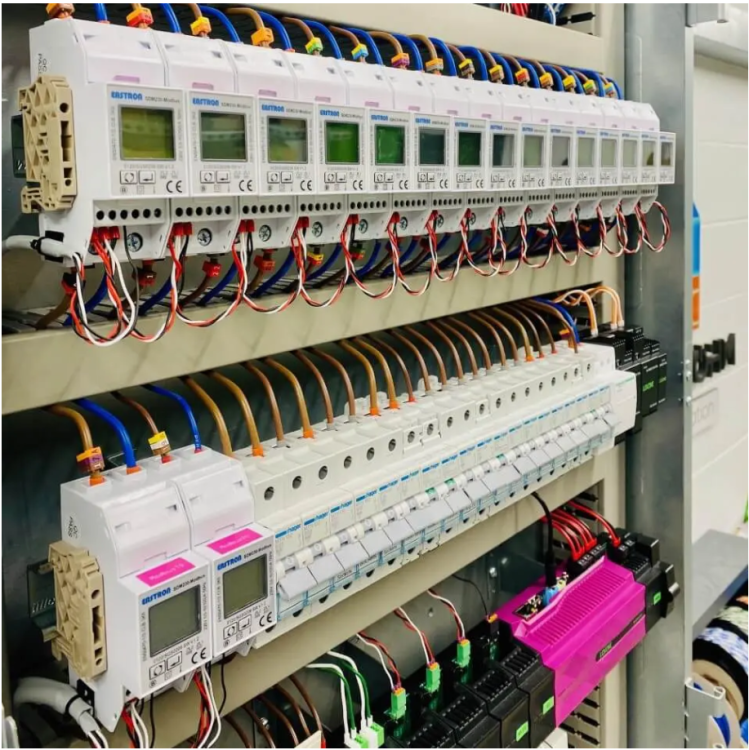
Could always do this for monitoring (from https://www.loxone.com/enen/blog/ehome2-future-homes-standards/) 🙂 I was going to get some of the local bytes smart sockets (which are pre-flashed with TASMOTA), but there are some things that it is easier to monitor in the consumer unit or Loxone panel or that don't have sockets. Does the Emporia support three-phase and voltage sensing (I don't have any three phase appliances, rather single-phase split across three phases)?
-
Let me know if you get this working. Only have very minimal energy monitoring here currently, but would be really nice to improve on this, especially given Loxone's recent improved support for energy monitoring.
-
PIV, heating and cooling: pros and cons, can and can't
Dan F replied to Garald's topic in Other Heating Systems
We also have no UFH, fan coils or A2A upstairs. We didn't plan for any of these because, in theory, the overheating risk with fully automatic blinds everywhere was extremely low. The reality though is that overheating risk is based on <25C and night flushing. But, up to 25C isn't comfortable and during a week-long heatwave, it doesn't get cool enough outside to flush out hot air. We find that the first floor heats up due to three reasons (excluding solar gain) - Through the fabric of the building - Humans - MVHR. (If the average house temperature is 22C and outside it's 37C, your MVHR unit is injecting air at 25C if your MVHR is 80% efficient). To cool down the first floor to an ideal temperature we'd need to cool the ground floor to <20C probably, which then becomes uncomfortable downstairs. We did install an MVHR post-heater as a backup plan and it does makes some impact, but it primarily stops MVHR from heating up the first floor rather than providing any kind of active cooling. In order to try to use it to actively lower the first-floor temperature it needs to be run on boost and left on all day. In this scenario though, part of the cooling power is wasted on cooling the additional incoming air that you wouldn't be cooling if you weren't running MVHR on boost. I knew MVHR post-heater was minimally effective from the beginning, but I never realised that the cooling power from post-heat and fan-coil units was not at all comparable because one is cooling incoming air on boost and the other is cooling exiting room air. -
Yes, that's what we have. What towel rails are you using? We used 12v ones which are nice, but this still meant 230v supply given run would have been too long for 12v. These: https://www.thermosphere.com/products/bathroom/towel-bars. (12v driver is hidden behind cabinet drawer along with isolators). Temperature sensor using 1-wire?
-
If you plan it carefully, you can put them behind a cabinet drawer. To do this though, you need to know what cabinet you are getting and how high you plan to install it ahead of time. In our cases, it's worked quite well, and while the isolators aren't super-easy to get to they are fully hidden but still accessible. We have a fancy toilet in one bathroom and electric UFH and 12v heated towel radiators in all bathrooms, so up to three isolators in total.
-
Thats what we did, using a standard Loxone cabinet-mounted relay output. As for the temperature sensor, I extended the 1-wire loop to include sensors in the bathroom floors as well as in the ground-floor slab.
-
Did you look at the 412-page "compact" catalogue yet? It'd keep you busy for a couple of weeks... https://www-de.wera.de/fileadmin/pdf/catalog/EN-Compact-Catalogue-2023.pdf
-
Look at the following brands for high-quality screwdriver sets. https://www-uk.wera.de/en https://www.wiha.com/gb/en/ The challenge is working out which set makes the most sense..!
-
4 bathrooms, and making sure that there is enough hot water.
Dan F replied to Big Jimbo's topic in Other Heating Systems
Why not heat it more with ASHP? When I know we'll need more hot water (e.g. visitors) I heat ours to 60C with ASHP. Yes, the COP drops when you get up to 65C flow temperature, but it's still almost twice as efficient as an immersion. -
4 bathrooms, and making sure that there is enough hot water.
Dan F replied to Big Jimbo's topic in Other Heating Systems
So thats not too dissimilar to our usage. We have a 300L tank which we heat at night (cheap tariff) to 55C. We also have WWHRS. This gives us a total effective amount of hot water available at 40C of about 520L. At 12L/min, that's 4 x 11-minute showers. In practice though that (considering other hot water usage) and allowing for longer showers that's 3 showers. In our case though, it is very rare for us to have more than 2 (rarely 3) consecutive/parallel showers. So, while some days the UVC is only heated between 2-5 am and this lasts us all day, if the UVC goes below 20% during the day then it gets reheated without waiting until 2 am. In your case, I'd look at maybe using a 400L + WWHRS based on the flow rate and showering time you mentioned. If you want longer higher flow-rate consecutive/parallel showers then you'll likely need multiple tanks like @Dave Jones. I'm not sure a gas boiler would necessarily avoid this. -
4 bathrooms, and making sure that there is enough hot water.
Dan F replied to Big Jimbo's topic in Other Heating Systems
It all depends on the length. 15mm may be fine for 12L/min fairly close to UVC, but if you want 15+L/min and lengths are 15m+ that's a different story.