


Dan F
-
Posts
1431 -
Joined
-
Last visited
-
Days Won
2
Everything posted by Dan F
-
4 bathrooms, and making sure that there is enough hot water.
Dan F replied to Big Jimbo's topic in Other Heating Systems
All four at the same time? You'll need to consider that when pipe runs get designed, especially if you want to minimize the effect on the flow rate of other showers. Probably want a dedicated 22mm run to each shower (depending on length). I'd avoid a standard approach, which uses a loop around the house, in this case. 12L/min, but how long is an average shower? -
4 bathrooms, and making sure that there is enough hot water.
Dan F replied to Big Jimbo's topic in Other Heating Systems
A lot of people store hot water at around 48C, but there is no you can't store water at up to 60C if you have R290 ASHP. It's a trade-off between COP and the heat losses from UVC (reasons to use lower temp) vs. more hot water for showers (reason to use higher temperature). A 300L tank at 48C will give you 360L of shower water, whereas the same tank at 60C will give you 420L of "shower water" at 40C. How many showers this gives you, will depend on how long you shower for and your design flow rate, but assuming a 12min shower (@ 12L/min), that's between 2.5 and 3 showers. An ASHP recovers more slowly though, so (assuming ASHP is shared with heating and you don't oversize it) it will take an hour or more to recover (although there are some approaches using PHEs which try to work around this). You can also get another 30%+ from your stored water by using WWHRS. I don't think there is really anything you can do with gas that you can't do with ASHP (aside from the very fast reheat time), it is really about being clear on what your requirements are and designing for this. What is your design shower flow rate, how long are showers? Maximum parallel/consecutive showers? -
What is the heat source?
-
Loxone question: So many dimmers...
Dan F replied to BartW's topic in Networks, AV, Security & Automation
Before you do that, there are a few important points: - You need to consider voltage drop if you are wiring these back to your panel. Especially if using a single run for multiple fittings, this could become significant and an issue. - If you sum the watts of all the fittings you want to use per channel, what do you get? Is it less than 50A which is the max Loxone RGBW extension supports per channel? - But, more importantly, the drivers that come with downlights are typically constant current. The Loxone RGBW extension is constant voltage and uses PWM. You can't AFAIK, simply switch LEDs designed to run with constant current drivers to use constant voltage drivers. You don't want to kill your 29 fittings. -
Loxone question: So many dimmers...
Dan F replied to BartW's topic in Networks, AV, Security & Automation
Use DALI and you have limitless options for zone creation and dimming (after the fact) without wiring specific zones. Also avoids banks of AC dimmers in your cabinet and reduces the amount of home-run wiring. 🙂 -
The "charger" element of the charger-inverter needs to support 130A (20kWh/3hr/51.2v). This can often be a different figure to the "inverter" amps. You are right that most of the type charge voltage may be closer to 55v, but worth leaving some margin. Would the 6kW Sunsync be a a good fit? The 5.5kW would also work at 120A.
-
Got it. I used it for both heating and cooling. It's not very effective though. Fan coils make a lot of sense, I was just wondering why you are using the "chiller unit" if you'll have fan coils, given the relative effectiveness of the "chiller unit" is significantly lower than both UFH and fan coils. I know. Are you assuming that you don't heat UVC(s) during the day, or is it simply that you want to plan for the 5 showers to be in parallel of close succussion and therefore reheating isn't an option? 1350L is a lot, even at 18L/min and ignoring WWHRS. What UVC temp are you assuming? What shower length? Right. It is worth considering though, that it will in practice, will mean that a 15min 18L/min shower may only need around 125L hot water instead of 190L (assuming 55C UVC).
-
Sorry, my bad. What is the chiller unit that uses cold feed from ASHP then? (We have a Comofopost after our MVHR using an ASHP feed and while it cool as well, I've heard them called post heaters). My experience is that they are only sufficient to stop MVHR heating house when very hot outside, but not really effective for any active cooling.
-
You set it up as a zone as part of heating installation. You'd do the same if using fancoils, they ideally be a zone on same install using same ashp. Unless you were using separate A2W unit for fancoils like they often do europe, but that's not typically justified, at least for typical house in UK.
-
MVHR post heater won't be enough on its own, air flow is too slow. Fancoils would work through, as would ufh or good old radiators. Not sure why @Dave Jones is using both post-heater and fancoils.. Out hot water usage is 2-4 15min showers a day. 300L is enough given WWHRS and heating it to 55C, but wouldn't be otherwise. That's because we only heat it on cheap/night tariff though. If we were happy to reheat it during the day would be plenty, unless maybe if everyone decided to shower at same time. 900L of water at 55C with no WWHRS gets you 5 x 15min showers a day at 18l/min with no reheating. Is this is your calculation @Dave Jones, do you plan to only heat at night? Also have you considered WWHRS to avoid need for 3rd tank?
-
When you say MVHR chiller do you mean one of those units that uses a brine loop to cool incoming air using ground temperature? Depends on how big the cylinder is, what temp you have it at, how long you shower for and if you use WWHRS. We find that a 300L@55C with WWHRS works well for the 4 of us. We heat it at 2 am every night on a cheap tariff and it lasts all day. A 12 min shower @ 12L/min uses around 20% of the tank.
-
MVHR will recirculate, but air from downstairs isn't enough to heat upstairs given you'll have heat loss via the roof, windows and walls on the first floor. If you think about it, the air supplied via MVHR on the coldest days of the year will be approx 17.5C (assuming -2C outside 85% efficient MVHR). If the house is insulated to a passive standard throughout and airtight (a bit harder to do with a retrofit), some people do skip the first-floor heating relying on UFH/towel rails in the bathrooms only. This can work well but only if you are happy for the first floor to be a few degrees colder than the ground floor on the coldest days of the year. Some people are fine with this, others aren't, while others use supplementary heating for just a couple of weeks a year. If the final spec won't be passive level though, I'd definitely be panning for UFH, radiators or potentially fan-coils on the first floor.
-
Another thing to consider is that you don't necessarily have to use resilient bars on both sides of the wall, you can get a lot of benefit from using them just on one side. We used double PB on both sides +resiliant bar on just one side in critical locations. Look at the British Gysum white book if you want to see decimal reduction numbers for the different options. https://www.gyproc.ie/sites/default/files/Non-loadbearing timber stud.pdf
-
It won't be long if the garden office is just behind the kitchen. I'm not sure what stage of the build you are at, but if you were to use a pre-insulated pipe (e.g. Rehau) underground between the two buildings then heat loss would be very minimal and the risk of freezing would be nill. If you need to run piping externally with standard insulation then you could make it work, but may be less ideal I'd agree. You will need to wait for hot water, but it wouldn't be that long and this wouldn't be a major concern IMO if it wasn't used very often. If you did use it more often you could easily use recirculation to avoid this, but you'd have increased losses unless you can program recirculation to only come on when the garden office battery door is opened for example. We used an underground pre-insulated pipe for hot water in a garden office around 30m from our UVC. The pre-insulated pipe wasn't cheap, but we're happier using water heated with ASHP, rather than direct electricity given there is no reason not to. We used 2x25mm, to allow for recirculation if required, but I think there are some products with a smaller return pipe. Based on the distance, design shower flow rate and temperature you plan to keep UVC tank you may be able to use a 20mm pipe which would reduce wait time for hot water. I don't know what you are doing for heating/cooling in the garden office, but we have used a second pre-insulated pipe run for an additional UFH circuit which is hooked up as an independent zone on our heating.
-
I have been in touch with them and they have insisted that they don't lower the voltage on the LinearDriver and that the issue must be down to the IC not working with the EldeLED PWM frequency. The reality though is more complex than this, because the Meanwerll (2.5kWhz) has a very similar frequency to the EldoLED (2.4kHz). I could try and engage the support team in the Netherlands and provide scope outputs and see where that leads. First I'm going to wait and see what the tape supplier (Holectron) who provided both tape and drivers says.
-
Yes, it's odd. It's definitely related though, as this phenomenon goes away when the light output becomes consistent. LinearDrive is just a brand name for their CV driver. They use a specific PWM frequency which is a multiple of 25, 30. 50 and 60Hz (for TV compatibility in theory) and from what I've seen at higher outputs the signal isn't pure PWM (bunched pulses instead of evenly spaced), but I'm told by their rep that they do not reduce the voltage at lower outputs (that's not what I'm seeing though!) If the voltage is reduced though, I've no idea why the LED tape with another LED driver IC (420 instead of 430) is absolutely fine though! Unless it's something to do with other components on the tape/IC somehow impacting the driver output.
-
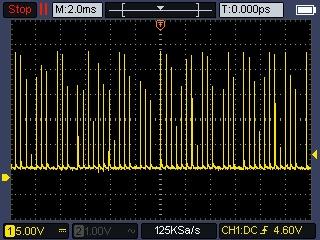
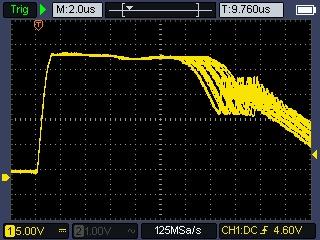
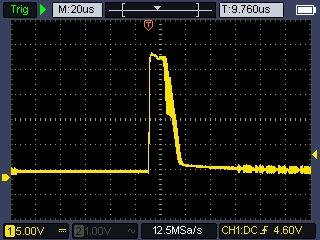
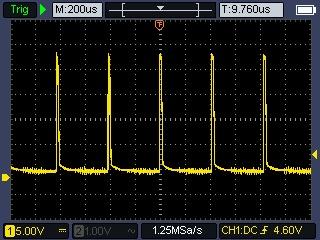
I'm talking about this one. I can see that there are sampling issues at 125kSa/s, but how can you tell that the smaller peaks here are phantom and that signal only has 24v peaks? If I switch from "auto" to "once" and re-trigger multiples times, each time it triggers I see different peaks, which match this plot.
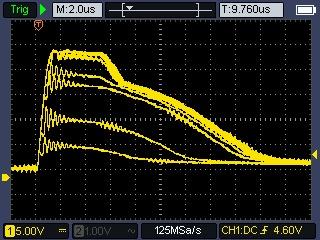
-
From my (more novice) perspective, Meanwell has a consistent 24v pulse which will ensure that the LED forward voltage will always be high enough to be "on". But, the EldoLED shows peaks of mixed voltages at a low-duty cycle. (I can see 5v, 10v, 17v and 19v peaks in there). The 7 LEDs per module have a forward voltage of around 2.9v x 7 = 20.3v. So, my thinking is that any peaks below 20v will mean the LEDs won't come on at all, or will only partially come on. This would make sense, given light output is less than expected at these levels. But why this would impact different modules differently I don't know! Any why the EldoLED driver does this is even more confusing.
-
Meanwell @ 1% output (34% perceived) - Meanwell is 2.5kHz and EldoLED 2.4kW. - That last 2.0ms plot isn't showing reality, as the Meanwell waveform is very consistent. - Meanwell actually seems to have a faster rise time, but it performs flawlessly vs. the EldoLED. Looks like the issue may be more to do with the fact that pulses don't seem to be consistently 24v with the EldoLED. If this is deliberate, a side-effect of the IC or some other component on the tape or some other issue I have no idea!
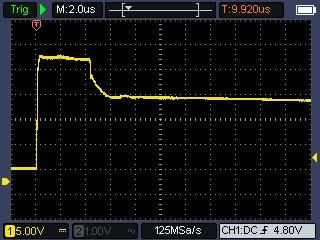
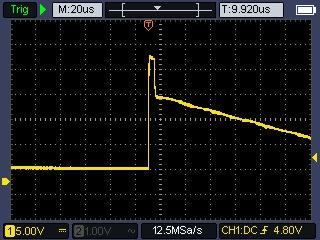
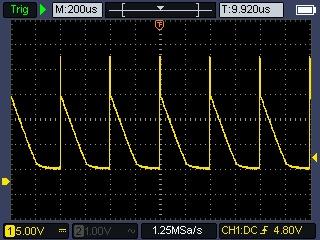
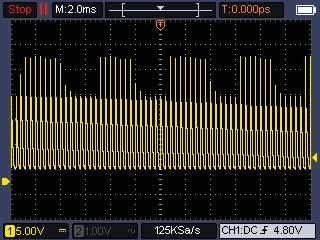
-
EldoLED @ 1% output (34% perceived) EldoLED @ 5% output (57% perceived)
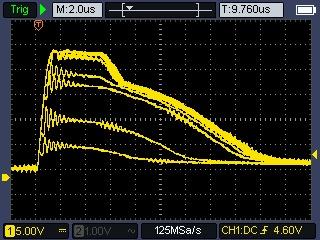
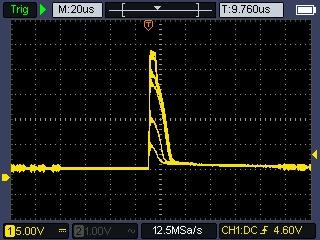
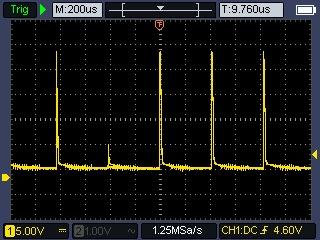
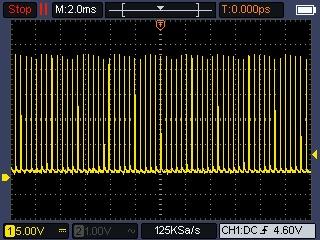
-
It may be this, but how would you explain it affecting some modules more than others? Also, my initial tests with the cheap scope seem to show that the Meanwell rise time is just as fast.. (let me post some screenshots) They all become the same brightness at around 2% (45% perceived), there isn't any sudden jump. My feeling is that generally modules are dimmer than they should be, rather than brighter, but it's hard to tell as I don't have two tapes sides by side with the different drivers.
-
Yes, definitely. I've borrowed a cheap scope, so will be interesting to see what they both produce. The reality is that the LED tape supplier should supply compatible tape/drivers (which doesn't seem to be the case), and given they supposedly have 5yr warranty, I'd like to think they can resolve this, especially given I must have a good 50-100m of this tape in total. That said, the diagnostics is very interesting, and if I know what the issue is it makes it easier to push for a solution and not get fobbed off 🙂
-
Yeah, I don't know if what I'm seeing is some brighter modules, some duller modules or a mixture. I assume the rise time is the same regardless of the duty cycle, but this side-effect only seems to be happening when the high is < 10uS (assuming 25 kHz PWM) Here's where it gets slightly more interesting. I happen to have a 5m length of the previous generation of this tape which uses the 420 (https://www.diodes.com/assets/Datasheets/BCR420UFD-BCR421UFD2.pdf) instead of the 430, and this appears to work fine. If you look at the 420 datasheet it talks about dimming down to 0.5% with 25kHz PWM which implies it deals with highs down to 0.2uS. On the other hand, the 430 datasheet seems to recommend reducing the frequency to achieve dimming. Meanwell + 420 OK Meanwell + 430 OK EldoLED + 420 OK EldoLED + 430 BAD
-
The LINEARdrive is used with a 24v Meanwell power supply, so the input is fixed at 24v The "Stabilized current design" means that each LED module (10cm with 7 LEDs) has its own driver IC which ensures constant current. The dimming is via PWM from LinearDrive. The on-tape IC output, in theory, also switches on/off based on PWM input. Looks like it's explained in the IC "application notes": https://www.diodes.com/assets/App-Note-Files/BCR430UW6-App-Note.pdf There seem to be some caveats in there about the "minimum duty cycle" and "rise time". Wonder if this might explain why dimming is perfect with a Meanwell driver but results in patchiness with the Eldoled.
-
Yes, it uses Log curve. DALI defines 45% as about 2.2%. The Meanwell driver goes down to 0.2% and the EldoLED down to 0.1%. Of course, while 2% seems low, from a perceived light perspective it's still quite bright and not ideal for this weird dimming behaviour as observed to happen.

