
Radian
-
Posts
2586 -
Joined
-
Last visited
-
Days Won
15
Everything posted by Radian
-
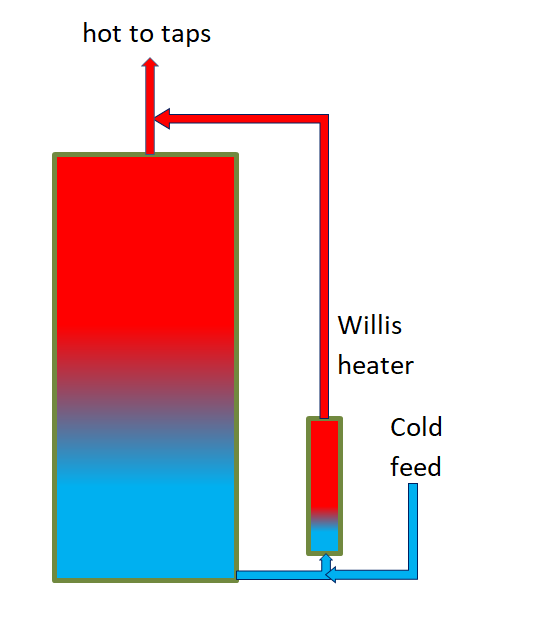
Bear with. I'm trying to get my head around this. Like this? So the cold water entering the bottom of the Willis heater will 'float' up once heated due to it's lower density (the basic principle of thermosyphoning). But will this continue to displace the hot water at the top of the HW cylinder until it's all 'pushed down'? I'm not finding it easy to picture the equilibrium point of the whole system.
-

Garden wall - am I obligated to repair?
Radian replied to jayseeninety's topic in Party Wall & Property Legal Issues
Some epoxy resin, thick long timbers both sides and clamps might pull most of it back. Or maybe just make it fall over. -
Do Octopus really let you bounce between tariffs like this? Seems too easy to game their system.
-
We've signed up for Octopus Outgoing but they're taking ages to get it all in place. Gave the old boiler a new lease of life by repairing it's SMPS and gaining full control over it via ebus (most importantly being able to adjust flow temperature for PDHW). That's right, brass or stainless steel. Not so much expense in the materials but lower economy of scale due to not being so universal in use. Paying £200 for a pump probably negates any economic advantage in using destratification in the life of this system (or mine come to that). I'm becoming a bit less less dismissive of the dangers of Legionella, as the forum post I linked to earlier said: And only today day I read how a woman had all four limbs amputated after contracting Legionella from a mist machine. The suggestion that mild exposure might lead to cold-like symptoms is the kicker for me. Disentangling this from hayfever (which our whole household suffers from) is fraught with difficulty. Yes I'm aware of their use for giving a boost to HW flow but plumbing one in doesn't really get me much further than using the internal one I've already got. The same tap points top and bottom would be required, but I guess thermosyphoning might eliminate the need for a circulating pump? And I thought the 27" one I bought was pretty long! Good suggestion though. [Quoted text from spammer deleted by mods. OP's following answer left in case of interest] To investigate suitability, I've been range-rating my gas boiler down to the lowest working power level and found 15kW to be about the lower limit before the house is to slow to respond. Insulation can't be taken much further without a major ripping out of vaulted ceilings and replacement of all glazing with 3G. But any savings gained would be equally applicable to gas. The only change in the equation would come with a significant re-structuring of the energy market to favor electric over gas. I see it as being pretty much on parity at the moment.
-
That's the really frustrating bit. I replaced our old cylinder with this one just a couple of years ago. Hadn't even heard of PV diversion back then and didn't even bother to fit an immersion until this year. Huh. Reading around other forums I see it's not even straightforward fitting a destratification pump as non-return valves don't seem to work well in gravity fed systems. They seem to double-up as check valves to prevent thermosyphoning and as such need a substantial forward flow. Plus the pumps are more expensive than regular CH circulation pumps as they have to deal with a constant supply of fresh hard-water.
-
Yes, there's a good reason for those annual checks. Mine's a vented cylinder with 22mm expansion "T'd" off the top so much less of an issue - although accidents have occurred when boiling water has deformed the storage tank in the loft where the vent pipe discharges. Anyway, I've started my own thread about the problems I'm having making use of DHW as an energy store
-
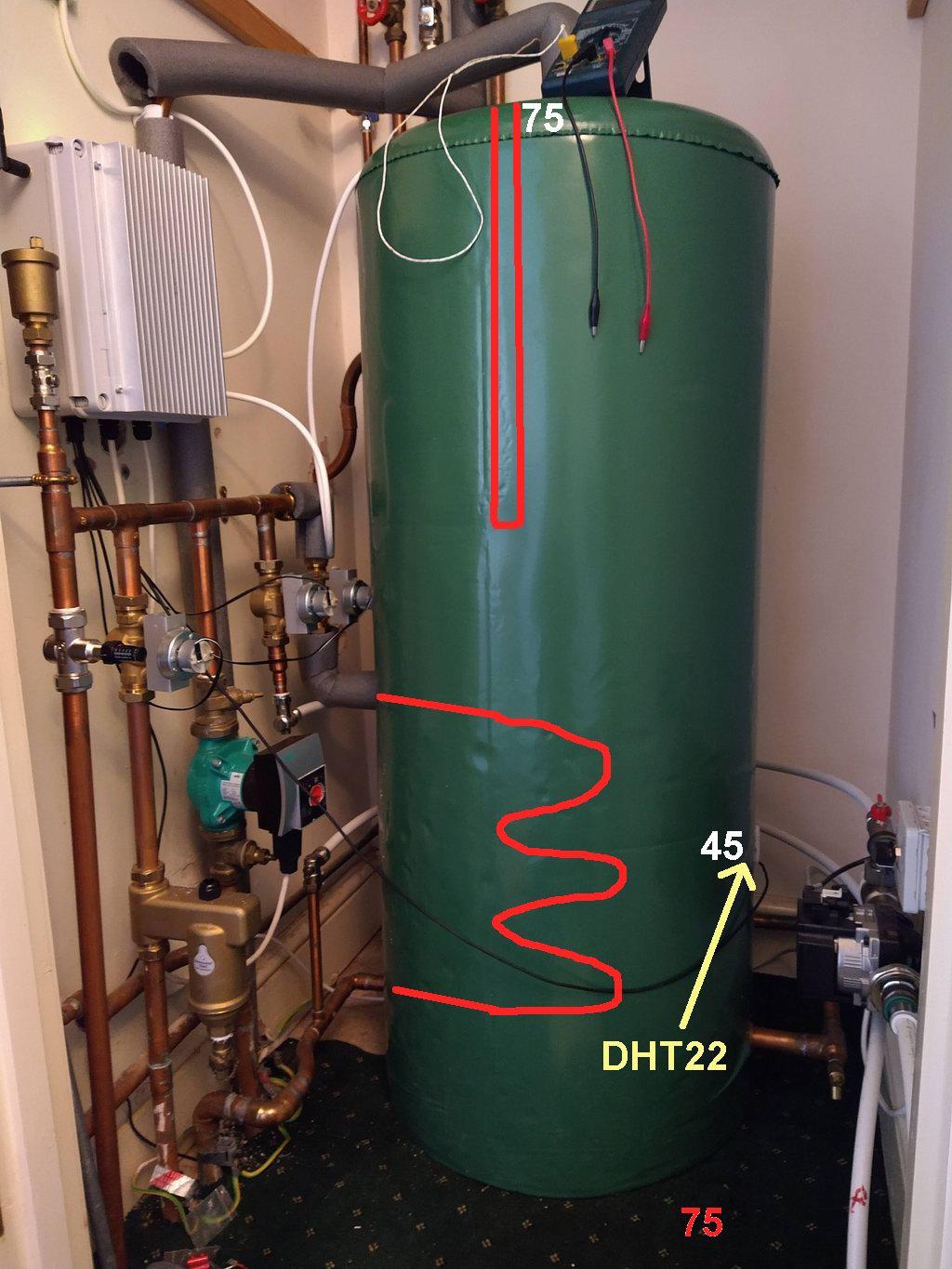
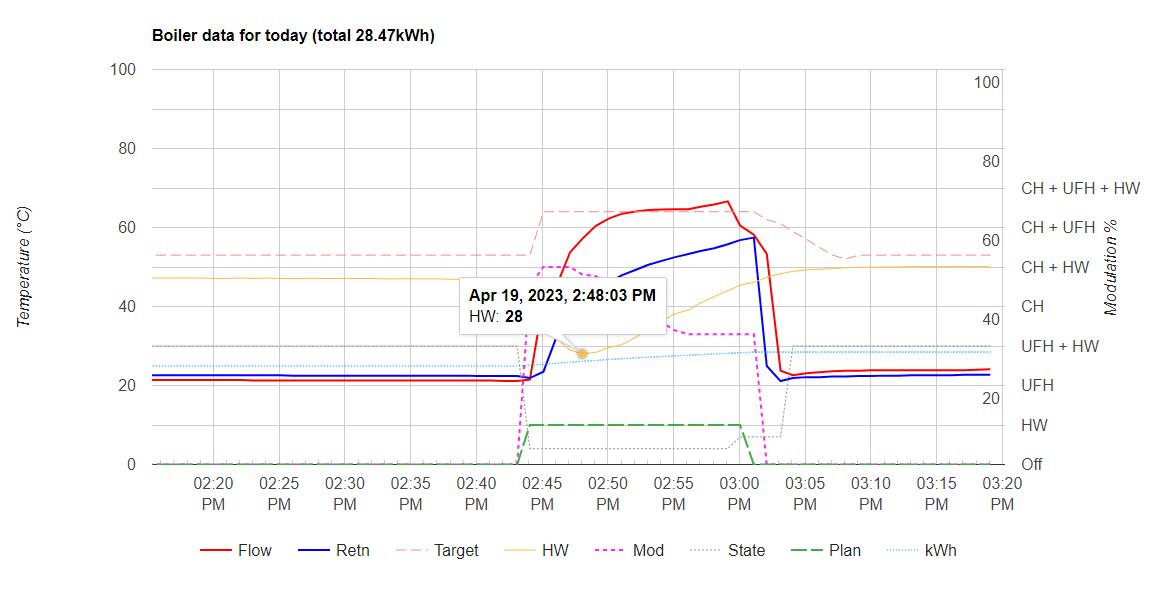
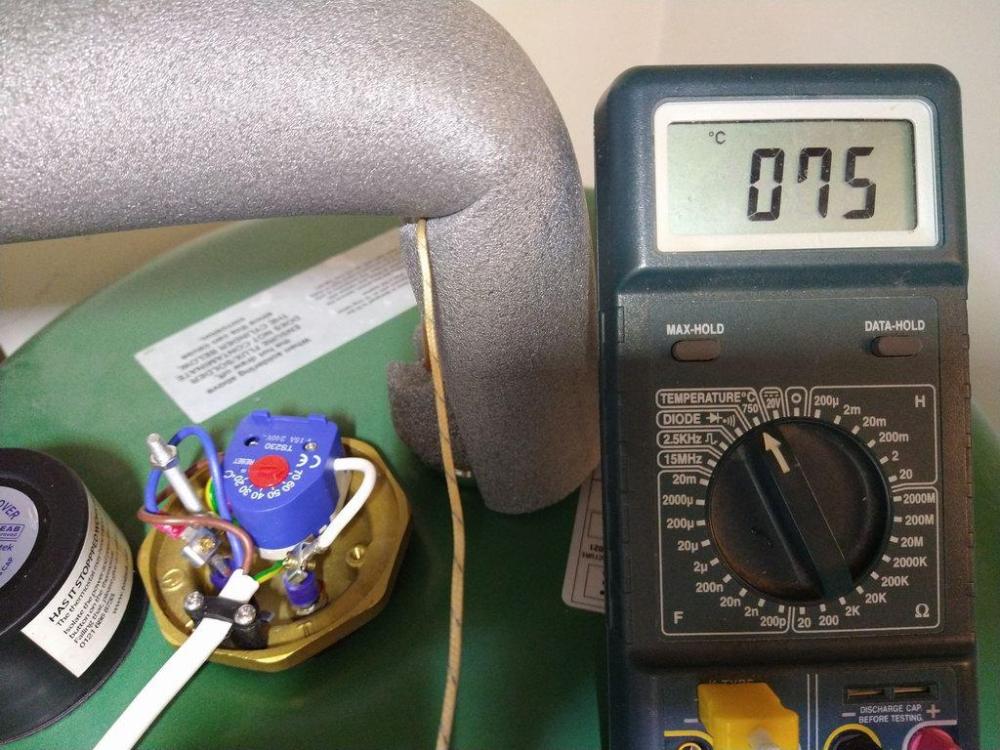
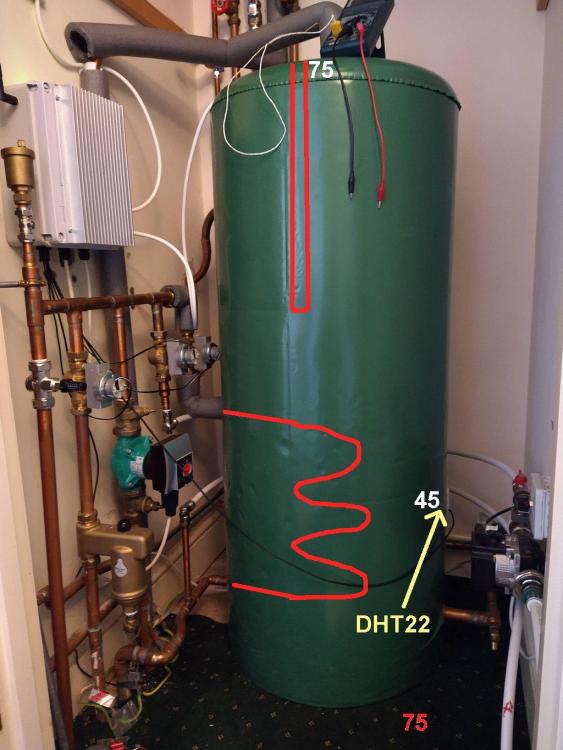
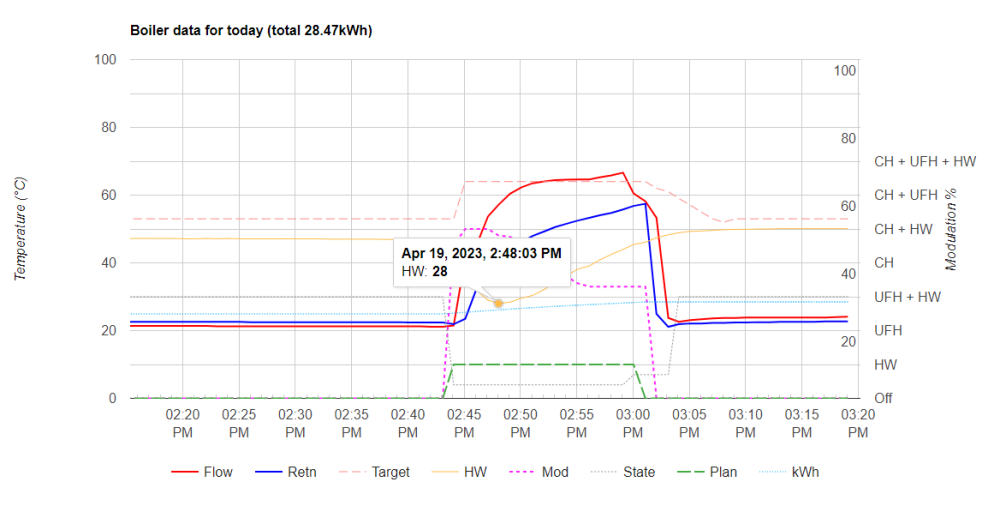
In a another recent thread I noted how I'd corrected the calibration of my immersion thermostat to store more energy using my DIY PV diverter as the factory setting was quite a bit out and switched off the immersion well before reaching the temperature setpoint. It now max's out at 75oC as promised on the dial. But I'm still very unhappy with the results I'm getting. Evidently due to stratification, the water leaving the top of the cylinder can be as high as 75oC while the point where my DHT22 tank sensor is located is at 45oC. This is a much greater difference than I anticipated. I confess to being totally inexperienced about this issue and it has really made all the effort of building the diverter somewhat pointless as I can only get about 3kWh into the tank at a time. Since getting 3.2kWp of solar PV on the roof late last year, this is the first time I've seen more than 20kWh generated in one day and more than half of that is now pointlessly going out to the grid. Even this whopping 30oC difference is being measured statically (when everything has settled for an hour or two). When I draw off water, it continues to come out at a constant 75oC for quite some time (while being pushed up by the cold feed) which rapidly trips the tank sensor turning on the gas boiler and I don't want that! Here's how it looks: briefly drawing off HW, the lower part of the tank got down to 28oC even though the water at the top was still coming out at 75oC (not plotted - the HW trace is the output from the DHT22, I don't have a permanent sensor at the top) The fact that the water coming off the top remains pretty constant at the same high temperature suggests an even slug of water to the depth of the immersion that gradually gets pushed up by the cold, like so: I get that a de-stratification pump would help but it'd be quite a bit of effort to implement and I'm not so sure the outcome would be worth it. I went blindly into building the diverter in the first place. I don't want to put even more effort into the project only to be disappointed once more.

-
So what's with that cable? I hope it's definitely going to stay dead!
-
Most efficient timetable for heating a unvented HWC
Radian replied to Adsibob's topic in Boilers & Hot Water Tanks
The losses from DHW cylinder and immediate pipework are also dependent on the temperature of the environment that they're housed in. It occurred to me that while it's difficult to add extra insulation directly to our cylinder, I can easily add insulation to the ceiling and inside the partition walls that form the airing cupboard. Reducing the temperature differential should result in a linearly proportional reduction of standing losses. -
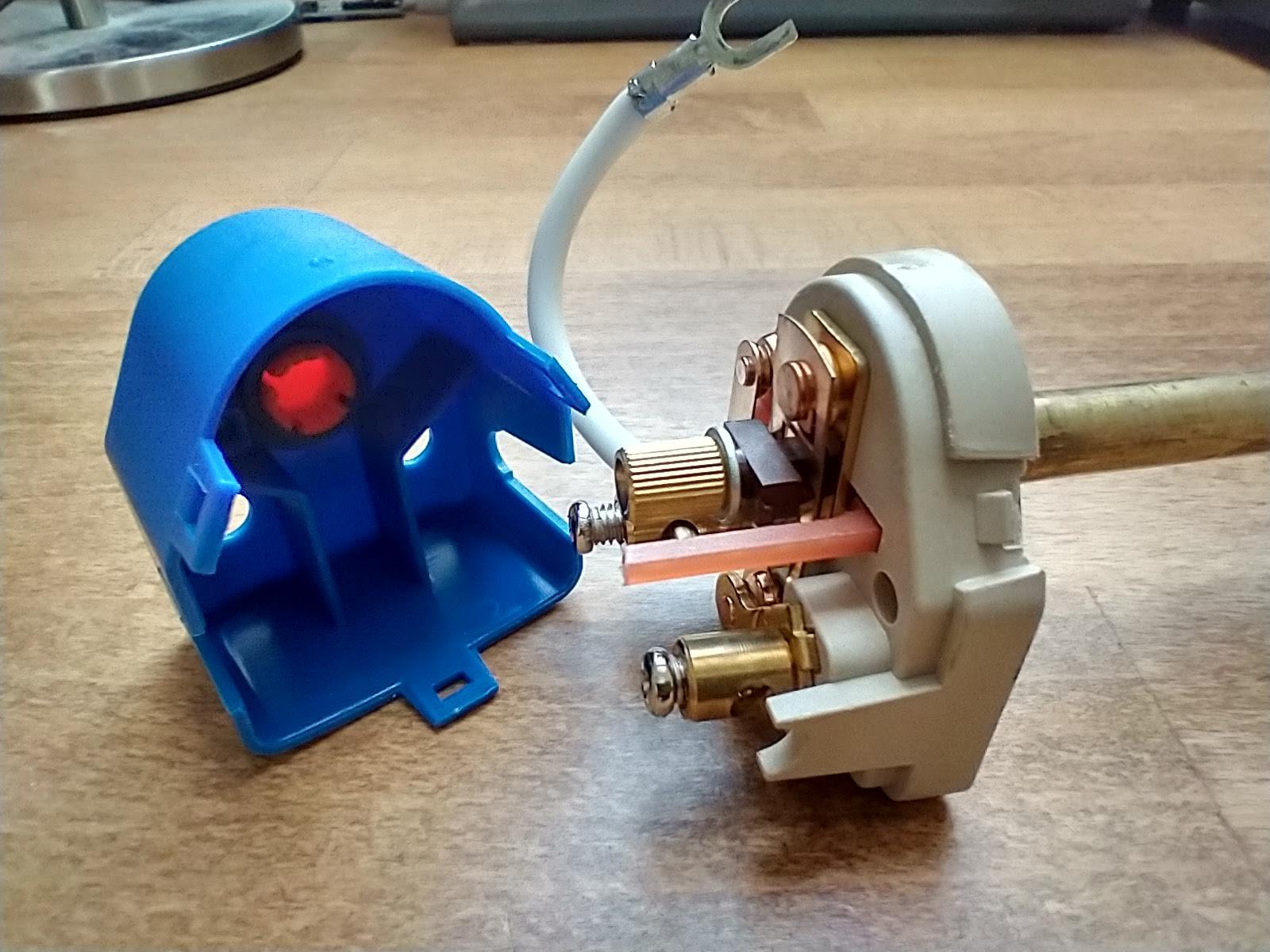
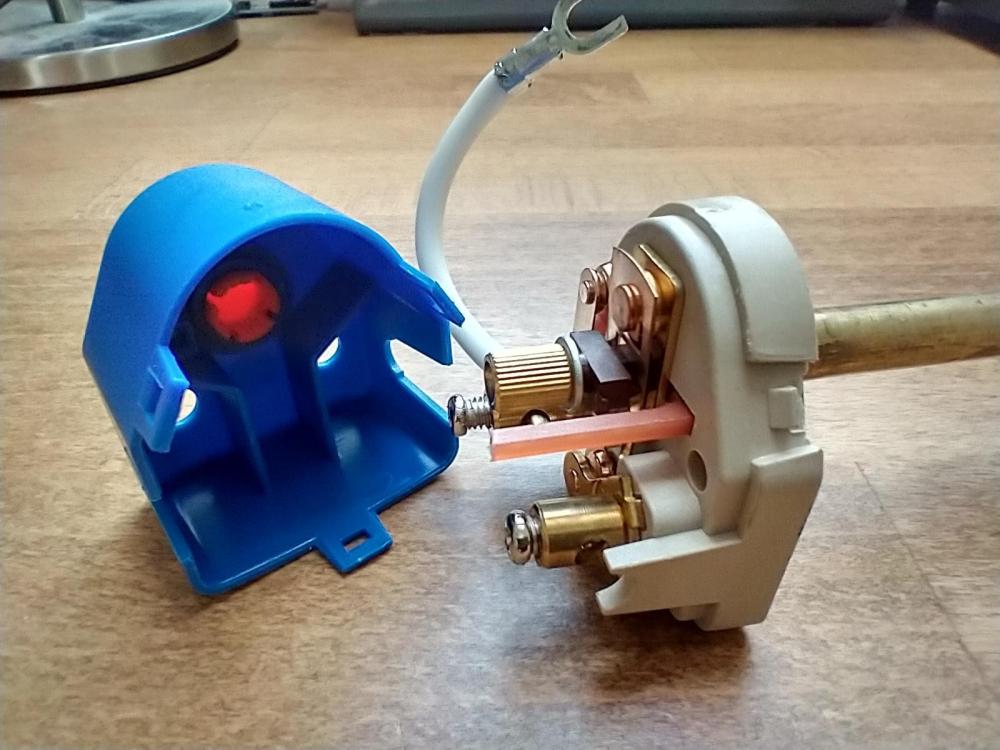
Testing the rod thermostat out of the cylinder I found the switching point is around 15oC lower than shown on the adjustment pointer. Difficult to say exactly because of around 5oC hysteresis. 15oC certainly tallies with what I was finding with the dial set to 70oC and getting water at 55oC. I took the cap off the thermostat assembly and found the pointer sits on a splined shaft so can be put back on with an offset. Trying that now.
-
Warm roof - which vapour control layer and which PIR?
Radian replied to BotusBuild's topic in Flat Roofs
I'll try to remember that next time I attend a riot. -
Very good point. So long as it exceeds the losses, the first law of thermodynamics makes sure that the temperature will rise regardless of reaching the design power.
-
So perhaps the water right next to the pocket with the sensing element in it does actually reach the setting on the dial, in which case the 70oC might be the truth. Maybe the difference with the temperature at the top of the tank reflects the physics of the water blending? The worry here is that bypassing the stat could lead to local boiling. I'm not worrying about catastrophic boiling of the whole cylinder but the consequences of boiling at the element might have a subtle effect on the element - might it push it past some design limit? Mixer taps get round the problem of storing HW at a wide range of temperatures so it's very tempting to find some way of lifting the limit.
-
Yeah but from what issue? Scalding hot water? Uncontrolled boiling in the cylinder? Electrical wiring or insulation integrity? In which case why promise 70oC and deliver 58oC? In other words, what perils await me and @JohnMo if we bypass the stat?
-
Where is your PV inverter? Reluctant to put them in house...
Radian replied to Carrerahill's topic in Photovoltaics (PV)
At 95% efficiency A 3kW inverter is going to dissipate around 150W so it's not more than having an extra person in the house. The devices themselves are extremely unlikely to catch fire (unlike batteries). They just go pop and blow a fuse if things go South. -
I'm also struggling to get more than 58oC hot water even when the built-in immersion thermostat is dialed all the way up to 70oC While I've also contemplated bypassing the immersion thermostat and controlling the heater with an external thermostat, I'm wondering if there's a reason for this apparent 'universal limitation' among like devices? Do they deliberately underrate them because they'll rapidly fall over if made any hotter? Seems odd that they'd consistently mislead with the temperature dial.
-
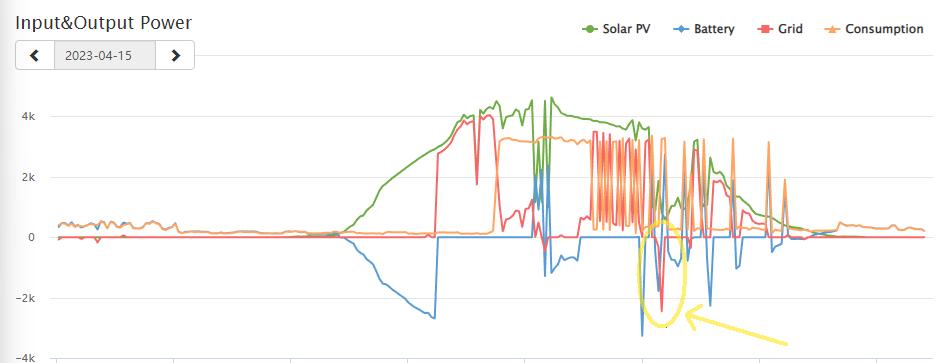
"Consumption" does indeed sound like local power demand - be it supplied by solar PV, battery or grid (or combination thereof) but seeing as how Grid is positive for exporting (i.e. when your battery is max'd out, all the excess power suddenly switches to going out to the Grid) then negative (below the line) would signify import. The way the red trace slopes down initially looks more than a spike to me. Just before, the battery took on charge while PV briefly rose. Then the Grid spike overlaps the battery discharge and consumption making it look to me as though the battery inverter reached its maximum generation limit (3kW?) and the load was such that a top-up was needed from the grid. That's what it looks like.
.png.88113d5b72d9b6f48c04224b3b2f4d1c.png)
-
You had cropped off the time axis legends so it may have been earlier than my guess of 5PM
-
Just wondered about the import spike at 5PMish. Nosey ain't I 🤣 Maybe an induction hob?
-
So I can see the immersion cycling on and off but what's the setpoint - did you wind it all the way to 70oC? Seems to by tripping lower than that. Oh, and what took around 6kW shortly after you switched off the immersion? The battery max'd out at 3KW and you imported another 3kW from the grid by the look of it. 😕
-
Sadly ALL these LED's are manufactured in China. The only advantage of buying from a UK seller is that they've probably already vetted the various models they've imported to eliminate the truly awful stuff.
-
I couldn't see where it says it's 'dimmable'? The 12V-24V spec means it has a buck regulator inside that maintains a constant LED current over the 12-24 volt range. Dimming can only be done with a PWM drive signal but that's not necessarily going to be nice to the buck regulator. Generally these are non-dimmable.
-
There's no active 'stirring' being done by the boiler, it's indirectly heating the water - just like the immersion rod. The big difference is your boiler is probably putting anything from 10kW to 20kW into the cylinder rather than the lowly 3kW of the immersion.
-
Nice work! I wonder how fine-grained you can make the control for use as a PV diverter load? To balance import/export to zero means working within 1000J or less (450J in the case of my utility meter) so you would need to run at minimum modulation for mere seconds. I doubt this would be possible or desirable. I guess a more approximate approach based on bulk energy monitoring against a minimum export threshold would be better than nothing. I've been experimenting with this but it's nowhere near as accurate as dumping mains cycles into an immersion load.
-
Yes, the self-oscillating power driver is incredibly simple (a couple mosfets, capacitors and inductors) and the same circuit can synchronously rectify at the receiving end. In fact, it's totally bi-directional - you can put DC in at either end and get it out at the other! Great for wirelessly charging drones which could also drop-off power at another station. If you notice there's another passive loop sitting on the floor 0.9m below with a blue LED. That's also receiving power. The CD case loop uses copper foil but that's a bit more lossy than the copper tube. The optimum coupling distance is in the order of the size of the transmitting loop so a wall-sized loop could light a floor lamp from a few m away. My bad. Megahertz.