
Radian
-
Posts
2586 -
Joined
-
Last visited
-
Days Won
15
Everything posted by Radian
-
I call ours a pain in the arse. Been on and off a couple of times to fix leaking into the cavity wall. And waste huge amounts of lead.
-
 Didn't the £5K BUS subsidy just push up the 'installation and supply' cost by £5K? Like when new solar panel installations got zero VAT rated and suddenly all the quotes we got went up by around 20%
 -
Has crud built up under the duct so creating a dam and keeping water in a pool on the other side? Repeated freeze/thaw might have weakened it - or maybe it's bio matting (algae) can't really see from photo.
-
What's the consensus on legionella and dhw storage temps
Radian replied to SimonD's topic in Boilers & Hot Water Tanks
From the report on MCS compliance page 51, my emphasis in bold: "Sterilisation or pasteurisation is achieved by raising the cylinder water to over 60°C. HSG274 (which refers to commercial installations) states that: “Arrangements should therefore be made to heat the whole water content of the calorifier, including that at the base, to a temperature of 60°C for one hour each day.” However, a review of heat pump manufacturers’ literature identifies varying guidance on the sterilisation process with temperatures ranging from 65°C to 73°C for between 30 and 90 minutes either weekly or fortnightly." It refers to HSG274 which is directed towards commercial installations and seems to be the only in-depth HSE guidance available. Then its goes on to show a diagram with a fairly typical looking immersion mounted in the top of a cylinder: Even if scheduled to heat at 60oC for one hour each day, this will fail to heat the water below the immersion without additional destratification measures. I appreciate that most new DHW cylinders installed alongside ASHP's will be unventilated types probably with bottom mounted immersions but with the widespread installation of top mounted units, it's clear that in many households it's been common practice to only partially heat the water when relying solely on the immersion to achieve the temperatures required for sterilisation. The lack of clarity in all this continues to bug me. I'm trying to emulate switching to an ASHP by modulating down my gas boiler but don't want to do something stupidly dangerous in the process. The plan was to use my solar PV diverter to heat the DHW via an immersion - hopefully exclusively so during the summer. I had already successfully reduced the flow temperature from the boiler to 55oC for radiators but all but given up on heating the HW cylinder with anything less than 70oC. I was hoping to eliminate this with the immersion but now I'm unsure. Obviously I can play it safe and run the boiler like this once a day but it's tempting not to. Hence wanting to get a thorough understanding of the issues.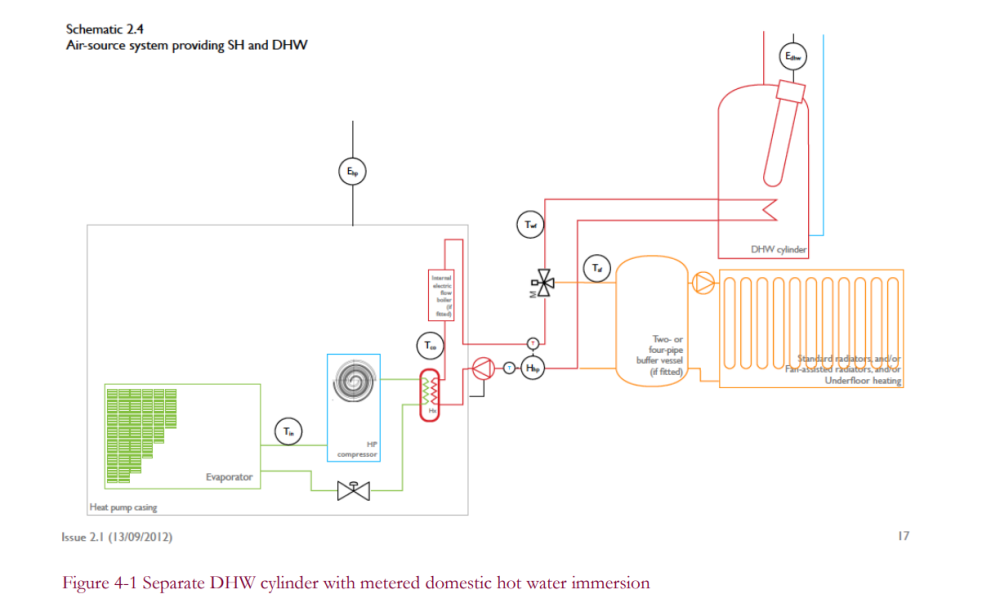
-
What's the consensus on legionella and dhw storage temps
Radian replied to SimonD's topic in Boilers & Hot Water Tanks
In addition to cleaning I actually replace them about once a year as the plastics degrade and become difficult to get properly clean. They're cheap enough on Amazon! An informal risk assessment is really what I'm talking about now. But if they're small enough to be suspended in the air, then they're breathable. I can see how I might be coming across as a unnecessary worrier, however it's more like I can see lot's of dots that don't seem to be joined up. I know there are (thankfully) very few reported cases of outbreaks - what I refer to as headline cases. But you may have noticed that I'm talking about lower level health issues that may be going unreported. What I'm making little headway with is the mechanics of the issue. The recommendations are clear enough but don't address the technicalities. Just recommending temperatures in excess of 60oC doesn't acknowledge the reality of stratification for example. And avoiding 'dead legs' isn't really referencing distant hot taps that have generally not reached full temperature by the time they're turned off. Or been fed by mixer valves to restrict their maximum temperature. In another recent topic, an MCS compliance document was posted up regarding ASHP installations that had some interesting points about Legionella, revealing that "very little specific advice is available for domestic applications" "ACoP L8 is supported by HSG274 Part 2 which cites temperature as the most common method of Legionella control: “It is recommended that hot water should be stored at 60°C and distributed so that it reaches a temperature of 50°C within one minute at outlets.” However, this guidance is aimed primarily at commercial hot water systems with either secondary returns (a pumped circulation pipe loop returning hot water to the cylinder for continuous reheating), or trace heating (an electrical resistance tape attached to the pipe where reheat is achieved by current flow in response to change in electrical resistance due to any drop in temperature). It therefore should be noted that all HSG & ACoP’s refer to non-domestic situations and very little specific advice is available for domestic applications." IMO the conclusions were fluffed stating that "between ⅓ and ¼ of the sites examined show regular patterns of immersion." which was used as a proxy to demonstrate that anti-Legionella measures had been implemented. It did not monitor actual DHW storage temperatures nor make clear those systems that achieved high temperature flows. -
What's the consensus on legionella and dhw storage temps
Radian replied to SimonD's topic in Boilers & Hot Water Tanks
I really do find that hard to believe. What's that mist of tiny water droplets I see in the beam of the shower light/fan as they're drawn in then? The point about atomisation is that being breathed in - this being a pulmonary condition. -
What's the consensus on legionella and dhw storage temps
Radian replied to SimonD's topic in Boilers & Hot Water Tanks
I'm dredging this topic up again due to recent revelations about the amount of stratification in my own open-vent DHW cylinder. It's possible that the majority of UK households still have vented systems. Regardless, they're common enough to consider the lack of reports about lethal infection as an indication that this is a non-issue. However, I know understand that the nature of Legionella infections are on a spectrum with the majority of exposures only resulting in non fatal flu-like symptoms. Maybe there is an issue after all? To quote hse.gov.uk: Likewise, most sources state that water temperatures should either be below 20oC at cold water outlets or higher than 50oC at hot water outlets. But I can identify plenty of situations where this isn't going to be the case. Last summer for instance, the cold water direct from the rising main here was 24oC around the days we hit 40oC, Freak event for sure, but maybe to be repeated much more often. But what does occur on a regular basis is the stratification of water temperature in a DHW cylinder. I'm left pondering the 80 liters of water that regularly sits at between 20oC and 40oC in the bottom half of my cylinder. Sure it gets heated to over 55oC and collects in the top half from where it's drawn - until the second long shower in succession runs cold. And what about the pipework between the mixing valve and hot tap in the bathroom - this transports and holds water at no more than 40oC by design. Clearly there are numerous cases where the recommended temperatures are not achieved in practice and I wonder if this might give rise to less serious health issues that don't make the headlines. Mysterious cold-like symptoms that could be mistaken for hay fever perhaps? -
I can easily change the HW setpoint - I just bark at Alexa: "set hot water to zero" (or any other desired temperature). This has been one of the more useful hacks I've done with my heating system as anyone in the house can give it a boost when planning to use HW without opening an app or using a wall mounted control. The programmed values are then restored at the given times. So yes, I can effectively override the boiler and even change the schedule but being lazy, and being an engineer, means I'm looking for the maximum amount of automation. This is a good suggestion. To begin with I will try it out by shifting the weighting towards HW HI as more PV divert Joules are accumulated. I'll have a ponder on that.
-
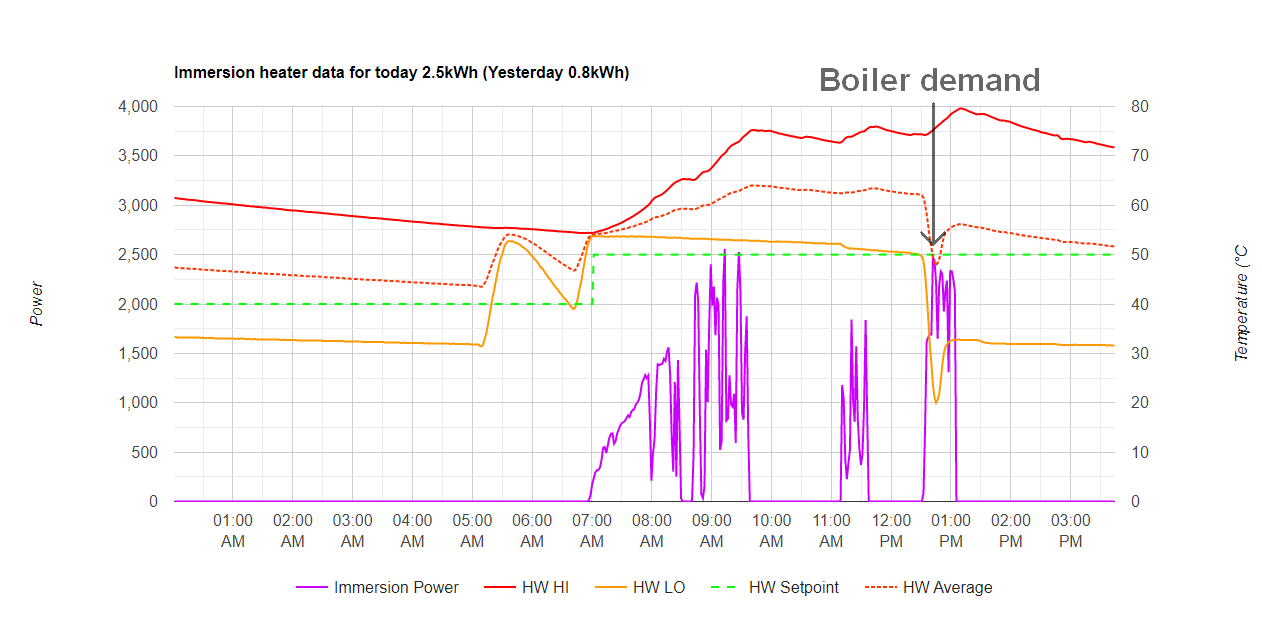
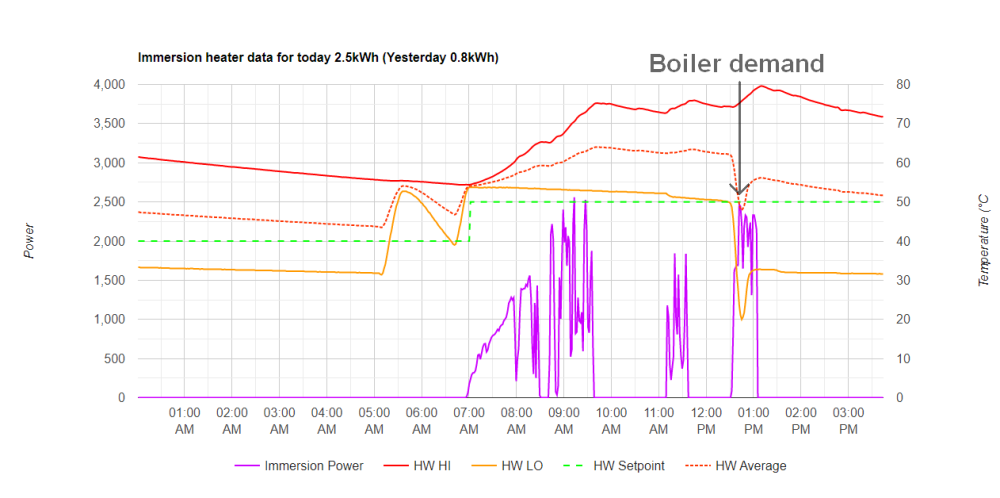
The faulty immersion has been replaced under warranty and, for the time being, extra expense on the plumbing has been vetoed while other more pressing issues are being addressed. This means I'm trying to make the most of what I've got: A 0.6m long immersion in the top half of a 1.2m tall (160l) cylinder. I've put in a permanent temperature sensor right at the top in addition to the one 1/3 the way up that was governing the boiler demand so I can plot the goings-on in the cylinder. Now the problem remains being how to stop the boiler firing-up when the partial draw-off of lovely hot Solar PV diverted water is replaced by unmixed cold when there's every prospect of there being sufficient 'free energy' up at the top of the tank to make this unnecessary. Take today so far for example: A nasty case of stratification: HW LO falls after 7AM while HW HI goes up. Ignoring the shenanigans until the Sun comes up at 7AM, the immersion gradually builds up the water temperature in the top half of the tank (red: HW HI), even while the lower half loses heat through ambient losses and occasional draw-off (orange: HW LO). Gas boiler demand is currently governed by the average of these two temperature readings (orange dashed: HW Average) so that at 12:30PM a 10 minute shower (🙄) displaces a significant amount of water causing the bottom sensor to fall to 20oC thus pulling the average below the HW Setpoint. The immersion was going great guns at this time and the HI sensor in the top of the tank shows plenty of HW was available - but still the boiler fired up. I guess I could weight the two sensors differently - 50/50 seemed like a reasonable starting point. But taking extreme cases to aid understanding, if the sensing was biased to 100% of HW HI, there might only be a tiny bit of HW just 'floating' at the top and nearly 160l of room temperature water below it. I could move the LO sensor up a bit but the current position has worked well before I built the PV diverter and in the winter its height reflects how long it takes to reheat the cylinder during sustained HW use. Any suggestions?
-
My take on this is that something is far better than nothing. So the cheapest grey foam 'pool noodles' that SF and TS hawk for around £1.50/m are good value. I also believe there's little point in going to town on the heating pipes leading to emitters. If emission is require in the building, a little extra heat leakage into the fabric isn't going anywhere unhelpful. However, HW storage and maybe the boiler flow & return to the valves on the HW side are worth keeping cosy. You don't want these pumping extra heat indoors during the summer.
-
Like the sea of brightly colored wheelie bins you see on terraced rows.
-
You'll need to search for an installation manual for your boiler. Most are easy to find even if decades old.
-
It's still a gamble if you get condensation or not. If this happens the main loft space won't be adequately vented.
-
A2A sizing - am I on the right track?
Radian replied to Gill's topic in Air Source Heat Pumps (ASHP)
If you have WiFi connected devices, like My Daikin A/C, then there's a scheduler that can be shared by multiple units. Investigate the smart options if available for the equipment you intend to buy. -
I think my experience shows the aims of the OP may be achievable - at least for those of us living in the South. I've been on a mission to range-rate my 30kW gas boiler down as far as possible to emulate replacement with an ASHP. The first step was to implement a digital interface to gain control of flow temperature to run separate DHW and radiator temperatures. Surprisingly to me, over the last winter, I managed to get down to 15kW max. power output and run the existing radiators at 55oC without any great drama. This is significantly lower than the original design levels. Less than 15kW didn't work out too well for the DHW when asking for 65oC so I caved in at 15kW (but I may re-visit this as I was under pressure to 'fix' things at the time). Now I've got full control over flow temperature I need to look at load or weather compensation to see if I could improve the projected SCOP. The house is detached 4/5 bed built to slightly worse insulation levels than should have been in force for 1998 although the empty cavity walls have recently had an EPS fill. Annual gas consumption has remained fairly consistent over the last four years (including this year's experiment) so the losses remain fairly constant but are replenished over a longer period.
-
We can't trust energy companies
Radian replied to Radian's topic in General Self Build & DIY Discussion
With half-hourly updates, multiple Time-Of-Use metering would seem to be unnecessary as it could be administered remotely - but it does depend on reliable communications and that's not a given. I wonder what they do to mitigate any dropouts? And why do even stone-age SMETS1 meters like mine have elaborate TOU registers if they're not actually used? Didn't we have a forum member join us recently who was in the supply industry... -
We can't trust energy companies
Radian replied to Radian's topic in General Self Build & DIY Discussion
Sorry, no. My meter is set for single rate and there's no indication in the app that it would be able to group usage but it would cost you nothing to try it. There's absolutely no pressure to engage with the company once you've installed the app. so nothing to lose in trying it. -
We can't trust energy companies
Radian replied to Radian's topic in General Self Build & DIY Discussion
This is what really bugs me. Last year I downloaded the Bright app and by just agreeing to share my data and providing the ID printed on my IHD I can see the half hourly DCC data in the app and through their API. For both my actual energy suppliers (old and new) to be groping around in the dark over this data is frankly ridiculous. -
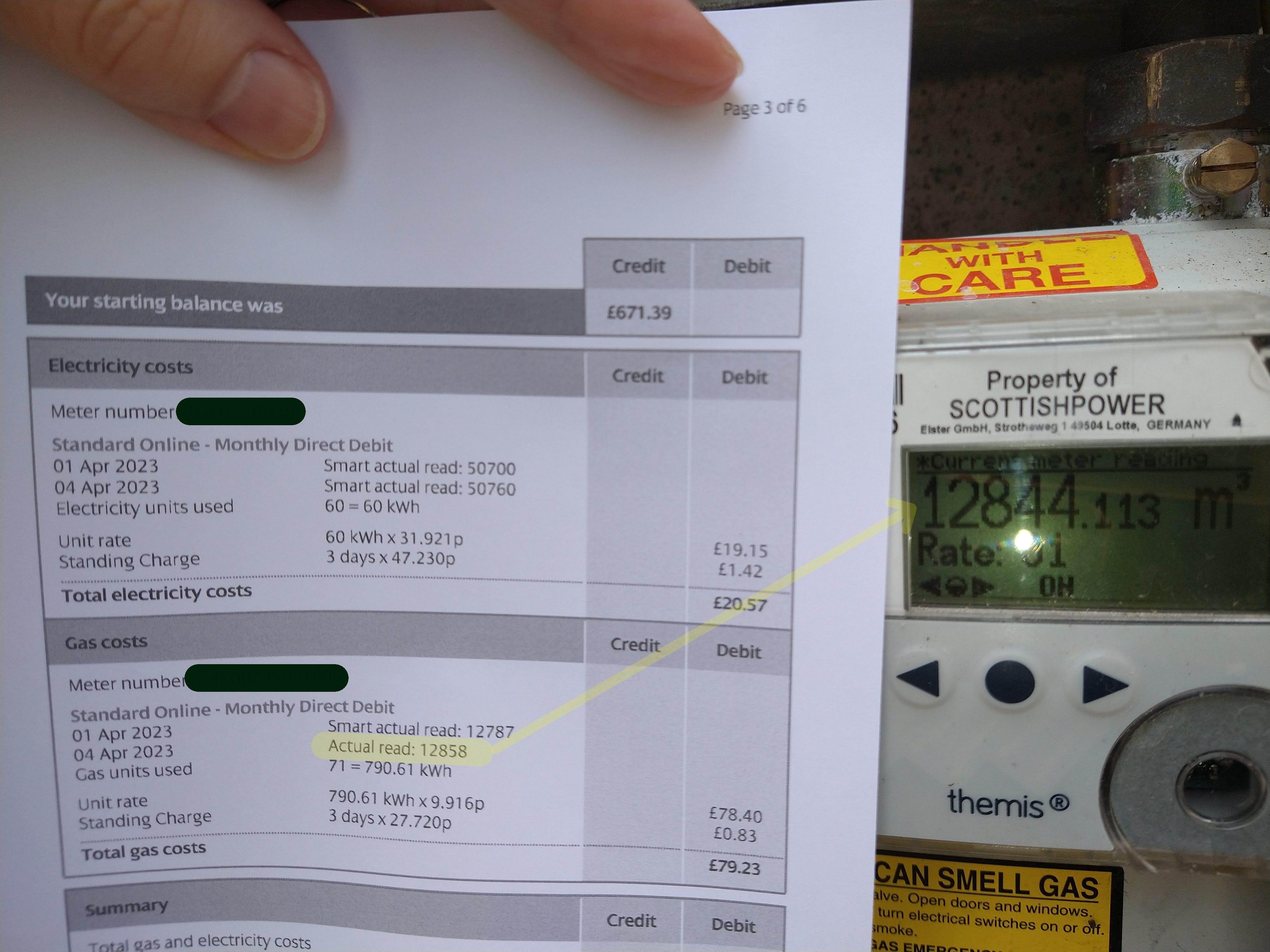
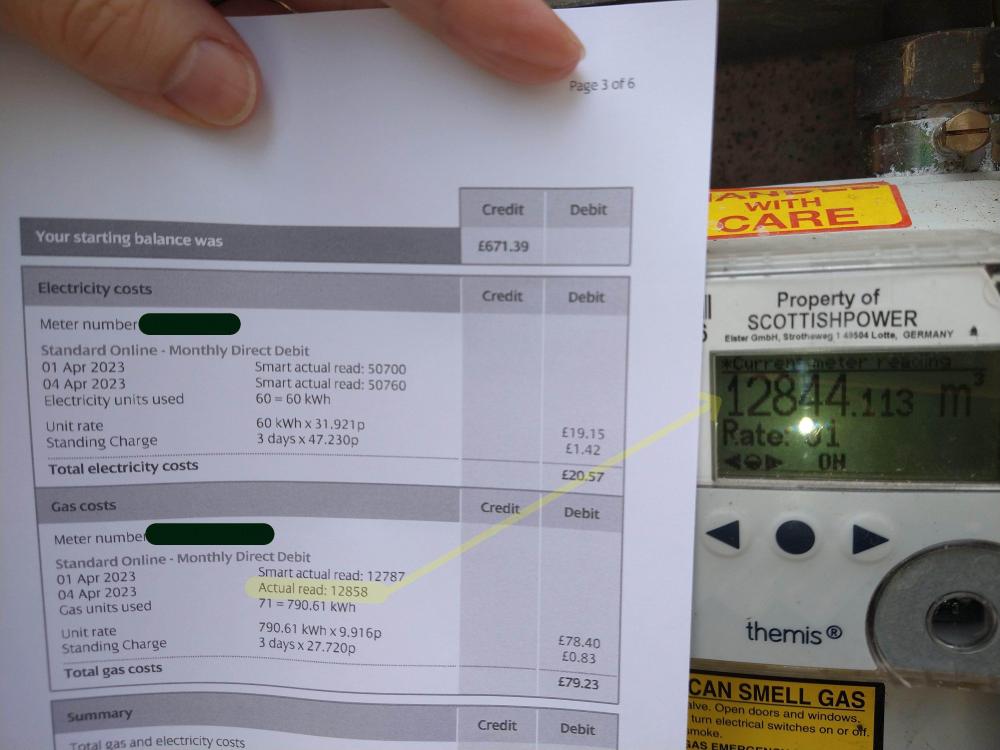
When we recently moved from our previous supplier to Octopus, I was prepared for a fight over getting back the huge amount of credit we'd stacked up (a consequence of our new Solar PV and cavity wall insulation radically dropping our bills after a cold spell late last year). What I hadn't bargained for was bare faced lying over alleged "actual" smart meter readings. Following an initial account statement that mostly agreed with my figures, I got another balance statement that covered the last few days in April before the handover on the 5th. This attempted to charge us nearly £80 for £15 worth of gas consumed, and a similarly inflated proportion for electric. The proof of this deceit was being able to take a photo of a printed copy of the alleged "Actual read" showing a higher figure than the actual meter reading -- even though this photo was taken a week later, when we got the final bill on the 12th. By then we still hadn't even racked up the amount of usage they were claiming for up to the 4th. Naturally this was to be deducted from our credit before it was refunded to us. Could easily have been overlooked by the customer and gotten away with.
-
Should I return this immersion heater?
Radian replied to Radian's topic in Electrics - Kitchen & Bathroom
Funny thing: I need a Titanium one for our very hard water. When I look for alternative makes I see reviews such as this: I'm seeing a really annoying pattern here. -
Should I return this immersion heater?
Radian replied to Radian's topic in Electrics - Kitchen & Bathroom
Genius. Went for the last resort option and bought another new one. This morning when it was powered by the solar PV diverter it took out the RCD on the consumer unit. Megger showing less than between 0 and 100K between Live and Earth. So insulation has broken down. I think it's got water inside the element as it even creates a junction EMF 0.8V through the disimilar metals and liquid electrolyte. The same crappy solder joints are present: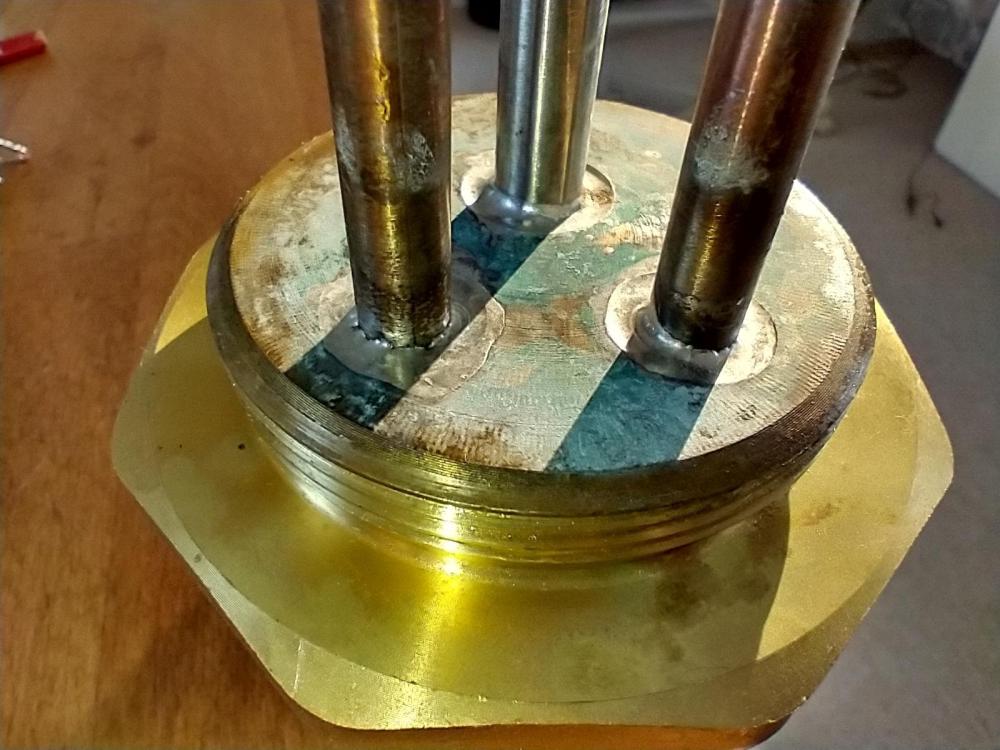
-
Terrific. Woke up to the RCD tripping off the house power just before 7AM. A quick look at my power plots confirmed my suspicion that the my Solar PV diverter had just started to dump the excess into the immersion. A megger test reveals that the insulation resistance of the immersion heater element was less that 1M. I can't seem to get a break with this project.
-
That would be a refreshing change! I'm doing my best to encourage such 'optimal usage' and am quite pleased with the response so far. Fresh hot cakes cooked by the Sun are a delight and reasonably guilt-free. But if I baked them it would still add to the carbon problem.
-
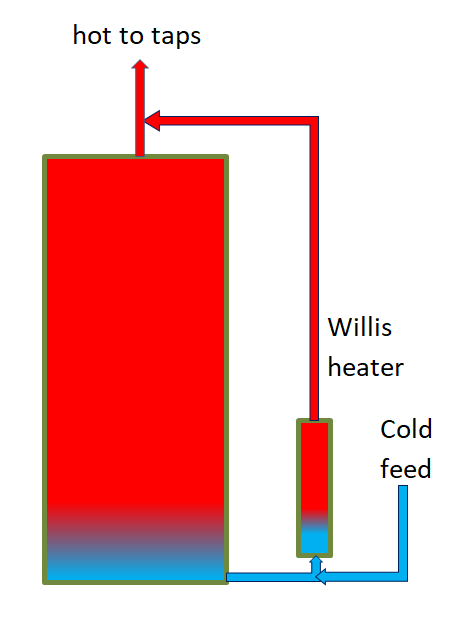
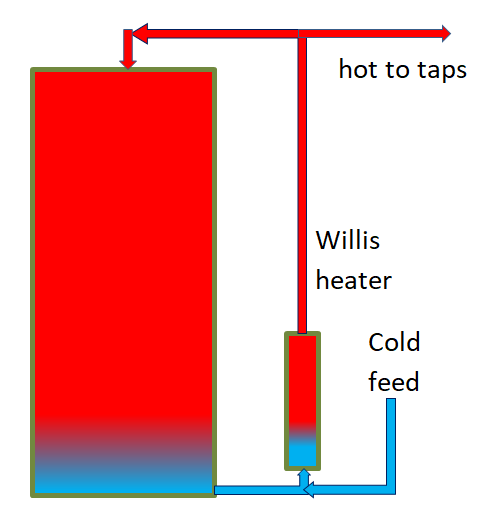
My power control into the immersion is proportional so I can adjust it as required. The advantage of having a powerful heater is that it can absorb excess energy when available. I'd like to 'fill it' as fast as possible - you never know when the Sun's going to go in or someone decides to bake a cake. Currently the top half of the cylinder (almost exactly half: 1.2m high cylinder, 0.6m high immersion heater) has 60l which will increase in temperature by 1000/(60*1.16) = 14.4oC for every kWh put in. A 3kW heater doesn't exactly sound crazy. It would be great if that was the case. At the moment, the slightest draw-off from the top of the cylinder brings fresh cold up to the thermostat around 1/3 the way up the cylinder and invariably trips the boiler on even though there's a vast amount of 70oC water up at the top (when sunny). I'm trying to work out the best pipe layout to help this happen. Literally what I've drawn would seem to be a good start as the first thing the cold flow going in sees is the Willis, but I think the take-off point could be improved like this:
-
So it can't get 'plugged' with a buoyant slug of hot water at the top of the cylinder like in the picture I posted above? Hopefully then it sinks ending up like this...