
Radian
-
Posts
2586 -
Joined
-
Last visited
-
Days Won
15
Everything posted by Radian
-
My previous post gave you the cause of the problem. The compressor is working but an internal heating element in the crankcase is faulty (R1). Obviously replacing the compressor would clear the fault but may be unnecessary if the heating element Insulation Resistance can be restored. Leaving relay KA6/2 permanently out of circuit will clear the fault but may compromise the operation of the compressor in the long-term. An electrician who has an insulation resistance checker could monitor the actual condition of the element and if not too much leakage current, could power the element in an attempt to dry out the moisture that's causing the breakdown. That would be my approach.
-
R1 is listed as compressor crankcase heater. Seems as though there's an Insulation Resistance breakdown in the compressor housing. Running that heater element in isolation (not via an RCD) may restore its integrity. Moisture may have been accumulating and now we're in the colder seasons the heater is coming on and tripping. Infrequently used cooker elements have the same habit of tripping when used for the first time in a long while.
-
Hi Bosi, How is the manifold plumbed into your heating system? Is there a zone valve? Does the pump have any built-in activation sensing (i.e. a control box that senses water coming in above a certain temperature)?
-
Insulating the entire housing stock might just be technically possible but air tightness? I only wish.
-
Good point! In our case it's nice to stand in the opening and peer out at the neighbours to the side ? The view to distant hills is quite good as well.
-
Thanks TonyT, I just came across this very old iscussion on the IET forum which explains it quite well.
-
Yes, that's what the paragraph about cable resistance was all about. It's a separate issue to the 'no intermediate load' stuff - indeed such loads would help keep the AC volts down. I can only guess they say don't do it because there would be no residual current protection for intermediate loads.
-
Not really practical to extend the DC side. But from the Chinese table the loss in a 20m long 6mm2 cable is given as 0.5% Looking at some tables for SWA, 8 mV/A/m is the volt-drop in a 6mm2 cable so I'd be looking at 2 x 2.56V drop @16A (4kW) which is more like 0.2% The inverter must (will) have some form of current limit so the RCBO between it and the grid will be there to protect the cable in between.
-
Thanks Marvin. Ah, I see, they say no loads between inverter and main breaker. Now I already realised that there would need to be an RCBO in the garage consumer unit, for local loads, to provide protection from the current coming out of the inverter if that was connected direct to the SWA. But I can't read any explanation into why they're saying no intermediate loads. A local load will look no different to the inverter if presented before its connection to the RCBO or on the other side. Sure it will create an intermediate voltage drop that will lead to less current going back into the house/grid, but this is balanced exactly by the local load so there's no nett loss. I wish all statements such as the one they're making were accompanied by an explanation ?
-
Looking at installing 3 or 4 kW on our detached garage as it has the only suitable unshaded roof available. The Garage has a small consumer unit cabled in 6mm2 SWA back to house on a 32A MCB. This cable is something like 20m long. Does this sound OK when most of the load is in the house? The inverter would be in the garage of course.
-
'Twas from here.
-
Same here. Gave up and settled for this instead: These seem to be widely available

-
You're welcome. What's their delivery going to be? The best way I found to cut it was with a TCT blade with lots of teeth otherwise spec'd for aluminium. Obviously chop saw flies through it but you can easily saw by hand or any other kind of tooling you would normally use with wood. For scribing to irregular butt-joints the jigsaw is OK but has to be variable speed set to almost the lowest. Any faster and the kerf of cut just melts back together - as though you'd never cut through it! Oh, and WD40 (or other kind of silicone spray) is good for keeping blades lubricated and polishing the plastic if it gets scuffed. I like this stuff because it's 100% PS, unlike some composite cladding and because its colour is all the way through not just a surface wrap like all the UPVC alternatives I found. The only downside is its fire performance which I'm sure is absolutely dismal.
-
I used that to trim another gap I had. I added dye to black it out. Got some sexy black vents in there too but you can't see them... Time will tell if it stays put.
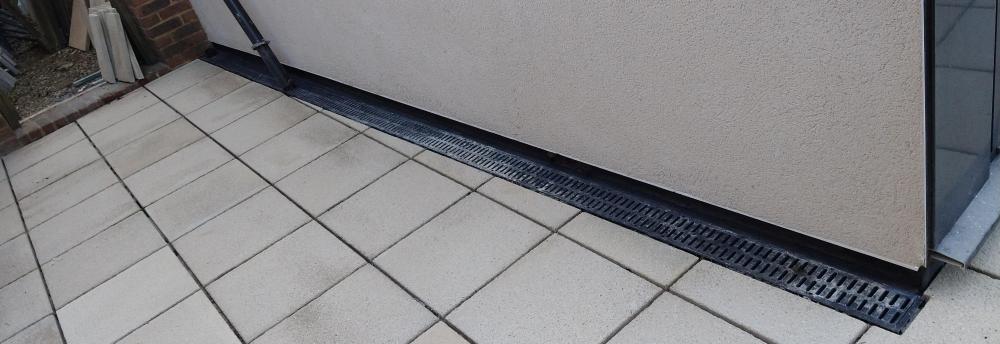
-
Oh, 12:1 then ?
-
I agree with Buzz here. At this time of year it takes weeks to be rid of all the water that went into the mix. The mortar might cure in a few days but it remains damp for considerably longer. Dampness hides the efflorescence that will inevitably develop and lighten the joints in time.
-

Garden patio compromise - ideas how to decide
Radian replied to Haylingbilly's topic in Landscaping, Decking & Patios
Perhaps you could make the retaining wall look more attractive. A half-way house might be to terrace it by having two 0.5m lifts. The lowest is used as a planter, maybe just 0.5m deep. -
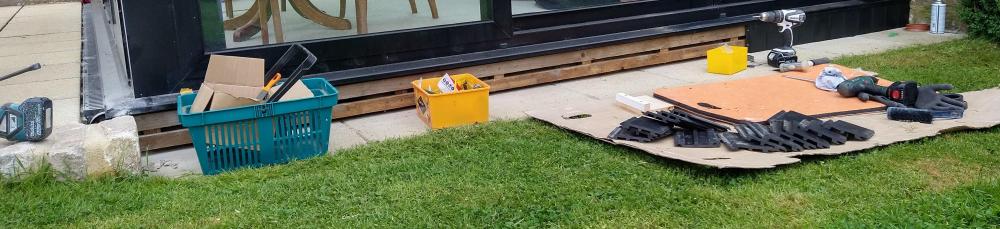
Kedel.co.uk was the place I got it from I secured short vertical battens every 400mm onto the blockwork with then fixed horizontal battens on top of those. You can get plastic battens to make this last a lifetime or if you're on a tight budget (like me) use recycled roofing battens. ?
-
Free to collect from Dorset. (This kind of stuff:)
.jpg.d566c7094c8ece1cbdc761d024917bb5.jpg)
-
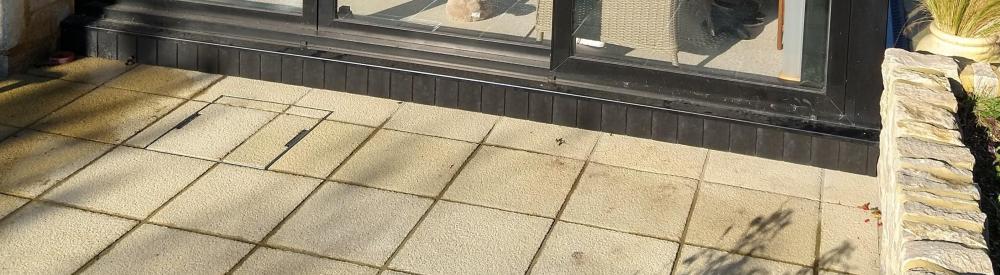
Hi. I used PS cladding to finish my plinths. This cladding was used on other elevations so it made sense in the overal design. It also meant that I could pack the horizontal battens to bring it out to the edge of the sills. I understand that the PS is made from recycled CD cases!
-
Semi-final plans --- feedback/critique welcome!
Radian replied to RK6's topic in New House & Self Build Design
I think this point is all too easily overlooked. From personal experience, my advice to people who plan to work from home is to take every opportunity to minimise temptations to slip seamlessly between home and work as it is both counterproductive and can become a pressure-cooker for stress. We deliberately left an 'air gap' between our home and an outbuilding we recently extended to operate our business from. It may mean making a quick dash when raining but that's an important part of the overall philosophy. It would have been all too easy to link the buildings and wander from room to room but now the conscious decision to 'go to work' then 'come home' feels much better. -
I'm sure that would go through the pointmaster. If you look at the dimensions of the nozzle (say 10mm x 50mm) then there's no reason it wouldn't flow - BUT if compressed into that space it could interlock. That's the whole thrust of my diatribe here... keep the pressure as low as possible yet keep the volume moving and it all works out. The deeper the pocket you can fill, the easier this is to acheive.
-
What do the boiler manufacturer's installation instructions say about what you can do with the PRV pipe? Sometimes the MI's have some useful tips.
- 12 replies
-
- 1
-

-
- copper pipe
- thermal bridge
- (and 2 more)
-
Garden patio compromise - ideas how to decide
Radian replied to Haylingbilly's topic in Landscaping, Decking & Patios
Is the ramp to the left of the main steps really going up to them? -
The sand I had wasn't supposed to be sharp but it wasn't particularly well graded. However, the makers of the gun with the wide nozzle actually do claim it can be used with sharp. It was a right faf sifting it before I discovered it wasn't necessary.