


Hastings
-
Posts
284 -
Joined
-
Last visited
Everything posted by Hastings
-
I would definitely not release mice any further away from where nearby resident ones will already be living, probably just a matter of a few metres from your garage. Finding any suitable but also unoccupied territory at any distance away is practically impossible, and the further away you take them the greater the stress and likelihood of death you cause them.
-
In this day and age and the Animal Welfare Act (2006) legislation http://www.legislation.gov.uk/ukpga/2006/45/contents , I personally wouldn't take the risk of publicly suggesting something that might be illegal, which deliberate drowning of a rodent almost certainly would be. The law is complex, often quite surprising and little known about by the general public. Certainly there is no particular right in the UK to choose any method we like to kill an animal. Relocating and releasing a live-trapped vertebrate is possibly unlawful in the case of mice, definitely unlawful in the case of certain specific species (and not just pest species like grey squirrel or signal crayfish).
-
Mice are good swimmers and not afraid of water. Be aware of UK law when it comes to dispatching them https://www.gov.uk/pest-control-on-your-property
-
There is a Hikoki gas version at £290 - the gasless one is £440 (with batteries) and although I doubt I will get enough use out of it to benefit from the lower running cost, after re-sale it's not going to be an issue.
-
Thanks Russell. I'm drawn to the Hikoki - almost half the price of Paslode. Any problems with the gas (pressure?) in the +5 to +15C range I'm likely to be working in? Is it like with Propane vs Butane in lower temperatures?
-
Working on my own and on a steep learning curve I won't be firing 1000s of nails a day, so lower battery capacity caused by temps is not likely to worry me. Running out of gas canisters would be a bigger issue as everything like that comes via ferry so I would need to over buy on gas to prevent that. Modern Li-Ion batts are so much better in cold compared to the Ni-Cads I was using in the 90s (when I had to get by with them on a cine camera in -40C). Anyone know about the Dewalt or other battery-only first fix nailers?
-
Good point. This project is off grid and whilst we will have 240V from sun and wind to batteries at some point, for the moment a small petrol genny is our power - makes running an electric compressor not a sensible option I think. It's an island site too so transporting compressor will add cost again.
-
Just for the record regarding screws for framing, since nobody has mentioned them yet, I was looking at these kind made specifically for timber framing (Simpson do something similar) :
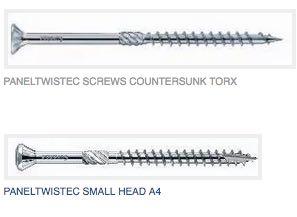
-
My roofers used a gas canister Paslode and I didn't notice they had any issues with it but then I was paying for all materials including gas. There are about 5000 of 63mm nails needed just to fix 11mm OSB sheathing to all the walls and to the upstairs ceiling. That'll be getting on for £100 in gas plus I'll be working in cool weather (7-11C range). Wouldn't I be better using a battery only gun like the Dewalt? I will build the walls in sections then fix in place, therefore will be switching between 2 or 3 different nails (90mm, 75mm, 63mm) - how much an issue is that in practice? I've never used one.
-
Thanks for the replies. Very useful to hear viewpoints from outside the box. I hadn't thought about the added cost of 1,000s of screws vs nails. I'll go with nails and can stop worrying about the structural implications of not using them.
-
90mm Round Wire and 75mm Ring Shanked x3.1mm Paslode nails are specified in the engineer's drawings. I think it is pretty standard for 2"x4" structural framing sheathed with 11mm OSB. Did your engineer approve the screws instead?
-
Are screws an acceptable alternative to using nails in a timber frame structure or are nails the only fixing flexible enough for the task? I want to avoid the cost of a nail gun but also having just demolished the ptevious timber frame build I'd like to make the new frame easier to demolish without damage to the material when it's time is up. The build is inside an existing stone building on two levels and will not be supporting the roof.
-
New house build inside old house - timber stud or SIP?
Hastings replied to Hastings's topic in New House & Self Build Design
Thanks for the help and ideas everybody, I've now headed over to the Timber Frame forum here to learn more. -
New house build inside old house - timber stud or SIP?
Hastings replied to Hastings's topic in New House & Self Build Design
Yes, that's the current plan but I'd like to improve on the design details ie. get the upper floor joists to be contained within/inside thermal envelope and sole plate insulated from foundations concrete. I don't feel like I have the best stick frame design details in place. Is there somewhere online I can refer to for current best practice? -
New house build inside old house - timber stud or SIP?
Hastings replied to Hastings's topic in New House & Self Build Design
Thanks for that very clear explanation. I now realise that what I was thinking of is not really SIP but perhaps semi-SIP, where two OSB layers are seperated by timber framing and then insulation blown in on site after construction. Posi joists barely penetrate the walls at all. I've noticed this from several Passivhaus new builds (e.g.. @JSHarris's very helpful draw gs) I will need metal web floor joists to facilitate air ducting. -
New house build inside old house - timber stud or SIP?
Hastings replied to Hastings's topic in New House & Self Build Design
Useful suggestions Thank you. Will look the GBS project up. Who is MBC? I'm aiming at adding only 150mm to the existing 500-700mm walls so not that much impact on floor space. In fact I look at the reduction as a positive, being a fan of less is more. I would go further but for the not so positive 'tunnel' effect on window openings (even with their angled reveals). The current design has Simpson L brackets fixed to ring beam and to external wall just to tie in walls as well as maintain 25mm air gap and maintain air flow up to roof space. Compacfoam is interesting - will have a look at that. Having the upper floor resting on the stone walls instead of on the stud frame would allow a reduction in the framing and therefore more insulation in place it. -
New house build inside old house - timber stud or SIP?
Hastings replied to Hastings's topic in New House & Self Build Design
I can't imagine any new refit of today not becoming very obsolete within a very short time compared to the overall life of the building (approx 150 yrs to date) - say 30-50 yrs tops? Never heard of foam as best way to waterproof rubble walls. -
New house build inside old house - timber stud or SIP?
Hastings replied to Hastings's topic in New House & Self Build Design
Yes roof is fitted. I would assemble the panels inside the house, in sections and stand them up into position, yes, the same as the with a stud frame design. It sounds as if I need to understand more what a SIP actually consists of. -
New house build inside old house - timber stud or SIP?
Hastings replied to Hastings's topic in New House & Self Build Design
This is more farmhouse than croft so two full storeys and the roof space will not be used for living space. The new roof trusses tie the wall heads together. I hope the old rotten mid floor was no longer providing any structural help because it was removed a few weeks ago in preparation for the new internal concrete floor - footings for the timber frame build. I will not use any foams or foam, spray or board based, when it can be avoided as I can't imagine how it will be disposed of at end of life. I've also seen how boards like Celotex can distort and shrink after storing a leftover sheet loose in my garage. I will be using wood fibre insulation. The air gap between the new stud frame and the old stone wall has to be lightly ventilated with small holes in the stone wall 300mm above ground level every 1.5m and open at the top to the roof space. I would rather not ventilate that much but Building control insisted. -
The project is an internally insulated airtight/MVHR refurb of an old rectangular stone house on two levels. A standard way to do an internal insulation refurb of an old solid stone walled house in Scotland is to build a new internal timber stud wall, set 25mm back from the outer wall. In my case the wall is proposed as 11mm OSB, 95mm timber stud infilled with insulation, 20mm insulation board, plasterboard and skim. This seems a sensible option if the existing old upper floor(s) structures are to remain. But what if, as in my case, the upper floor is condemned due to woodworm, wet and dry rot and has to be entirely replaced with new floor? Basically the whole house is now stripped out and new roof fitted, leaving a 'barn' like single interior space. In this case, is there not an opportunity for a thermally more efficient SIP (structural insulated panels) type inner rebuild? In the timber stud wall design I have for my project the engineer has specified a new upper floor structure made up as a stressed deck (plywood screwed to 445x45 joists) that spans the entire open plan ground floor 10mx5.5m kitchen/living space, supported only around the 4 wall edges. What I don’t like about this is that the floor joists extend all the way across the top of the ground floor stud walls, in the form of a double joist ring-beam going around the entire perimeter, thus interrupting the thermal continuity between ground floor walls and upper floor walls. I would much prefer that the whole floor deck hangs off the inside face of the new timber wall without obstructing the thermal envelope, as I understand to be the case with SIP construction. SIP construction of course is in its element when it comes to new build but is there any reason why the design is not also very suitable for putting together from scratch on site in a major internal refurb of an old house?
-
Does anyone have any experience of the Interflush device, fitted to cisterns to save water? It seems like a great idea, as I don't believe dual flush really works in practice as it makes naive assumptions about human nature. It seems to be designed for the lever action flushers which I don't see on offer any longer.
-
Internal wall insulation 600mm masonry wall - condensation risk
Hastings replied to Robbie's topic in Heat Insulation
@jake Pavatex is the system. Natural Building Technologies is the UK distributor. -
Celotex installed in cavity block wall build
Hastings replied to Hastings's topic in Heat Insulation
I just looked again at the site and the PIR sheets are not t&g edge, just standard edges. Would building control approve such a poor design? Edit: Just heard from the architect that it was specified because it's easier to install than the T&G version (due to the cavity ties) and BC approved it, therefore no problem. There is no hope for humanity. -
Internal wall insulation 600mm masonry wall - condensation risk
Hastings replied to Robbie's topic in Heat Insulation
You are right - my mistake - I just talked to the Pava distributor and the VCL is not a total barrier but a breather type, (sounds very similar to roofing membrane) which makes sense. They also confirmed it goes on the outside (cold side) of the insulation. -
Celotex installed in cavity block wall build
Hastings replied to Hastings's topic in Heat Insulation
Thanks everyone - very useful info.