


Jenni
-
Posts
173 -
Joined
-
Last visited
Everything posted by Jenni
-
Quick question - would it be a good idea or wrong to fit the valve after the wall is finished, from the back, ie next door room which is stud wall neighbour to the bathroom?
-
In terms of look I'm aiming for, I was drawn to what ProDave has achieved in regards to low profile overhang. I definitely want oak, I do like the look of ply edge. MDF with iron on edge would be easier / cheaper to source, could also be flush to the wall, but I worry the edge tape might look tatty after a couple of years. I don't think having it professionally edged is a go-er, I need to cut the board into 6 various sized pieces.
-
So it turns out that oak faced ply is pretty hard to come by. MDF is more available and being recommended to me by various merchants. Does anyone have any experience of iron-on edging, is it up to the job?
-
Thanks everyone. I'll post pics when it's sorted. (going to be a couple of months I reckon)
-
Thank you. Do you think thinner ply would be ok, say 12mm, given that there's already (I think) pretty good support there? Will plaster skim run flush to the ply work ok? I'm a bit worried it's will end up a flaking away and looking a mess. Any suggestions for fixing the ply to the existing ply on window sillls, and to plasterboard?
-
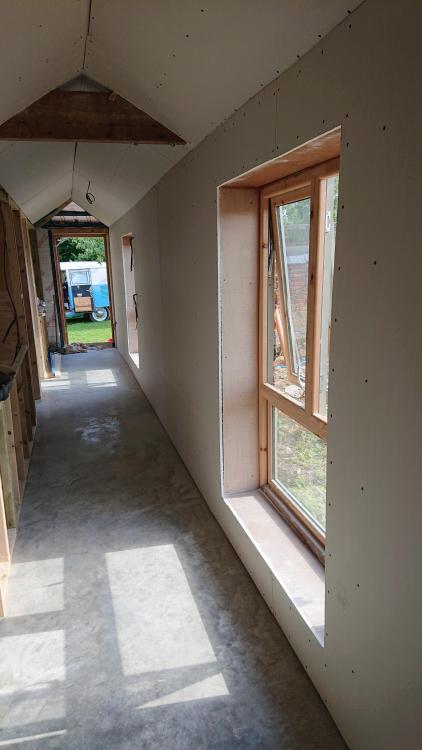
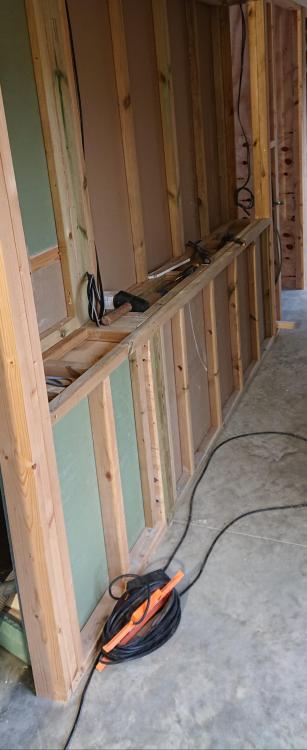
Thank you both for tips so far. I do have access to a rail saw, as you say its an excellent bit of kit. I thought a couple of pics might help. The windows already have a base ply on them so good support for oak faced to go on top of. The shelf has a fair amount of timber to support it, I was thinking I may plasterboard it first then put the oak faced ply on top.
-
Hi. I hope it's ok for me to add to this thread. I first saw your window board pic a few years ago and love it. I want to create a similar look and am thinking of buying oak faced plyboard to do the job. (I think this will work better than floorboards as the sills are deep - 280mm. And I want to make some nearby 2m long shelves to match). I hope people here can advise on 2 things - what thickness ply to go for? and, the possibility of just having the ply edge visible rather than the slimline trim? (with plaster skim ending flush with it).
-
Sanity check, duct / valve placement.
Jenni replied to Jenni's topic in Mechanical Ventilation with Heat Recovery (MVHR)
Thank you dpmiller. The wc certainly qualifies based on duct length. Any other thoughts on the open plan area ventilation? Maybe it's fine and I should try to stop overthinking it. -
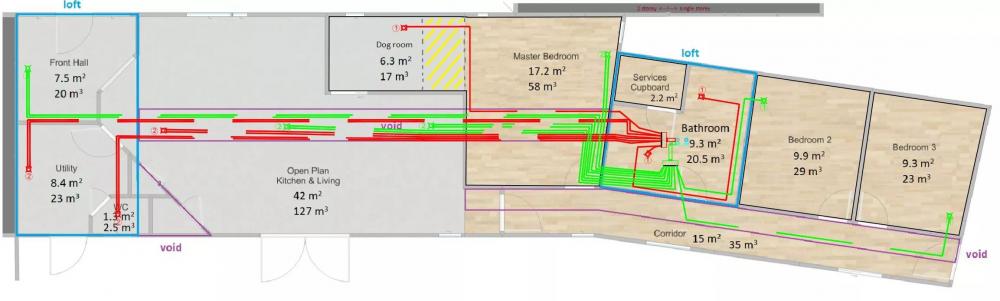
Evening. I have a layout suggested to me by BPC, there's a couple of points I'm curious to have other opinions on please. Do you think 1 valve / 2 ducts is enough extract from the open plan area? Putting all 3 valves along the centre of the open plan room makes installation easier, but is there a possibility of air not circulating well around the whole room? Is 2 ducts extracting from the wc overkill? (I'm not sure yet if wc will even have a door on it, but even if it does, 2 seems overkill for such small space.) For context, ceiling height of the hall+utility is 2.8m. The open plan room is vaulted with a flat top section to create a service void, height 4m. I'll be having a recirculating kitchen extractor fan.
-
I've just had a read through of the Hudson Reed manual, it lists hot supply temperature as 55c-65c. So it's good to hear yours is working fine at lower input temps. Thank you Dave.
-
Thank you Peter. Are there any concealed valves (that you're aware of) that will work at lower input temperatures? I will have an immersion, but would prefer not to be tied to using it all the time.
-
Hello. Efforts are generally focused elsewhere, but I'm still mulling over shower valve options so I'm back again with another question. A valve I Iike says "Hot water temperature 55 to 85 Degrees", and in the manual says - Does this mean it's not suitable for use with my ASHP hot water system, where the tank will generally be at 45-50c? (this one - https://www.victorianplumbing.co.uk/cruze-twin-modern-round-push-button-shower-valve-with-2-outlets?campaign=googlebase&gclid=Cj0KCQiAtqL-BRC0ARIsAF4K3WHWaUvYdYOK3-tAzM3bAkuwrTntu6RqCSAOVy4wduDyWU8hJr0EsssaAjibEALw_wcB&gclsrc=aw.ds)

-
Shower tray and enclosure recommendations
Jenni replied to Cpd's topic in Bathrooms, Ensuites & Wetrooms
I bought a heavy stone resin tray from these guys, (they do other, lighter materials too) they were helpful to deal with, had to order via a stockist where there was a wide range of prices for exactly the same product (ended up cheapest via Travis Perkins) They have quite a few options for offset quadrant at 1200x900. And you can get "easy plumb kit" that lifts the tray as you're describing you need. Also anti slip trays that may be good for older people. https://www.mx-group.com/products/shower-trays -
Metal tracer, for plastic pipes
Jenni replied to Russell griffiths's topic in General Self Build & DIY Discussion
Hi. Is the silver foil tape detectable when the pipes are pinned to foil faced pir insulation? -
That's great. Thank you for your advice Nick ?
-
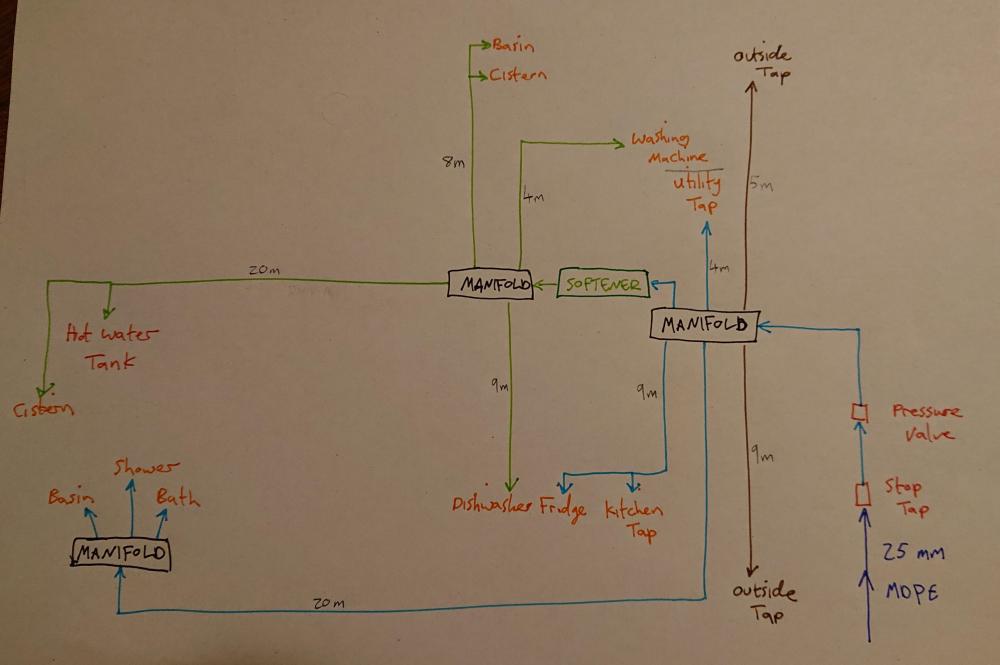
NRVs and drain off, points noted ? The second hard manifold is debatable I suppose. I have a 50mm duct to run through. I thought a single larger bore pipe that splits to smaller near point of use might be easier than trying to get 2x 15mm and a 10mm pipe down the 50mm duct. I suppose I could go with just 2x 15mm and T off a 10mm for the basin (from the bath 15mm)? I've read that 15mm is recommended for high demand items like bath+shower. And that WCs and hand basins are fine/better with 10mm. But I'm not sure about appliances like dishwasher and washing machine - is there a minimum size they need? Last thing, any pointers on what size pipe I should use from the softener to the UVC? And size pipe to the 2 (possibly 3) manifolds? Thank you ?
-
Hi @Nickfromwales, any chance you've got a chance to check out revised drawing please?
-
Hi @Nickfromwales, do you think my second attempt is an improvement on the first? Any further suggestions please? I'm keen to nail down the basic setup so I can install the main pipework into ducts shortly.
-
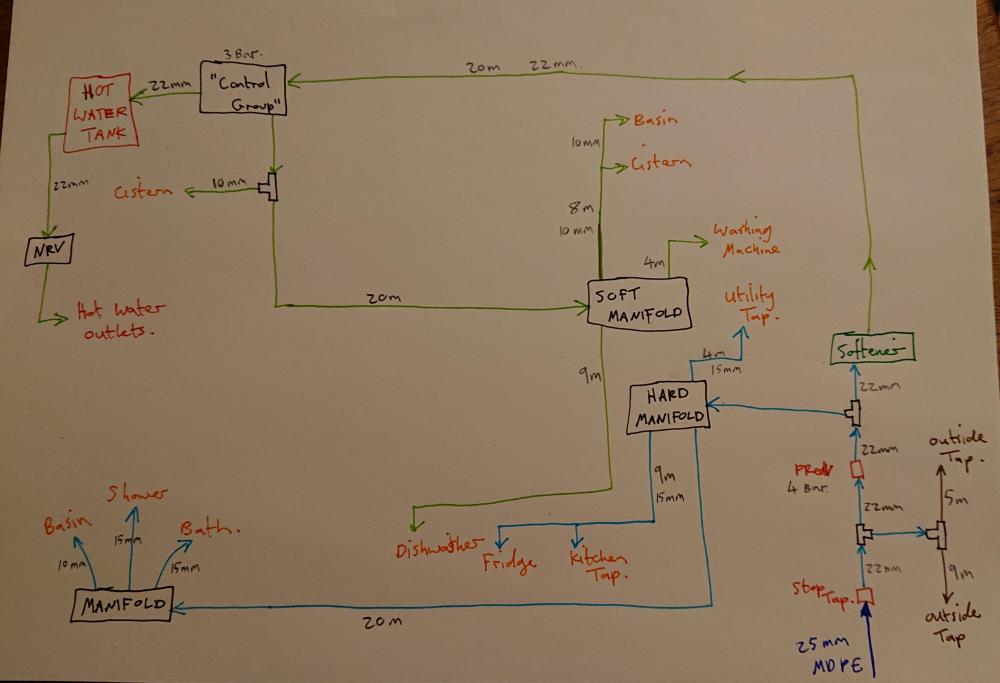
Trying to take on board your advice Nick, here's version 2. I've jotted on approx distances in meters, and potential pipe diameters in millimetres. Any better?
-
There isn't any loft, single storey barn conversion. All mains pressure with an unvented cylinder. (When I filled the UFH manifold with a hosepipe, the guage on there got to about 3 bar). I don't really like the feel of softened water, but I recognise the benefits of it to appliances, toilet flushes and UVC in particular. The pressure valve due to some previous damaged caused by water co allowing pressure to go too high in the past, just trying to mitigate risk. I've tried to do the diagram to also show the relative positions of things. As a barn conversion there have been various compromises, the water comes in a one end where the kitchen and utility are nearby, then the bathroom plant room is well over the other side. I understand what you're saying about the UVC having cold mains priority, but I'm not sure how to achieve this while also having hard water to cold taps within the physical constraints. No problem moving the outside taps to just after the stopcock, I am interested to know the logic behind this please? Thank you.
-
Hello. Picture is a diagram of what I think my water pipe layout needs to be. I'd really appreciate some advice on what size (plastic) pipe to use please? Most urgently for the 2 long runs to the UVC and Bath etc, as I need to run these through ducts ASAP.
-
Yes, if SW Suffolk counts as SE. We put the ufh pipes and manifolds in, and the reinforcing mesh. Had a company in to do the pour, approx 200m2 done in 2 days. Separate company did the polishing. It's not perfect by any means, but as a barn conversion rather than high end loft, it's good enough for us. Splitting the job up meant any risks sat with us, but that meant cost savings, and was cheaper than other floor covering options, plus it's what we wanted, ie no carpet, few grout lines.
-
Kitchen layout options - an island too far?
Jenni replied to Moonshine's topic in New House & Self Build Design
Just a thought. Lose the corner cupboards and have more of a galley. Hob on wide peninsula, sink on wall.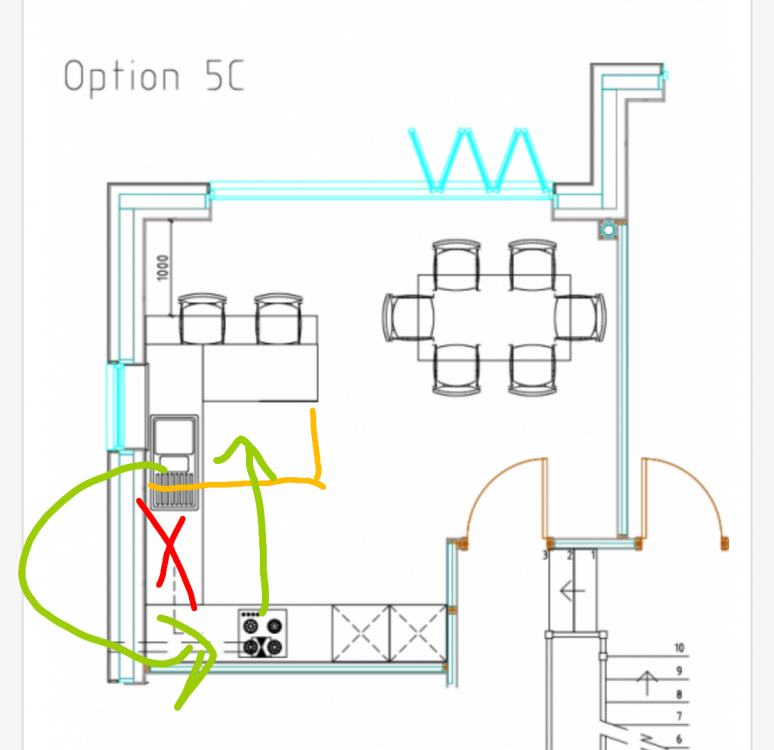
-
Coping with imperfections...
Jenni replied to MJNewton's topic in General Self Build & DIY Discussion
Definitely not alone. Often the fear of making the wrong decision, or choosing the wrong tradesmen, or not being good enough at it yourself, is paralysing in itself. Not sure it's a solution, but I do find that getting a quote, but then doing it myself is good, as I know however bad I've done it, it's saved a load of £££. Plus, I visit building sites regularly (for my job) and see what kind of horrors go on there. So I console my mistakes with, cheaper, and better too. -
Creating an airing cupboard
Jenni replied to Russell griffiths's topic in General Self Build & DIY Discussion
I'm siting my airing cupboard above an ufh manifold, I think that will have some losses, combined with mvhr extract above to draw the air through.



