lookseehear
-
Posts
166 -
Joined
-
Last visited
Everything posted by lookseehear
-
Using multifoil under steico insulated roof
lookseehear replied to lookseehear's topic in Heat Insulation
It’s a brand new roof, so it’s actually less of a retrofit. Rafters are 150mm. i think you’re right that the risk is higher, I just can’t work out how much higher and if it’s allowable by Recticel etc then maybe the risk is mitigated by decent breather membranes and a small amount of ventilation from counter battening and not having the insulation jammed against the breather. -
Using multifoil under steico insulated roof
lookseehear replied to lookseehear's topic in Heat Insulation
Any thoughts here? -
Using multifoil under steico insulated roof
lookseehear replied to lookseehear's topic in Heat Insulation
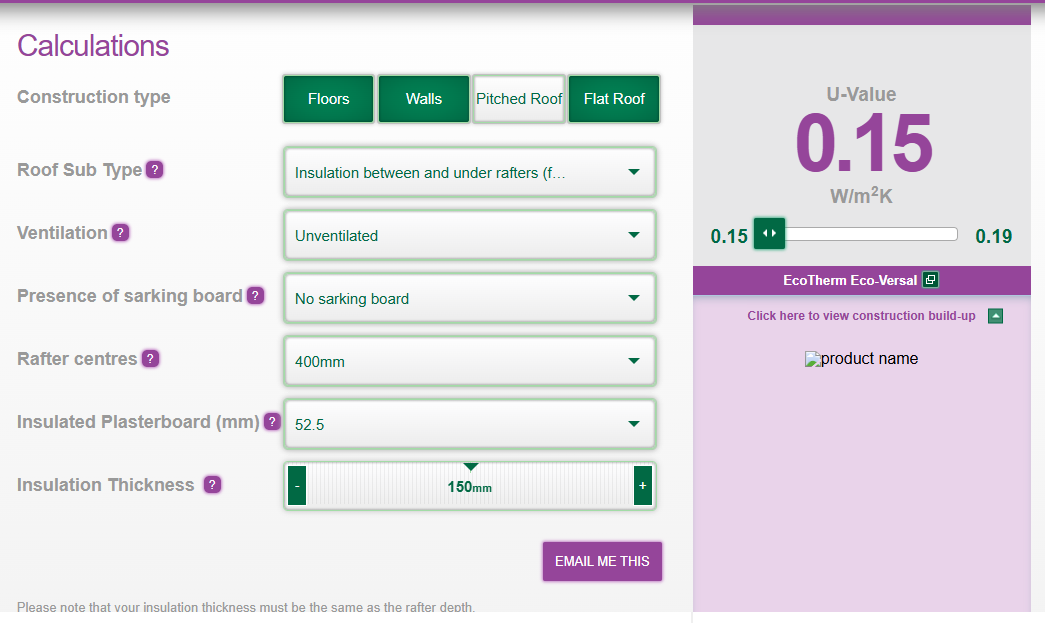
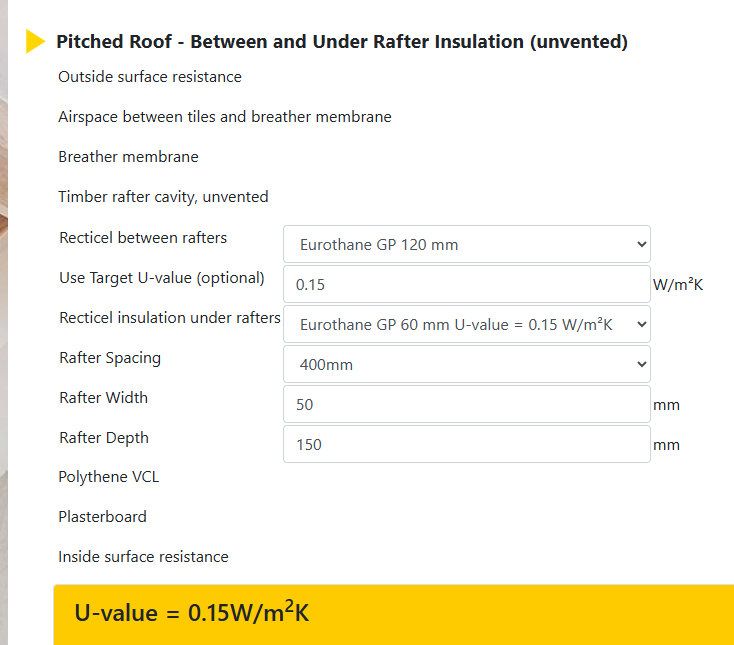
I've checked with the SE and no sarking board or 'racking' layer required. I'm thinking about taking the simple route here and going with PIR between and under the rafters. I've been on a few websites (ecotherm, recticel etc) and they seem to indicate that a 50mm ventilation gap isn't required providing a breather membrane is used, but that maybe you need to leave at least 25mm of rafter 'unfilled' and potentially counterbatten as well. Ecotherm calc below showing 'fully filled' with 150mm PIR, with 40mm underneath to get to 0.15, and Recticel only showing 120mm in 150mm rafter. Is going 'unvented' a bit of a risk or are modern breather membranes combined with a good VCL underneath sufficient to ensure no risk of condensation?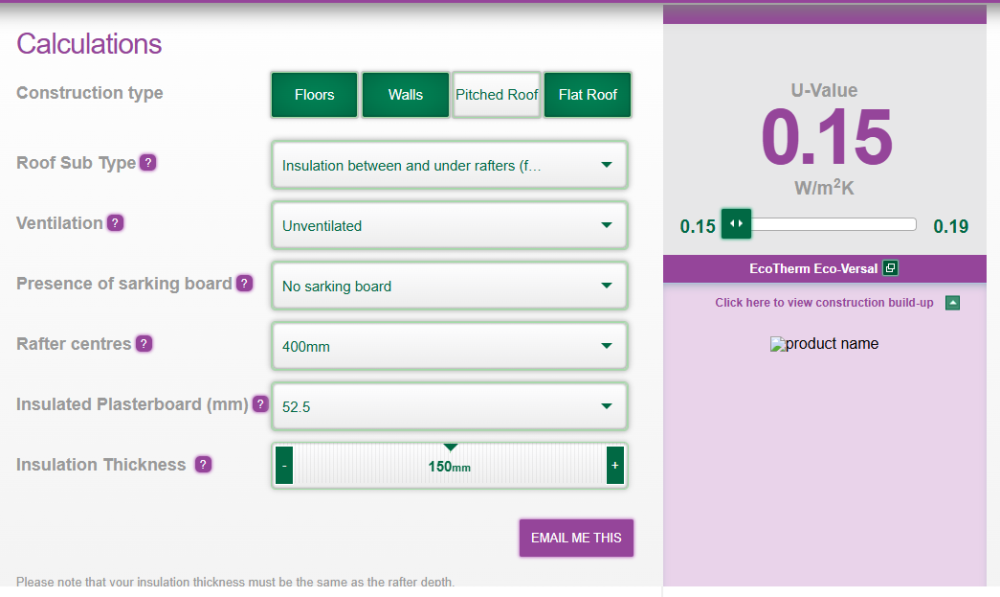
-
Long hot pipe runs (second HW cylinder?)
lookseehear replied to lookseehear's topic in Bathrooms, Ensuites & Wetrooms
Thanks for the response. I'm really hesitant to move the DHW cylinder - we've got a dedicated plant room already constructed and drains in place for bathrooms. I like the idea of a manifold and will have a think on that. I'm not that keen on the smart plug idea - they always feel like a good solution to short term problems to me, and I don't want an Amazon device in my house. Given the complexity of the job (heating included) I'm leaning towards speaking to a local HeatGeek certified installer (potentially under their 'black label' service) for the heating and DHW plumbing. -
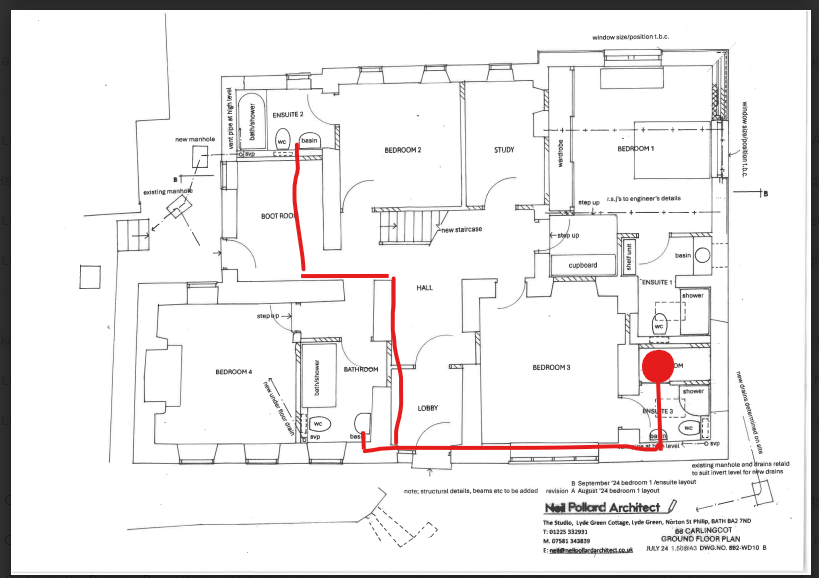
We're starting to plan pipe runs for new bathrooms in our extension/renovation project - as a reminder everything is moving around due to going upside-down and house is being rewired/replumbed. DHW cylinder is going in a small plant room in one of the new extensions which is on the corner of the house. In total the hot water requirements are the kitchen plus 3 shower rooms (ensuites), one 'family' bathroom mostly used by guests and one small WC. The bathroom layouts in the below sketch are not correct, but the room positions have not changed. The red circle is DHW cylinder and the red lines are likely HW pipe runs to 'family' bathroom, ensuite 2 (shower room) and the kitchen which is above the boot room and Ensuite 2. I had assumed we would run 22mm for all the main pipe runs and branch off to 15mm to maintain flow, but I've now realised that in the kitchen that could be a 15m+ pipe run in 22mm and would take half a day for hot water to appear at the tap, and the same problem in ensuite 2 and (to a lesser extent) in the family bathroom. What I want to try and avoid is the shower in bathroom 2 being severely affected by the kitchen hot tap being used. I know that we won't be able to use all the showers simultaneously, but I'd like to be able to use any two at once. I can see a few solutions but maybe there's one I'm not aware of: Use 15mm instead of 22mm from where the pipe branches off near the front door to the back of the house to serve the kitchen and ensuite 2. This would lessen the delay overall, but with less more restricted flow to the back of the house, the shower would be more likely to be impacted by the kitchen tap? Run two 15mm hot branches (or one 15mm and one 12mm) from the 22mm running along the front of the house to the back of the house. the 15mm just to the shower in ensuite 2 and the 15mm/12mm to the kitchen tap and ensuite 2 basin. This might isolate the shower from the sink more effectively and reduce delay for hot water to the kitchen/ensuite sinks. A second small hot water tank with an immersion under the sink to feed the kitchen hot tap and the hot tap in the shower room and run 15mm from the front just for the shower in ensuite 2. This would decouple the kitchen from the ensuite shower and mean close to instant hot water at the taps in the kitchen and ensuite. I've seen the heat geek mini store and wondered if I could put that in a corner kitchen cabinet in addition to the main DHW cylinder in the plant room. The mini store could run the kitchen and the ensuite shower/taps. I've no idea if this is even possible - planning to put in an ASHP as part of the building work and don't know if/how it's possible to run two cylinders on opposite sides of the house in parallel from one ASHP. i know I have a tendency to overcomplicate things, but unfortunately that's just the way my brain works - I'm thinking through all the options at the moment. Any feedback?
-
Fine tuning my IWI Solid wall (Warm Batten) design
lookseehear replied to Annker's topic in Heat Insulation
I just wanted to pick up on this point. It's often not useful to compare internal and external RH's because of the temperature difference. You may know this already, so sorry if I'm teaching you to suck eggs! 95% RH at 15 degrees is roughly 70% RH at 20 degrees, which is why opening windows to allow colder external air in is almost always going to help dry a house out. If your internal warm air is 95% RH then that's much more likely to be a sign of a problem (water coming from another source). I've lost count of the amount of times during the winter I've seen people posting online saying that they won't open their windows because the weather shows it's 100% humidity outside, when in reality 100% humidity during a cold spell will give lovely dry air once warmed up to room temperature. -
Fine tuning my IWI Solid wall (Warm Batten) design
lookseehear replied to Annker's topic in Heat Insulation
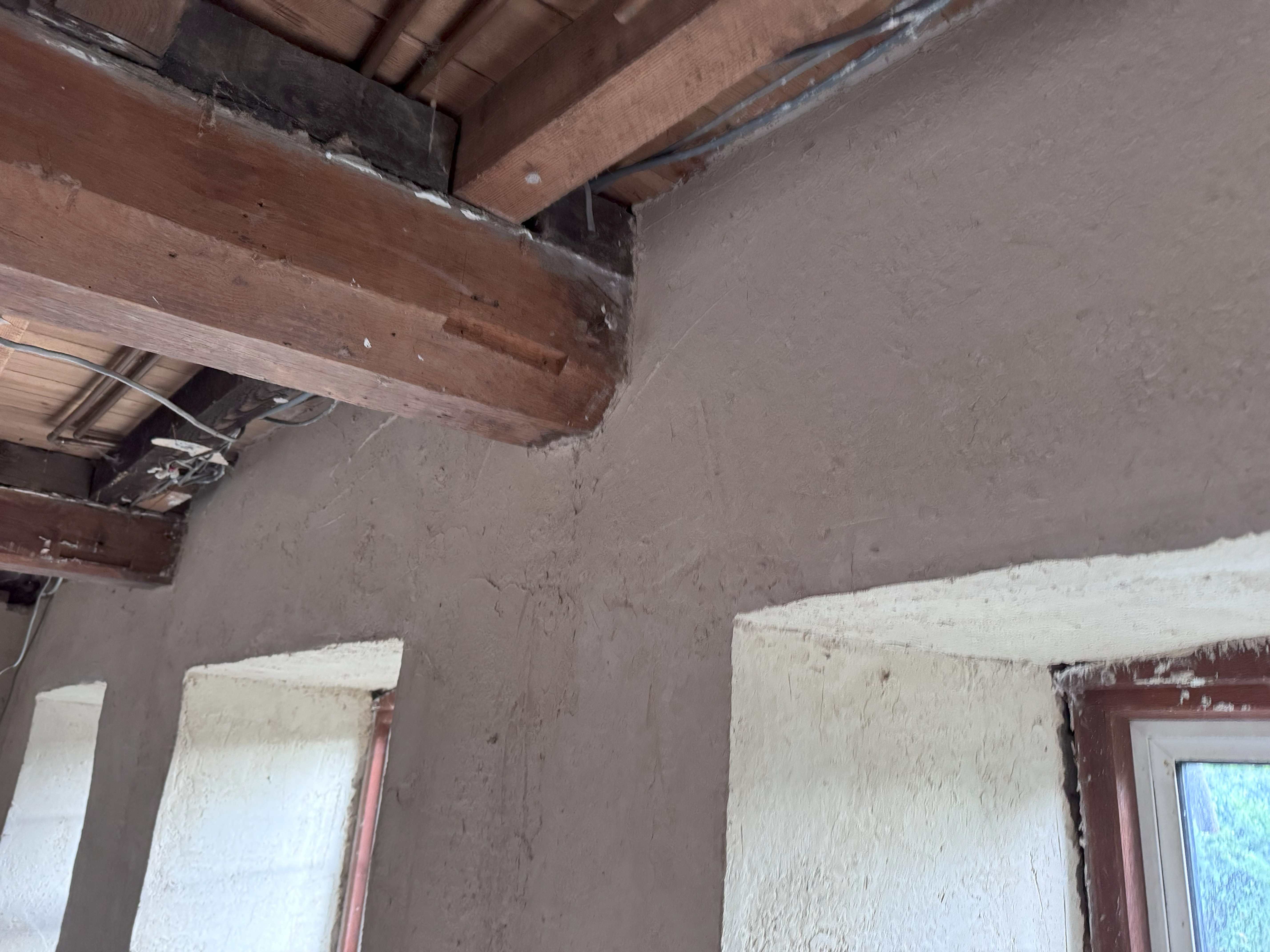
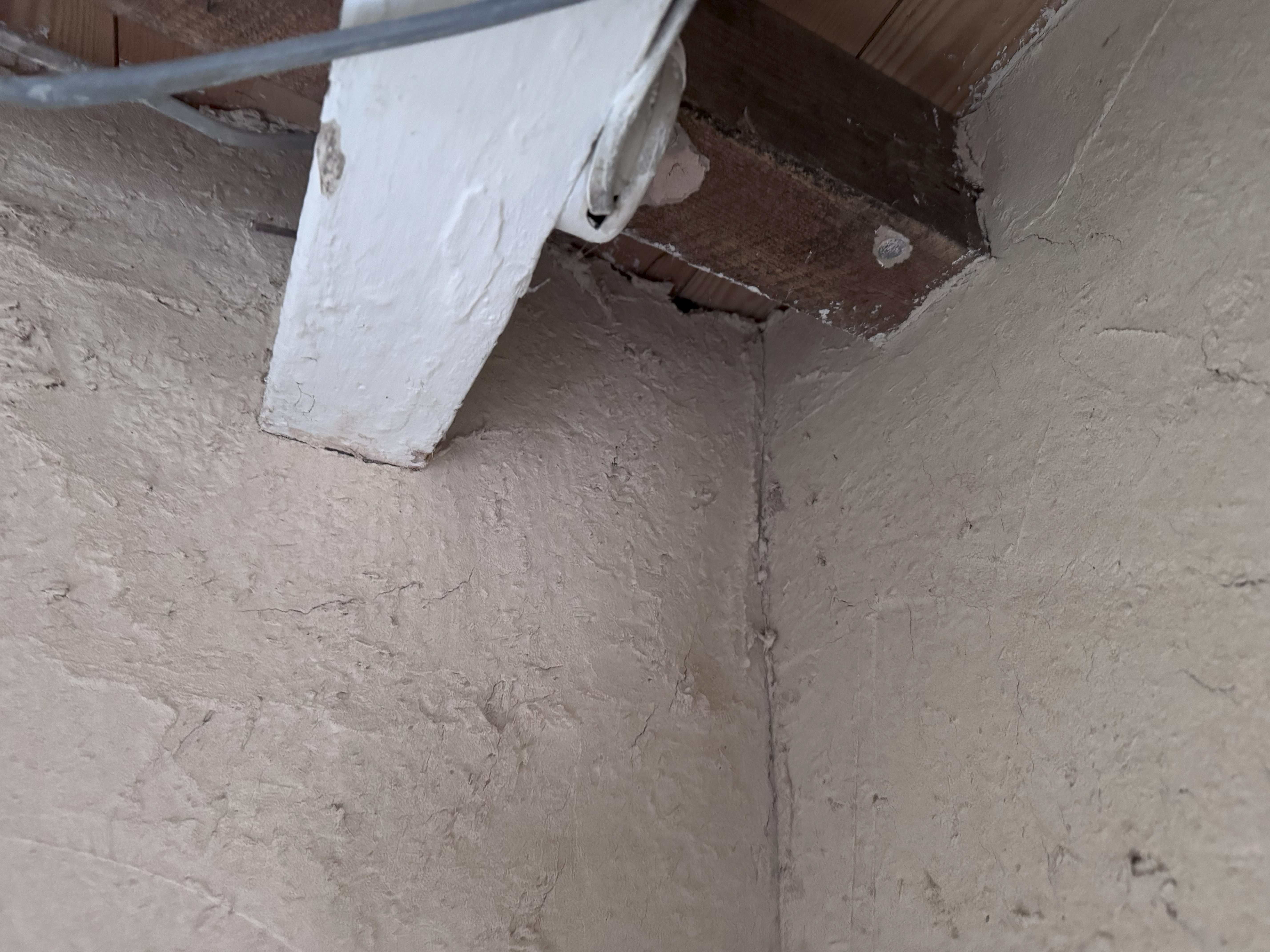
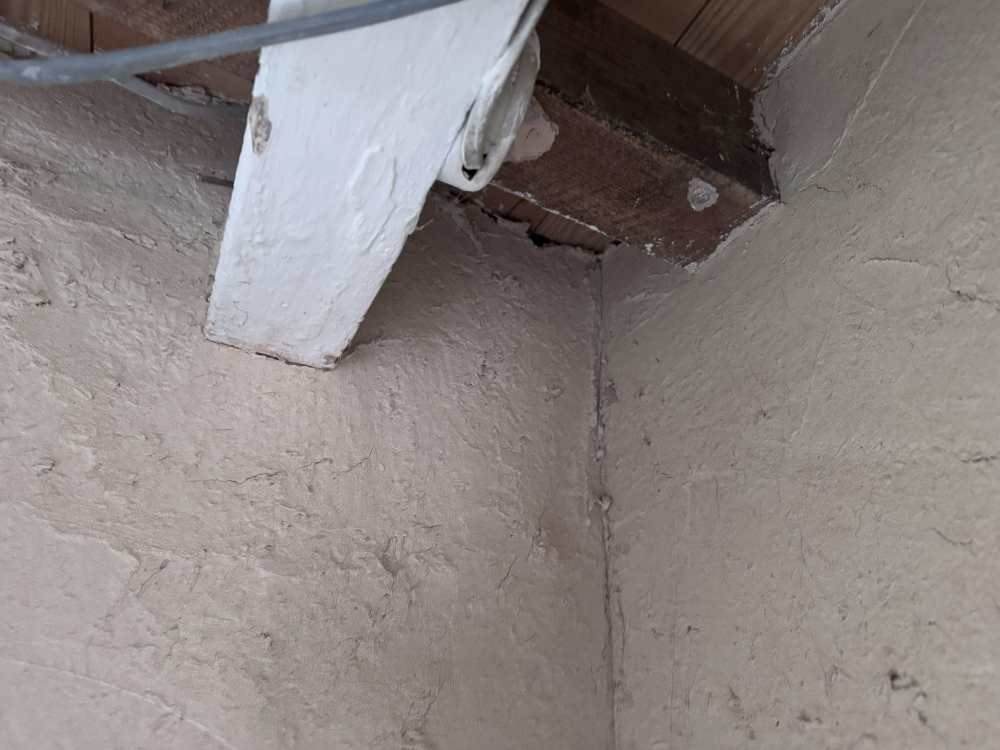
I have got some airtight tape and haven't got any airtight paint which is steering my decision! Here are some pics of what I've done.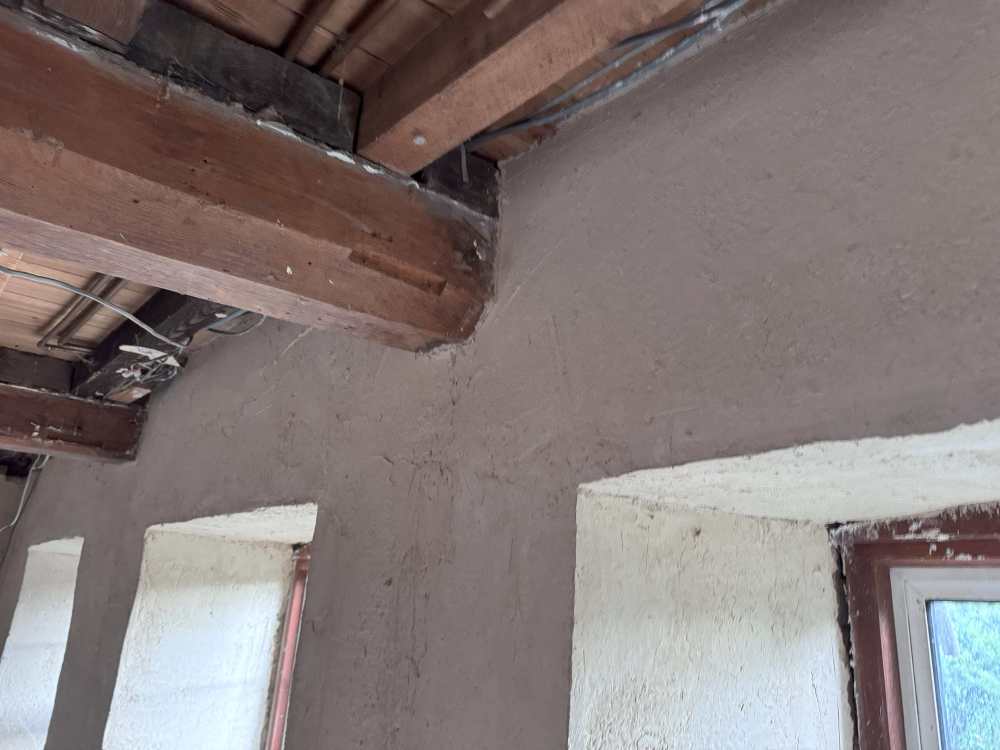
-
Fine tuning my IWI Solid wall (Warm Batten) design
lookseehear replied to Annker's topic in Heat Insulation
What I've been doing is using lime hemp plaster (pre bagged from Ty Mawr) to fill these gaps with some appropriately sized stones. Basically find a stone that nearly fits, put some lime plaster in and then push the stone into place, then cover the lot with more lime plaster around the joists. I'm then going to airtight tape the joists back to the plaster. It's been a lot harder than I thought in an old house. You take the ceiling down and there are voids in the wall all over the place. -
Using multifoil under steico insulated roof
lookseehear replied to lookseehear's topic in Heat Insulation
I don't plan on making the roof vapour permeable from the inside, and am planning a VCL under the rafters to achieve this. The Steico is for decrement delay reasons as well as 'better for the planet' reasons. It's hard to know how a space is going to react in the heat of summer, but it would suck to go through all of this then feel we need some kind of cooling solution when we could have fixed it with an insulation that performs better vs heat. Steico's standard roof buildup doesn't seem to include a structural board for racking, but I imagine it's probably preferable? How do you find your roof performs on hot days? -
Using multifoil under steico insulated roof
lookseehear replied to lookseehear's topic in Heat Insulation
Haven't decided but am leaning towards LED strips recessed along the top of the walls which will illuminate the vaulted ceiling upwards - we're creating a battened insulated service void against the walls, so there should be a neat spot to do this. Service void in the vaulted ceiling was more for flexibility but maybe we don't need it. I was going to use multifoil taped to parged walls as VCL/airtightness layer on the inside of rafters but if I do PIR underneath I would assume that a continuous layer with joints taped and taped back to parged wall would be sufficient. Steico flex is (from my understanding) easy to fit between rafters in a snug way (held in place with battens), and over-boarding with steico special dry sarking board. I understand a breather membrane isn't required over steico special dry, but Ecomerchant said it's probably a good idea in case any of the tongue and groove joints are damaged. Concrete pads are in to take roof steels which are being measured for next week and hopefully installed in September. These will be on top of existing roof, so that roof timbers can go on top and the existing roof can be removed in a phased way. -
Using multifoil under steico insulated roof
lookseehear replied to lookseehear's topic in Heat Insulation
This would get me to required U value with at least 30mm PIR under the rafters. Am I right in thinking that any cables within service void need to be 50mm back from the surfact, so would need thicker batten?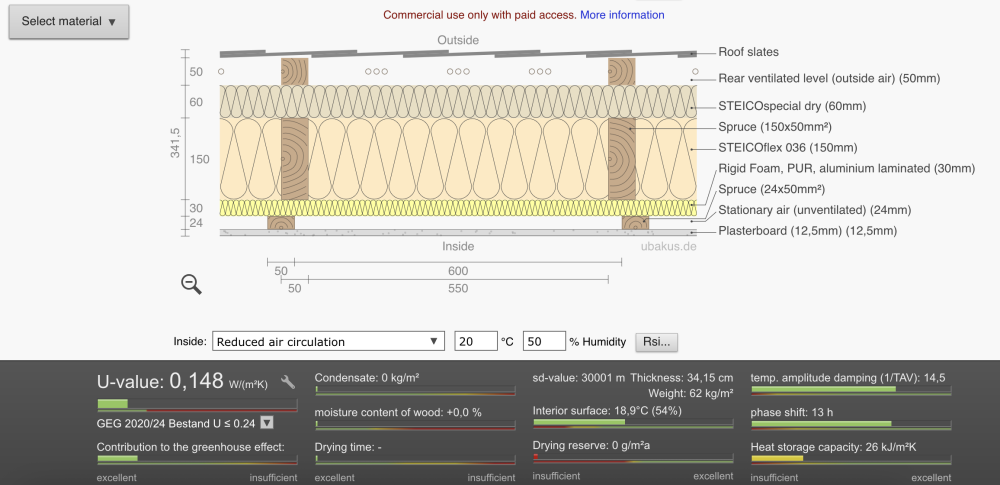
-
Using multifoil under steico insulated roof
lookseehear replied to lookseehear's topic in Heat Insulation
Just to check you mean PIR under the rafters but still to use Steico within and above the rafters rather than PIR for the whole lot? The reason I didn't want to do this is it removes the service void, but I guess we could just add a service void below the PIR and put the plasterboard on battens. -
Using multifoil under steico insulated roof
lookseehear replied to lookseehear's topic in Heat Insulation
I should probably be clear that when I say spray foamed, I mean the PIR would be cut close to size and any gaps spray foamed so there are no issues with the PIR being cut accurately to the gaps between rafters. He doesn’t want to use spray foam as the insulation. I don’t think the architect said thermal mass, I can’t remember the exact wording. Does it matter? The living space is upstairs with vaulted ceilings, but the roof pitch is low, so floor to inside of the ridge is roughly 3m. -
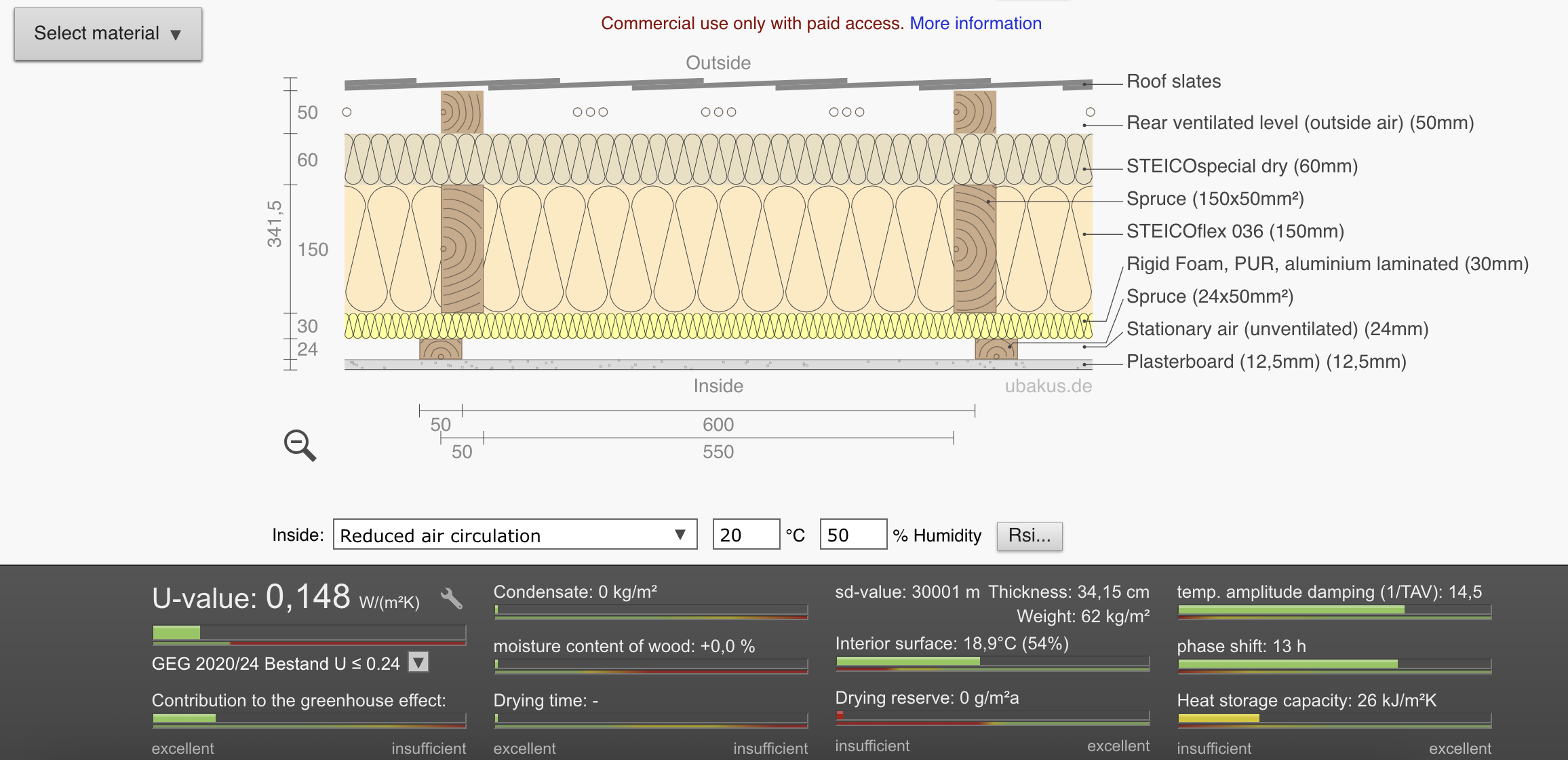
We’re in the final stages of planning our re-roof. The engineer has specified 150 mm rafters, supported by a steel ridge beam. Our architect is encouraging us to use wood fibre insulation for its thermal mass and decrement delay (since the main living space will be upstairs), which I’m increasingly drawn to. The builder, however, would prefer PIR spray-foamed between the rafters, with multifoil stapled underneath, counter-battened to create a service void, and finished with plasterboard and skim. We’re already raising the roof height slightly beyond what was approved in planning (approval was for a 200 mm increase). If we fully fill the rafters with Steico Flex, plus add 60 mm of Steico Special Dry sarking board on top, we achieve roughly a 0.19 W/m²K U-value. I think adding multifoil underneath could bring us down to the required 0.15, while also serving as a vapour control layer—and it would keep the builder happy. My understanding is that multifoil requires a low-emissivity cavity, which in practice means leaving an air gap between the multifoil and the plasterboard. Still, it feels unusual to see it specified as part of a roof build-up. Am I missing something here? Are there obvious alternatives I should be considering?
-
Old Property Reroofing to Warm Roof Advice
lookseehear replied to Lears's topic in Roofing, Tiling & Slating
Hijacking this rather than starting a new thread because we'll be doing something similar. What I was hoping to do was fully fill 150mm joists with steico flex and overlay with 60mm Steico special dry sarking board, but this only gets me in the region of 0.18-0.19 when I need to hit 0.15 for new element in existing building. The builder has suggested counterbattening under the joists and using multifoil/superfoil within the unventilated cavity (which will also work as a service void) then plasterboard and skim underneath. The multifoil will also act as the VCL in this case. I'm struggling to model multifoil in Ubakus - anyone got any tips on this hybrid approach? Edit: ChangePlan's U value calculator seems to get me to 0.14 using Superfoil SF19BB under the rafters, but seems to want 40mm as a cavity. -
Recommended manufacturers or Installers in the South West?
lookseehear replied to Lears's topic in Windows & Glazing
Have you been to the National Self Build & Renovation Centre in Swindon? You can see many of these brands windows side by side there which might help with making a decision. -
Fine tuning my IWI Solid wall (Warm Batten) design
lookseehear replied to Annker's topic in Heat Insulation
how was it with the sand mix vs sharp sand? -
@JohnMo thanks for all your input here, I really appreciate you taking the time. How big are the rads? If we’re going to have them in bedrooms I’d probably go for columns to save wall space. Is it feasible to run rads and ufh both from an ASHP in an open loop configuration? I assume the ufh would need to be mixed down to a lower temp. I’m also assuming that bedroom temperatures can still be controlled with TRVs on the radiators? From recommendations in my previous thread I want to keep things simple controls wise. One issue I can see is that we will get quite a lot of solar gain upstairs from roof lights, sliding doors being one open plan space which will have exposure throughout the day, whereas we won’t get a lot downstairs due to smaller windows and smaller spaces which only get sunlight at certain times of day. On a cold winter day with lots of sun, heating load upstairs will be reduced, but downstairs won’t be impacted as much, so any reduction in flow temperature overall could result in cold bedrooms.
-
This was my line of thinking too, but on the ground floor will also be a home office and kids bedrooms which will likely be occupied a lot more as they get into their teens, and hence will need to be able to be heated to 20-21 degrees to be comfortable. Here’s my new plan: Keep the boiler, because I don’t feel that I can economically run radiators off an ASHP Put in a thermal store (size?) and have radiators downstairs and ufh upstairs use some of the savings from not getting ASHP to relocate the oil tank or put in a smaller one Put in as much insulation in the floor downstairs as I can fit consider a separate air con unit for the living space upstairs. Even poorly insulated as it is, downstairs rarely overheats even in heat waves, so I don’t see any requirement for cooling downstairs electric UFH mats in bathrooms on timers/switches for comfort Does this seem sensible? I need to understand the thermal store bit a bit more though.
-
I understand the theory, but I assume that only works with ASHP rather than with oil boiler and thermal store because of how much more efficient UFH would run at constant low flow temps. If I’m using oil to run UFH via a thermal store it’s no more efficient than running radiators, so the ‘no insulation’ scenario means burning a lot more oil.
-
Direct to ground
-
Ok this is definitely helping. The reason I was moving away from the idea of a thermal store is because of some comments on here suggesting that you get roughly half the amount of hot water storage in one compared to an UVC of the same size. That point aside I like the idea of using cheap electricity or solar PV to heat thermal store to contribute to either space heating or DHW. We have a 200l UVC currently and don’t use all that much of it, but the kids are still young and we are going to end up with four bath/shower rooms. Do I therefore need to be looking at 400l thermal stores? separately, if I’m thinking of UFH and can’t put much insulation in the refurb areas, should I be thinking about the no insulation option or would putting 25-40mm PIR be better. Assume for now that comfort is more important than heating costs.
-
You may have read my previous thread: I really need to make my mind up and I'm still struggling. As a refresher: We have an 18-25kW external condensing oil boiler and 1200L oil tank in the garden The house is 5 beds and detached and we're putting the living space on the first floor and bedrooms on the ground floor We're replumbing and rewiring the whole house Two extensions will be insulated to modern standards, as will the new roof The older parts of the house are harder to insulate substantially, but we will be putting in a thin layer of carefully installed and well detailed internal wall insulation and significantly improving the airtightness We're replacing all windows and doors with triple glazing/modern equivalents I'd estimate we would be averaging 50-70W/m2 peak heating requirement when all done but it's hard to tell because at this point we're chipping away at the project bit by bit Option 1: Stick with oil, new radiators everywhere (oversized) Pros Cheapest at the outset Easy to control room by room temp with TRVs Reduced oil usage compared to high flow temps and small rads Cons We commit to keeping burning oil No weather compensation The boiler is (I believe) oversized for what we need, so would need to make changes (buffer tank/TS?) to the installation or swap out for a smaller boiler We have to fit large radiators in each room Option 2: ASHP and radiators Pros Renewable factor and compatible with solar PV/battery Means we can remove the big, unsightly oil tank from the garden Can utilise the BUS to get the grant from the government Option of FCUs for cooling Cons Risk of high running costs due to high flow temperatures required running rads off an ASHP We have to fit large radiators in each room Less controllable room temperatures due to the time it takes to warm up a room using low flow temperatures, and counter-productive nature of using TRVs to throttle flow in an 'open loop' system Option 3: ASHP and UFH Pros Renewable factor and compatible with solar PV/battery Means we can remove the big, unsightly oil tank from the garden Can utilise the BUS to get the grant from the government No need to find space for radiators 'comfort factor' of having warmer floors than using radiators Likely lower running costs than Option 2 due to lower flow temps meaning higher SCOP Option of FCUs for cooling Cons Least controllable of all the options Requirement to find the headroom for some insulation (or not based on this thread) Most disruptive to install Likely most expensive up-front Most risks of getting a poor quality install (maybe?) A few other thoughts on UFH and the complexity of the specification Heat output is obviously restricted by some floor finishes, and we'd likely have carpet in bedrooms, but I think it can be mitigated if the pipes are within a chemical screed, heating is run continuously and small pipe spacing. I had thought an overlay system would work, but I realise that overlay systems just can't get the same heat output Some rooms downstairs will be occupied just at bedtimes and will be fine at 18-19 degrees, but our kids bedrooms will likely be occupied a lot more as they get into their teenage years, so those rooms will probably need to be 20-21 degrees. The above is just a brain dump really, but I'm really tearing my hair out trying to work out what the right option is, when we'll need to live with it for the next 20+ years. Any thoughts? How can I bring some clarity to the decision?
-
I'm particularly interested in this because we're moving our living space upstairs, so we're thinking about having UFH on both floors. In my head, there's zero (or negligible) heat loss when it's for the upstairs because all heat is within the envelope of the house (ie heat 'lost' downwards is still heating the house fabric).
-
His argument that UFH + ASHP work really well for uninsulated floors makes a lot of sense to me, and I imagine it would get more efficient through winter as the heat warms the ground gradually, but it's counter to what is often written on here that UFH doesn't work without at least 150mm insulation.