


lookseehear
-
Posts
167 -
Joined
-
Last visited
Everything posted by lookseehear
-
Stone built internal wall insulation advice please
lookseehear replied to sb1202's topic in Heat Insulation
It's hard to tell but the most important thing with the loft insulation is to make sure you retain ventilation at the eaves - it looks suspiciously like the loft roll is pushed up against the underside of the roof. -
Stone built internal wall insulation advice please
lookseehear replied to sb1202's topic in Heat Insulation
Ideally you would have your insulation layer with a membrane, then more battens to create a void where you can run services (pipes, wires) to avoid having them puncture your vapour control membrane, then plasterboard over the top (or dense WF and lime plaster). -
Stone built internal wall insulation advice please
lookseehear replied to sb1202's topic in Heat Insulation
Welcome! You'll find lots of people doing similar things to you on here - I'm one of them. Definitely have a read through this thread when you get a minute. I, too, am confused by the membrane on the cold side - I think the idea is that because wood fibre insulation is very hygroscopic (will absorb moisture), it will act like a bit of a sponge making your walls stay relatively dry but your insulation becomes wet. This goes against the idea that wood fibre should be able to buffer moisture in the walls, and will inevitably create air gaps between the membrane and the wall. Seems unnecessary to me! "Knowing nothing of your building I'd guess that 100mm maximum" - I'm fairly sure this is referencing how much insulation you can use. If you are insulating internally you are limited on how much you can use, because the more insulation you put in, the warmer your house but the colder the stone walls become which increases risks of condensation within the structure. I think that what Redbeard was saying is that 100mm of insulation might be on the edge of being too much internally for a solid walled property. If you are familiar with U values, it would seem sensible to aim for something in the region of 0.4-0.5 rather than trying to get to modern standards (below 0.2) with internal wall insulation. "What about the window reveals?" - I'm probably going to use something like a thin layer of wood fibre or mineral wool to take up the unevenness of the stonework, then a thin layer of modern PIR insulation on top, all fully taped to the windows and any airtightness/vapour control membranes but this is open to critique. Low thickness is important here to avoid impacting window size. "Don't forget to ensure the wall ins touches the roof ins too." - this means that your wall insulation should be continuous with roof insulation to avoid any cold gaps or bridges. It looks like you're wanting to retain the cornice detail from your photos so not exactly sure what you'll do here but probably just careful attention to detail around the edges to avoid gaps. -
Does anyone know what the norm is if you aren't able to order all your windows up front because you don't have finalised measurements? My builder is getting on to me about ordering windows for the extension which is fair enough, but we will also be replacing the windows for the rest of the house over the coming year (somewhere in the region of 25 windows overall) and some of the openings are going to be extended in width and or height from existing. This makes ordering all of them at once a challenge, but I don't want to buy a few then be over a barrel when it comes to ordering the next tranche because we want them to match the existing so can't shop around. One option is to buy the windows for the extension and accept that these may be different to the rest of the house, then try to get ourselves in a position in the spring to bulk order windows for the rest of the house as a whole, but ideally we'd agree some kind of price based on an estimate up front then tweak as necessary, or do suppliers ever offer a price per m2 or similar? Second question is about fitting. I assume for best results the glazing supplier will need to also do the fitting, or can I get my builder to do this? We're looking at triple glazed alu clad timber ideally.
-
Are these common? Do I just ask the window manufacturer for them? Not sure I follow how this works - lets say I get in the shower with the door closed (as you do) therefore the fan in the 'wet' room ramps up to maximum, but the 'dry' rooms are still dry meaning trickle vents will be closed. Where is the air coming from in this instance? Our kitchen/diner/living space is quite large (65m2) - would you put two in? I'm pretty sold on this I think. It does seem a shame though when you have lovely warm air after a shower only to dump it all outside!
-
It took me a minute to see what you're getting at - I guess I didn't quite realise how low the air flow rates of MVHR systems are, but at 20-30m3/hr to a typical living space there's not really much 'redistribution' of heat going on other than keeping it within the overall thermal envelope. I probably need to take a serious look at the cost and disruption of ducted MVHR vs decentralised systems with heat recovery because I had assumed one of the benefits of a centralised system is that you are putting warmer air back into living spaces.
-
I often see distemper mentioned in the breathable paints discusssions.
-
I read through this earlier in horror - so pleased you got it sorted. I can't imagine what the last couple of days have been like!
-
I agree, but if you take an example where you have 21 degree warm air (could be warmer than this when extracted close to the ridge of the vaulted ceiling) and 8 degree fresh air incoming, with 80% efficiency then you could reasonably expect the air being pushed to living spaces being above above 18 degrees (18.4 degrees would be 80% efficiency assuming it's linear). Bear in mind that we currently tend to have bedrooms at 17 degrees around the clock currently. I'm not expecting it to 'heat' the rooms but to reduce the number of days we use the oil boiler by making those rooms more comfortable during the milder months in spring and autumn.
-
Our oil boiler is only 3 years old (a Worcester Bosch external model) so I assume it is relatively efficient (as oil boilers go) but it is probably oversized (18-25kW). I didn't know about avoiding running them in condensing mode but I'll definitely be looking it up.
-
I'm coming back to this thread after some time thinking and my current plan is a hybrid (with an eye on simplicity and flexibility): Focus on insulation and airtightness, to the point where it makes sense to have MVHR Put in an air to air heat pump for the main living space which is upstairs. We'll be spending 80+% of our time in there when at home and not working or asleep. It's ~65m2 living/kitchen/dining space with vaulted ceilings albeit only 3m to the ridge beam. MVHR will be continuously moving the warm air to other living spaces, so it might make sense to oversize this somewhat. Given this space is upstairs I'm very keen to have some active cooling which is a big benefit of the a2a HP. I think just using the a2a with MVHR will suffice for 75%+ of the year as the main heating and cooling of the house. Retain our oil boiler and unvented cylinder, and use this as top-up heating in the winter and for DHW when there's not enough solar PV Electric UFH mats/towel rails in bathrooms for comfort The benefits of this are: It's relatively simple - we'll set the temperature on the a2a in the living space, and the rest of the house will likely be a couple of degrees cooler it's flexible - as much heat as we need in the winter and cooling in the summer. we'll drastically reduce the amount of oil we use we don't need to oversize radiators significantly - oil boilers don't appear to benefit from low flow temperatures as much as gas boilers and they will only be used to top up the heat as required.
-
Labour's new planning strategy
lookseehear replied to Lincolnshire Ian's topic in Planning Permission
The problem here is that the LPA will just reject if it's approaching the deadline rather than allow an acceptance by default. What you need to do is increase the friction for rejection (more paperwork, more signoff required etc) and reduce the friction for accepting and make it the default option. If there are humans making the decisions then they're subject to the same push and pull forces that we all are in decision making. Rightly or wrongly people don't like change in their area, but the biggest reason that I hear anecdotally is always about infrastructure and often is more of a political issue than relating to development - not enough parking, not enough good school places, roads can't take more traffic, no doctors appointments already, too much immigration etc etc. yet the same people often bemoan the 'death of the high street' when a bit more footfall might make a difference there. -
Labour's new planning strategy
lookseehear replied to Lincolnshire Ian's topic in Planning Permission
I'm genuinely interested in what a better system might look like in terms of who should be making decisions. Is it so fundamentally broken that it's beyond repair for the forseeable? -
Fine tuning my IWI Solid wall (Warm Batten) design
lookseehear replied to Annker's topic in Heat Insulation
I think IceVerge covers this in the video, with the main points being you can use standard gypsum plasterboard but don't use latex based paints that will seal it all up. On the point of only insulating 1st and 2nd floor, it would probably make sense to try and remove and refit the coving if you can. -
Fine tuning my IWI Solid wall (Warm Batten) design
lookseehear replied to Annker's topic in Heat Insulation
I've just watched it - definitely helpful and clears up some of my thinking. Thank you! -
I just bought a Flir One from Amazon on black friday deals for £145 - hopefully good enough for our needs.
-
Fine tuning my IWI Solid wall (Warm Batten) design
lookseehear replied to Annker's topic in Heat Insulation
What kind of Lime would you specify - quicklime? hydrated non-hydraulic? NHL 2/3.5? Thank you so much for making a video - I know that I and others will get a lot of value from it. -
Fine tuning my IWI Solid wall (Warm Batten) design
lookseehear replied to Annker's topic in Heat Insulation
Same! It really feels like we're searching for the same solution here - at least we'll have some safety in numbers! -
Fine tuning my IWI Solid wall (Warm Batten) design
lookseehear replied to Annker's topic in Heat Insulation
There's also the SWIP system which has insulating studs which can be pulled plumb and close off the gaps between studs and wall, however they might not work if you can't fix to the wall. See Charlie DIYte on YouTube for a video demonstration. -
Fine tuning my IWI Solid wall (Warm Batten) design
lookseehear replied to Annker's topic in Heat Insulation
Would it be fair to say that flexible wood fibre would be a step up from mineral wool here from a moisture buffering perspective? -
We need a chemist: Portland cement and Lime.
lookseehear replied to SteamyTea's topic in Research Resources
I'm sold on using Lime in solid wall buildings, but what I can't work out is do you have to go the 'whole hog' and use a hot non-hydraulic lime mortar for pointing and haired lime putty for plastering or is there a middle ground? The heritage crowd will tell you that anything with any cement in it is not to be used, but finding a good tradesperson is difficult enough without factoring in the extra cost of the time required to use these slow-setting mortars and plasters. I keep telling myself I should just learn to do it myself, but I know that these aren't the kind of jobs I'm very efficient at. -
Plenty of sympathy here - we have been battling with went trenches too, albeit on a smaller scale (35m2 extension). Foundations that were going to be 500mm thick ended up 900mm in places due to having to keep taking the top layer of clay off as it got soft and soggy. Our OSB shuttering held up OK, but was a bit too close for comfort in places and wouldn't have been sufficient on a bigger project. Our biggest issue was that we can't get a digger into the bottom of the trenches, so a lot of horrible digging and excavating by hand. The thing that helped in the end was having a pump sat in a small sump running on a timer rather than on the float so that the water didn't get above the top of the sump regularly. This helped us get it under control while finishing the digging, then got BCO approval the day before the pour. Groundworks are hard, depressing (literal) money pits, but once you're through this bit and are standing on clean concrete it will feel worth it. Agree with Iceverge about keeping the builder on side. From his perspective he may feel that if he makes a mistake in an email then he may be held to it. Try if you can to talk it through somewhere that isn't on site and take your time. This part is stressful for all involved and if the builder is otherwise someone you trust will do a good job then it's worth trying to get through it. Here's a picture of our trench prior to foundations in solidarity.
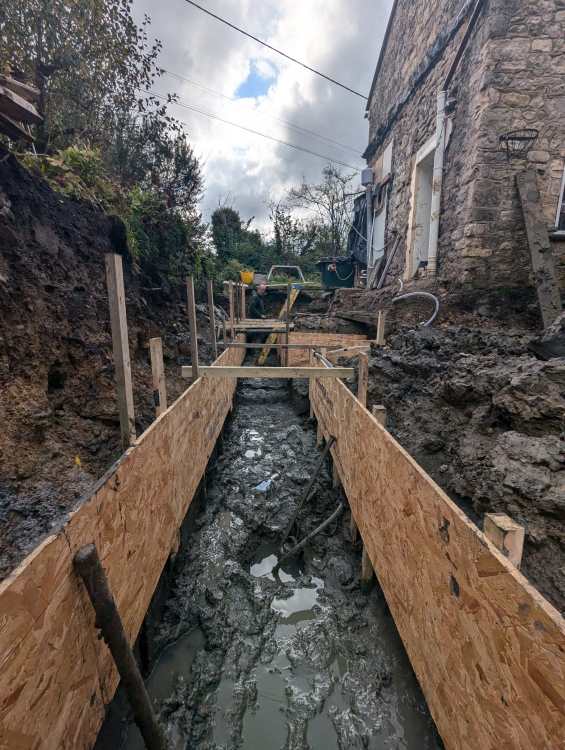
-
We need a chemist: Portland cement and Lime.
lookseehear replied to SteamyTea's topic in Research Resources
I like the approach of this thread. I think that as Mike points out it's the physical properties that matter more than chemical once set, or are at least perhaps higher on the priorities list. I come to this with a scientific background (albeit graduating 15 years ago, so a lot of hazy memories) but little building experience. I saw this video recently and thought the outcome was pretty interesting, despite only really focussing on a very specific part of the physical qualities - the ability to transmit water vapour. I'm not a particular fan of Roger Bisby and think he's too close to 'clickbait' for comfort, but this simple experiment seemed to show that a 6.1.1 mix of sand, cement and hydrated non-hydraulic lime was the most vapour permeable of all the mortars tested, but because this contains both portland cement and lime, the physical and chemical qualities could be distinct from either in isolation. -
My problem is that not all lime is created the same. I know the difference between NHL 2, 3.5 and 5, and I know the difference between those and non-hydraulic lime. We had a survey of our house before we moved in by a historic buildings surveyor, who recommended all repointing etc be done with non-hydraulic lime mortar, and that any gypsum plaster be removed and replaced with a non-hydraulic lime based plaster. If you go anywhere near a 'historic buildings' or 'old homes' type community online you get shot for suggesting anything cementitious is used in an older house. The problem being that tradespeople willing to use these products that take many times longer to set than cement or gypsum based materials are rarer than hens teeth! It also means you're very limited in the types of finishes you can use - limewashes/distempers/clay paints. What I always try to do in situations like this is understand the evidence, the science and the data and try and make a plan which balances convenience, cost and results. The problem with that is that not many people have experience of all of the options over a long term. It's either fine because they haven't seen problems with it yet, or it's terrible and to be avoided because it didn't work out for them.



