-rick-
-
Posts
873 -
Joined
-
Last visited
-
Days Won
1
Everything posted by -rick-
-
Finding GPT really useful for this. It suggests: 2K water temp drop, combined flow rate 26.9 L/min 5K water temp drop, combined flow rate 10.2 L/min 10K water temp drop, combined flow rate 4.65 L/min I guessed at some of the heat loss specs but they are roughly inline with what I've seen while browsing radiators. So in summary, to ensure sufficient flow I need to balance to maybe a dT of 2-2.5C? (I doubt my boiler will ever fire at full modulation for long at all given the size of the radiators so maybe could target minimum flow and around 4K drop)?
-
Best it can do is set the pump at 70%.
-
2x Single Flat Panel 800x500 2x Single Flat Panel 1000x600 1x Single Flat Panel 800x600 1x Double Flat Panel 800x600 1x Single Flat Panel 400x500 2x Towel Rail 500x750 Total 9 All fed via what looks like Speedfit 15mm pipes homerun to manifolds at the boiler. 22mm copper at boiler. Edit additional info: Pipe is through the floor (presume embedded in screed, though can't feel heat through floor except in very limited area near manifolds. Furthest radiator is about 6m straight line away, closest <2m
-
Two reasons: 1. It wasn't installed as one and I don't have the kit it was supplied with (manual says it should have been included in the box) 2. While I'm sure I could get the kit, the boiler is installed in the centre of the property and installing an outside sensor would involve making lots of holes in plasterboard. As I needed to replace the timer anyway, my plan was to use load compensation instead of weather compensation. It might not be as good but it's a lot easier to set up. Neither is going to be particularly useful with the size of radiators I have in the room with the highest heat loss and the overall ability of the installed radiators to dissapate the boiler output at minimum modulation (6kw) Overall I think so (just wrote a lot on this) but then realise that I think you are just referring to this specific bit: Firstly, there is a bypass installed. I have two towel radiators with manual flow valves only (not lockshields, so nothing to prevent anyone adjusting them). It's not entirely clear to me what they mean by uninterrupted flow. I've adjusted the valves so there is a dT across these two radiators of about 5C. One of these radiators is the closest to the boiler (<2m) so was bypassing a large portion of the flow until I started balancing. 10% of the minimum output of my boiler is 600W. The radiators are 500x750 and looking at similar online they I'm finding outputs specified as ~250W per at dT 50. I struggle to believe that's right given the heat output I get from these (the one closest to the boiler seems to overwhelm the other radiators nearby (assuming doors are left open) putting out enough heat that the other radiators barely come on. Even if these two towel radiators are turned down too much right now, there will still be plenty of flow elsewhere to satisfy the minimum specified above as I have the TRVs removed from 4 radiators with a total output (at dT 50) of approx 3500W, these rads were (at the start of this thread) controlled to a dT of about 8 but all still putting out decent heat.
-
Good idea! This is what GPT came up with (which seems good to my non-mathsy eyes): Flow rate for the specified radiator and temperatures Given your inputs, we can estimate the radiator’s actual heat output at 60°C/50°C water and 21°C room air, then use an energy balance to get the flow rate. Given data Radiator rating: 550 W at ΔT50 (mean water to air) Inlet water: 60°C Outlet water: 50°C Room air: 21°C Radiator output at actual conditions Mean water temperature: Tm = 60+502 = 55∘C Temperature difference to air: ΔTair = 55−21 = 34∘C Output correction (ΔT method): Radiator output scales approximately as Q=Q50(ΔTair/50)^n. For typical steel panel radiators, n≈1.3. Q ≈ 550×(3450)^1.3 ≈ 550×0.606 ≈ 333 W Flow rate calculation Water-side temperature drop: ΔTwater = 60−50 = 10∘C Mass flow (energy balance): m˙ = Qcp⋅ΔTwater ≈ 333 W / (4180 J/(kg\cdotK)⋅10 K) ≈ 0.0080 kg/s Volumetric flow (water, ρ≈1000 kg/m3): V˙ ≈ 0.00801000 m3/s = 8.0×10⁻⁶ m3/s ≈ 0.48 L/min ≈ 28.7 L/h Notes and sensitivity Exponent sensitivity: If the radiator type uses a different exponent (e.g., n= 1.2 to 1.51.5), the output—and thus flow—varies modestly. Across n = 1.2–1.51.5, the flow would be roughly 0.44–0.53 L/min. Fluid properties: If you’re using glycol mix, adjust cp and ρ\rho accordingly; glycol will increase the required mass flow slightly. Direct answer: About 0.48 L/min (≈29 L/h) for water under these conditions. If you know the exact radiator type, I can refine the exponent and give a tighter figure.
-
Similar here, though pretty sure imperial measures was touched on, though I couldn't convert metric/imperial in my head until much more recently. Whatever happened in school I think I've ended up using Imperial more as I got older* though not for anything important. I've always measured my height and weight in imperial but if I'm measuring or weighing anything else it will be in metric. * In recent years I've been watching a lot of makers on Youtube and a lot of them are American and so I've been a lot more exposed to Imperial measurements than I was when I was younger.
-
'Smart' heater vs heater with wifi controller?
-rick- replied to Crofter's topic in Electrics - Other
Keep it simple and use something like this? https://www.tlc-direct.co.uk/Products/SMTGBD4.html * Confirm with electricitian this is suitable -
Looks like the party is over....
-rick- replied to Beelbeebub's topic in Air Source Heat Pumps (ASHP)
I see people say we are crowded alot. I don't think that really stands up. According to the quick check I just did we are the 51st most crowded country. Plenty of far more crowded countries (democracies) exist and don't have the same issues with planning, etc, that we do. Of course people should have their say, but individuals (or small campaigns) shouldn't be able to block things so easily. Wholesale re-evaluation of what parts of Britain we want to preserve with minimal changes and what parts we don't. We need to free up a lot of land/loosen a lot of restrictions at the same time if we are going to solve our issues. The south is so protected, you move from greenbelt, to area of outstanding beauty, to area of special scientific interest, etc, so virtually nowhere is available to build on without huge numbers of hoops to jump through and all these protections just devalue the point of protection. If everywhere is protected then nothing is really special. It's obviously huge difficult to do and I doubt anyone has the political will to do it. The alternative to me seems like slow decline. Old people will die off and not be replaced so we will naturally over the next decades free up some land. But the economic and social consequences of doing it that way are dire. -
Agree, it's why I started this thread, to check I hadn't misunderstood something. If I open up the lockshields on the cold room rads again, dT will on those rads will drop to 2-3C, overall dT 5-6C. So just wondering if you/anyone has any suggestions for how to find a middle ground, ie, keeping the boiler happy while maximising dT. I don't think I have any way of measuring the flow rate.
-
Yeh I agree. Unfortunately, they are not bog standard ones and colour matched to the interior so getting replacements that match the rest is not cheap. I've ordered some cheap Chinese fan kits to attach to the small rads to see if that buys me enough output but they won't be here for a while. If I'd known what I know now a few years ago I would have replaced the rads but given I want to move I doubt I'll be here long enough to get any sort of payback on the rads. Or at least, reverting to my previous heating strategy of ignoring the temp in that room seems like a better plan to me. The other rooms are fine and radiators seem adequate. Maybe not enough for low temp at -5 OAT but should be good at 0. Keston System S30 (A rebranded Ideal Logic with extra gubbins to support 50mm flues). Pump is built in Grundfoss UPM3 15-75 (according to the photo in the manual), boiler modulates pump between 70 + 100%.
-
It's looking like I can't maintain room temp at OAT 5C unless I allow flow temps >60C. With a DT of 5 that means operation will be entirely non-condensing, unless i've misunderstood something. As I understand it, if I can get my flow temps below 50C then DT doesn't matter anywhere near as much.
-
Yeh, that matches my thoughts. Any suggestions for the best strategy to achieve this while maintaining as high a DT as possible?
-
Looks like the party is over....
-rick- replied to Beelbeebub's topic in Air Source Heat Pumps (ASHP)
One part of government not co-ordinating with another (planning). So the upgrades were planned then got slammed into planning issues. Supposedly a lot of new build and upgrades to the network will happen over the next 5 years. Paid for out of bills of course, but if it stops curtailment and the associated cost the impact will be more limited. -
Sorry for the highjack! Ha! you should have seen mine. A mess of choc blocks with loose screws and exposed single insulated cables (thanks Mr Installer!) The universal plate should be compatible with the Wiser so you should just be able to slot it on (using existing wiring). To add opentherm cabling yes you can cut out a section of the mounting plate for the wire. Assuming the wire is thick enough then the installed unit should clamp down on it. The thermostat has a little plastic bracket with it. I liked Camerons idea (in the video I linked) of buying a normal blank plate to go in place of your existing thermostat (assuming its wired remote from your controller) and attach the plastic bracket to that. Having said that I've moved my thermostat to a location closer to the place I want to control the temperature. As an update to my progress, I'm realising that my CH system has been badly designed and have very little hope of achieve low temperature efficient operation without spending a lot more money. My existing radiators can't dissapate enough heat to heat the room at low temp or avoid cycling with the minimum modulation of my boiler. It's likely Wiser could be doing some things differently to cope a little better with this situation but most of the issue is with my CH system. The wiser does a fantastic job of maintaining a very stable temperature (within 0.2C) assuming the CH system has sufficient capacity. (In my case during the day, but it starts losing control as the temps drop at night unless I bump the flow temp up outside condensing range).
-
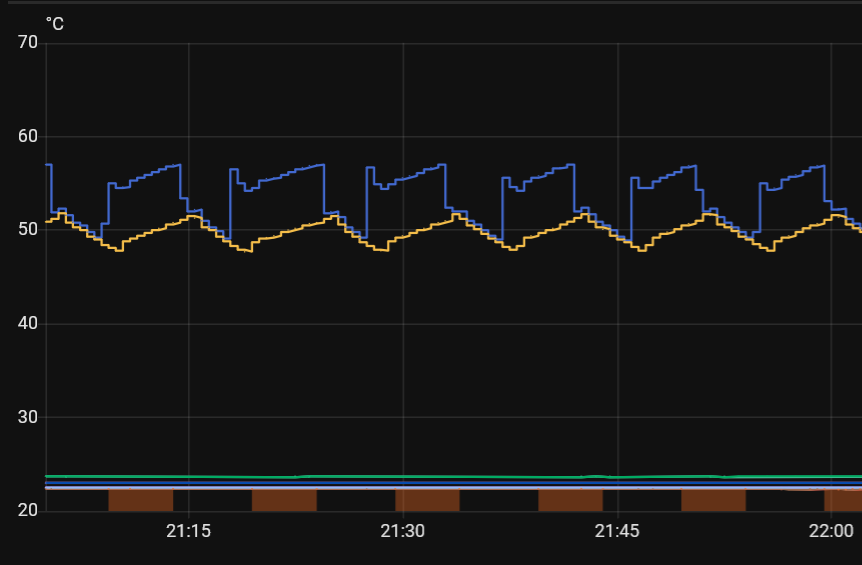
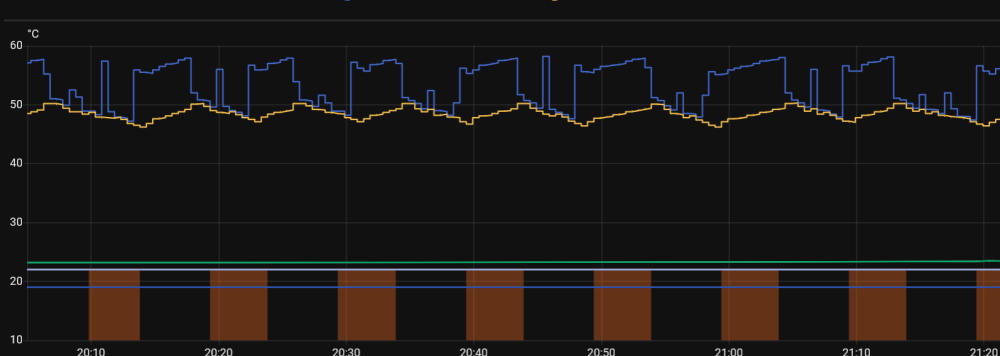
As you may have seen from other threads, I recently got a Wiser heating controller and have been spending time looking at my heating system. I've known there have been problems with it for a long time and had basically been ignoring them by only limited a subset of my rooms and not worrying about the rest. Now I have the controller, I have some tools to monitor function an also wanted to attempt again to heat my whole flat, with the hope that I can optimise things and the overall cost won't be hugely worse than existing. Very quickly, I've realised I needed to balance the radiators. I've done a couple of rounds of balancing. First round, I dealt with the radiators that were heating first and obviously stealing flow from the other 4 (which are located in my higher heat loss rooms that I've not been actively heating). At this stage, I'd left the 4 wide open (in hindsight not ideal). This made a difference in the speed of getting to temperature (2-3 hours, not 10) but the overall dT was still about 6C which is not great. Chart below from roughly steady state once to temp (I know the temps are fairly high, that's another thread that I will write at some point*). Today I did another round of balancing, I've now restricted the flow on all the radiators now and have managed to widen the dT to nearer 9C and had planned to go back tomorrow and tweak some more. I have some concerns though. Firstly, the locksheilds on most rads are now barely open and I'm concerned about minimum flows and noise in the pipework (noise so far is minimal but I'm clearly very close to more noticable noise). Is this what I should be doing or have I misunderstood something? Secondly, since I've done this I noticed the boiler is now really short cycling (the cycling before at steady state was not great but now it's clearly problematic). My thesis is that before when the boiler cycled the initial burst of heat from the ignition got absorbed by the high flowing water fairly easily, with the more restricted flow caused by additional balancing work this burst of heat during ignition is not being lost in the flow and is causing the temp limit to trip and the boiler to lockout. During the lockout the return temp drops further giving more space for the heat from the next ignition. In theory you could deal with this via the controller but Wiser doesn't appear to have an easy way to do this (there is a hystersis setting in the debug output but no obvious way to change this). Is my thinking right? Is there a way to address this with balancing / doing something different on the physical side? * My system as installed (when the flats were built) is a mess. The radiators in my high heat loss areas appear undersized even when dealing with traditional dT of 50 and obviously totally inadequate for any sort of low temp heating. In the first screenshot here, the state seems steady but in reality the room was slowly losing heat as the OAT dropped and the heat input was capped but the minimum boiler modulation + max flow temp as I had it set. The second graph has a much higher max flow temp, but you can still see the minimum modulation is an issue (even though the property could likely absorb that heat ok).
-
SMART Life. Smart? Bollox is it smart
-rick- replied to ToughButterCup's topic in Networks, AV, Security & Automation
Install ESPNow on them and use Home Assistant? Not sure it supports everything, but I thought Tuya stuff was fairly well covered. I don't mind automating things if it makes life easier. But anything that ties you in to internet services (potential monetization by the provider in future if not currently) is a strict no-no for me. -
1 gigabit ethernet requires 4 pairs with specific properties. Most people installing data will these days will want to install something that supports faster speeds*. For faster speeds the spec of the cable really matters. Cat6A spec is what you should be aiming for and can support 10 gigabit ethernet (and HDBase-T for HDMI, etc). Cat5 spec might handle that over short distances (35m max) but that's it. Routing an ethernet cable directly parallel and closely coupled to a mains cable is generally frowned on. I'd guess the main question is whether this 'cat5' cable with in the EV Ultra cable actually meets the spec for Cat 5. Firstly, there are multiple 'EV-Ultra' cables, some with only 2-cores of data, some offer 2xcat5e spec (2x4-core). Looking at the datasheets, I'd guess that the 4-core cat5e FTP cable version does meet the spec for gigabit ethernet. You can probably run 2.5g and 5g on it as well. 10g likely very limited. As it's a shielded cable (FTP) that does give some reassurance about interference from the closely coupled mains cable. * 1gig ethernet is approximately 100MB/s. With the storage on modern computers being capable of >3000MB/s, 1 gig ethernet can feel very slow if trying to access a NAS or similar though it's fine if all you want is internet access.
-
Air monitoring thingamajig
-rick- replied to Russell griffiths's topic in General Self Build & DIY Discussion
I didn't think regs required CO2 alarms (in England). CO alarms near gas appliances yes. -
Definitely wouldn't be the same without him. Buildhub MVP
-
Before doing this, confirm whether the draft is coming from the seals or from around the edge of the frame. Sounds more likely that the installers didn't seal around the frame too well (or it failed).
-
I'm not fully committed yet. Did look at those EPH controls you recommended before reordering the Wiser system. The EPH would have required another re-wire of the wiring centre and cost at least twice as much. One of the benefits of reordering now is that I now benefit from the extended return times Amazon gives you around Christmas. So I've got months to get to grips with the Wiser system and still have the option of changing my mind. So far its mostly working for me, couple of niggles that I'm trying to work out if its me misunderstanding something, a bug or intentional design but I don't think anything show stopping (given workarounds I've discovered). Todays task is installing Home Assistant to access the debug info. Shame that appears to be the easiest way to get it. My biggest concern right now is how much scope there is for me to run low and slow and heat the whole place is with the existing radiators. Half the flat the system can easily cope, the other half seems more difficult. Heatpumps being funamentally low and slow and the controls being designed around that vs boilers where low and slow is a new thing grafted on must mean there is a lot of technical debt/legacy that gets in the way.
-
Quick update from me. I'm just in the process of returning the package I ordered and replacing it with a different one (Multizone Kit 2 to Thermostat Kit 3). Reason being the TRVs are utterly useless. I knew smart TRVs weren't hugely useful and the only reason I got them is because I have a high heat loss area (subject to high solar gain when the sun is out) and low heat loss area and I wanted either area to be able to call for heat. The TRVs are useless because their temperature algorithm is totally divorced from reality. Heating on: Room 18C, measure 23C Heating off: Room 16C, measure 13C The Thermostat Kit 3 is technically a dual zone kit and the second zone doesn't work with Opentherm so I don't plan to use it. However, I believe you can configure two of the Smart Thermostats to control the same heating zone and this is the cheapest way to achieve two calls for heat within the first gen ecosystem (it's also on significant discount right now so I will end up spending less - even though it was the more expensive option when I was originally ordering). If it hadn't taken me so long to get the system up and running I would have given it a bit more time and seen if Wiser support would trade the two TRVs for the extra Thermostat. But they haven't responded to my support case yet and my returns window on the original order is about to expire so I'm forced into quick action. Still trying to get my heating system into shape. The system was on full bore for the entirety of yesterday and didn't get the high heat loss area above 21.5. Been attempting to balance things today that does seem to have made an improvement but a bit too early to tell (especially as it's warmer outside).
-
Looks like the party is over....
-rick- replied to Beelbeebub's topic in Air Source Heat Pumps (ASHP)
Now done some reading and agree this doesn't seem like such a big deal. I think I was misremembering (not even sure what my last company did would count as sacrifice). -
Looks like the party is over....
-rick- replied to Beelbeebub's topic in Air Source Heat Pumps (ASHP)
I was under the impression that this was how a lot of private/company pensions work. Certainly how it was done in my last job. -
Looks like the party is over....
-rick- replied to Beelbeebub's topic in Air Source Heat Pumps (ASHP)
The leak today is different from the previous one. Someone hit publish too soon with apparently little damage other than taking the wind out of Reeves sails. From the politics reporters I follow, the leaks prior to this have been a deliberate policy by some in government as a way of seeing what will fly and whoever is responsible should be fired for the damage theyve done.