.jpg.c21f3ac78c9b7efd90cbdcb312744dc5.jpg)
jack
-
Posts
7462 -
Joined
-
Last visited
-
Days Won
41
Everything posted by jack
-
Welcome to Buildhub. Not sure about nails, but what about a concealed beam hanger at each junction? More work, for sure, but likely a better result. Edited to add: there's also quite a lot of weight going to end up on the long beam where the left end of the short horizontal (in the pic) meets it. No idea if that's an issue given the size of the beams.
-
.jpg.c21f3ac78c9b7efd90cbdcb312744dc5.thumb.jpg.7adcad4c0e384f5ecd7d56b0618df6e5.jpg)
Laying engineered structural floor on joists
jack replied to ProDave's topic in Wood & Laminate Flooring
I'm completely with you on this goal. Our nailed-chipboard-on-easi-joist-floors creak in our bedroom. We used extra screws in the other rooms, and they mostly don't squeak, but somehow our room was overlooked when we suddenly had to get carpet down at short notice ("In by Christmas!") It. Drives. Me. NUTS! Most nights as I creak my way across the floor on the way to bed I idly wonder how much effort it would be to roll back all the carpet and add some screws. -
An economist is shooting at a target. The first shot is 3 feet to the left of it. The second shot if 3 feet to the right. The economist yells "bullseye!"
-
Depends whether Dave is doing something wrong with them! A guy was going to take a bomb onto a plane. A friend asked him why, and he said he was worried about terrorists, but that it was incredibly unlikely there'd be two bombs on the one flight.
-
Welcome aboard. Out of interest, roughly where in the country are you?
-
How do I calculate the amount of PV needed?
jack replied to ToughButterCup's topic in Photovoltaics (PV)
I don't think the definition of "regressive" has anything to do with policy. Energy is a basic and essential commodity to everyone in society. Energy pricing is, today, whatever it is. Increasing its price would absolutely be regressive in the sense of making things more regressive, in exactly the same way that increasing VAT on food would be regressive. So in that sense, yes, increasing the cost of any of any basic necessity by adopting or changing a tax or subsidy system in such a way that it has a greater net impact on the poor is "regressive". I also agree that the alternatives may be even worse, hence my reference to a "planet-sized can of worms". -
How do I calculate the amount of PV needed?
jack replied to ToughButterCup's topic in Photovoltaics (PV)
The term "regressive" has far wider usage than just taxation. https://dictionary.cambridge.org/dictionary/english/regressive: "used to describe an economic or tax system in which there are advantages for rich people and disadvantages for poor people: Economists generally regard sales taxes as regressive, since the poor spend a greater part of their income than the rich. regressive policy/subsidy/measure Two decades of regressive policies have doubled the numbers living in poverty." -
How do I calculate the amount of PV needed?
jack replied to ToughButterCup's topic in Photovoltaics (PV)
Thanks, I didn't know that. I honestly assumed that the scheme was funded by government but administered by the power companies. Just did a quick bit of research. With some rounding (and possibly ignoring the impact of Northern Ireland): There are ~27m households in the UK. The average electricity bill is £592. Assuming one electricity bill per household, you therefore end up with ~£16b spent on domestic electricity. FiTs cost ~£1.1b a year (not sure whether that factors in the cost of administering the scheme - unlikely I guess). If I'm looking at the right numbers, this suggests that the cost of the FiT scheme is around 6% of the domestic electricity market. I haven't got the time, energy (pardon the pun) or knowledge to dig into the impact of the payments for deemed self-consumption. However, it also a fact that I export a lot of energy to the grid over the year, for which the electricity company pays me relatively little. I don't know how cheap the electricity I supply is relative to their wholesale sources (it's likely very complex to work this out accurately), but it would be interesting to know how far, if at all, this goes to mitigating the cost of the FiT scheme to other consumers. I agree that energy is much too cheap, but increasing the price to better reflect the real cost would be hugely regressive. To avoid this, you'd need to bring in some sort of means-tested energy pricing system, which involves opening a planet-sized can of worms. -
How do I calculate the amount of PV needed?
jack replied to ToughButterCup's topic in Photovoltaics (PV)
That assumes that if the government weren't paying me for this, they'd be doing something better with the money. Seems unlikely given their track record! -
How do I calculate the amount of PV needed?
jack replied to ToughButterCup's topic in Photovoltaics (PV)
If the government didn't want people to consume locally, they could just as easily have insisted on proper metering. It wouldn't have cost them anything - the consumer pays for the installation, and the power companies pay for the cost of administering payments. I therefore take the view that the government put the deemed consumption measure in specifcally to encourage local consumption. Maybe they foresaw the rise of the electric car, and wanted to get a head start on installing local capacity to avoid the need to expand the grid to cope with increasing home charging. Hahahhaahhhha, had you going for a minute there. Of course, what really happened is that the government stuffed up, in which case I'm performing my civic duty to punish them whenever they drop the ball. If there're no consequences for their incompetence, how will they learn? -
Result! We should be encouraging this sort of approach to customer service. Want to name the parent company that gave such a good response?
-
Neighbour protocol/ tree problem.
jack replied to zoothorn's topic in Party Wall & Property Legal Issues
We don't really know the full story, but from what you've told us, I'm a little concerned about how much you're reading into at least some their actions (and I'm aware of this possibility because I know I personally over-analyse and worry about things). Regarding your previous comments about them aggressively calling for their cats off your land, cats are utterly unbiddable, so the cats are there by their own choice. I can't see how else you get a cat back into a house other than by calling it, so I'd be careful about reading too much into someone shouting a cat's name towards the general area where they know the cat is likely to be. Same with the poo in the planting area - cats love a planting area where someone's gone to the trouble of loosening up the soil for them to take a crap in. That's by far the more likely answer than someone coming and burying cat poo just below the surface. Re: the hedge, what do you mean by "eyeing up"? Unless they've said something, how can you conclude that they're planning criminal damage to it? The best piece of advice I've ever heard is that you can't control other people but you can control yourself. You may be angry or upset, and that's a perfectly rational first response when people behave like arses, but fundamentally the thing that's making you unhappy is your response to the situation. Your reaction to other people's actions is something you can learn to control. Work on how you respond, and your stress levels will reduce, for sure. All that said, I'm not sure how I'd cope being in your situation. I don't cope well with bad behaviour in others, and I don't understand why some people insist on being tits. -
GSHP vs ASHP magic spreadsheet?
jack replied to CADjockey's topic in Ground Source Heat Pumps (GSHP)
We've only disabled the inbuilt immersion in the ASHP. We have two immersions on the unvented cylinder, and they are used with a PV diverter. The entire tank reaches 75+ deg C on many days during the sunnier half of the year. As for winter, after a lot of research, I concluded that our situation involves a low risk of Legionella: domestic situation with smallish-tank for the size of the house (= complete turnover of tank water every couple of days) no iron or steel components (= no sludge or rust for Legionella to live in) softened water (= reduced build-up of calcium deposits in which Legionella might live) a sealed system (gravity fed systems with open header tanks are a potential vector) occupants who are not at high risk (no elderly and infirm occupants, or regular visitors who might use showers). I therefore don't run a Legionella cycle. We do have one relatively long dead leg, which is the run to the guest room ensuite. The shower in that room is never used, and in theory that could be a problem, but a Legionella cycle at the hot water tank wouldn't really reduce that risk much. Within the next year or two I can see this bathroom being commandeered by one of the kids, which will remove this potential issue. Some units just have a code you input via the service menu. It's done that way because the Renewable Heat Incentive doesn't pay out for units with a cooling mode. The lockout is a way of getting around this. Personally I haven't bothered with cooling mode on mine. The main place we have issues with heat is upstairs, and there's no UFH there. A foot of snow sits on top of the unit and on the ground around it? Makes no operational difference as far as I can tell. -
GSHP vs ASHP magic spreadsheet?
jack replied to CADjockey's topic in Ground Source Heat Pumps (GSHP)
Our 289m2 house on the Hampshire/Surrey border doesn't have the solar gain that Jeremy's does, and has some large windows to the north, so despite the similar construction, we need a little more heat input than him. As an example, when our ASHP went on the blink at the start of last winter, we used a single electric column heater to heat the entire house. Bathrooms were a little too cool (no heating in the bathrooms - that's another story), but for most of winter, the house was perfectly comfortable running the column heater on medium (which I assume is somewhere between 1000-1300W). During really cold spells, we would run the heater on full (2000W) overnight. I wouldn't describe the house as being "toasty" during this period, but it was perfectly comfortable. It would have been better if our entire downstairs wasn't polished concrete, which tends to make the house seem cooler, on average, than the air temperature would suggest. Edited to add: our ASHP is a 5kW Panasonic unit, and it's more than up to the task of keeping the house warm while also providing hot water. -
GSHP vs ASHP magic spreadsheet?
jack replied to CADjockey's topic in Ground Source Heat Pumps (GSHP)
No, it's disabled in the software. -
GSHP vs ASHP magic spreadsheet?
jack replied to CADjockey's topic in Ground Source Heat Pumps (GSHP)
Our ASHP is on the far side of our attached garage. The pipework runs through the centre layer of the insulation under our slab. The total distance from ASHP to cylinder is around 8-9 metres. It works perfectly fine, although I'm sure that's at least partly because it's so well insulated. Our ASHP is rated to 55 deg C, and the tank reaches that temperature every morning without fail even in the middle of winter. Ours is a monobloc (single exterior unit outputs hot water). A split system (or bi-bloc) has the fan and refrigerant unit outside, and outputs hot refrigerant to an internal unit that heats water. Split systems tend to be more expensive and require installation by a refrigeration engineer due to the use of refrigerant connections. -
I could watch skilled trades working all day. Beats actually doing anything myself! You can see why plasterers either have amazing shoulders or serious shoulder problems. My shoulders are aching just watching him do three minutes on the ceiling.
-
How long is too long for a hot shower feed?
jack replied to Miller3857's topic in Bathrooms, Ensuites & Wetrooms
They somehow did worse than that. The shower in this bathroom takes 3 seconds to start warming up. The basin takes over 40 seconds. The downstairs plant room with UVC is just to the right of right hand wall: I assume the shower pipework goes straight up inside the wall, whereas the basin suffers from a much longer route. It's possible the longer route was required to get around, eg, drainage and MVHR runs. I'm just not sure. We should definitely have had HRC to our kitchen (~12m run from UVC) and downstairs toilet (~8m run).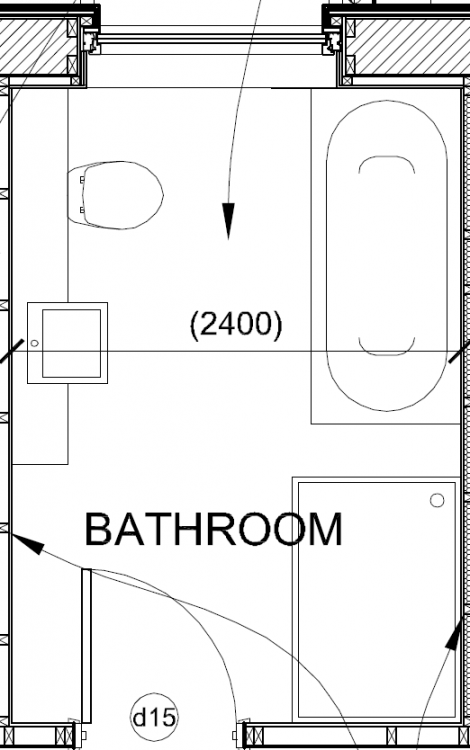
-
GSHP vs ASHP magic spreadsheet?
jack replied to CADjockey's topic in Ground Source Heat Pumps (GSHP)
Ours is on the far side of our (attached) garage and I've literally never heard it. When it's ticking away at low speed providing UFH heating during winter, you can feel the cold breeze from the fan as you walk by, but that's about it. Admittedly, it only does water heating between 4 and 6 am, so I suppose it could be making a huge racket at that time. We certainly can't hear anything in our bedroom, and its the closest room to the ASHP. We have 8.5kW of PV, but during winter, there are many days when it hardly generates any energy at all. It's much better in the shoulder months - spring can provide some useable energy at a time when the ASHP might sometimes be on. -
GSHP vs ASHP magic spreadsheet?
jack replied to CADjockey's topic in Ground Source Heat Pumps (GSHP)
Yes, they do work better in summer, but they're still useful for hot water during that time (assuming you aren't using PV and diverter - our ASHP basically turns off for several months a year during summer). And while it's true they work better at a time when you need them less, that it a misleading way of putting it. The question is, do they still work, in a cost-effective way, when you need them most. Assuming a well-insulated house and a properly designed and scaled ASHP heating system, the answer is an emphatic "yes". As others have said, the much higher capital and maintenance costs for GSHPs make them generally uncompetitive against ASHPs, assuming you're not prevented from using an ASHP due to, eg, planning restrictions. -
That should be all you need, really.
-
Ah, sorry, it's a joke based on the long planning history of this house. Joe's local council were insisting on 1.5 storey based on a mythical "local vernacular" requirement. He took it to appeal and won.
-
This would have been better as a 1.5 storey cottage. Much more in keeping with the local vernacular.
-
First he'll need to plant the hazel seeds, manufacture the necessary tools , dig up some limestone, build a crusher, build a kiln, etc. We may be some time.
-
You could make one, surely?
.jpg.c21f3ac78c9b7efd90cbdcb312744dc5.thumb.jpg.7adcad4c0e384f5ecd7d56b0618df6e5.jpg)