

.jpg.c21f3ac78c9b7efd90cbdcb312744dc5.jpg)
jack
-
Posts
7462 -
Joined
-
Last visited
-
Days Won
41
Everything posted by jack
-
Thanks for that. In my opinion, the document you supplied isn't evidence that would be accepted by anyone with a scientific background. Science aside, it involves a test (not "tests") that happened over 30 years ago, and the original documents upon which it is based are very unlikely to be available for cross-checking. If others are interested, I'm sure they can ask for your document themselves. The Advertising Standards Authority doesn't care what your job title is. If you're making laudatory statements about your company's products in such a way as to encourage people to buy them, then you're advertising, end of. As for aragonite formation, I know my chemistry knowledge is pretty weak, but these two posts seem to contradict each other: Which is it? As I understand it, aragonite is a crystalline solid, hence must be a precipitate. If "Aragonite is formed inside the device", it must therefore "precipitates inside the unit itself", surely? If not, how else is aragonite formed inside the device? This is a fairly simple question that still hasn't been addressed despite having been asked by different posters in different ways.
- 199 replies
-
- 1
-

-
- hard water
- water softener
- (and 1 more)
-
Would aragonite crystal revert to calcite directly, or would it dissolve back into solution from where it re-precipitates out as calcite (assuming the relevant conditions are present)?
-
My apologies. I assumed that if a company is so secretive that expired patents that it didn't even own are so commercially sensitive they can't be identified, then test results would be super duper tip top secret. If it can be attached to an email, it can be provided as a PDF on a website. You could also (or alternatively) provide a brief summary, such as what institutions did the work, what they tested and what the results were. Again, if the science is good, none of this should be an issue. And since these results aren't commercially sensitive, can you PM them to me please? I'm really interested in what they say. The tension between these two statements is the crux, imo. I can't recall whether Halcyan has specifically said when aragonite is formed. Since there is no plausible way that dissolved ions can retain a memory that would allow aragonite crystals to selectively be formed downstream when conditions of heat etc arise, it seems to me that precipitation at the device is the only other alternative. Halcyan's definitive answer on this point would be useful. I very much look forward to your answer, because if all CaCO3 is precipitated as aragonite, then pH should change measurably. If, on the other hand, you're saying that aragonite is precipitated somewhere downstream rather than at the device, then I think you have considerably more explaining to do. I disagree.
-
I don't think that's what they're alleging happens Jeremy. I think they're saying that the device causes the CaCO3 to precipitate out as aragonite as it's treated, not at some later stage. Precipitation should be easy enough to test. Confirming that it's aragonite will be harder. Based on their own argument, aragonite doesn't bind to itself or anything else. Accordingly, unless a very significant proportion of the CaCO3 is precipitated as aragonite, I can't think of any mechanism for preventing the remaining CaCO3 from precipitating as limescale in the usual way. But hey, I don't pretend to be a chemist/physicist, and I'm open to evidence (note: "evidence", not reviews or testimonials). The "independent industry tests" (which, incidentally, you've mentioned once, not "a few times") intrigue me. They're apparently so commercially sensitive that you won't publish them. If I had tests that proved my product worked in spite of its proposed operating principles violating the known laws of physics, I'd be shouting about them from the rooftops, not forcing people to contact me for them. Can you not see how this looks to the average potential purchaser of your product? Also, if the existing "independent industry test" results are so good, why are you: Are the existing results not good enough to prove your point? Reviews and testimonials are no sort of proof. They can be faked, cherry picked, and in any event are unreliable because most people see what they want to see. Your own "technical information/data" isn't independent, so is entirely worthless. If what you say is happening is really happening, testing is straightforward. Run some water through your system, filter out the colloidal precipitate, and check whether what you've filtered out is aragonite or calcite. Conductivity should fall due to the reduction in ions, pH should fall due to the reduction in dissolved CaCO3. I'm sure someone with more than A level chemistry will be able to propose other simple tests too. And as for this: From the landing page of your website: Are you saying that your product provides "softer water" without softening? Surely that's internally inconsistent? And if your answer is that this phrasing is intended to involve a comparison with actual soft water rather than implying you're doing any softening, then in my opinion this sentence intentionally misleads through the use of "softer" instead of "soft". I don't know what impression you think your posts as a whole will make on people who find them in the future, but at the moment my gut feeling is that they're doing your company more harm than good. Edited to add: still awaiting an answer to my question above about why "pH does not change at detectable levels" if aragonite is being precipitated in any significant amount.

-
Welcome! Find the right sub-forum and ask away.
-
.jpg.c21f3ac78c9b7efd90cbdcb312744dc5.thumb.jpg.7adcad4c0e384f5ecd7d56b0618df6e5.jpg)
Site visit? (MBC frame now up)
jack replied to Weebles's topic in General Self Build & DIY Discussion
By coincidence, I was recently in contact with the plumbing firm we all used and he expressed an interest in doing more work for self-builders (I think we're faster payers than most of the developers he's worked with!) I believe they work mainly in Surrey and Southwest London, but anyone interested in talking to him can drop me a pm. -
The way you introduced the topic of mineral content with the phrase "but please remember" sounded to me like you were suggesting the effect somehow wasn't testable. Apologies if that wasn't intended, but as I think the conversation to date has made abundantly clear, several members understand completely what you're alleging happens. Any tests are hardly going to just involve checking for calcium carbonate. Why not? I'm no chemistry expert, but from my A-levels a few decades ago I seem to recall that pH should change if you precipitate a significant proportion of calcium carbonate ions out of solution to form aragonite.
-
But you allege that aragonite is formed. Aragonite is a solid, and hence must reduce the concentration of ions. While one would expect dried solids to be the same upon evaporation, conductivity and pH, for example, should be different.
-
Why is internal sewage pipe round and not square
jack replied to Triassic's topic in Waste & Sewerage
For drainage with a slight fall, it also offers the best combination of flow rates for small and large volumes of water. Small volumes of water in a square (flat down) pipe would flow quite slowly. -
Most magistrates are pretty good at sorting out what's what. I doubt any would consider that any benefit was gained from what's been done to date (especially given the costs of remediating the piers, assuming it can be shown that they were damaged by the first builder). That said, I'd be tempted to accept that £120 extra is a small price for dodging this bullet. Also, the last thing you want is to make an enemy of someone locally well known. Personally, I'd consider accepting the loss, diverting my time and attention back to what's being done now by the new guy, and chalking up the extra as a price paid for useful experience. Probably not what you want to hear given the horrible job that was done, but your time, energy and emotional well-being have a price too.
-
I think I saw something else he did (lab tables with removable tops?) on the forum you mentioned above. Extremely tidy work, and in stainless too!
-
Yep, already thinking about a strip of epdm or nitrile rubber along the bottom. Concrete floors make something like this a must! I hear you on the costs of galvanising etc. We've started getting quotes for galvanising and powder coating our gates and I've been surprised at some (well, nearly all) of the prices coming back.
-
Site visit? (MBC frame now up)
jack replied to Weebles's topic in General Self Build & DIY Discussion
... and we did the same with @JSHarris There's quite a chain (a few chains, actually). Lovely to see it being continued as each new link in the chain moves forward. -
That applies to everything - the guys who turned up to do ours expected us to supply EPDM for under our doors and compriband for where the external blind rails meet the cill. They asked for this in both cases on the day they actually needed the materials, despite the fact that they'd been onsite for days and we'd asked them when they were quoting whether they needed us to supply any materials.
-
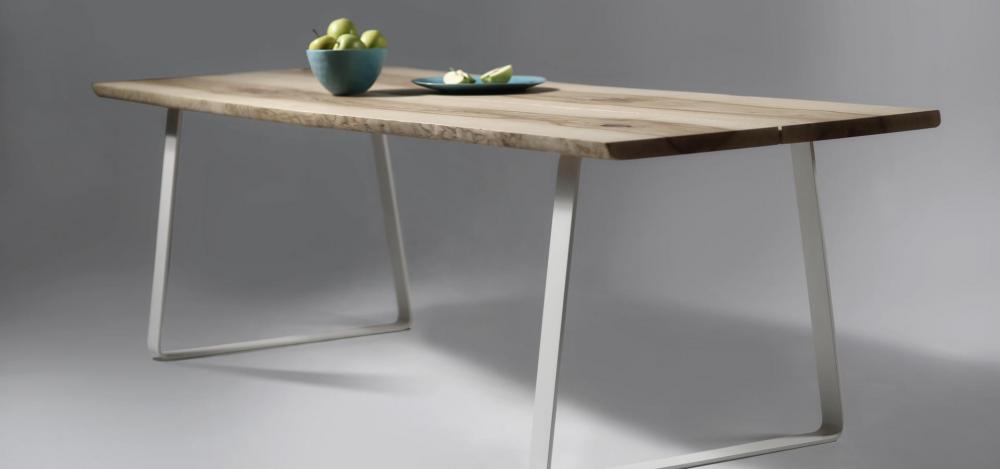
I agree. I don't know what's underneath - there could well be more to it than you can see. I'm a little concerned about the amount of leverage that could be put onto fixings into the bottom of the table if they just go through the flat bar where it links the tops of the legs. I think that at the very least there should be a couple of tabs extending along the underside of the table surface, or (as you say) rails linking the legs and attached to the underside.
-
Stop right there - £60 a leg would be perfect! I'd guessed 60 x 10 but I trust your and his eyes over mine. We were actually thinking of just leaving it raw (with the mill scale still on it - it'll probably flake off on the bends). We did that with the handrail on our stairs and it's developed some really nice patinated areas. Where's your mate based? Edited to add: maybe by PM would be better... Thanks
-
Exactly. That's why I don't want to spend a lot of money on it!
-
It's basically this (but dark coloured legs):
-
Interesting stuff, thanks! We had a blacksmith (guy who did our stair balustrades) lined up to handle this last year, but he's since closed his business and gone to work in an entirely different field. We'll likely be looking again. The big issue with the legs is getting all the angles even and the bends regular. Perhaps that's easy to do - I (as usual) haven't a clue.
-
Ha, I know you have this stuff and that it isn't yours. I'd have been at your doorstep with a pile of oak and a case of beer otherwise!
-
The existing table isn't in great nick overall, and even with the right top wouldn't be anything like the look we're after. I was thinking about just dumping a piece of ply in place of the existing tabletop, but that will remove all incentive to get the oak done! Interesting idea. I don't presently have a router, but have long been looking for an excuse to buy one! The boards will be slightly separated from each other, so this shouldn't be an issue.
-
Sounds like we're order of magnitude in the right region, thanks Jeremy. I'd rather not wait another year - our current table is falling apart!
-
Interesting stuff, thanks Mike. I wouldn't want to pass these on and buy replacements. One of the main aims here is to have the tabletop come from the same site as the house, and to get some meaningful use out of a tree that we felt bad about cutting down (it was in poor nick, but still...). Given it's been around 4 years since the tree was cut down, and 2.5 years since it was planked, I'm willing to take the risk. I can live with a bit of movement after it's made. I'm not interested in a billiard table smooth finish on the top, either.
-
Pretty sure that's wrong for an internal ceiling of a dwelling. We had to have pink in the garage, but not in the house.
- 52 replies
-
- 1
-

-
- plasterboard
- fire resistant
- (and 1 more)
-
Very kind of you to offer. I'm not sure how much welding is involved - it's mainly about getting a reasonably small-radius bend in the steel. We've looked into that option but can't find anything with the right legs. Anything in this general style tends to be very clunky. That table you linked is a tidy bit of work. We're thinking of getting it painted/powder coated in RAL 7016, same as our windows. Everything I've read about oak in the past suggests that it's now probably too tough to do much with hand tools (and a lot of time). I think the toughness that comes with seasoning is a large part of why oak frames are usually done while the oak is green. Suspect you're right. Even if the tools were up to the job, it'd take forever, and there's still a decent chance I wouldn't manage to get it flat anyway. Eye-watering = several hundred quid (admittedly including painting). It's frustrating because I know the cost of the metal is minimal, plus there's little if any cutting or welding involved. Just some bending and a few holes to allow attachment to the tabletop. Yes, there are all sorts of things available online, but most of them we find pretty unappealing tbh. They tend to be roughly made and/or too chunky looking. Believe me, we've looked! No!
.jpg.c21f3ac78c9b7efd90cbdcb312744dc5.thumb.jpg.7adcad4c0e384f5ecd7d56b0618df6e5.jpg)

