


Beelbeebub
-
Posts
1521 -
Joined
-
Last visited
-
Days Won
11
Everything posted by Beelbeebub
-
If the centers were sited on the coast not only could the power from ofshore be brought to them easily but they could also have sea water intakes and outlets for the cooling system.
-
Force all AI data centers to fund new build renewable capacity and grid upgrades to handle it equal to their demand, up front. That way whwn the bubble pops, hopefully before the data centers get built, we get a load of free capacity. 😁
-
But we have the alternative in front of us. We have a road map of how to do it. The national grid have the plans and projects to upgrade the transmission. We have the generation technologies already proven. We just need to do it. It would be madness to spend as much money rebuilding a coal based infrastructure. You saw the report that the cost of a single oil crisis, like the two we have had already this decade, is equivalent to just following the plan we have.
-
Too slow or too fast?
-
There would be an interesting case for people with old style meters, they would just run backwards so any export would be effectively net metered, ie your effective payment per kwh export would be whatever you import unit cost would be! 😁
-
Via CE/UKCA marking? At least for the device and any requirements for it to operate safely. Obviously it can't control shoddy house wiring (eg not using an outdoor rated socket or just running a really long extension cable) but those risks exist with any electrical equipment.
-
China is reducing imports. Their goal is energy security through independence. Being reliant on coal and imported coal at that, is counter to that aim. So they are increacing local production whilst reducing reliance on coal as a %of their mix. Given the size of China it's going to take a while but they are driving in the right direction. So is the UK to be fair.
-
It's not that it isn't secure. It's that there isn't enough of it (besides all the other issues). Again, if we use coal to become energy independent we still have to electrify the economy (ev's heatpumps etc) and we have to rebuild lots of coal mines and coal plants. And then work out what to do 25 years later when the coal runs out
-
Like all their arguments it's simplistic in the extreme and designed to appeal to people who can't or don't understand nuance or complication. The UK deficit is over 70bn The total number of illegal arrivals is less than 50k. So unless each one is costing us £1.4million it's not the answer.
-
They will fix the energy security issue by stopping the small boats. They will fix the potholes in the roads by stopping the small boats. They will fix the cost of living crisis by stopping the small boats They will fix the NHS by stopping the small boats They will lower taxes by stopping the small boats They will ensure England win the world Cup by stopping the small boats. They will get rid of the itchy burning sensation between you toes by stopping the small boats. They will fix your leaky roof by stopping the small boats.
-
China still has a big infrastructure for coal as it was a huge operator and coal is still used. There is a huge amount of inertia in the planning and commissioning system.
-
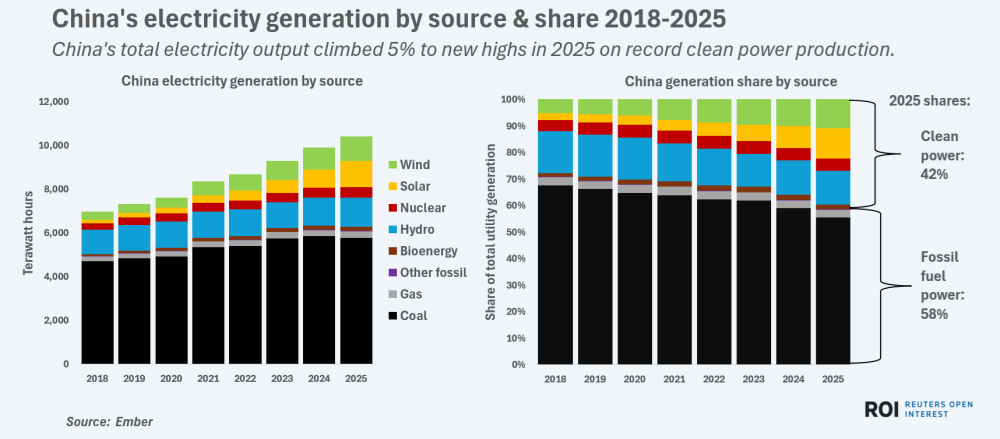
China is building new coal, but not much and as some is replacing old coal the total growth in thermal capacity is very modest. About 60Gw (out of nearly 3,500 Gw total) against 90Gw of wind and +300Gw of solar. As you can see even though energy production is rising the share by fossil fuels is falling. For all the people who say "why shoukd the UK do anything, China is the important one" - China is doing something. They installed more wind capacity in one year that the entire UK grid (some 45Gw is, depending) and more than 4x in solar. LNG imports were falling (luckily for them) and oil was falling though it did rise slightly last year, mostly due to refilling stockpiles (wouldn't that have been a good idea). I believe actual use of liquid fuels fell.
-
Farage "Given that our critical reserve of natural gas is down to two days and how vulnerable we are, and with talk potentially of energy rationing coming later this year, isn't it time we change course, get rid of excessive taxation on the exploration companies, open up the licences, and become self-sufficient in natural gas." Of course, given his propensity for lying he will outright deny that he ever meant that granting gas licences ever meant that we could become self sufficient in gas. And Badenoch " Drilling in the North Sea and expanding other sources of generation … is the only way we can protect families from rising bills.” And countless others going on TV and social media giving tge impression that there are vast reserves in thrnorrh sea and the only thing stopping the UK from becoming Saudi-on-sea is woke lefties.
-
This is only a theory but certain segments of the population have become so entrenched against renewables because of their opposition to "green stuff", which seems to be very culture war based, that they are unable to accept that renewables can make sense for other reasons.
-
IIRC the bare lifetime £/Mwh was around £60 for a CCGT plant. I imagine a coal plant would probably be more expensive to build and run. It was around £40 for an offshore wind project. Onshore and PV were a little bit cheaper again For the gas plant £40-50 of that £60 was fuel. Which has now near doubled
-
The point you are missing is that right now, all the still standing coal plants will require significant investment to get back to producing power. They aren't just sitting there waiting for someone to turn the key. The time to reverse the decision was before they stopped working. That ship has sailed. The argument that it was a bad decision to shut them down in the first place is a hindsight one and if we are playing that game we can argue that we should have started our nuclear replacement earlier and for more plants. You can argue we shouldn't have banned onshore wind for the last decade. You can argue we should have been pushing for more efficient homes and heatpumps years ago. But "if wishes were horses we would all ride."
-
And which mine was that?how many employees.? What capacity? As far as I can see the last major Mine (kelkingly) closed around 2015. It produce around 2m tonnes a year and emolued around 700. If you include mines closed in the last 15 years (where you plausibly be able to rehire some staff) there are less than 2,500 employees and they priced about 5m tons of coal, less than 25% of what we burnt back then. Currently there appear to be less than 500 miners making less than 100k tons a year. I'd we assume the rail isnin place, which it will only be for past coal mines and plants, *and* we manage to restart coal mining on a scale not seen for generations *and* we refurbish old coal plants and build new ones *in the next decade*. Then we still have to work out what to do by 2050. Or we could just keep doing what we have been doing for the last few years here and around the world (just 3 Chinese Co. installed more capacity than the entire UK grid last year alone) and add more and more renewables, update our grid and local storage. Then our demand for fossil fuels will have fallen so that waht little we do produce in 2035 will be a reasonable proportion of our consumption.
-
I really don't understand thus quest to find any other source than that we are successfully installing at pace at the moment.
-
And the lines to the mines?...
-
And the idea that we "still have coal in the UK" is not the whole picture. We have coal deposits in the UK, but we don't really have the skills, infrastructure or political will to extract it. Who has recent expertise in coal mining in the UK? All the knowledge any coal miners had will be the better part of 40 years out of date. Who makes the equipment? How much does it cost? Which communities will welcome the return of coal mining with all the negatives it brings (subsidince, ground water contamination, spoil heaps, heavy machinery). Who are you going to get to work down the mines? I know modern mining is a lot less labour intensive but you still need some young people who want to do it. How do you get the coal from the mines to the power stations, rail is your only viable option so we'd have to build at least some some new rail lines. How long and how much will that be? And don't forget, once you have done alm that, trained up a work force, built a supply chain and logistics route, refurbished or built new power stations. It all comes to halt in 25 years when we run out of coal...
-
At the point they are blown up they aren't functioning stations. If we had a functioning coal plant that was scheduled to shut down in the near future I would absolutely argue to keep it operating. IIRC that is exactly what happened to Radcliffe on Soar, which had it's operation extended due to rising gas prices in 21/22 But at this point, today, the plants have been shut down for at least a year, often several. It is unlikely they were shut down and "put to bed" with restart in mind. The shut down was probably more focused on decommissioning. It is probable that some equipment has already been removed or disabled so starting up (say) Radcliffe would be a massive undertaking. It's the difference between carefully putting a car away in a heated garage on stands hooked up to a trickle charger for the winter vs leaving it in a field for the scrapper to take away (and probably ripping out anything you can sell on ebay in the meantime) With hind sight having Radcliffe running now would not be a bad thing from an energy security pov, though it should be noted coal has risen 20% in price recently. There is nothing to be gained by pausing the demolition now.
-
https://www.upliftuk.org/post/just-one-months-gas-supply-from-14-years-of-licensing-by-previous-government. • From 2010-2024, the previous Conservative government handed out hundreds of new North Sea oil and gas licences across seven licensing rounds, which will lead to just 20 new and re-licenced fields. • These 20 developments have the potential to produce – in total, over their lifetime – less than six months of UK gas demand and less than eight months of oil. •To date, they have produced the equivalent of just 36 days of extra gas. They have also produced just over two months (64 days) of oil, however, most UK oil is exported. Now to be fair, this report had been produced by an organisation(s) that is pro energy transition but, let's say they are an order of magnitude wrong. That's still chicken feed.
-
The point (of this thread, started well before the current ME capers) being that it is unwise for the UK to rely heavily on external energy resources *and* the only sovereign energy resources we have in sufficient quantity are renewable ones. We must reduce fossil fuel reliance, which means - Reduce consumption (insulation etc) - Electrify transport and heating - Increace our renewables generation And you can come to the above conclusion with no reference to "green stuff"
-
Alot of discussions focus on the intermittent nature of wind and solar. But if we build out a big capacity then even when the fleet is operating at a low % of the peak it's till enough. Sure that means we have far too much on a good day but that's a good problem to have. Obviously we need to build out storage both at a grid level (hydrocand battery farms) and micro - home batteries. If every home had a 5kwh battery we'd have 125Gwh of storage. The evening peak would probably be eliminated. A 10gwh battery (not unreasonable) would do most homes for 24h non heating loads. I estimate you could build a standard mass build house with enough panels and batteries to make it a net generator over the year and not need grid power for half of it for under £10k extra. That frees up a huge amount of capacity for car charging and electric heating. We might need to fire the gas plants up over the winter - but that's still alot less gas burnt
-
There are half a dozen or so still to be demolished coal plants. How long and how much money do you think it wil take to bring them back online, even if we assume no equipment has been removed or demolished? We'd have to check and refurbish everything - where do we get the engineers and parts? We'd need to restock the coal - from where, how do we transport it? All this is doable but will take time, probably years and lots of money And then, we can't have coal plants sitting around doing nothing. We need, ideally to habe them as an active (if only intermittently) part of the grid. But coal isn't very good (as mentioned previously) at occasional use. It's much better as base load - which is not what we need. The entirety of thr "let's use coal" argument rests on the idea we have vast reserves. But we don't. And we don't have an industry to get at those reserves anyway. I wonder, even if you went back to a decimated coal town, how many people you'd get signing up to"work down pit" (said in Yorkshire accent). I can get the idea that gas could have a place as occasional use plants - especially in the nationally owned, vertically integrated with the gas fields model. But coal isn't a good fit. The money spent maintaining the coal plants would be better spent on upgrading the did to reduce capacity constraints, increacing storage (say another pumped storage facility) or building more renewable generation.


