


Beelbeebub
-
Posts
1521 -
Joined
-
Last visited
-
Days Won
11
Everything posted by Beelbeebub
-
I think the plug in battery systems might end up being the better solution. A 1 or 2kwh plug in unit - especially if linked to time of use tariffs - could make a big difference to bills and the current 4-pm demand peak. I keep thinking that octopus or similar could offer a tariff where you get a plug in battery and got a guarenteed low price for Xkwh a day. Say you pay £1 a day all in for 5kwh with the rest charged at normal rates - maybe a roll over/forward facility up to 10kwh in a single day. The energy supplier would make their profit by charging the battery at cheap periods and thus reducing their volume a at high price periods. If such device were just a suitcase sized box delivered to your door, connected to WiFi and plugged in somewhere it could get really good uptake.
-
https://www.aer.gov.au/news/articles/news-releases/aer-releases-final-default-market-offer-2026-27 If renewables are going to make the grid more expensive how come they are making it cheaper on Australia? The combined range of price changes (flat rate and time of use) are: New South Wales: Residential -3.4% to -7.7%, Small business -9.0% to -20.9% South East Queensland: Residential -7.2% to -10.7%, Small business -10.4% to -14.0% South Australia: Residential -1.1% to +1.4%, Small business -6.8% to -12.1% AER Chair Clare Savage said.. “The reductions compared to last year reflect easing costs across most components of the DMO, particularly in wholesale energy, where we’ve seen lower electricity contract prices, reduced spot price volatility, and increased output from wind and battery generation during evening peaks.” “Despite uncertainty created by conflict in the Middle East, wholesale energy costs have not increased.” Of course australia did see diesel almost double before falling back to (currently) about 25% more than pre war levels which is painful - but underscores the advantage of switching transport away from fossil fuels.
-
I see this point come up alot, but wouldn't it only apply if the person overloaded the circuit to begin with? If you have a standard ring on a 32a breaker they can run several appliances together, say 3, up to the 32a limit, but the typical 2.5mm cables are only rated for 20a and the whole concept relies on both ends of the ring taking the load so no one part ever sees more than 20a. A person could run more than 32a of load if the additional current was provided by the solar but as long as the wiring run from the solar to the load wasn't exceeding 20a it would be fine. So a tumble dryer plugged into the same double socket as the solar would be fine. The problem might occur if the loads and sources were too far apart or unbalanced but that is a statistical risk the ring main system accepts anyway.
-
there are premade rubber cable entry "patches" for cable and pipe entry.

-
Yes, this is (I think) more of a modern problem. In the past our politicians were somewhat more serious. You may disagree with various historical politicans and they may have made disastrous decisions and mistakes but it seems (at least in hindsight) that they took the job of being a politician seriously. They would sit for hour long serious TV debates where they would delve into complex matters. The interviewers and opposition acted in good faith and followed up. Look at the TV debates of the 70's and even 80's. The vast majority of government work carried out by the professional civil service and their advice was taken seriously. This was why someone with no particular ecperice ofnhealth/defence etc could fulfil the role. Now, as mentioned, politicans don't act in good faith. It's all soundbites, misquotes and blaming the "deepstate" for stopping you doing what you want to do (mainly because it's a massively stupid thing to do). One of the Trump appointees - possibly homeland security, recently floated the idea of cutting the number of federal customs and border staff at airports im cities that weren't cooperating with ICE. At the time everyone thought it was just some off thr cuff remark because to cut staff at NY, Washington etc airports - some of the biggest in the US, would cause absolute carnage with most of the economic fallout being borne by the cities that the travelers were eventually heading for rather than the ones they first landed in. Anyone with an ounce of understanding of international travel, tourism etc would contemplate such a scheme. Anyway, it looks like they might be serious.... Because Trump's primary criteria for appointments is personal loyalty rather competence.
-
There's an intersitn flip side to this which is the tendency of people who are really skilled in a given area to not think of their skill/knowledge etc as exceptional and think everyone else is of a similar ability. This is what sometimes males excellent skiers, artists, scientists etc bad teachers. "you just bend the knees and turn the skis!" they shout at their poor student. It's can also lead to disastrous political consequences when politicans, who may be immersed in a complex and counterintuitive policy area, put questions to the public assuming the answer is obvious to everyone.
-
I remember when diesels were slow, noisy and heavy.
-
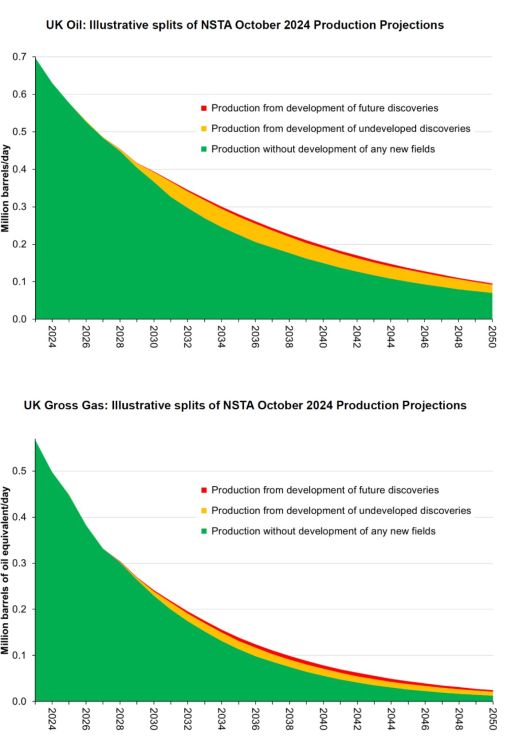
That graph is by the oil industry. It's including absolutely everything they suspect might be out there. It includes unknown discoveries ie fields we don't even know exist yet and even unknown improvements to extraction technology to get more oil than we think we can at the moment. And even then, after all that optimism, production still falls 50%. The question of whether or not the costs of extracting that last little bit of oil are worth it or not is seperate from the question of what good that little extra bit will do.
-
This is the point ☝️ Some politicans are selling the idea that the UK could be Saudi Arabia or texas if only thr "woke" politicans would get out of the way and allow the oil companies to drill, lower our bills and increace our energy security (out of the goodness of their hearts). It's bollocks. Our high energy prices and energy insecurity would not be made better by all the drilling in the world and the very things that will help are opposed by the same politicans.
-
Could you dm some details?
-
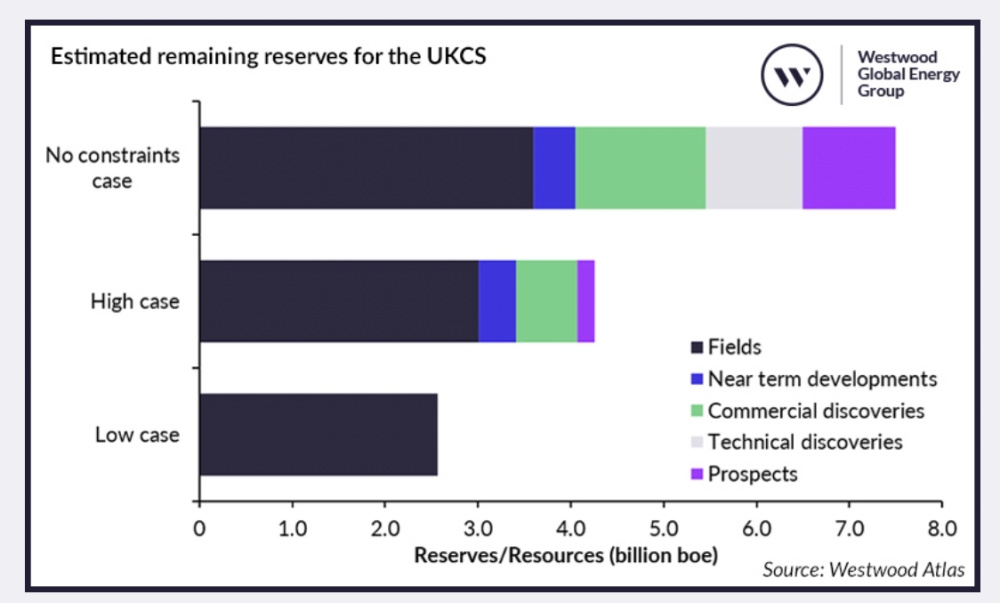
They are included in the Westfield report which has a wildly optimistic "no constraints case" case. And even that case has production falling by 50% from today's figure by 2035. For reference their low case (2.5bn) is less than the NSTA central estimate which is about 3.5bn. So their high case is maybe 1bn (4.5bn) more than the current official estimates.
-
I know, people still think the answer to our problems is simply to grant more oil licences. It doesn't matter how often they are shown, by figures from the oil industry itself, that it would make no difference they just keep on about drilling for oil. 😁
-
It's not £5bn tho. That's the revenue from current operations. The revenue we forego from not drilling the new sites isikely to be less than 10% of that... So less than £500m. In the context of government spending that's a rounding error. But again, and I don't know how many times this needs saying, drilling for more oil will not improve our energy security - the amount of oil availible is just too small to matter.
-
UK ‘built for climate that no longer exists’
Beelbeebub replied to SteamyTea's topic in Environmental Building Politics
That's an interesting idea, though is there any evidence? I understand the theory but wouldn't the input (output?) of heat energy to the air mass be vansihngly small small vs the input from solar radiation and other energy use? By definition, if it measurably increaced the heat in the local atmosphere would t that start to rise and draw cooler air from surrounding land mass into the city? -
On coal, this has been covered, but even if we went" all in" on coal - and that would require massive investment in building and reopening coal plants and mines - we would still need to electrify heating and transport (unless you want coal fires in houses and coal powered cars) and after all that we would still have less than 50 years of coal left. On fraking - again it's been covered but fracking is massively bad for the landscape. Go onto Google. Maps and look up "wickett, Texas" then zoom out amd look at the grid of fracking sites. Then zoom out again. The US can extract oil via fracking because it is prepared to turn an area the size of England into an industrial zone. There is also the matter that the test sites seem to show the potential in the UK is much lower than initially assumed.
-
Not really. In pure revenue terms it's abiut £5bn a year. To be fair, I'm not sure if that includes the windfall tax which might add another £2.5bn a year. Note there are also costs to the taxpayer on costs associated with decommissioning. These are dependent a fair bit on how you view them (is a tax break on decommissioning costs a cost to the tax payer?) but also run to the billions. None - or as near as practical to none. Firstly the current model is the oil/gas extracted is sold on the international market to the highest bidder. So cost wise, uk consumers will have to pay the market price. We see this now where very little our oil comes from the gulf but the people who did source from there (China etc) are now buying from the same people we buy from (USA etc) so our price goes up. The price of petrol and diesel in Texas, which produces vastly more oil than it consumes, has risen. Secondly, because of a mismatch entween the oil we extract and the oil our refineries can accept we.tend to send out oil aboard to where it can be refined and either buy the resulting refined product back or we import oil suitible for our refineries and then sell the resulting products to the highest bidder who may be a UK consumer or not. So even in terms of "can we physically get hold of the substance we need" more production will not help us. However, if a significant portion of our current demand for oil (cars etc) and gas (home heating) were to convert to electricity and we increace our non fossil fuel generation capacity (ie solar, wind, nuclear) - then we could be more energy secure.
-
The graph is relevent because it makes the argument that more drilling will have any benefit beyond higher profits for oil companies irrelevent. We are already on course to extract the vast majority of our remaining* reserves. Extracting that little bit more won't make us richer (unless you own an oil company) or more secure. The only thing that will make us more secure are the policies that reduce our consumption of fossil fuels, the majority of those policies come under the "Net Zero" umbrella. *as reserves are calculated on the basis of economic viability the volume will fluctuate with World price. If the world price dipped to $10 a barrel the uk's reserves would be zero. Likewise if it shot up to $200 our reserves will seem to increace.
-
UK loosens Russian oil sanctions as fuel prices rise https://www.bbc.co.uk/news/articles/cy42x3g7r89o We are having to take action against our national security interests (buying diesel from an actively hostile foreign power that has invaded a European country and deployed chemical and radiological weapons on UK soil twice) because our transport network is critically dependent on a fuel we cannot produce enough of ourselves.... This action would be less neccesary if we had higher EV adoption rates. It's too late for this crisis, but we need to be ready for the next one. Again the NZ policy of strongly encouraging EV adoption - a policy that political parties with strong links to Russia have explicitly said they would reverse - is vital from a national security perspective regardless of any environmental concerns.
-
UK ‘built for climate that no longer exists’
Beelbeebub replied to SteamyTea's topic in Environmental Building Politics
If only there was a mass produced technology that could efficiently use electricity to heat and cool a space... -
No. That's my point - there really isn't much extra oil/gas left to get out. To a fair degree the argument whether or not to extract the last few % of the Uk's oil and gas is moot from a energy security standpoint. It will make no difference to our energy security if we continue on the projected path (green) or issue new licences (red and orange) What will make a huge difference to our energy security will be how much energy we can produce and use in the UK. So to that end we need to Reduce demand (insulation and public transport) electrifiy heating (heat pumps) Electrify transport (EVs) Increace local electricity production (winds, solar, nuclear, storage etc) All of those are "Net Zero" policies.
-
Indeed, mad. Still males makes me laugh. We will continue to consume fossil fuels for a while yet. The point is not that we shouldn't produce it in this country it's that we can't. Again, looking at the graphs in the previous post, our production is falling and the difference between our current course and drilling like lunatics is basically sod all.
-
Fully agree Yes, but I would caveat that with the point it cuts both ways. Certain political parties have made statements to the effect that they "will end net zero madness" and basically halt all renewable projects. We see this with trump who is literally paying companies not to install renewable projects despite causing a surge in fossil fuel prices! In the UK those same parties tend to follow up their "no to renewables" stance with the assurance that the UK will make up for that loss in generation by extracting more oil. In effect saying "we don't need renewables we can become a fully fossil fueled economy *by drilling for more oil*". This is often followed up with the promise that the UK can have lower bills and greater energy security by going this route. This is ideological BS. Yes, there are many ways to skin a cat, but the key point is that UK fossil fuel production is fast declining from only 50% of consumption and there is very little we can do about it. The difference between folloing our current "Net zero" and "drill baby drill" is so tiny as to be irrelevant. It's the difference between the green but and the orange&red bits. For gas in particular it's pretty much a rounding error.
-
So, No, you can't define it then? Here is the official definition "to be aware of and actively attentive to important facts and issues (especially issues of racial and social justice)" So throwing "oh look at you - so aware of important facts and issues" as as insult says more about the mindset of the insulter than the insulted. But more importantly to this thread - it has absolutely bugger all to do with net zero policies except as part of the wider right-wing culture war. I'm all fornsunding renewables. But here are some "important facts and issues" The annual tax receipts from north sea production are about £5bn and as we have established production (and hence tax revenue) *will* fall. So the effect of drilling for that "good sweet oil" will be marginal. Revenue might be (at best) 1/4 rather than 1/4 of that in a decade. So say £1.5bn difference. That's chicken feed at this scale. We have also established that increacing out NSea output would not have made any difference in the current crisis. Our volumes are too small to affect world price. But the cost of staying on oil rather than electrifying our cars (for example). In April it was estimated uk motorists paid £2bn more for fuel. It would be better to pay for the renewables from the potential £2bn a month saved than the £1.5bn a year raised. So the "woke" NZ policy of transport electrification that seems to so enrage certain political segments well beyond any rational arguments would be saving motorists billions a year as well improving air quality.
-
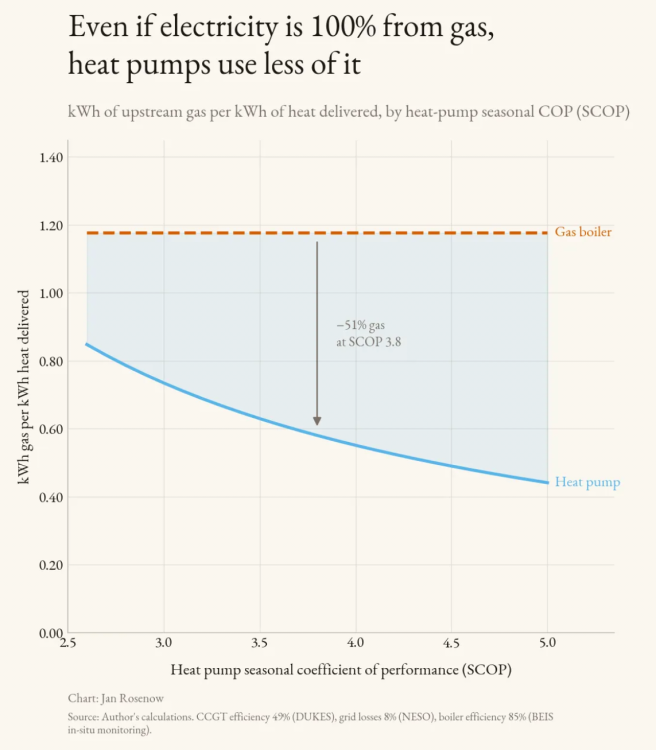
Let's just pretend we are all die hard fossil fuel enthusiasts and are not gkig to have anything to do with renewable generation. Even then, bring gas in a power station, sending it down the network and using a badly installed heatpump at the other end uses 25% less gas than burning it in a gas boiler on site. So out limited gas reserves will go further. But heat pumps are "woke" (but not fridges obviously, they are very traditional and manly because you can store raw meat and beer in them) so real men can't use them.
-
Can you explain what exactly "woke" is? It seems to be thrown around alot as an insult.




