MikeSharp01
-
Posts
5693 -
Joined
-
Last visited
-
Days Won
16
Everything posted by MikeSharp01
-

Interesting couple of days with the new heat pump.
MikeSharp01 replied to MikeSharp01's topic in Air Source Heat Pumps (ASHP)
How did you control it. -
Interesting couple of days with the new heat pump.
MikeSharp01 replied to MikeSharp01's topic in Air Source Heat Pumps (ASHP)
How do you control it -
Interesting couple of days with the new heat pump.
MikeSharp01 replied to MikeSharp01's topic in Air Source Heat Pumps (ASHP)
Yes it is. It is in the open space on the ground floor. It is the wireless one that comes with EMON system from open energy. How does it not reflect reality? -
Interesting couple of days with the new heat pump.
MikeSharp01 replied to MikeSharp01's topic in Air Source Heat Pumps (ASHP)
Thanks Gus but the space is not all it seems. I have a space 245mm deep along the wall in front and 125mm on the wall to the right as there are kitchen panels, all openable, along the facing wall and cabinets, all of which will slide out for access, along the right hand wall. -
Interesting couple of days with the new heat pump.
MikeSharp01 replied to MikeSharp01's topic in Air Source Heat Pumps (ASHP)
Yes, it is. I should have split it. I have not found any controls for the pump in all the places I have looked but I am hopeful that I can squeeze that up a little further and witha complete pressure flush I can get the performance I want. Getting your head around how these things work and the perverse incentives (just the laws of physics really) they seem to have built in is fun. I have had that thought, the whole place is cold and it has a significant decrement / increment delay as you can see from the trends. I need to get the delta T down a bit more, I have 6 or so at the ends of those runs today which is re-assuring. I am hoping its just a sediment restriction in that long loop and I can get it cleared if not I am going to have to think a bit more out of the box aren't I. I was interested today to see how the heating affected the building and the slab. Going into the heating session this afternoon we had a room temperature of 16.5, at the end of the day before we had 16.9 so a drop of 0.4 deg C in 12 hours with a delta T inside to outside of 11 deg C. 6.549 kWh of electricity raised the temperature back to 16.9 deg C now. Over the three days 33kWh (£8.91) has lifted the internal temperature 5 degrees against an average delta of 10 degrees. Yes, rediscovering my inner child is real fun, I wish I still had the sponge brain I had then you can learn so much so fast its frightening now to think about how slow I am! -
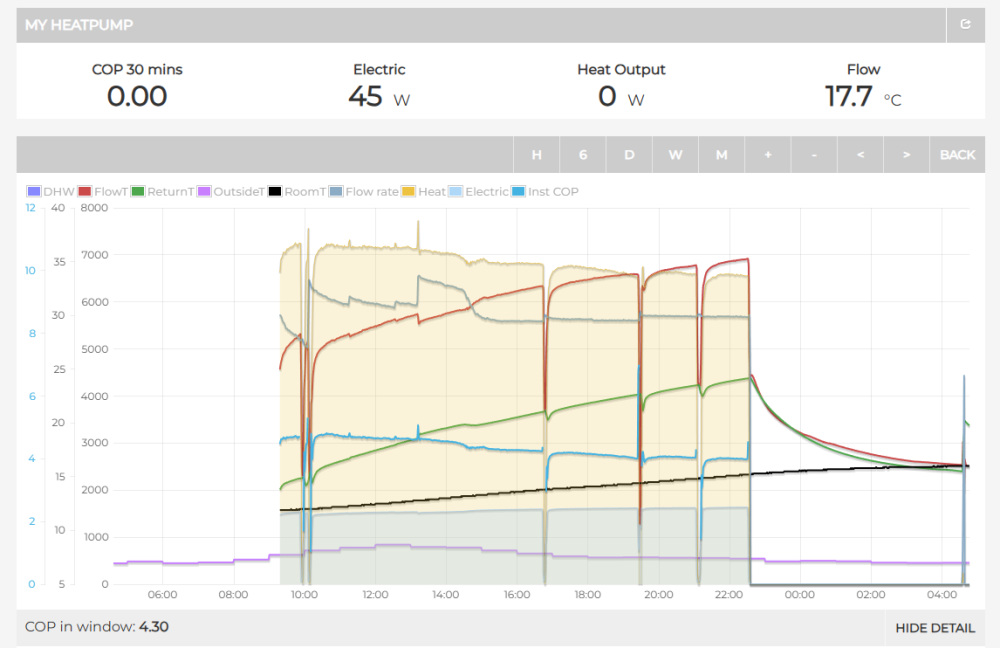
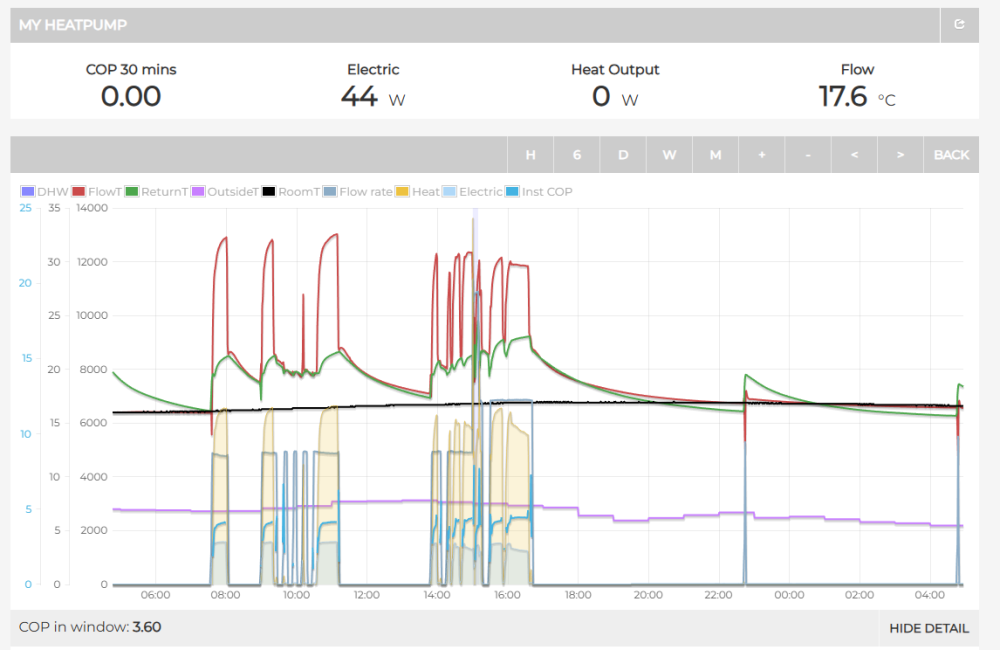
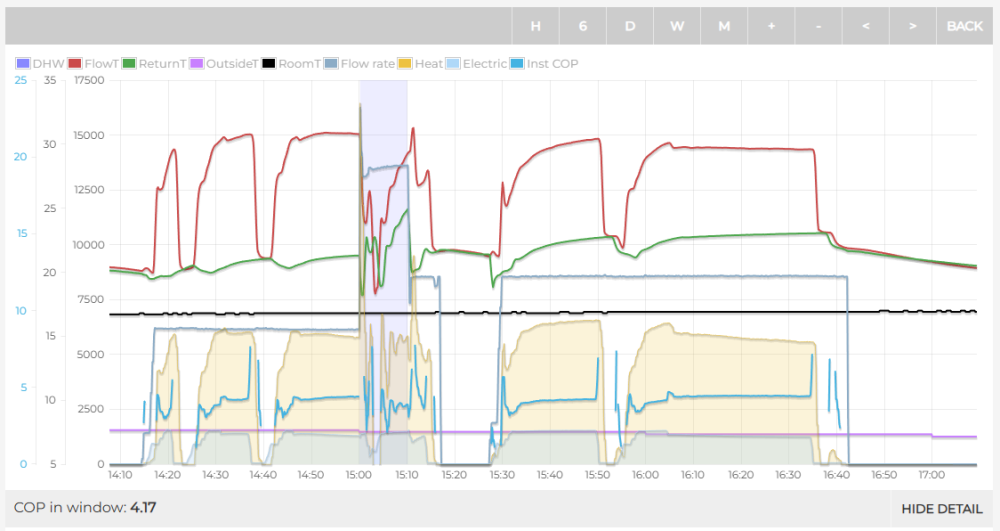
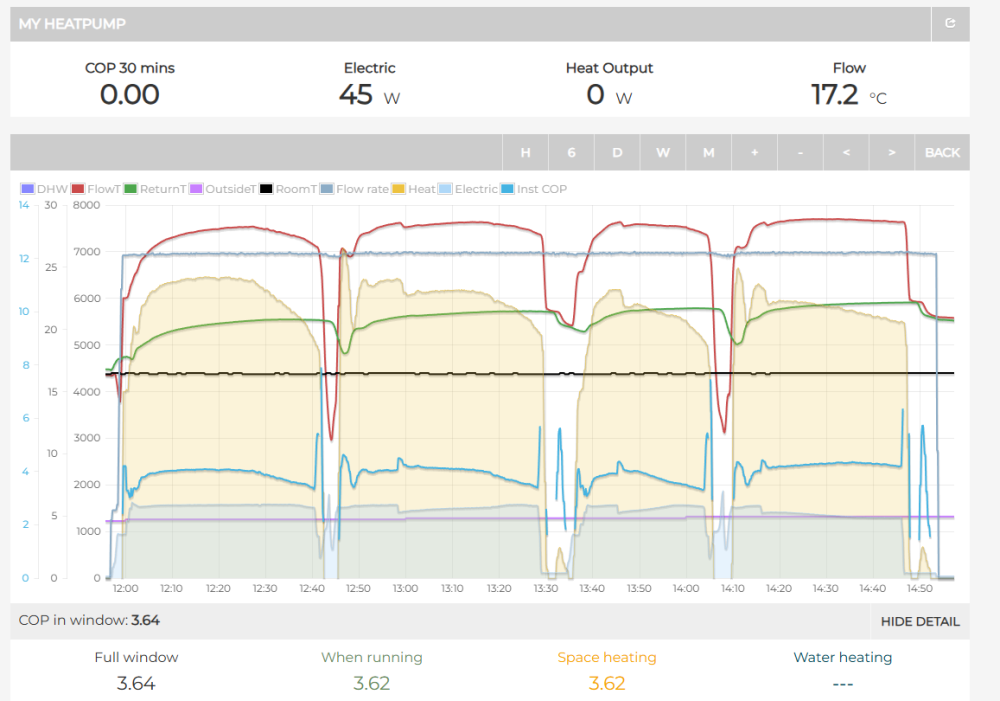
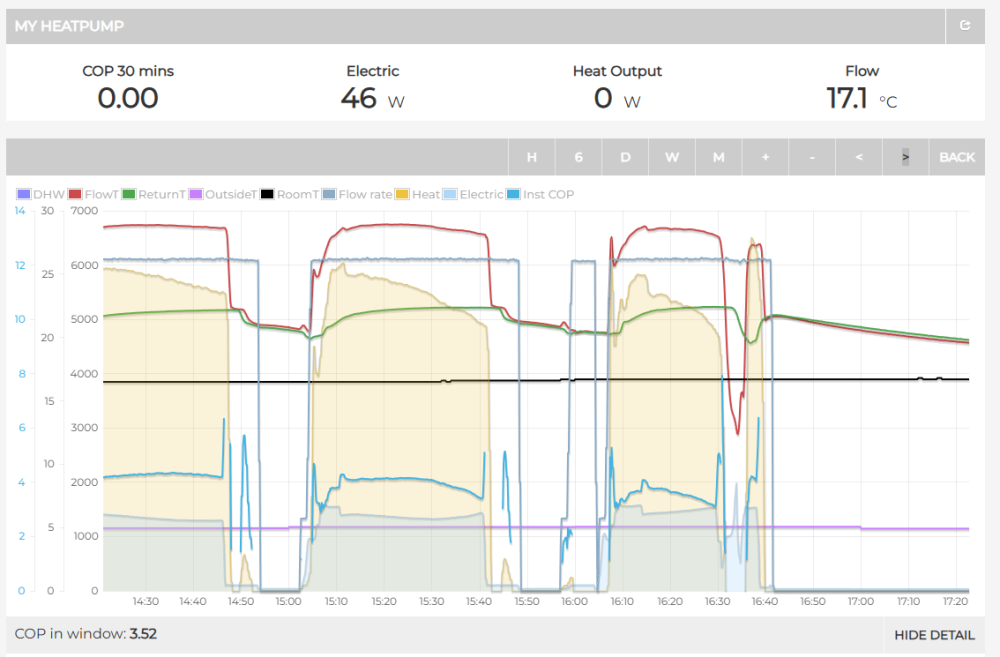
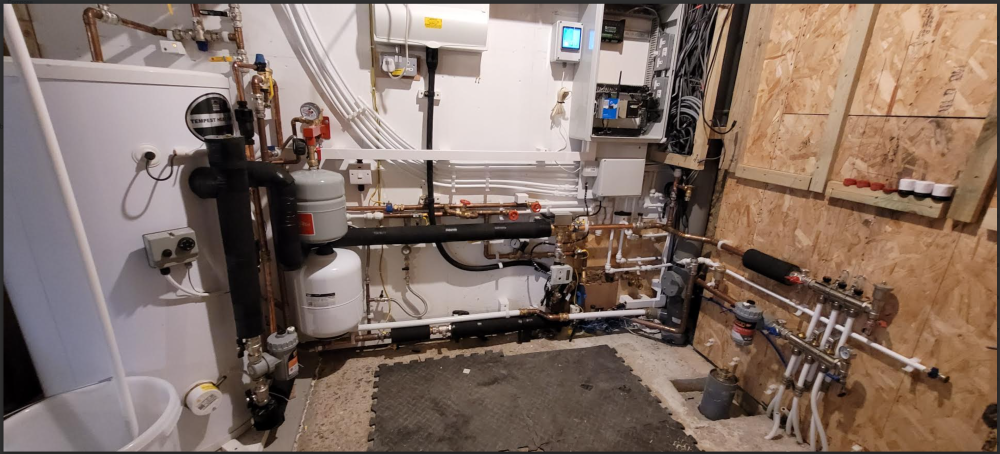
I started playing with the new heat pump on Sunday, first day I had since commissioning. Thought it would be fun to run it and heat up the slab so just set it going, I had not done any tuning or fiddling about so this is the out of the box operation and in the context of a very cold slab! So we are setting out to raise 70T of concrete 8 or so degrees. (Spoiler alert we still are not there yet.) Here is the first day as observed by the EMON heat meter system. Clearly a number of issues, two main ones - of course the experts I hope will see more. Firstly the delta T is huge 11-12 deg C for the most part, and really does not improve across the day. Secondly the flow rate is quite low - which may explain the high delta. So I did fiddle with the flow meters at lunch time but put them back to where they were as 5l/m was the design flow - rightly or wrongly and it didn't improve the delta T massively although, as you can see it did close to between 10-11. I checked the pump settings and it has a few of them PUMPf. PWM.OUT PE and PUMPf.PWM.IN.PE the former was at 5% and the latter at 15%. (PWM being Pulse Width Modulation and 50% being the duty cycle of the pulse so the motor could be wound up to 100% from there if needed. The room temperature is climbing and carries on doing so after turn off as the slab continues to give up heat to the space. (15.2 at turn off tops out at 16). That was Sunday, I turned it off at 23:00, remotely via the Huilian app, because I was worried about over heating the slab. COP across the day 4.3. I had the set point at 28 degrees, but as we shall see that was a very daft idea as it goes way beyond that, or so I thought! So by the end of Sunday I knew I had a flow problem but was not sure where that was coming from given that the pump appeared to be running at 5% PWM, the flow meters were all, just the three of them, showing 5l/m flows and the calibrated heat meter flow was showing just around 9l/m actually flowing. Something wrong somewhere. So it could be a flow restriction or a pump setting or something I was not understanding. Monday I just started it up again but this time I played with things a lot more in the AM. I spoke to the Heat Pump manufacturer just really confirmed what I already knew. I fitted a slab temperature sensor to give me some comfort I was not going to crack the slab, I had fitted the pockets at the slab pour so now I just stuffed the DS18B20 down the pipe 10m or so and connected to my data logger. (Turns out I could have connected it to the EMON heat meter system had I wished) So I now knew what my slab temperature was mid slab. (I could get the surface temperature via the IR camera.) As you can see the playing did not reveal much I cleaned the filter, tiny amount of clag in it, replaced it no improvement in flow and I adjusted the set point down to try and control the max temperature, as you can see it had no effect - I was obviously not controlling the set point I thought I was. The pulses you can see in the AM are me playing, observing, stopping, making an adjustment and restarting - nothing worked so I set everything back as it was. I looked at the Carell controller settings didn't find much. My setpoint was there but was not affecting anything. The Huilian App has loads more settings, you just have to find the one you want, or think you might want! Lunch time and I thought I would just work through all the settings on the Huilian app and see what was there. I found one which set either 'control on out' or 'control on in' it was set to 'in' I thought that cannot be right for my setup, I suppose you might do that in industrial situations but surely not here, I need to control on flow (out) as I want to limit the temperature of the water entering the slab, don't I? - so I toggled it. Now it looked like I could limit the flow temperature but as a tweaked that down all the happened was that the heat pump shut down hence the pulses after lunch. So I could control the upper limit but not close the delta T gap as if I tried it tripped. At about 15:00 I tried another trick asked the machine to heat the hot water. Let's see what 28mm pipe all the way did to the flow rate. You can see the result below: 19l/m so no restriction in that pat of the system, if that was the problem. So I had a cup of coffee at 3:15 (how very civilised) and took stock over the last M&S chocolate digestive! I thought, OK, the flow must be restricted or the pump settings are wrong. Let's remove all restriction in the UFH system by opening the flow meters to full bore. This did have an effect on the flow rate immediately. I could just about see the outer two flow meters in the bottom of the sight glass and the middle one is maxed out at 5l/m. We now have 12.2 l/m flow and control of the setpoint so the last few runs were done tweaking down the setpoint and I got to a delta T of 6.6 deg C which I thought was OK to head home with. Tuesday (today) could wait but there were still some thoughts to be had. We cannot open the flow any more, but there may be a restriction in the central loop, this is the longest at 185m, as I cannot get the flow meter float into the bottom of the glass, possibly air in there somewhere. The pump looks like it is just ticking over so I needed to know more about the pump and its control but my search on Monday had not revealed any setting for the pumps 'aggression' level! SO I decide that first thing tomorrow I would fit the pressure transducer to the UFH flow line and see just how hard the pump was actually working. Today dawned another day and I had some proper work to do for chunks of it so I left the heat pump off after fitting the pressure transducer. At Midday I started it all going and you can see the results below. First things first the pressure transducer revealed that the pump pressure was about 62 kPa (9 psi ). The pump has a max output of about 88 kPa (12.8psi) so there is some headroom in there to increase output somewhat if it wanted to, or could be forced to. So here, above, are the runs up to around 15:00 from 12:00 today. Looks like its making sense 2 defrosts and one 'breather' maybe not a short cycle because the pump stays running. But at the end you can see what looks like something else! here it is: Two short cycles and defrost over a couple of hours - should I like this - I think not. So where to next. My plan is to pressure flush the UFH loops again, remove all the Glycol (I know I didn't tell you about that but hey you would just have been putting everything down to that if I had told you earlier - didn't want to put it in but felt I needed to for cover over the XMAS break when the system was not running.) and pressure flush the rest of the system and fill it with one of the sludge removing chemicals in case there is any residue in the UFH loops, they have been filled with the previous Glycol since 2018 after all). Anyway if you have been reading this far and have any thoughts, observations, advice or even distain you might like to share I would love to hear it. The playground should you want any further voyeuristic opportunity!
-
Low points: and how to get out of them
MikeSharp01 replied to ToughButterCup's topic in General Self Build & DIY Discussion
Those who don't make mistakes never made anything. -
Low points: and how to get out of them
MikeSharp01 replied to ToughButterCup's topic in General Self Build & DIY Discussion
Chaos theory - the starting point changes everything Financially as well Cathartic? This whole thread makes some hard reading but it does tell you all you need to know about this place if nothing else. It tells us, the world cos it's out there, that we are a community that can help in all dimensions from celebrating successes - well done @SimonD on getting the MCS accreditation, to supporting those who struggle and is one hell of a struggle - more than a PhD Ian by a decent margin. Along the way offering; design, procurement, tech and even interpersonal skills - how to sack your plumber, support. True you can get some of this support from Reddit but not without some serious overheads. Cheers Buildhub, THE forum for people like us. -
DNO curve ball - Section 37?
MikeSharp01 replied to New to this's topic in New House & Self Build Design
Can you not drop your kVa requirement to a smidge below the limit? -
Useful info. I will havea play over the weekend. Is that a thing - Steamy will be along shortly, no doubt, with his cosh.
-
Why 28?
-
DNO curve ball - Section 37?
MikeSharp01 replied to New to this's topic in New House & Self Build Design
Let's hope someone here has some ideas for you as otherwise pragmatism rules and you will need to get that planning application in and start the process. You may just be able to amend your existing planning enough to encompass the requirements. As long as you can be confident you would get it out of the other end there is no reason not to carry on with the build and use a generator to supply power when needed to the site or perhaps your neighbour would allow a hefty extension lead to be run. -
I get that but it assumes a static envelope if, using your analogy, the rugby ball is shape shifting as you measure the curve would work only when the ball hits the shape it was when you measured it. In my terms if I leave the windows open when it's cold outside the heat will be removed faster than you are making it up so the temperature will drop and once you close the windows the temperature difference will linger for a period which, in a well insulated building, could last a reasonable time. Obviously the reverse also applies so if you have a big party the house will overheat and stay overheated! Have I got that wrong? We do have a number of internal temperature sensors and via the BMS connection to the heat pump we should be able to adjust things if the Weather Compensation (WC) is not effective. On the whole I suspect when I get it all going that the edge cases I set out above, windows open and parties, will not be an issue but I do think it is important to stress test all the assumptions built into the accepted truth.
-
The heat pump is running, it has some teething problems but it works very effectively at warming the slab. The heat Meter (EMON Pi) is also up and running. So now I want to move on to setting up the Weather Compensation and see what happens. Looks like you choose a curve setting as best guess and then observe what goes on to fine tune. One thing I cannot see anywhere in the system we have is an internal temperature monitor the typical systems seem too open loop to me. I get the system does not use a thermostat but I don't get how it can get away without having some sort of measure of the internal temperature of the house because it doesn't know how the house is being used, what is coming in via the sun or indeed if the house is cooling or heating more than the output is providing for. Still the heating period has a few weeks to run yet and I want to make every day a school day learning how to heat the place so I guess I should just give it a go, any definitive advice as to the process I should follow.
-
Yes, sorry, tomorrow I will make a short video of what's going on, I wonder if the thump is happening out at the machine so I will check that as well.
-
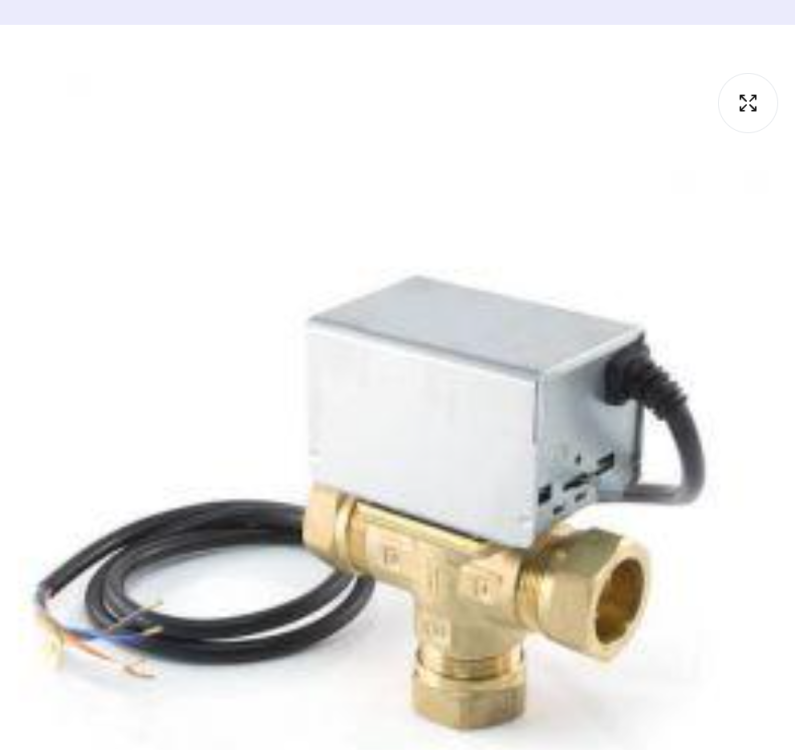
Its a diverter not a mid position, this is what is on the invoice: "CE-ZVD28PW - 28mm 3 Port Diverter Valve" sorry for the misdirection.
-
I did have them almost wide open, little red floaty things as close the bottom of the dial as possible but I backed off the outer two in an attempt to balance the flows a bit as the middle loop is twice as long as the other two happy to leave it all wide open. Will experiment tomorrow.
-
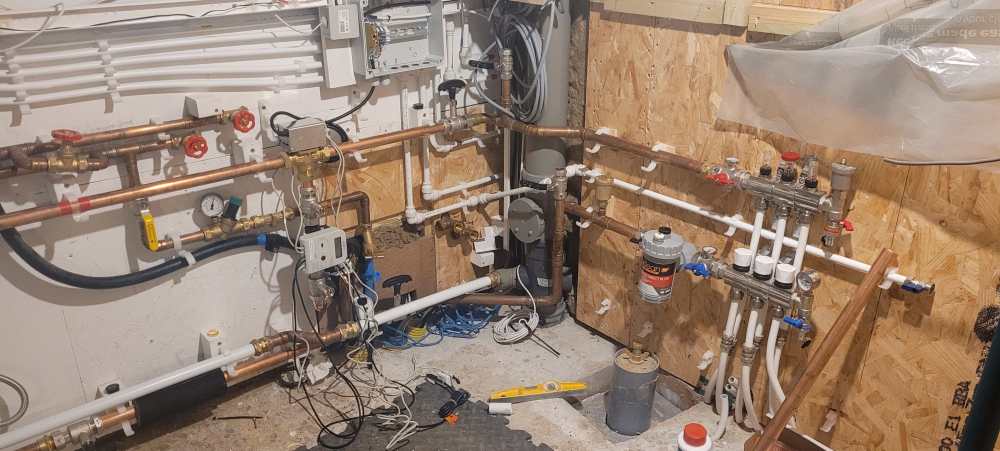
No fault codes. I think so it is all 28mm, one clip at least every 500mm, more often usually inside, although not on the risers to the tank entry points albeit they are fixed at the top of course - can look at that and see if there is any flexing. Outside runs are clipped outside the insulation to cable trays with a flexi at the end to the heat pump. As to air I cannot be sure but there is a trap at the highest points of both the tank and UFH loops (see pic for UFH) and I bled the stubs that will be running to the fan coil units upstairs. (Although I could check those again now its been running for a bit.) Here is a pic of the valve and the UFH pipe work
-
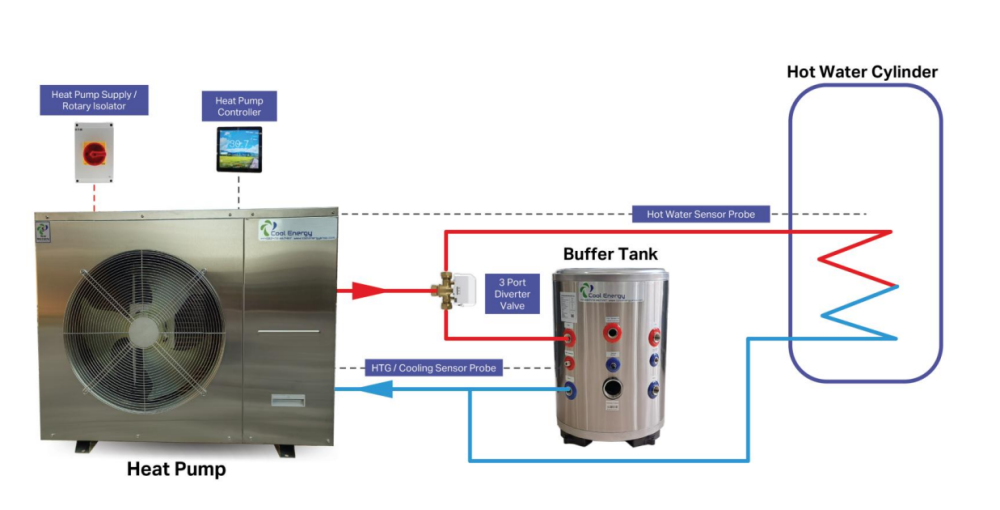
Interesting thought and entirely plausible. Here is the basic circuit I used from the install manual - except that the Underfloor Heating (UFH) is where the buffer tank is as we have no buffer tank. This circuit makes sense this way round although I guess you could put the valve in the return junction. The valve is normally open to the UFH and the Heat Pump sends a signal to the valve to change over when Hot Water heating is called for. So the flow comes up the middle of the valve and goes out either to the UFH circuit or the Tank circuit. Hence as the valve closes, on the spring, to the tank circuit it will have the flow helping it close. If that is the cause of the thump then it's a control problem. Perhaps the Heat Pumps circulating pump should be shut down while the valve changes over although that would be a firmware issue in the controller?
-
Its controlled by the heat pump and its the valve that came with the heat pump - this one I think: The ZVM28
-
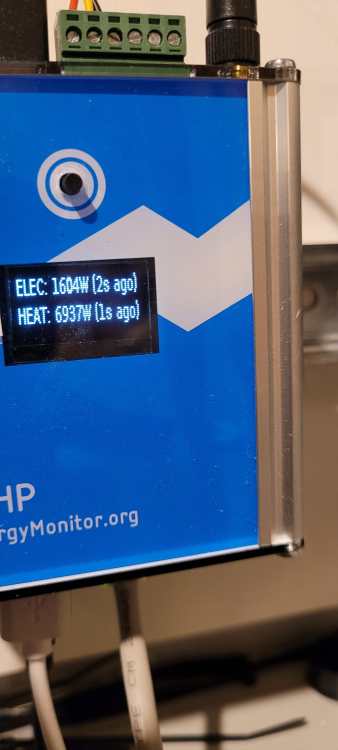
Been running the new heat pump today testing and commissioning the EMON heat meter. The heat meter is working well and telling me I get about 4.2 COP on heating the slab - with a cold slab at about 12oC. When I switch to heating the hot water the changeover happens smoothly and the heat meter starts reporting HW correctly BUT when I switch back at the end of the valve close we get an awful thump, I guess water hammer? Is this common and what might the / a cure be?
-
No we decided to get a new one, well two new ones, which I fitted yesterday. Yuk job.
-
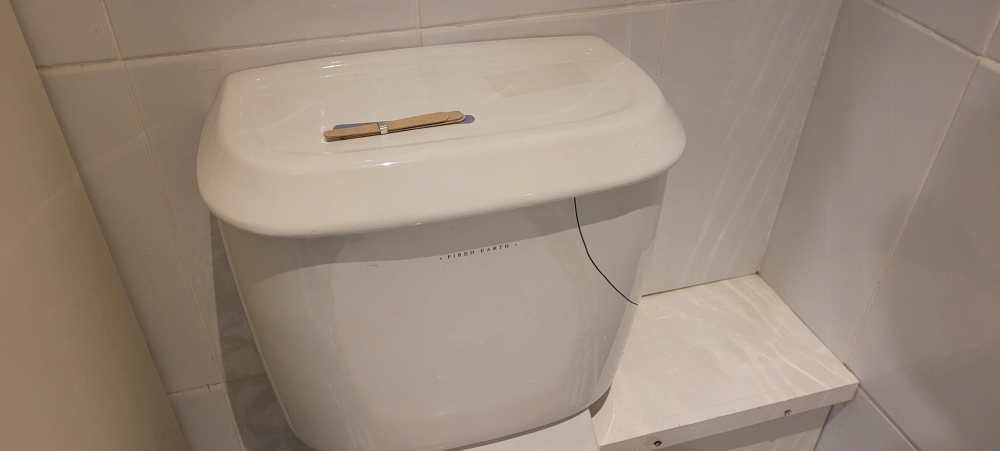
Yes sorry name mix up. To much happening in my world. After 20 years of trouble free service a cistern in one of our bathrooms just cracked without provocation, not been used since Christmas, drowned the router in the stairwell below, left us with no Internet and water everywhere. Sadly its a Fired Earth unit so no guarantee possible- still as I say it has done 20 years.
-
It is, at least that's what I asked for, it doesn't have a fuse anyway.
-
We don't need the immersion to clear the legionnaires risk the heat pump does that. So for now I have wired it straight to the CU breaker via a switch fused unit. So as of now we don't have automation of the immersion but there appears to be nothing preventing me using my contactor approach. The rules are clear that you can put stuff in between those fixed points provided it meets the wiring regs etc which is how the diverters do it. So I won't have any high current stuff on / around the tank other than the connection from Switch Fused Isolator to the immersion heater. Final job is to commission the heat meter & EmonPi. Hopefully Sunday, then I will have some real data to play around with and get an impression for how good or bad the system is.