Iceverge
-
Posts
4381 -
Joined
-
Last visited
-
Days Won
31
Everything posted by Iceverge
-
 Welcome welcome. Knock and rebuild in my book if it's within budget. Get a passivhaus architect who respects the limits of your wallet. Get planning and really nail the design. Right down to the last coat hook and socket. Tender to a range of top builders. Pick the best recommended. Enjoy your flash new house. Easy.
 -
What do you want from an architect?
Iceverge replied to CharlieKLP's topic in Surveyors & Architects
Sorry, perhaps you missed my meaning a little. A top class Architect will envisage a building not only to be visually sympathetic but also as burden free as possible on the occupants. For example they will have the insight and experience to not only place a window in a location that brings beauty within and without, but also ensure that it can be cleaned without undue duress. Some architect tech's I've seen have great skill in this. However it's not the core of their role or training. -
help me see sense with roof options, please!
Iceverge replied to Tom's topic in Roofing, Tiling & Slating
Go to a truss company. And ask for some of these. They'll even do the calcs for you too. Other wise a glulam ridge beam and I joists. In both cases. Batten + counter batten on top over roofing membrane. Airtight membrane below. Fill the void with pumped cellulose. Batten service cavity and plasterboard.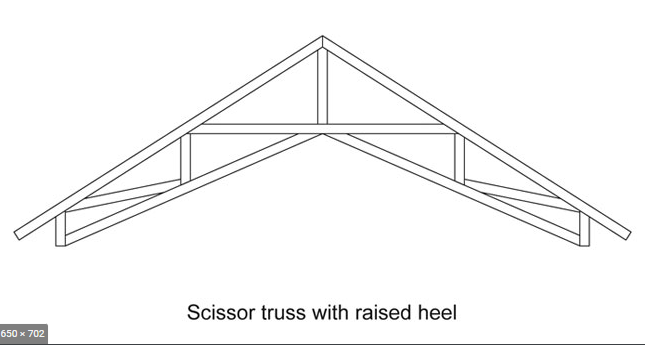
-
What do you want from an architect?
Iceverge replied to CharlieKLP's topic in Surveyors & Architects
1. Design within the clients budget. 2. Transparent fees. 3. Understand passivhaus. ( thermal bridging, overheating, airtightness etc etc etc) 4. Prioritise practicality over fashion. 5. Build not only for the clients now but also for old age disabled access, children etc. 6. Bring a sense of delight and joy to the design. 7. Excellent project management skills. 8. A little black book with the contacts of any reputable individual you might require. 9. An ability to mindread the planners and design appropriately. 10. Be contactable. 11. Be timely with drawings, requests etc. 12. Bill promptly. 13. Top interpersonal skills. -
Living with MHVR
Iceverge replied to Si3's topic in Mechanical Ventilation with Heat Recovery (MVHR)
No boost here, no sensors or remote control panels. Just run it at a slightly higher speed to average out the overall effect of humidity. Took a few months to find the right number. Works fine. Now it never gets touched and we completely ignore it. I could hear it at night in bed so I built a DIY silencer which works a treat. Filters have to be changed which adds to the cost. Ours were €22 a pop so about €88/year. I changed to car pollen filters that fitted at €32/year. Electricity about €30/year. Realistically if you're using a heat pump or mains gas there's probably no payback on the cost of energy. However. 1.It means you can avoid holes in the wall or windows for ventilation. These leave you completely at the mercy of a the wind and will make your house drafty and need to be overheated to achieve the same level of comfort. You will need to have a bigger boiler and radiators also. 2.Controlled filtered mechanical ventilation means your house's air is far cleaner. Less pathogens, less VOCs, less spores. A brilliant article here. https://passivehouseplus.ie/magazine/insight/natural-ventilation-does-it-work. This was a big pro for us with kids and me with hayfever. 3. Humidity will be actively controlled. Less dust mites, less insects, less mould. This means not only less cleaning but also that the structure of the building will be protected. Far lower lightly hood of any decay of timbers etc. 4. No traffic noise or whistling of wind through trickle vents. I'm sure there's more but its a big thumbs up from me IF specified and installed correctly. -
What ACH are you targeting? At 0.31 we still had 49cm2 of holes somewhere. We need to tilt a window to get full extract effectivity at max speed However on low speeds it works fine just using background leakage.
-
@cwr Try Philip @ https://www.prodomo.ie/ in Tralee. I think he posts to NI. I bought all my airtightness items there. I thought the prodomo own brand stuff was better than the belgacoat stuff i tried too.
-
Assuming the room is heated and well ventilated you shouldn't have condensation issues. Insulating the wall really should be considered to keep the surface above the due point.
-
help me see sense with roof options, please!
Iceverge replied to Tom's topic in Roofing, Tiling & Slating
Trussed roof an option? -
Energy like food, will probably be cheap enough that average users on average wages will be just about able to afford it. It's an extremely simplistic comparison but I hope enough to get the idea. I think the issue Nick is alluding to is the worse K value of insulation when compressed.
-
Didn't know that. Regularly see houses with 400mm specced here. Another good reason to batten, counterbatten and ventilate above the breather membrane IMO.
-
Approx 200m2 wall, 100m2 floor and 100m2 ceiling. 400m2 envelope excluding windows. 185m2 floor area. At the moment floor insulation is about £35/m2 for a U value of 0.1W/m2K, much the same for cavity wall batts and loft roll is only £12/m2 for a flat ceiling. There's almost no extra labour cost increasing flat ceiling insulation to 400mm ( 2x200 mm loft roll) so I think that is really a no brainer. Going from Bregs backstop to 0.11W/m2k will cost £5/m2. Similarly floor insulation is really only a material cost so I would use 300mm EPS (2 x 150mm) To go from Bregs to 0.12W/m2K at a cost £15/m2. Both are peanuts over the scale of a project for something that will last the lifetime of the building. Unlike fancy heating devices or renewables, insulation will pay itself off at some stage. Guaranteed. Wall and pitched ceilings are more expensive to think about as they come with extra costs in footings, wall ties, window and door openings, timber costs etc but aim for a U value of 0.2 at the maximum. As usual this is in addition to the usuals about airtightness, MVHR and 3G.
-
It only depends on two variables. Unit price of energy and length of tenure. Here is a crude approximation with equal insulation roof, walls and floor. This is for our house using cheap insulation (0.037W/mK) in a mildish area in the South of Ireland. For most people building a futureproof house isolated from the worst energy price hikes to 20 years+ . Southern coastal areas 200mm is enough. Most of the British Isles 300mm is a solid bed. North of Scotland 400mm insulation is best.


-
Payback is relatively easy to figure out. Just plug the U values into a model of your house with a predicted unit value of heating. In order to balance the relative benefits of our house I used 10c/kwh and increased the payback time until we hit passivhaus levels of annual heat demand. It was 25 years IIRC. We ended up at 200mm EPS in the floor, 250mm EPS beads in the walls, 400mm cellulose in the attic. Time over again that would be at least 300mm EPS floor. 300mm in the wall, 400mm in the roof. Maybe more............. To paraphrase Kate Moss, "Nothing heats as good as egomaniacal-insulation feels"
-
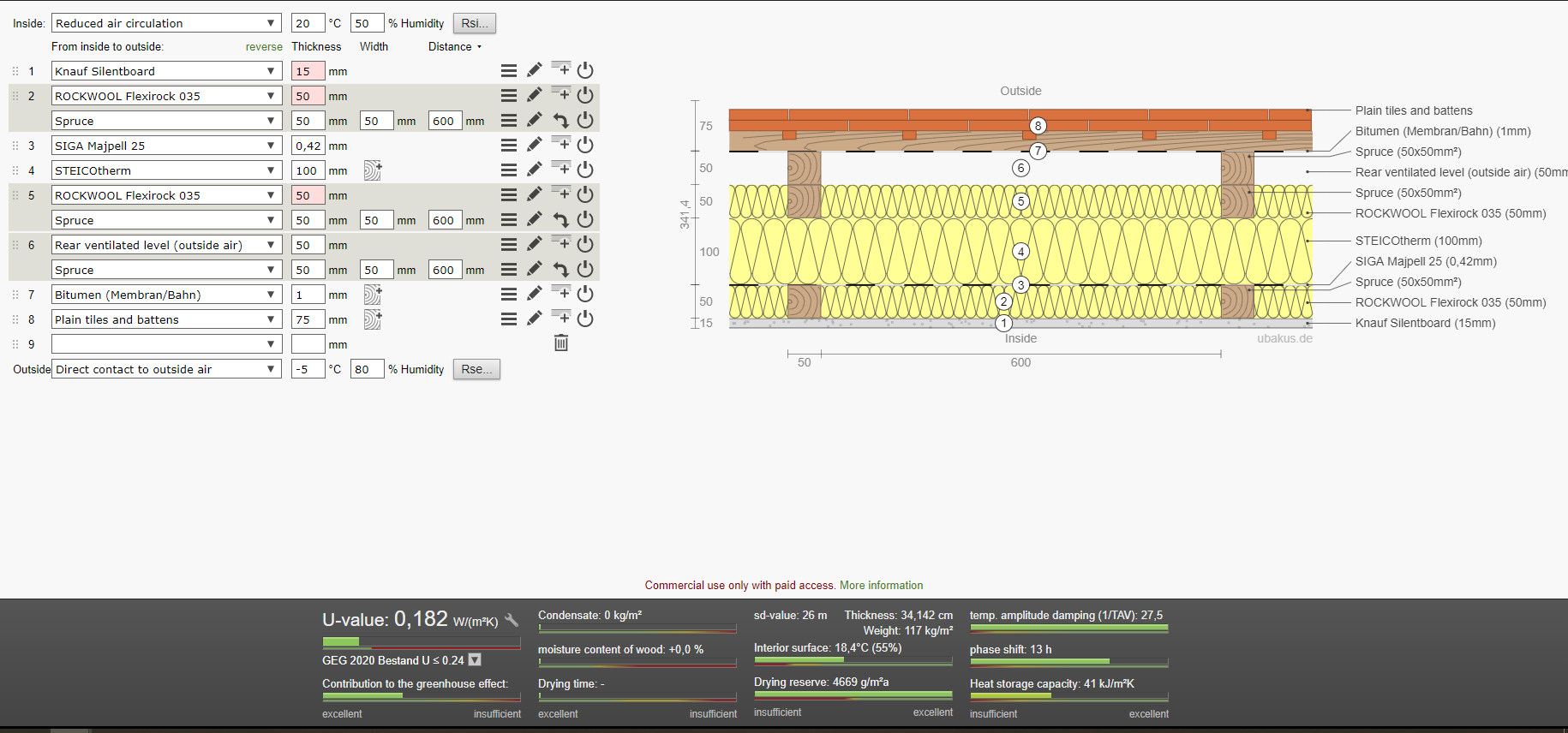
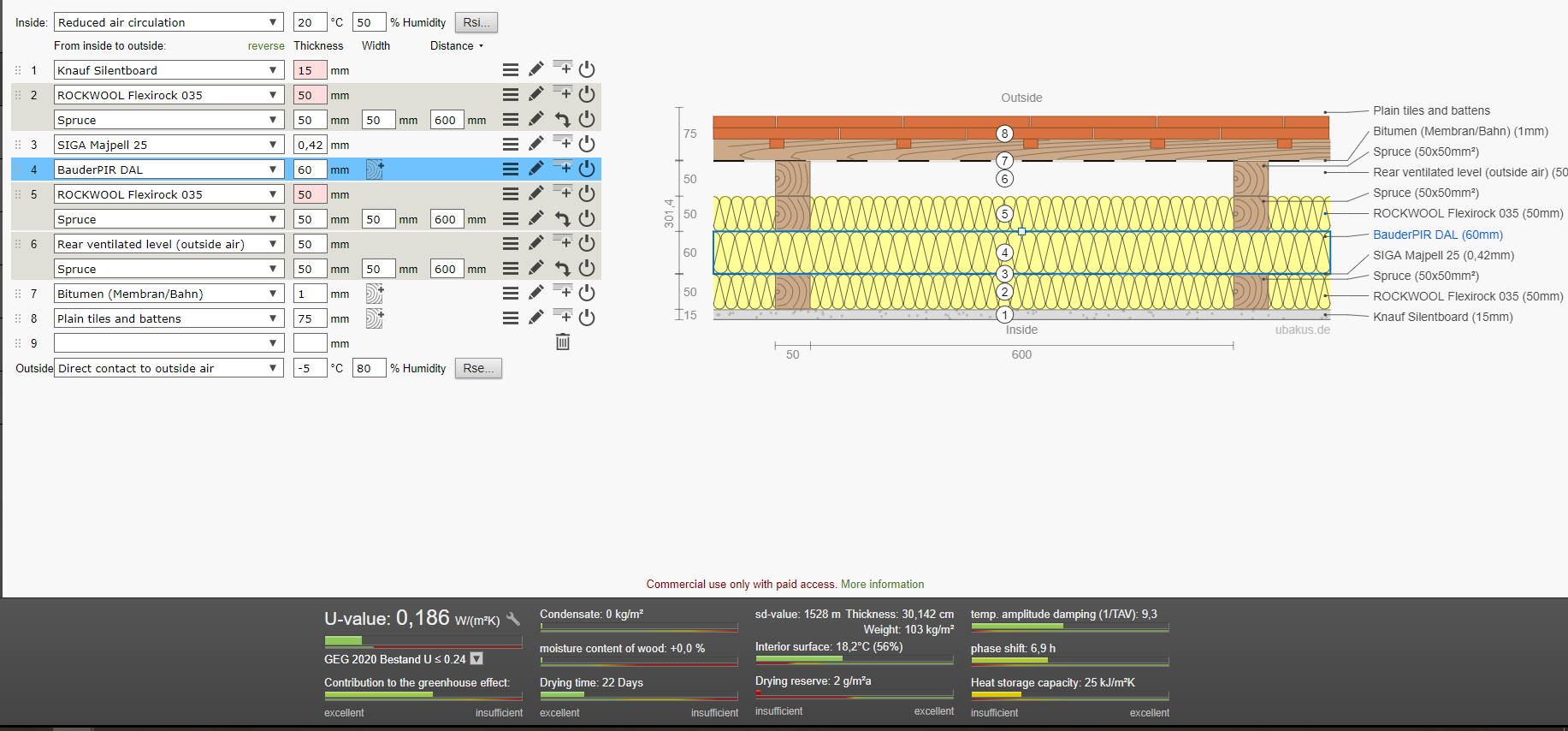
I forgot to say you'd need to lay some insulation on the horizontal portion of the eve space behind the dwarf walls. Rolled out mineral wool or blown cellulose would be fine. If you do plan on redoing the roof anytime in the near future I would just put 50mm mineral wool between the rafters, vcl and then a 50mm mineral wool insulated service cavity. The when the roof was redone top up the mineral wool insulation between the rafters to 100mm , put 100mm woodfiber over the top, membrane, batten counterbatten and tiles.
-
Sorry for the delay. Personally I would do the below. Note the service cavity allows for an unbroken airtightness barrier. Maybe put the woodfiber in 2 staggered layers to really do an ace job. If you're stuck for space or cash use PIR instead of the woodfiber. Remember U value is only one piece of a complicated picture and woodfiber would be my choice. For the eves space if you're really in the mood for some hardship you continue the method right to the wall plate. Otherwise just put 100mm Rockwool or similar batts between the uprights, 100mm woodfiber over. VCL and then 50mm insulated service cavity with 15mm soundblock plasterboard to finish.
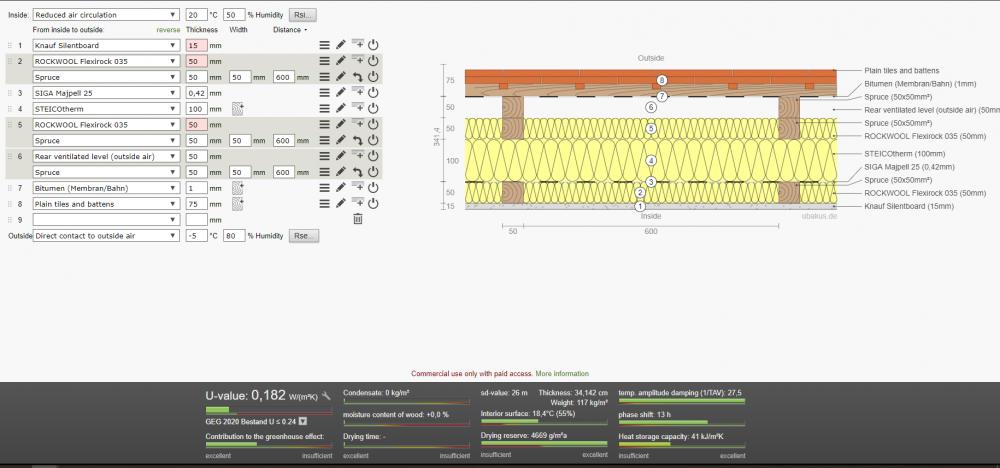
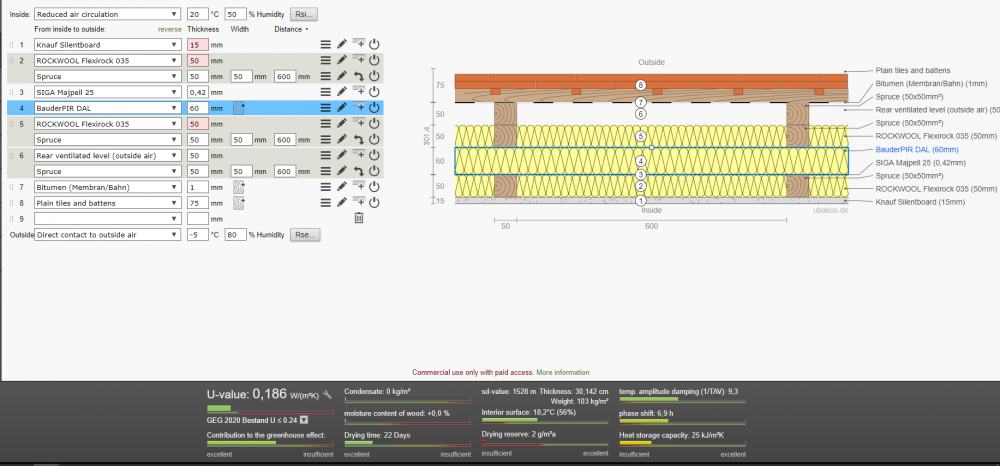
-
Without looking too closely it's only about £2.2k in materials assuming there's no major extra digging to be done.
-
I would. 1. Strip the roof and battens. 2. Consider reinforcing any rafters that look poor. If your roof isn't sagging I don't thing they look too bad otherwise. 3. Install a good quality roofing membrane. 4. Batten. 5. Reslate with fiber cement slates. They're about 20kg/m2 Vs 35kg/m2 for welch slate and 45kg/m2 for concrete tiles. The fiber cement slates (asbestos I think) are 71 years on my parent's house still going strong. A lighter roof will give the roof timbers a good chance. 6. Sell any welch slate you have left over.
-
They might go and die somewhere inaccessible and decay with a nasty smell. Also the poison can be passed up the food chain and do lots of damage to birds of prey that are quite helpful keeping rodents at bay. Simple traps or a cat maybe.
-
Do you have any more pictures of the structure of the attic. It almost sounds like you might be better off raising the floor, insulating underneath and installing some flooring.
-
Re roofing to a warm roof might be tricky being semi-detached as you would need to add insulation thickness above the rafters. I assuming the budget isn't going to stretch to a big bang job I think your bit by bit approach is fine. How much head space can you afford to loose? Do the rooms in the roof suffer from overheating on sunny days?
-
ODE TO SHATTAF A quandary as old as time itself, You reach for the roll, but there's none on the shelf, Scanning the room engulfed in panic, to mop the mess that was routinely volcanic. As your steamy behind sits engulfed in mush, Your wiry gaze spys the toilet brush. Alas tis too far for your arms to reach , As you flounder whalelike on a toilet beach. Whilst the bowl emits olfactory toxins, You morosely consider your spiteful options. Yell in shame to your wretched wife, or chance your luck with a pocket knife. Option B gets approval as you pray to Bog-God, You'll only scrape muck and not draw any blood, With the gloomy grin of a morose mortician, Slowly you start your solemn mission. But just before in deep you wade, You catch a reflection in the steely blade. Over you hip just out of sight, Beckons redemption glimmering in light. Merrily resheathing your swiss army sword, You sing praises to the toilet Lord. Glistening chrome with a flexible hose, charged with 3 bar pressure she blows. About to begin the washing game, steady your hand and take careful aim. pull the trigger with a mighty whoosh, commences the act of the cleansing douche. Chuckling as you splay and spray, Gushing your defecation troubles away. Stand and shake with a euphoric howl, And dap the drips with the bathroom towel. You exit the WC with a proclaiming laugh, "CIVILIZATION HAS ARRIVED, ALL HAIL THE SHATTAF” Iceverge 2022.
-
If you have decent ventilation above the insulation I wouldn't worry about it. Your instinct is correct not to wrap timber in plastic. Almost all moisture gets into a structure via air leakage not diffusion so like @ADLIan says seal all ceiling penetrations and you'll be fine. A consideration might be the thermal bypass. wind will simply blow through the mineral wool. No risk of timber decay but your insulation won't perform well on a windy day. I've heard suggestions of covering the mineral wool in building paper as a possible solution but I can't find the reference.
-
Welcome welcome. Any pictures to share? Fundamentally you need 1. A continuous layer of insulation with a 2. vapour control layer (airtightness too in this case) inboard and 3. space for ventilation outboard. Once that is done you're looking at 1. cost Vs 2. ease of install Vs 3. fire performance Vs 4. decrement decay Vs 5. embodied carbon V 6. u value for the various insulations. These won't matter a jot unless you get the fundamentals sorted first.
-
The only things that a self builder can offer over a volume builder are. 1. Self unpaid Labour 2. A site that may be unattractive to a developer. 3. No builders profit to pay. Everything else you will pay more for. What you get in return are. 1. A bespoke house. 2. Often a high performance home unavailable to mass market. 3. A tremendous learning and satisfying experience. 4. Lots of work that could otherwise be dedicated to leisure or gainful employment. Have we saved any money overall considering our time and input. Absolutely not. Would we do it again. Absolutely.