Iceverge
-
Posts
4382 -
Joined
-
Last visited
-
Days Won
31
Everything posted by Iceverge
-
 Hi @Selfbuildnewbie and welcoms. I actually quite like the layout apart from the store. Like @TerryE says its an expensive shed. Turn it into a home office imo. The outside looks a little wonky as @CharlieKLP says. I would start by posting a couple of pictures of the style of house you were going for. We can take it from there. The orientation of the house and the form factor are good. If you could tidy up some of the junctions you could convince it to be a passivhaus. Have you considered it?
 -
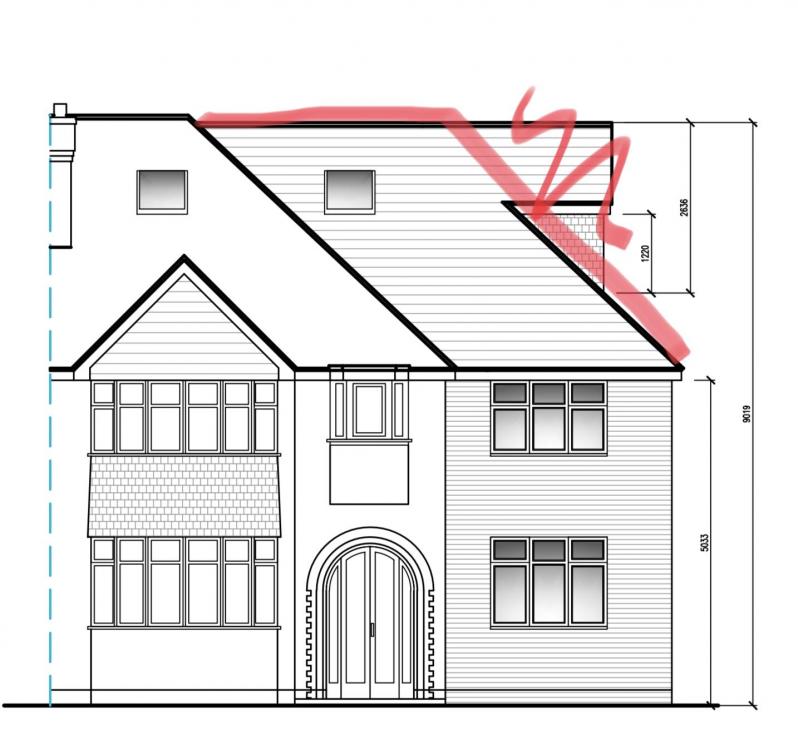
The budget is tight, perhaps the garden room won't add much value. I couldnt say for sure. What is invaluable is the experience, even if you break even you'll have collected a mountain of knowledge for the real deal later. I'm afraid I know little about conservation areas although if planners are of much the same breed everywhere it needs to be either "exceptional design quality" or completely plesant and innocious. The latter is true here IMO if you bin the ugly dormer(s). As to the ensuite, a shower would ideally be about 2.1m high minimum. Can you make this work? a shower tray recessedinto the floor might help. A bed can happily live with the back against a 1.2m knee wall and a toilet not much more. I'll stick to my guns on your architect. They've shown a good understanding of the flow of a building, how light penetrates, where you want it (eg. kitchen) and where you don't ( by the tv)and how to route services, pipes etc. A pencil drawing with some water colour washing would probably convince a lot of planners.
-
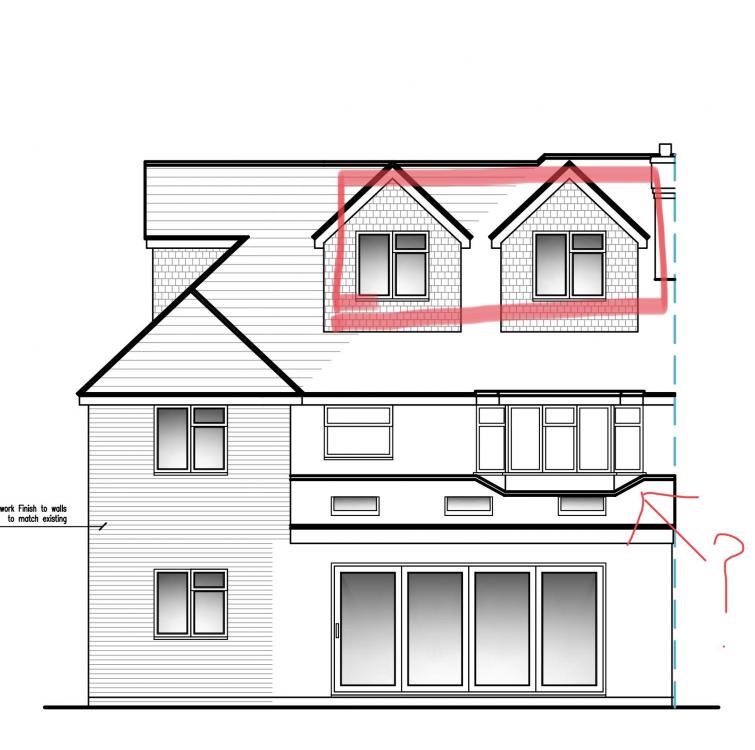
I would bin that dormer from the outset. It'd be a disaster if by some chance the planners granted it! A simple box dormer would be my preference.Cheaper, more space inside etc etc. If given a free hand velux's would be fine too. Again maybe your architect is an expert at dealing with gaming the planners. That bay window might be tricky to integrate into the kitchen roof. Maybe it'd be easier to remove and rebuild it or just replace with a plain window. I would try to put an ensuite on the top floor. Make the Utility into an ensuite for the ground floor and make the first floor ensuite into a laundry room. This would maximise your market for clients. Lots of multi generational families with an elderly parent need a ground floor bedroom+bathroom. Plenty of adult children living at home who would appriciate either the privacy of a "studio" top floor or a bedroom away from the rest of the family. On the whole I think your architect has done a very good job. Slightly prettier drawings might help "sell" the vision a bit more to the planners.
-
Where's North ? Can you improve the resolution on the uploads please?
-
Trench foundations. The EPS beads worked fine. You need to make sure the cavity is kept clean however. Ideally using a board to catch the morter drops. We used the beads right down below the floor level eliminating the need for the rigid boards as per the denby dale detail. Mineral wool would be better in a fire, but if the fire gets into the cavity you've had it anyway. Good thread here.
-
Stainless Ties from Vartry Engineering in Wicklow. PHPP is excellent for such calculations. Opting for basalt ties would have taken our annual heating demand from 2599kWh to 2575 kWh. It would have saved €3.12 per annum. Given the astronomical cost of basalt ties the payback was over 500 years! That said you'll never regret putting in too much insulation. If doing it all again I would do 300mm EPS in the floor, 300mm in the walls and 400mm in the roof at least.
-
I paid €800 to a guy who in hindsight did a half assed PHPP for me. After that I downloaded the manual and started playing with it. Most of it doesn't need filling out unless you are getting certification. It would easily save it's price (about £150 i think ) in optimising insulation. We ended up at 200mm EPS floor, 250mm EPS beads in the cavity walls and 400mm cellulose in the attic based on an hour spent checking where our € made the most difference with phpp. Jeremy's spreadsheet gives very similar results but doesn't calculate overheating which can be significant. If you just want to know you max heating load and you are planning on building thermal bridge free + airtight+ MVHR then a simple calculation will do. Just measure the outside of the house like PHPP not the internal. The internal heat gains from electrics etc cancel the MVHR losses and other sundries. (External Floor area * U value) + (total external wall area * U value) + (external roof area * u value) + ( Window area * U value) Add them all together and multiply by your maximum temp difference you'd expect on a cold day. (114m2 *0.16) + (232m2 * 0.13) + ( 114m2 * 0.09) + ( 30m2 * 1) = About 89 * ( 20 deg difference in the south of Ireland) = 1780 W total heating load. PHPP gives 1497W. Either way a 2000W heater will do ( and is doing) the trick! By the way we didn't bother with a stove due to dust and smoke inside as well as the trouble getting them beyond passive levels of airtightness.
-
Given that it's valentine's Day I think you had better get stuck in turning back the clock. Then like any proper married couple hold the fact against her for all time.
-
That's very reasonable. What level of self labour are you aiming for?
-
Some lovely buildings there. However in my taste , not in this circumstance. I've thrown about 5-6hrs at this and I've very possibly run out of talent. I suppose you've lined yourself up for a crack at it then!
-
There's a win here I'm sure of it. From not only this extension, but many others contributers, it's apparent Architects often are faced with an impossible set of requirements which often cannot be met. Perhaps a part of the skill of the job is to kindly communicate how the customer is not always right. Contrary to @ETC would be keen to retain a similar style in this example. A bolt on contemporary extension would feel like my granny wearing bling trainers, but that's just my taste I suppose. However I do think there's a good market for architects presenting balanced functional non flashy design. Personally I think you're very close with the downstairs at least. On reflection the utility and W/C are better off as per your suggestion. I like @AliGs though of recessing the wall 0.5 as well as the skylights. I've always though sun pipes were a little naff . Fair play for sticking with us. It can be bruising to put your design out to the masses for digestion.
-
I've just seen this now. The window I've drawn to the north is probably looking at nothing so.
-
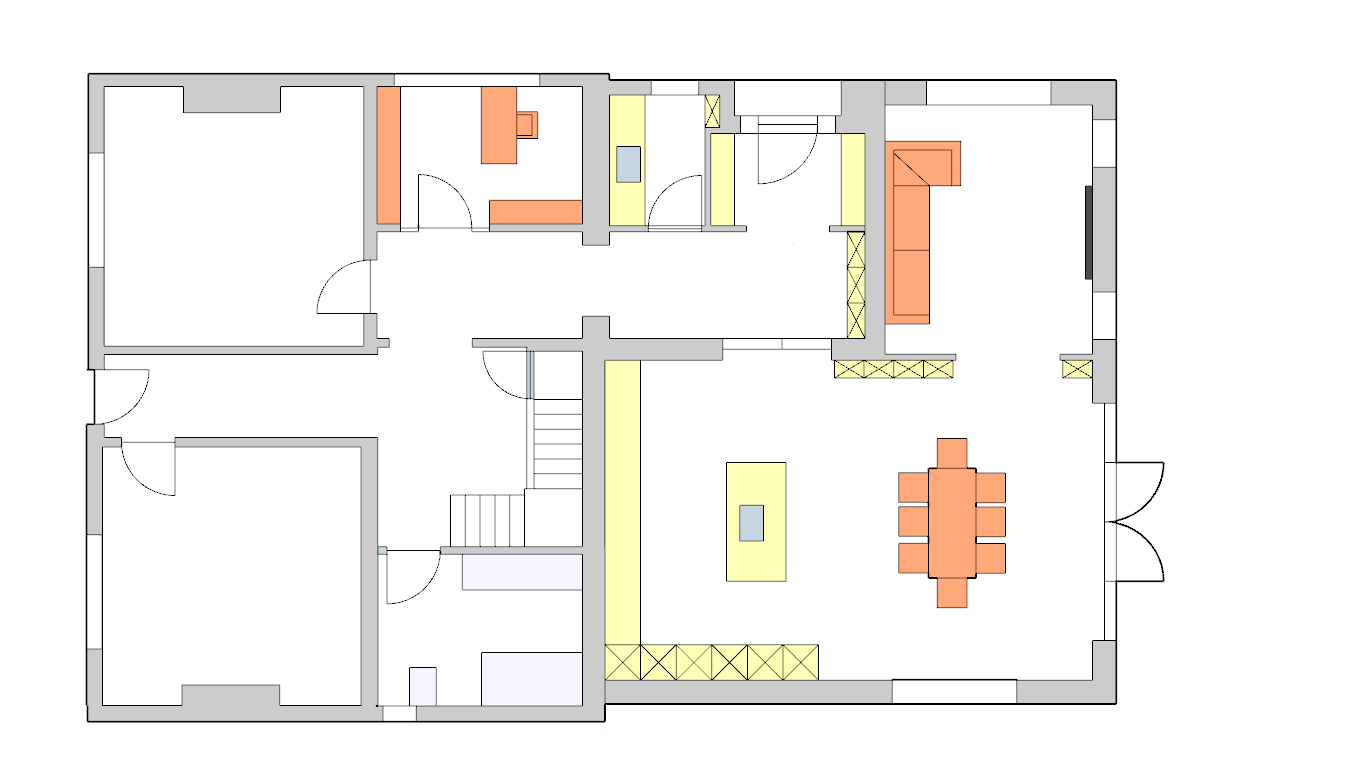
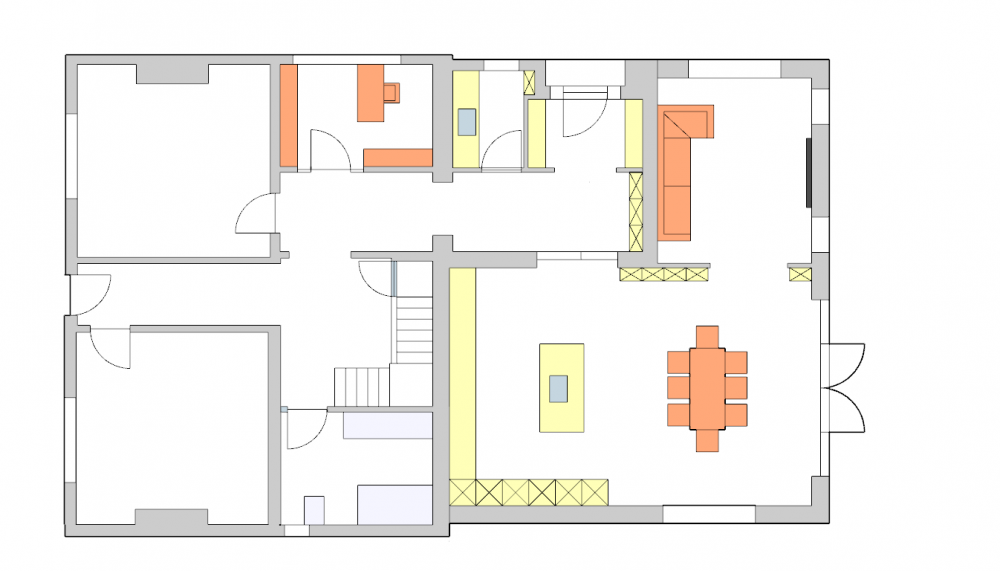
It's a matter of a couple of thousand maximum. Well worth it. Here's a similar effort to yours. I've made a separate utility and a walk though boot room/porch. I think this would be nicer than the design you had. More suitable for a main entrance. Your kitchen location might be better however. I don't know if the window to the north I've included will work with obstacles/views. A quick internet price up shows the French doors with fixed side panels costing 45% of the equivilant bifolds with much better performance.
-
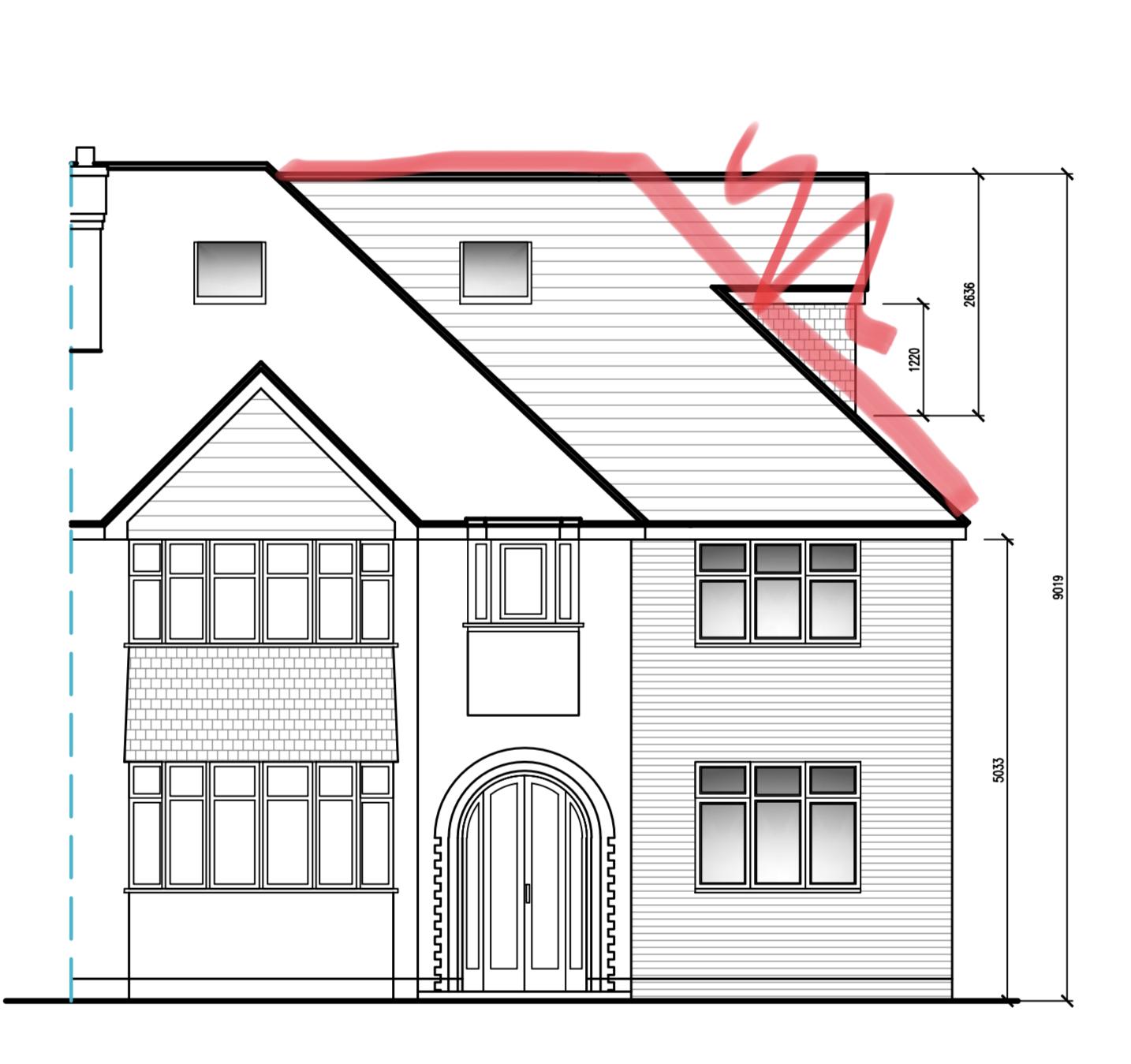
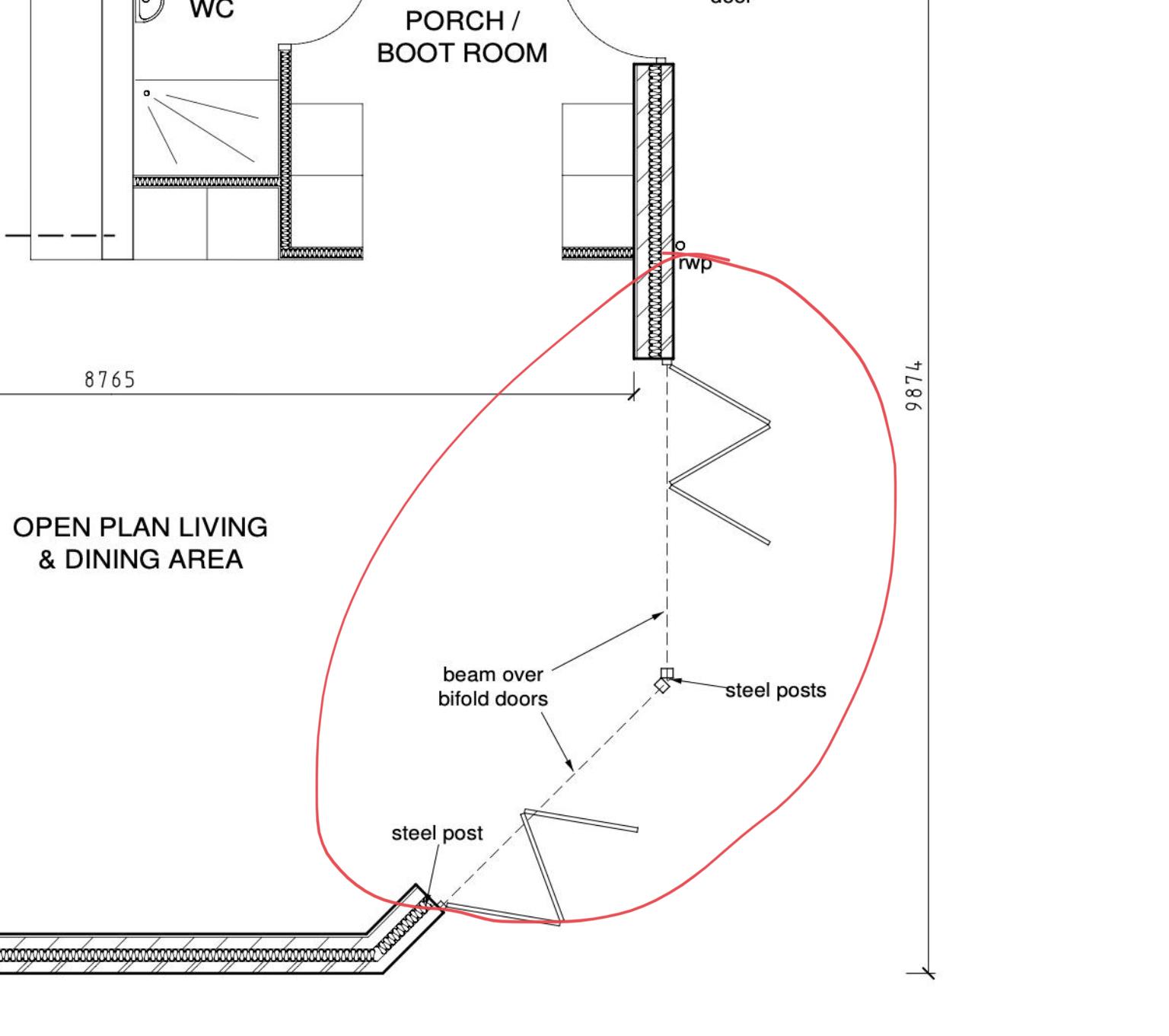
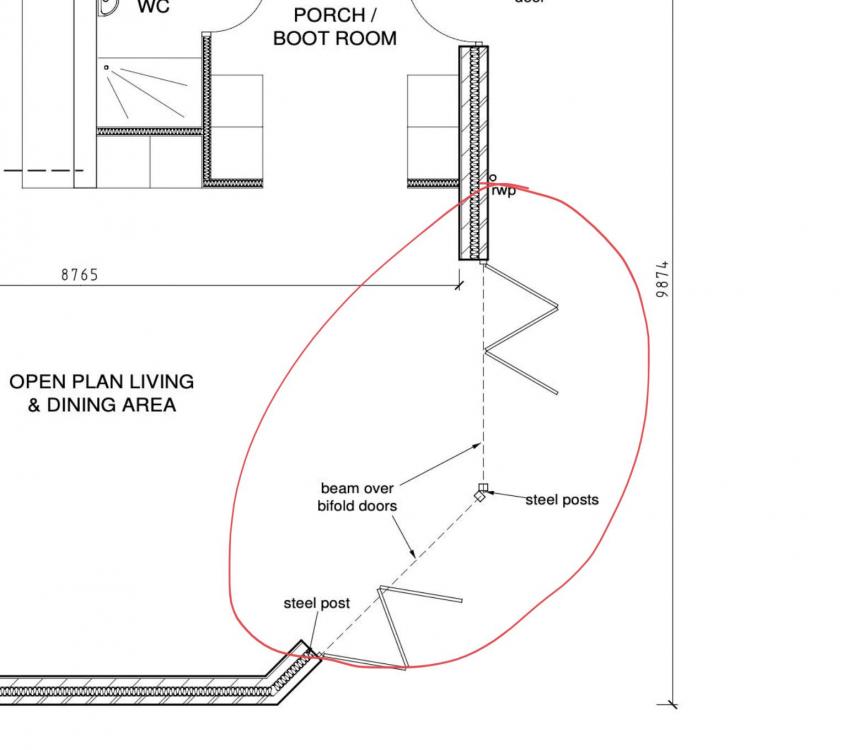
A very handsome house. What a privilege to get to have it. I might have a go at another design, beware it can take a few hours. This corner is also bugging me. I don’t think it fits with design of what is a nice square building. Also it makes the roof unnecessarily complex, will probably introduce lots of thermal bridging through the steelwork, and the bifolds will be drafty and expensive. You can have non drafty but then they’re extra extra expensive. French doors or sliders would be better.
-
Its a pretty design. It might be quite expensive to build it to a high standard with the amount of fiddly corners etc. The roof is especially complex. Have you costed this to be built to a thermal bridge free standard. Looking at it I would say there won’t be much change out of £60k to do the roof alone. Perhaps budget isn’t such an issue. I would encourage you to get a passivhaus designer to put it through PHPP before you commit to the design, You don’t need to reach passivhaus but it will accurately measure your levels of energy use and overheating. With electricity heading for 30c a unit you need to be able to predict your energy use accurately. SAP is notoriously inaccurate for well build houses. I do like the barreled roof. A clever use of space if constrained with ridge height. Nothing overly complex about them unless they have many oblique intersections with other surfaces............ ASHP can be used for cooling. Designing out overheating through appropriate glazing, shading and the use of high decrement delay materials is better. Many architects are still in the oil era mentality of building energy and comfort. Is your lifestyle one that is compatible with a logburner? Maybe you’re a forester or a chippy with lots of spare offcuts to come home with every day. Perhaps you like taking walks and collecting sticks from the roadside like my Granny used to, or maybe you derive solace from a weekend spent splitting and stacking wood. If so and you can live with the interior and local pollution (nothing eco friendly about burning wood) you cause then go for it. Beware it’s very very difficult to get an airtight house (<1ACH) with a stove. In my 6 years constantly researching low energy buildings I have only come across 1 example. Otherwise save yourself £5k and buy a nice fishtank to look at. In a well built house you won’t miss the lump of radiant heat the we crave in drafty old buildings.
-
Internally? Even so it's not too late to have a remedial go at some extra airtightness. Make a DIY blowerdoor. Plenty of examples of you search on here. Get some silicon and go room by room and spend a day sealing leaks. It will help tremendously.
-
Internally? Even so it's not too late to have a remedial go at some extra airtightness. Make a DIY blowerdoor. Plenty of examples of you search on here. Get some silicon and go room by room and spend a day sealing leaks. It will help tremendously.
-
Hydrogen is the "filter tips" for the oil industry.
-
Hi @h18ant, Welcome welcome. It looks a lovely project, I like the site, especially the trees. Could you possibly upload the plans in a higher resolution and note North on the plans please. Finding it tricky to view them.
-
What stage of the build are you at?
-
Have you considered getting EWI in the wall whilst you’re at it? you may even get a grant.
-
Insulating a pebbledash solid wall and damp concerns
Iceverge replied to Ben Weston's topic in Heat Insulation
If you're happy with the plans just reapply for exactly the same design. In the meantime you can crack on with the extension. Then tie in the new/old house when the time comes. Even if you don't you'll save 4 months in the build program. -
Insulating a pebbledash solid wall and damp concerns
Iceverge replied to Ben Weston's topic in Heat Insulation
Does she not like money? Or warmth................? -
Insulating a pebbledash solid wall and damp concerns
Iceverge replied to Ben Weston's topic in Heat Insulation
The more I read the more I'm thinking "bulldozer renovation time." Unless you have a specific sentimental attachment or its of particular architecture or historical merit and you are willing to throw cash at it hand over fist. I don't like knocking down old stuff on principal but in this case it'll be unrecognisable anyway with EWI. Save yourself years of heartbreak, a ton of VAT and demolish. -
Central heating systems required for 1 storey new build
Iceverge replied to Adam NT's topic in Central Heating (Radiators)
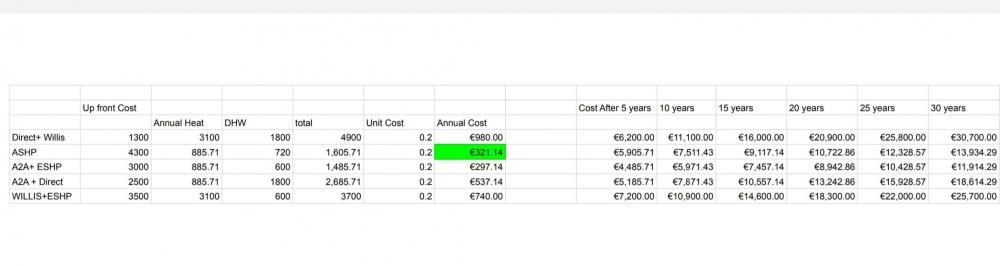
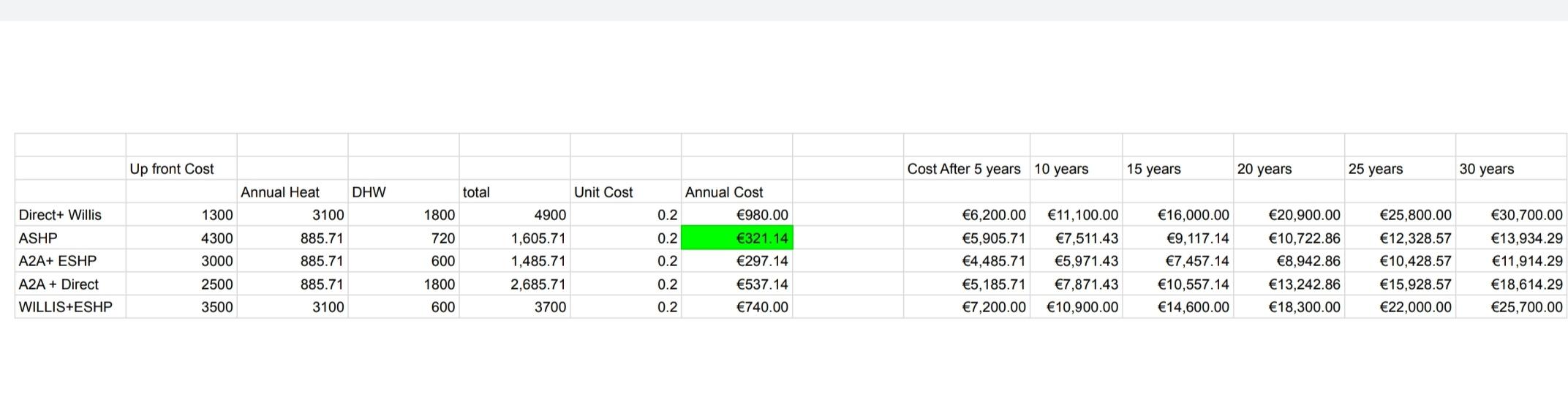
If you can buy an ASHP at a reasonable price it's the best option. I looked at a friend's similar project recently, almost exactly the same size for space heating and DHW. U values 0.12 ceiling, 0.18 walls 0.16 floor. 0.6ACH airtightness, MVHR and good airtightness detailing. Annual heat demand about 3000kWh. He is able to get an ASHP for €4000 through work so that's what I based my calcs on. I compared direct electric, an exhaust source heat pump, an A2A heat pump and an immersion and various combinations. The A2A + ESHP was the cheapest overall but could risk some rooms being too cold in a bungalow as it depends on air movement to heat the house. The ASHP was a close second, combined with UFH in a thick concrete slab would allow cheap overnight heating with the slab as a storage heater as well as excellent comfort. Forget renewables until you've got a structure that is as efficient as possible. Insulation has a far longer lifespan than any PV panels or wind turbines.