Jeremy Harris
-
Posts
26430 -
Joined
-
Last visited
-
Days Won
360
Everything posted by Jeremy Harris
-

Wash-hand basins: local instant water heater or not?
Jeremy Harris replied to ToughButterCup's topic in General Plumbing
Yes, but the advantages are significant, as you also lose any interaction between things like the wash basin and shower, or toilet and shower, if you run separate pipes (a toilet is fine on 10mm too). Running pipes from a common manifold fed with a fat pipe gets rid of pretty much all the interactions you can get with flow rates varying as taps are turned on or off, toilets are flushed, etc. If running plastic pipe, then the cost difference for all these extra pipes is pretty tiny. If running copper, then 10mm pipe can be PITA to run, especially if trying to feed it through posijoints, as it will snag on every web. -
I bought most of the stuff for our build. One lesson learned is to never underestimate how much time it takes to collate accurate lists of all materials, parts etc needed. It's easy to spend a couple of hours just putting together an order for all the electrical items, and that's when I knew exactly what was needed. Add on the time taken ordering and collecting stuff and that's probably another hour or so. That time has to be paid for somehow, so if someone is on a day rate it seems perfectly reasonable for them to add a bit on to the materials price to cover all the time taken to order and get the stuff.
-
Wash-hand basins: local instant water heater or not?
Jeremy Harris replied to ToughButterCup's topic in General Plumbing
10mm is absolutely fine for a wash basin supply. The French have been using small bore pipes for decades with no ill effects, IIRC, I think their "standard" pipe is about 12mm OD, so a fair bit smaller than our 15mm. Using 10mm plastic pipe is even better, as the pipe has a slightly smaller bore and a much lower heat capacity than copper, so hot water will reach the tap a lot more quickly (under 5 seconds for a 10m pipe run, which is pretty good). The wasted hot water is also a lot less, as in a 10m pipe run of 10mm plastic pipe there will only be about 0.385 litres of hot water, which if supplied at 45°C (which is what I have our mixer valve set to) will only "waste" about 0.0113 kWh, which is so trivial as to not even be worth considering. -
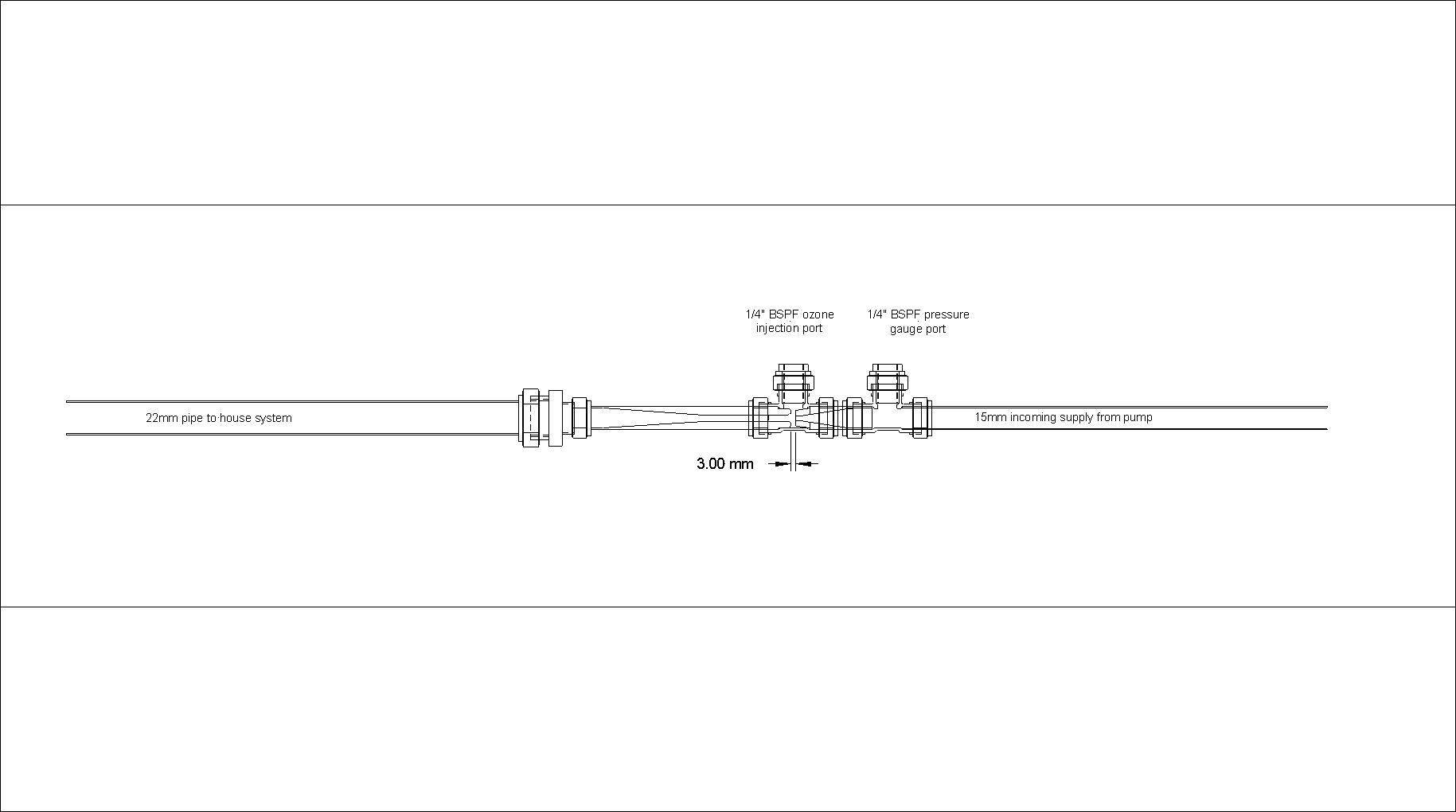
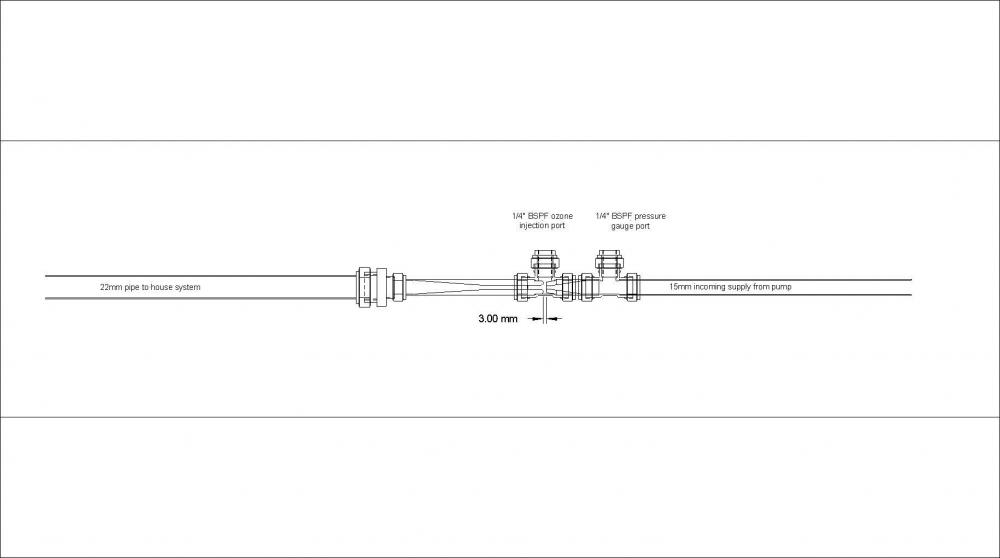
I can let you have details of my ozone injection system, as I spent a fair bit of time experimenting to find what would and would not work, and also which ozone generators are reliable and which aren't (they all lie about their ozone output, though!). The main problem is that pumping ozone is damned challenging, as it will seriously attack many materials that might be in any pump (particularly rubbers and elastomers, Viton is just about the only sealing material that works). I use a venturi/eductor injector, home made, but easy to machine up from 15mm brass bar and normal compression fittings: The ozone supply into the injection tee is via a 1/4" BSP VUP4.VM NRV, selected because it has Viton seals and a very low opening pressure. The ozone is supplied from a tubular ozone generator, fitted in a fan-cooled enclosure (it has a finned heat sink around it) that is fed with dry air from a modified 10" water filter housing. The water filter housing has a refillable filter cartridge, filled with silica gel. Air is supplied to the filter from a small pond aeration diaphragm pump, at around 3 psi. Any more than this and the ozone generator stops working. To prevent ozone flowing back when the system is off (bleaches the indicating silica gel and buggers op the pump) there are PTFE/Viton NRVs in the supply pipes. All the ozone piping is PTFE, I tried silicone, as used in milking machines, and it rotted out within a month or so. I can let you have a list of all the bits, plus better drawings, if they might be useful. The venturi/eductor flows water at around 12 litres/minute, with a pressure drop of around 3 or 4 bar, which is plenty to draw in ozone well. The long mixing section in the eductor, before the pressure recovery flare, is essential to get ozone to be dissolved well in the incoming water. In practice, the oxidation effect in the first few inches after the mixing zone is pretty high, with a lot of our ferrous iron being precipitated out as ferric oxide before it gets to the 22mm pipe section. This also works pretty well at killing off any bugs in the water, I suspect.
-
I guess you could do that. I run our ASHP at 40°C, as, by experiment, I've found that it never seems to run a defrost cycle when run at that temperature, but i could lower it and do away with the thermostatic valve. The buffer would have less effect, but I'm not sure that would be that significant, as at the moment it can run the heating for around 3 hours at a fairly typical 400 W of heating demand, which is much longer than is really needed just to stop the ASHP short cycling.
-
Wash-hand basins: local instant water heater or not?
Jeremy Harris replied to ToughButterCup's topic in General Plumbing
There's no doubt that instant heating with peak rate electricity is far more expensive that heating water any other way, so the real question comes down to whether the convenience of having near-instant hot water from a tap is worth the additional cost. A basin tap typically flows at about 5 to 6 litres per minute (any higher than this tends to result in a lot of splashing). Using 5 litres/minute as a general figure, then if that tap is fed with 10m of 10mm OD plastic pipe (so about 7mm bore) then it will take about 4.7 seconds for hot water to arrive at the tap. So, any instant water heater has to be able to heat water, and deliver it to the tap, faster than that -
UV is far less reliable than chlorine disinfection used by the water companies, both because it's not 100% effective (some bugs might not get dosed enough to kill/deactivate them) and also because it provides zero residual disinfection. A UV unit must never be used in front of storage vessels for this reason, but always immediately before the supply to all outlets. Residual disinfection is a really big advantage of chlorination, as the effectiveness of it is, like all other disinfection methods, heavily dependent on exposure time (one reason why ozone isn't as effective for treating water before storage/distribution). The clinical evidence shows that infections from domestic water supplies are very low. The data is collected monthly and published here: https://www.gov.uk/government/statistics/p-aeruginosa-bacteraemia-monthly-data-by-location-of-onset Looking at the last annual data set the incidence of "community onset" infections (which includes care homes, as well as domestic locations) is pretty low, and almost all can be traced to a setting other than a domestic dwelling. I can find no evidence that domestic hot water systems are a significant risk factor, especially not for otherwise healthy individuals.
-
Yes, and that's precisely why chlorine is used, as it provides very good residual disinfection in all the supply pipes. It only ceases to have any effect when the water is exposed to air, hence the problem with contamination getting in through break tanks etc.
-
True, but also any fair comparison has to be on a like-for-like basis. The fact that an electric shower will struggle to deliver more than about 4 or 5 litres/minute is just another reason not to have one unless you really have to, IMHO. I have our shower throttled down to 9 litres/minute, with a flow restrictor, and that's perfectly OK, but not luxurious. I'd not really want to have a shower that's much less than this, TBH, as I can still remember what our old electric shower was like from a few years ago.
-
TBH, even the higher losses from a UVC aren't going to change the overall balance. A UVC might lose around twice as much heat as a Sunamp, but that's still nowhere near enough to swing the balance in favour of using instant water heaters. The only reason for considering instant water heaters is really convenience, in that they may provide hot water at taps a little bit quicker. In practice I doubt this is that noticeable, as if small bore (10mm or so) pipes are used to feed basin taps, with a radial plumbing configuration from a distribution manifold, then the few seconds delay before hot water flows is probably much the same for either instant heating or tank-fed hot water.
-
We've discussed the possible health risks here before, but the bottom line is that in a closed system, supplied by mains water, there is zero risk of any bugs growing in the hot water system, as far as the inlet to any taps, mixers etc. Bugs have to have a way to get in in order to start multiplying, and that means the water supply either being compromised somewhere, or being open to the air, say from a break tank, cold water tank etc. There is a small risk from standing water left in the pipes feeding a shower head, as that water is exposed to air and sitting at room temperature, so it's a good idea to not let a shower sit unused for long periods of time. The more frequently a shower is used, the less chance there is of bugs growing in that water column. Even then, the risk is low, but exacerbated by the water being sprayed into the air in the first second or so that the shower is running, so increasing the risk that any bugs will be breathed in. If someone has a compromised immune system, or is suffering from lung disease, then the risk from using a shower for the first time in a week or so could be minimised by placing the shower head in a container of water when first turning it on, perhaps. In reality I suspect the risk is very low, and not something that's likely to ever be a problem for a shower that's in regular use.
-
The experiment needs to include low heat loss thermal storage, as that very definitely swings the balance strongly in favour of not having instant water heaters at the point of use. We heat our hot water for an approximate annual paid for electricity input (our house is all-electric) of about 900 kWh (it's probably a bit less than this, I'm extrapolating from ~9 months usage to date being 610 kWh). All of that paid for electricity is at the E7 off-peak rate, currently 8.148p/kWh. I have meters on both the diverted PV used to heat hot water and the off-peak boost supplies. We use roughly 2100 kWh/year for heating hot water, so if we used instant water heating for all of it then all would be at the peak rate (we don't shower or run the hot taps in the middle of the night) so the cost would be 2100 kWh * 15.729p/kWh = £330.31 Because we don't use any instant water heating, but store heat in a ~9 kWh Sunamp heat battery, charged by either excess PV generation or an off-peak overnight boost, our hot water cost is roughly 900 kWh * 8.148p/kWh = £73.33 If we didn't have any PV in the roof, and relied on E7 off peak electricity to charge the Sunamp, then our hot water cost would be roughly 2100 kWh * 8.148p/kWh = £171.11 There's no way that I could make the sums stack up to show that instant water heating makes any sense at all. The heat losses from the Sunamp are included in the figures above, and are around 800 to 900 Wh/day, so about 310 kWh. Not enough to be worth bothering with, given that instant water heating costs more than double the cost of just using E7 off-peak electricity, and more than four times the cost of using a mix of excess PV generation and off-peak E7 boost. It's a bit of a no-brainer of a decision as to which to go for, IMHO.
-
Yes, but that is no longer critical in determining how the system responds, as the Salus actuators do all the fine control. The incoming flow temperature can therefore vary over a wider range without having much impact on response. Prior to fitting these actuators our system would sometimes behave itself, with the flow running at around the 25° to 26°C that it was set too, but sometimes it would jump up to 30°C or more, due to variations around the set temperature within the thermostatic valve. Now it doesn't really matter if the thermostatic valve doesn't run down at around the 25° to 26°C point needed for accurate control, as the system works just fine with that set to ~30°C and the Salus actuators making the fine adjustments. I can't see why this wouldn't work with any sort of mixer valve, as all that matters is that the flow temperature is in the right ball park. A degree or two flow temperature variation from the thermostatic valve natural variation at low settings no longer seems to have any impact on how the system behaves.
-
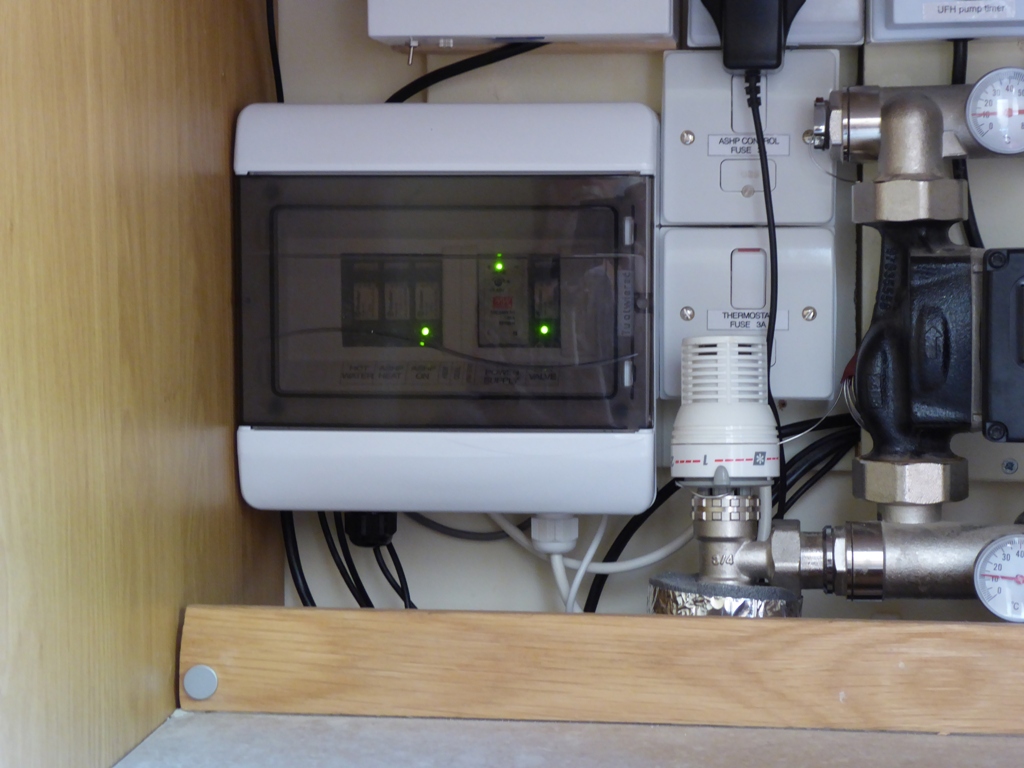
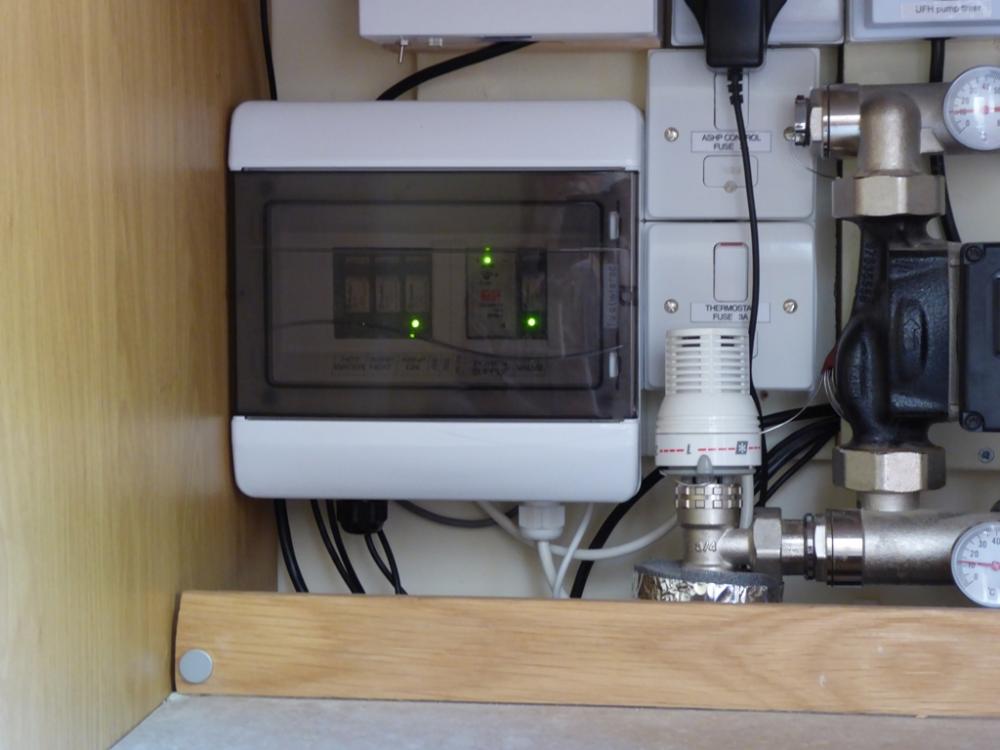
This is the thermostatic valve and hot feed into the UFH manifold: Hot water from the ASHP/buffer comes in at the bottom of that valve. Temperature controlled water comes out of the right hand arm. The tee where the pump connects is key, as that causes the pump to be able to recirculate return water (coming from the return manifold at the lower right). The output from the pump is at the top, and only feeds the flow manifold. The temperature sensor for the thermostatic valve is in a pocket inside the end of the flow manifold. The Salus actuators just fit where normal actuators fit, each with a flow and return sensor clipped to the UFH pipes.
-
In practice, all that matters in terms of heat output, is the differential temperature. The higher this is, the more heat is emitted to the room. In our case, because the mixer tends to be a bit variable at very low flow temperatures, I turned it up to a bit over 30°C when fitting the Salus units (it seems to be stable at around this setting). This results in a flow manifold temperature that's a bit under 30°C in practice (due to mixing from the return), so the actuators work with a 4°C differential. This seems to work very well, with good room temperature control and very little overshoot. The problem we had before was that if the flow temperature got too high (because of poor regulation by the thermostatic valve) the room temperature would overshoot the set temperature by up to about 1°C or so, then slowly come back down over the next day. Now the overshoot is much smaller, maybe 0.2°C at most. On our manifold the UFH circulating pump draws from both the return side and the incoming hot water side (via an inline thermostatic valve), as there is just a tee where the pump connects, with the left arm being the flow in, the right arm going to the return manifold and the upper arm going to the pump. This means that there is always a bit of mixing taking place in the pump and the flow manifold , as the pump tends to draw in some of the cooler return water, as well as some of the hotter flow supply. The main return back to the ASHP and buffer connects to the right hand side of the return manifold. Another advantage of these actuators is that you can open up all the flow controls to maximum, and let each loop just control itself, as the actuators will automatically balance to maintain the right heat output from each loop.
-
The blending happens through the mixing between the return and flow manifolds via the pump. Return water gets mixed with flow water, and the result is a pretty tightly controlled differential across the UFH pipes. Seems to work very well indeed - ours has been running like this for a couple of years or so now, and the temperature control is far better than we had with the two port mixing valve (which works in exactly the same way - it just throttles the incoming hot flow, exactly like a thermostatic radiator valve).
-
They work in exactly the same way as a two port thermostatic valve, so the mixing happens between the flow and return manifolds, by recirculation, in effect. The efficiency is identical, as there are no losses anywhere, or not any more losses than there are in the pipework anyway.
-
My personal view is that these actuators are the best thing since sliced bread! I had problems getting our mixer valve to regulate accurately, and also had the same problem you've described, where the ASHP pump came on with a call for heat, yet the actuators took some time to open. The Salus valve gets around both these problems and just does its thing, with no need for any setting up.
-
They work just like ordinary actuators, and will turn of or off just like wax-filled ones, but a bit quicker. They just have the added feature of balancing the temperature between flow and return as well, so they do away with the need to control the temperature into the UFH manifold. They should work with any UFH setup, as they make two models, a 230 V one and a 24 V one, so just choose the right ones to replace the actuators you already have. To save disconnecting the mixer you can just turn it up to maximum, which is what I've done, and then let the auto-balancing valves do their thing.
-
One fix is to just bin the mixing valve altogether and use the Salus differential temperature controlled actuators:https://salus-controls.com/uk/product/thb23030/. I'm using one and find it very good at maintaining a steady temperature across manifolds. These actuators also open and close a fair bit faster than the hot wax ones, which can be useful. They maintain a 4°C temperature differential between UFH flow and return if the highest sensed temperature is below 30°C and a 7°C differential if the highest temperature is above 30°C. I have ours sensing the flow and return temperatures on the UFH loops.
-
Water vapour, rather than steam. One reason for using mercury in a barometer is that it has a very low vapour pressure.
-
Ceramic element MVHR
Jeremy Harris replied to SteamyTea's topic in Mechanical Ventilation with Heat Recovery (MVHR)
The rotating drum full of fins heat exchangers seem to work very well at a large scale. We had one fitted in the air handling system at the new lab and offices we built and IIRC the efficiency was very high, plus it had the advantage of reducing the amount of humidification needed. -
Good fun to do as an experiment if you have a vacuum pump and chamber. I have one (an old fridge compressor) that I use for degassing resin mixes, with a glass bell jar so I can see what's going on inside. Put a glass of water in there and take the pressure down and it doesn't take long before the water just boils off. It doesn't need to be that high a vacuum, either. At room temperature water will boil when the pressure drops to about 23mbara
-
Yes, it does. Water drawn from an open vented tank has to be treated, easy enough to do, just a matter of running it through a UV disinfection unit. These are almost as good as the disinfection methods used for the mains water supply. The only real difference is that they don't provide any form of long-lasting disinfection, plus they are generally less than 100% effective, in that some circumstances may cause tiny amounts of bugs to get through. It's all a matter of degree, though. We generally have pretty good immune systems, so as long as the water is reasonably bug-free we're usually OK drinking it.
-
One way of estimating whether a borehole might be feasible would be to take a look at BGS borehole records (select the borehole scans option and zoom in to see any boreholes nearby): http://mapapps.bgs.ac.uk/geologyofbritain/home.html Typical price for a water borehole down here is around £100 to £120 per metre, including all rig costs, liner, grouting, well chamber etc, but excluding the pump, controls, pipe work, pressure vessel etc. Costs would probably be higher for hard rock drilling, due to the increased time taken. At a guess, drilling a ~140m borehole is likely to cost around £15k or so, plus maybe another £2k to £3k for the pump, controls, pipework etc. The chances are that the level of any aquifer will be just above the level of any spring fed ponds forming in quarries etc nearby. A borehole pump that's able to push a head of over 140m is no problem, the small SQ range from Grundfos includes models with a working head of up to about 230m.