Jeremy Harris
-
Posts
26430 -
Joined
-
Last visited
-
Days Won
360
Everything posted by Jeremy Harris
-

How not to run an incentive scheme
Jeremy Harris replied to a topic in Environmental Building Politics
It always seemed a barking mad idea from the start, paying people more if they used more energy. The NI implementation of it looks to have been even more barking mad than the rest of the UK scheme, and that's daft enough. It looked really attractive at first, and I spent a few hours reading up on it and trying to get my head around the relative costs and benefits. In the end I worked out that the cost of having an MCS approved ASHP install would be around £1500 on top of an ordinary install, and for that additional premium I would get around £85 a year in RHI payments over 7 years, so a total return of under £600. In order to get more back I'd have needed to remove insulation from the house and make it more draughty, which would have increased the energy use and so resulted in me getting bigger payments. You do have to wonder at the thought processes (or lack of them) of the instigators of these schemes. Alternatively, you could take the cynical view that the government officials (of any of the governments involved) were just hoodwinked by the manufacturers..................... -
Indeed it is. We were fortunate to find a stud in the lane right alongside where our drive entrance was to be. This was marked as a spot height on the OS vector map I purchased, so became the datum for everything we laid out. Because it was low down we couldn't use it for day-to-day use, but we created a new datum from it in the top corner of the plot, where it couldn't easily be disturbed. The big advantage of the OS datum pin was that we could always cross check any level on site in a minute or two from it, after we'd excavated down nearly 3 metres. This came in handy when we had the planners around to check the ridge height (someone complained) as we'd already checked and knew we were 90mm lower than the limit and I was able to just show the council chap the pin and the OS spot height and he checked off the ridge height in a few minutes, with no arguments.
-
I've treated the borehole as a water supply service, and it isn't in the above non-serviced cost (apart from electricity, which we put in early). I included the ground prep for the slab, putting in cables and ducts for services, the electricity supply (because that went in before the house went up), foundations, slab, UFH pipes, shell construction and erection, insulation, airtightness and test, 3G windows and doors (external), roofing slate, gutters, downpipes, external larch cladding and that's it. The only external costs included in the final figure are the water and foul drainage, the boundary fencing/hedging plus the drive surfacing with permeable pavers. The internal costs were probably a bit higher because we opted for oak joinery everywhere, so have oak doors, frames, architrave, skirtings and staircase. I think I worked out that just the material cost of the oak was around three times that of painted softwood, and it takes double the time to fit and finish, just because the timber is on show everywhere. Our kitchen costs were probably on the high side too, I think the worktops ended up costing over £8k, even though the kitchen is just a mid-range solid oak fronted one. Similarly, we've opted for an MVHR which was around four times the price of a basic model and also opted for higher spec stuff in the bathrooms and kitchen (taps, shower fittings etc). IIRC, the shower tray alone was around £450 or so, due to its size. We could have knocked around 20 to 30% of the internal wall finishing cost by opting not to skim the plasterboard, but I wanted dead flat walls and ceilings, so was happy to pay the extra for the plaster skim. Getting water in cost around £10k in total (eventually!), foul drainage around £4k, so that added a bit to the final cost, too, as those are probably higher-than-average costs. I've not included landscaping in the cost, other than the basic ground levelling, putting the drive and paths in etc. On top of that I think we've spent about another £5k getting raised stone-built flower beds, a sandstone patio laid, stone walls around the drive and garden, turf laid etc. The main ground works and retaining wall came off the site price, as we bought the plot for a price that reflected the ground works needed, so in effect the market price for the plot was that after the major ground works had been done (in effect we bought the plot for around £50k under market price, to allow for the work needed). We could easily have knocked around £200/m² off the cost by reducing the spec of the internal stuff, but we opted to spend more to get what we wanted and paid for it with my labour and the time its taken to finish. We've ended up with a build cost (including land, landscaping etc) that's around £20k less than the current valuation, which has surprised me, as I expected to spend about what the house was worth, perhaps a bit more. Given that the only regular bills for the house are Council Tax and insurance, and that even they are subsidised by around £500 a year from the "profit" the house makes, I'm not at all unhappy with the outcome. There are a few things I'd have done differently, but there is no way I'm building another house just to get things spot on!
-
For comparison, our foundations, UFH, insulated and weather tight shell, including roofing and all external cladding, rainwater goods, electricity in and connected, all main drain and water pipes in, etc, came to about £605/m2. but we're down in the South where labour costs are greater. We got to this stage with a main contractor plus three other contracts, and no DIY work, that all came later, doing first and second fix etc. We had no professional fees other than planning and building control. Our final cost, with all the internal stuff done, has come out at £1380/m2, including a great deal of DIY work (around 2 years worth, with just me working)
-
It's definitely the sub-base that makes the difference. Pavers are usually laid with a layer of sand over the sub-base (if they are non-SUDS compliant) and the sand will allow the pavers to tip and rut. Around here, the roundabouts that are done with the paver rings have the pavers laid on concrete.
-
I trimmed all mine to length before the plasterboard went up. I just allowed enough for the end of the terminal tube to be around 3mm short of the plaster skim finish. This meant sawing the threaded terminal tubes approximately to length, then screwing them into the threaded mounting plates to get them to be about flush with where the ceiling surface of the plasterboard would end up. Mine came with red plastic caps that fitted inside them and I left these in place when the ceilings were plaster boarded and skimmed. When the decorating was done I went around pushing the terminals into the tubes. There's probably 10 to 15mm tolerance on the push-in terminal fittings, so there's no need to be super-accurate with trimming the end of the pipes.
-
I can say for sure that concrete trucks WILL cause the blocks to sink in the tyre tracks. No question about it, even the very best laid block paving won't take the axle load of a concrete truck. You can mitigate this, by laying a trackway over the block paving, but frankly I don't think it's either worth the hassle or would prevent all damage to the pavers. I'd suggest saying to the neighbour that you'd accept the paved access being laid, but that the neighbour has to accept that it will get damaged by heavy lorries and that you will not pay for the repairs required.
-
Site hut & storage
Jeremy Harris replied to worldwidewebs's topic in General Self Build & DIY Discussion
They put it back in their van at night and took it back with them. I had a general rule (well, strong advice, rather than a rule) that no tools etc were to be left on site overnight. The reasons were twofold; I had no site insurance cover for any tools over £500 in total value, and wanted to encourage a culture of people taking tools off-site so that the site was less of a magnet for thieves. Tools are the stuff that's easiest to sell on if nicked, so are targeted, and whilst the thieves are in their nicking tools they will probably take copper pipe and cable etc as well. Take the tools away and breaking in for a few rolls of cable seems less attractive. The only time we had intruders on site was when the ground works guys were there, and they had a 10ft steel container on site for their tools, and that's what was targeted. The thieves did nothing more than add more scratches around the lock, as the ground works guy had obviously had problems like this before, and had welded up the locks on the doors so they were like Fort Knox. -
I've just had a very brief look around, and it looks as if you'll get a slightly better DER with a bioethanol stove than a wood burner, as far as I can see. The main reason is that a bioethanol stove is around 95% efficient, which is a heck of a lot better than a wood burner at around 60% or so on a good day. I need to check with FSAP to be sure, but on the face of it you should get a slightly better rating overall with a bioethanol stove versus a wood burning stove, I think. The look of the two is similar, but with no flue or air feed needed at all for the bioethanol stove (and no mess or smell). Cost may be an issue - the really nice bioethanol stoves aren't cheap, but against that you can offset the saving from not needing a flue or air vent.
-
Another cheap 12kW Kingspan Aeromax ASHP
Jeremy Harris replied to Stones's topic in Air Source Heat Pumps (ASHP)
That's useful to know. Given the high level of functionality this command unit has, in that it's a day of week/time programmer as well as a thermostat and a way of setting all the various parameters in the ASHP, then that's not a bad price. I must sit down and read through the auxiliary relay controls, as I feel sure that you can do quite a lot with this unit in terms of controlling a wide range of systems, switching valves, ancillary heaters, pumps etc. It's the fact that it has so much functionality that makes it look a bit daunting to set up, but I've only ever bothered to look at the ASHP settings options, not all the options for using this as the main controller for a system. -
The wood burner should, if the regs were worded sensibly, be negative points, because of the high toxic emissions and the fact that they are far from CO2 neutral in reality, but you're right, you will need to do a quick check of the DER and TER to ensure you're still OK (i.e. DER lower than TER). This is a two minute check on SAP, just change the heat source and see what the DER does. A bioethanol stove should score slightly better than a wood burner, I think (I don't have a copy of FSAP with me here to check right now). I'm with you on the mess! I fitted a wood stove to our second house when I was doing it up, around 25 years or so ago. The amount of dust and debris from carrying wood through the house was a blasted nuisance, but it was an old stone cottage with no insulation and full of draughts, so we needed the heat and put up with the mess. The next house we bought I made sure had central heating, with just a bottled gas coal-effect fire as a feature (which never really got used). We've never had an open fire or stove in a house since, always because of the mess, but with the recent highlight on the adverse health affects from burning wood I've come around to the view that the things are really pretty harmful, as well as messy.
-
No, I didn't get any cover for hired kit, as I felt that was taking responsibility away from those that had hired it. I only hired one thing, a mini-digger for a day, and I took the keys to that back to the hire place the afternoon I'd finished with it so that it was off-hire and their responsibility to pick up. Scaffolding is covered by the scaffolder's insurance, which is why you're never supposed to alter it after erection (although everyone does.....). The toilet was covered by the toilet supplier, as it was supplied as a service, not just hire (they came and emptied and cleaned it every week, included in the £25 a week charge). I don't know how much they cost, but my site insurance had a £500 excess, so even if the insurance did need to cover the toilet I'm guessing that most of the cost would have ended up being paid by me, anyway. Best ask for the extension of policy costs before you commit, as above they can really stitch you up over this if you get delayed for any reason.
-
If you want real flames (the "caveman", or "cavewoman" thing ) but don't need the high heat output of even a small stove, then bioethanol stoves are worth a look. They don't need a flue or ventilation, and so make the room they're in thermally more efficient even when they aren't in use, they have nice looking flames, but then burn without giving off masses of heat. The only real downside is the cost of the fuel (which is pretty clean stuff - think vodka............). A friend has what looks like a wood burning stove but it's really a dummy, one that has been converted so that it has an LCD screen behind the doors that plays video of a real fire. My in laws had a very nice electric stove that looked very like a wood burner, so much so that people often asked how they were allowed to have it (they lived in a smokeless zone in the city). Not the cheapest way of providing heat, but if you just want a focal point and don't use the heat much then they are worth looking at. My personal favourite is the bioethanol stove, though, as they do have real flames and so can't ever really be called "fake".
-
It needs to run under the floor and be sealed well to the external air inlet on the stove, to prevent cold air drafts coming in to the room through the vent. Aim for as good a seal as you can possibly get, as these air vents are a significant cause of heat loss even when sealed well and are pretty horrific if not sealed properly. The reason they always cause a big heat loss is because, when the weather's cool, but not cold enough to warrant lighting the stove, cold air flows through the vent and stove, turning it into a cooled box that draws heat out of the room. Given the very high pollution levels from wood burning stoves (they are around 100 times worse than a good diesel car) have you thought of using an alternative? They are a major cause of particulate emissions, in particular, and are well-proven to be pretty harmful to health, so much so that some places are now banning them outright. I'll admit to being a bit biased, as I live in a valley which fills with toxic woodsmoke on calm winter nights, all from one selfish individual with a wood burning stove!
-
On our panels there is no means of connecting an earthing lead to the panels, as they are, in effect, double-insulated, by the glass and EVA encapsulant holding the cells. The terminal box is on the underside of the insulated part of the panel, too. I think the only reason for needing to earth bond roof mounting frames is because there are cables tied or dangling over them, plus, possibly, the need to keep the frames at earth potential just to stop any build up of static or very tiny leakage current charge. The main risk is probably from damage to a cable tied to a frame causing it to short to it and make the whole frame sit at some high DC voltage. Also no insulator is 100%, so if the metal mounting frames were not earthed then there is a slight chance, given the large size of most mounting frames, that they could hold enough charge to give someone a slight jolt. It would only be tiny, a bit like the static shock you sometimes get when touching a door handle after walking over a carpet, but could, possibly, be enough to be a risk to anyone working on the roof, in terms of causing them to lose hold. With no metal frame work on the roof, just plastic mounts, the problem isn't there. The small alloy frames around the edge of the panels are anodised (so insulated to a fair degree) and don't come into contact with any of the cables, as they run out underneath the centre of the plastic frames.
-
Yes, it does. There's nowhere to make an earth connection to, as everything is insulated. Ours just has four wires coming down from the roof to the inverter, run inside 25mm flexible conduit, for the two strings of panels.
-
Site hut & storage
Jeremy Harris replied to worldwidewebs's topic in General Self Build & DIY Discussion
Yes, there's a requirement that you provide a site toilet and hand washing facilities. Whether workers use it or not is up to them, a bit like wearing PPE. You also have to put up site signage indicating the PPE that might be needed and also warning the general public that building sites are dangerous and they should keep out. An adequate level of fencing is needed in order to ensure that access to the public is restricted - in effect you must provide a barrier that removes the common law right of access. Generally, this means having fencing and gates that are around the same effectiveness as the standard Heras stuff, but you don't have to use that particular fencing. The main issue is that you have to be able to close off the entrance with a secure gate that is enough to make it clear that any access has been restricted. You're not required to provide a site hut, and in the case of a quick build like an MBC prefabricated frame the house will be up and watertight in days, and then the inside of the house can be the site hut. I made the mistake of hiring a portaloo for far too long, at £25 a week, inc VAT. I should have bought a cheap cassette loo from ebay and plonked that somewhere in the house as soon as it was up, together with a water container and bowl for hand washing. I think I had the portaloo on site for around 3 or 4 months longer than needed. Providing a fresh water supply for making tea is a good idea, I had no drinking water on site so ferried over 25 litre containers from home. Having an extension lead set up in a handy corner to run a kettle is also a good plan. I provided a kettle, but IIRC the MBC lads had their own they brought with them. None of the other people working on site brought along their own kettle, though, so the cheap one I provided did get well-used. I also provided a first aid kit and an eyewash station, simply because I had both to hand (I have around 4 spare first aid kits that I've maintained ever since I used to be in the cave rescue team - never knew when you might have to grab one in a hurry and go on a shout and it was handy having them already in either car and at home). I'm not sure if you are required to provide a first aid kit or not, but it seemed to make sense to me to have one on site. The final thing I did was print and laminate some emergency contact phone numbers and addresses for things like the local GP surgery, the local A&E department, contact numbers for me and a nominated key holder and a few other ones that might be handy, like local pubs and the village shop. -
I took the view that the public liability risk was near-zero before we started work, so didn't insure the plot as it stood empty (and found out that the previous owner, who'd owned it for several years, hadn't insured it either. The contract with our ground works company gave them complete responsibility for the plot, including site security and everything on it. This meant that there was no point in me having separate insurance in place whilst the ground works were going on, as it would have been subsidiary to the ground works company own insurance, and so not really worth paying the premium for. I took out insurance similar to the above, with the exception that I don't think I had personal injury or possessions cover like that; I think possessions cover was £500 only, as an incentive to not leave any tools on site! I took out insurance the day I took over responsibility for the site, which was the day the ground works company finished. This was because that was the point where I assumed responsibility for site security, safety etc, and so insurance was needed. One tip is to shop around and make sure you get a good deal, one where you can extend the policy if there is an over-run without incurring a punitive additional premium. I found that all the on-line insurers were inter-connected, so once you've had a quote from one you will either get a similar quote from the others or they may refuse to quote. On renewal I found that they lock you in. If you've had a policy from one insurer and you need to extend cover for, say, another year, none of the insurers on line will quote, they will just tell you to renew with your original insurer. In my experience that meant paying around 50% more for the extended cover. I ended up going to a broker and getting a significantly better deal than from the likes of Buildstore, and it may well be worth doing this from the outset, particularly if you tyhink you may need cover beyond the initial period.
-
Tre Mercati - Deck Mnt Side Valves
Jeremy Harris replied to Onoff's topic in Bathrooms, Ensuites & Wetrooms
My guess is that there has to be a fair degree of similarity in parts from the same manufacturer, if only to reduce the stock of parts needed to make different looking fittings (by using a "mix and match" policy). I found that our kitchen tap handle was swappable, and that the body between three different designs was the same, it was only the handles and the nozzle that gave the different styles. Is there any way you can check the diameter in a shop, first? I'm near-certain the cartridges will be the same, as it wouldn't make much sense for a manufacturer to use different cartridges in their range, but that assumes the manufacturer really is a manufacturer, rather than just a middle-man re-branding stuff that's made elsewhere................... -
Securing Bar Shower valves
Jeremy Harris replied to JanetE's topic in Bathrooms, Ensuites & Wetrooms
Reading this reminded me that I sat down with the shower valve working out the thickness of backing board to fit behind the plasterboard to get the spacing just right. Our shower valve had a fair bit of depth adjustment, but looked wrong with it projecting out at the thinnest wall panel setting, so I remember fitting a deeper panel in where the shower valve is fitted to get things to look as neat as possible. I suspect you'll need to do the same with this unit, taking into account the build up from the plasterboard, tiles etc. Nick will undoubtedly have the perfect answer! -
Especially our build where a vehicle couldn't really hit the house if it wanted to. I wonder how often houses are damaged by vehicle impacts? Not often, I'd guess. I'd also guess that brick, and possible block, was the sort of construction most likely to suffer very severe vehicle impact damage, based on photos where vehicles have crashed into houses, knocked all the supporting brickwork away leaving the structure above to collapse. Unless the house is being built adjacent to a stretch of road where there is a much increase risk of vehicle impact, I'd say that it's the very last thing anyone should consider when deciding on a construction method. Performance, cost, suitability for the site etc are all far, far more significant than the extremely tiny risk of a vehicle impact.
-
Securing Bar Shower valves
Jeremy Harris replied to JanetE's topic in Bathrooms, Ensuites & Wetrooms
This is one of those things that needs sorting before the plasterboard goes on. As above, you fit substantial noggins wherever you need to fit anything to a wall. I used 19mm plywood, fitted with 50 x 25 battens, between the studs wherever anything was going to be fixed to the wall. So I have them for all the wall lights, wall mounted TV point, in the ceilings for things like MVHR terminals and a fixing for a cooker hood, plus pull switches in the bathrooms, where the thermostats fit the hall wall, the shower valve and head fixings, everywhere that a wall cabinet was to be fitted, or a wall mounted mirror. All told there are probably around 25 to 30 of these plywood noggins fitted behind the plasterboard, often with holes drilled for the cables for things like wall lights etc. It needed a fair bit of thought to get them all in the right place, plus taking a lot of reference photos so I could check where they were after the plasterboard and plastering had been done, but it has made it a lot easier to fit things like the shower valve, kitchen cabinets, wall lights etc. -
The Great Thermal Mass Myth................
Jeremy Harris replied to Jeremy Harris's topic in Boffin's Corner
I helped to fix a ram pump around 30 years ago. It was in a small stream at Bochym Manor, near Mullion, Cornwall. I can't remember the date that was cast on to the case, but it was made around the mid-1800's I think, and supplied water to the house from the stream. Fixing it was easy, as it was only the failure of the 100-plus year old leather on the clack valve that had stopped it working, Once stripped, cleaned, fitted with a new valve leather and given a coat of paint it was fitted back in the stream, connected to the original cast iron pipe and supplied water to a fountain. These things have a quite remarkable pumping capacity, given their simplicity, and astonishing reliability. I think the only down side is the noise from the valve banging shut every second or two, not something you'd want near to a house. At Bochym the pump was well down the valley from the house, probably 100m or more away, so the noise couldn't be heard up there. -
Another cheap 12kW Kingspan Aeromax ASHP
Jeremy Harris replied to Stones's topic in Air Source Heat Pumps (ASHP)
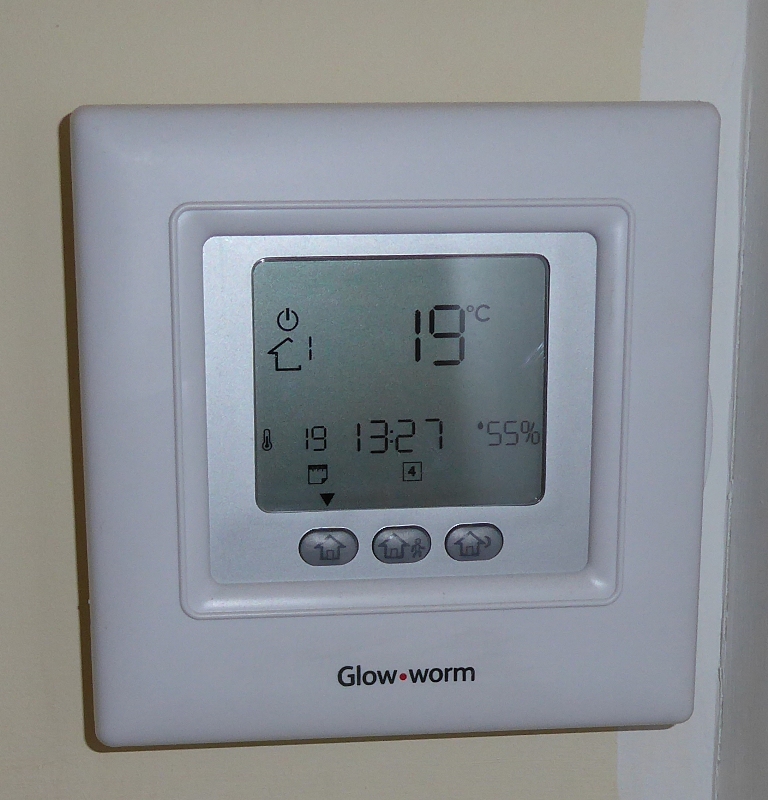
That's the same as the Command Unit I have, just with the Carrier logo rather than the Glowworm logo that's on mine:
-
Another cheap 12kW Kingspan Aeromax ASHP
Jeremy Harris replied to Stones's topic in Air Source Heat Pumps (ASHP)
That's right. There is an alarm LED outputs on the wiring panel and that, together with the 12V power, just feed the LEDs in this otherwise empty box. If you wanted the same diagnostics, then two 10p LEDs connected to the connector strip would do the same job.................. The alarm LED may also be duplicated on the circuit board in the unit - it is in mine - so you can read out the code by just taking the cover off.