Jeremy Harris
-
Posts
26430 -
Joined
-
Last visited
-
Days Won
360
Everything posted by Jeremy Harris
-

Anyone have the MBC open panel 140mm wall system?
Jeremy Harris replied to Dreadnaught's topic in Timber Frame
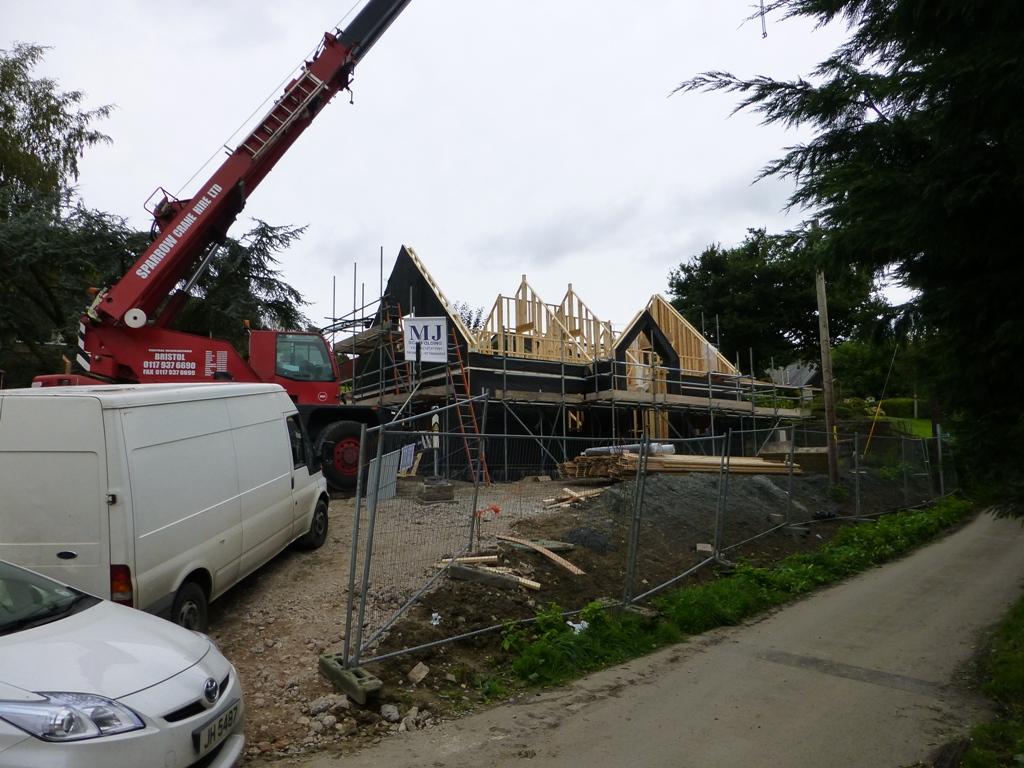
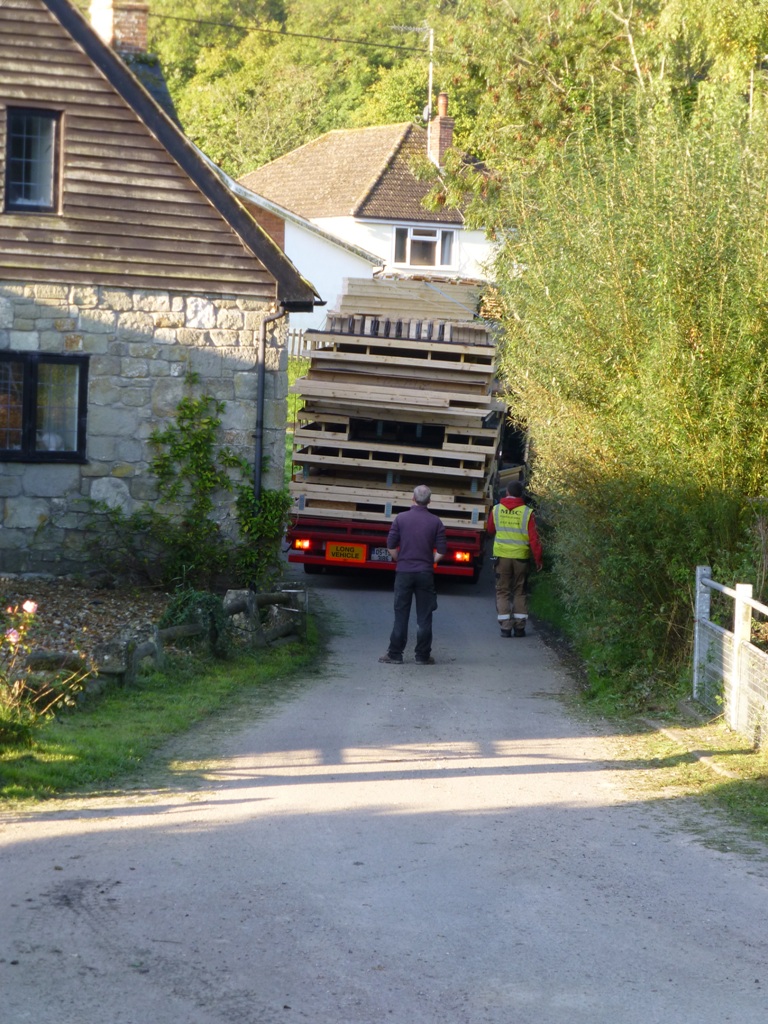
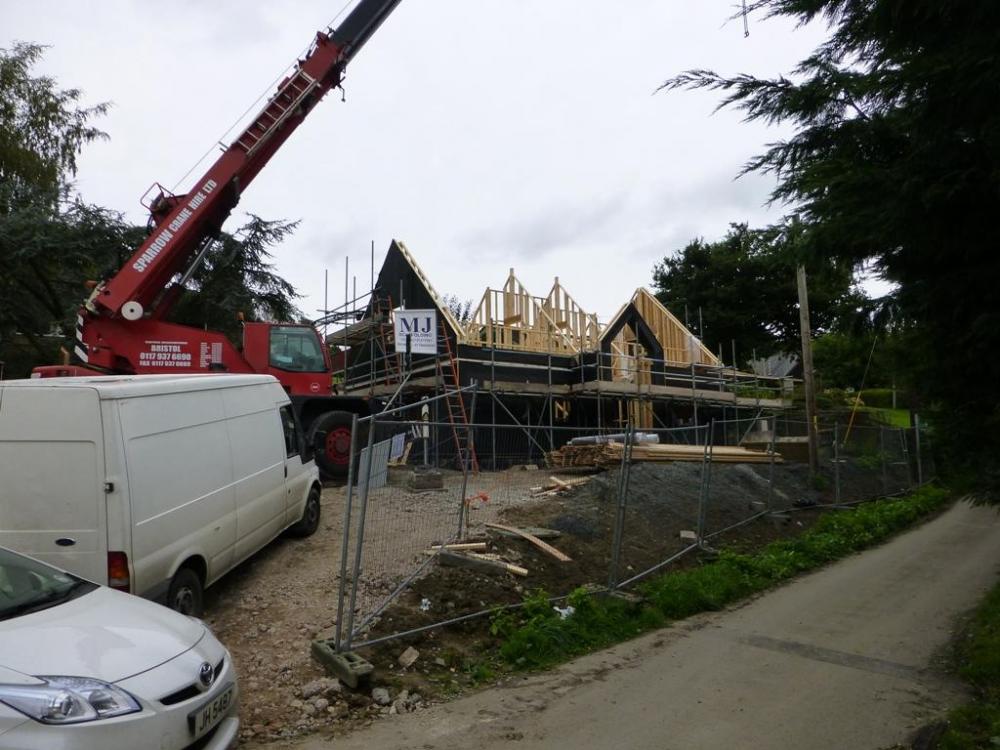
Same deal for us, five years ago. MBC provided everything except the scaffolding, skips and toilet. They organised the short wheelbase, long jib crane (drove all the way down here from Bristol) and measured up to make sure their artic could get down the very narrow lane (we had ~100mm of clearance either side at one point) and over the narrow bridge over the stream in front of our plot. I warned the neighbours that we were going to block the (very) narrow single track lane for a few hours beforehand, and all were OK. They shifted their cars out and parked them around the corner so they could get to them whilst we were faffing around getting the artic unloaded. FWIW, our lane is just about 2.75 to 2.8m wide where that 2.55m wide truck is backing in, so not exactly a lot of room to spare. The driver was damned good though, and made backing into that narrow space seem easy. The hardest part of the whole job was getting the crane into the site the evening before the truck arrived. The front of the crane was up tight against the scaff around the house, the back of the crane was right up against the garage slab. The crane managed to get up the 1:6 slope of our "drive" too... -
Anyone have the MBC open panel 140mm wall system?
Jeremy Harris replied to Dreadnaught's topic in Timber Frame
The panels aren't that heavy, as several of ours were just stacked up on the top level of the scaffolding and manhandled into place, IIRC. -
Anyone have the MBC open panel 140mm wall system?
Jeremy Harris replied to Dreadnaught's topic in Timber Frame
If you look carefully you can spot "JH" on my old Prius parked in once of the photos... MJ Scaffolding were great, BTW, if anyone is looking for a scaffolder around our area. We mucked them about a lot, with short-notice requests to changed the scaff, and they responded quickly every time. -
Unless I switch it off and on again to reset it, then 9 times out of ten it won't accept any charge at all after running off two morning showers. Once or twice it has decided to accept a charge at this point without me resetting it, but that's the exception rather than the rule. The problem then is that we can have a sunny day and yet the Sunamp sits there as a dumb dead weight doing nothing at all (unless I've reset it). At this time of the year it may, possibly, cool down enough to accept the grid boost charge in the early hours of the next morning, but we've already had one occasion when it didn't, and the second shower ran cold the next morning (which is what got me involved in trying to find out what was going on). Currently, with me resetting the unit every day, it's reliably utilising any excess PV generation we may get. I can't really fault it, in terms of performance, it's just the failing in the control system that lets it down. I have a narrow DIN rail mount time switch and plan to wire that into the box to do an automatic reset, just to save me having to go in the services room and turn the thing on and off every day. I should add that this problem only occurs for users whose normal usage pattern discharges a bit less than 50% of the Sunamp's capacity each day. Those who tend to use more than 50% per day may not have a problem. For us, I wanted the additional capacity as a buffer, so that excess PV generation from one day could be stored to be used the following day, in case it was cloudy.
-
Anyone have the MBC open panel 140mm wall system?
Jeremy Harris replied to Dreadnaught's topic in Timber Frame
Our site is tiny, yet we managed to get a 100ft jib crane on it (just):

-
Anyone have the MBC open panel 140mm wall system?
Jeremy Harris replied to Dreadnaught's topic in Timber Frame
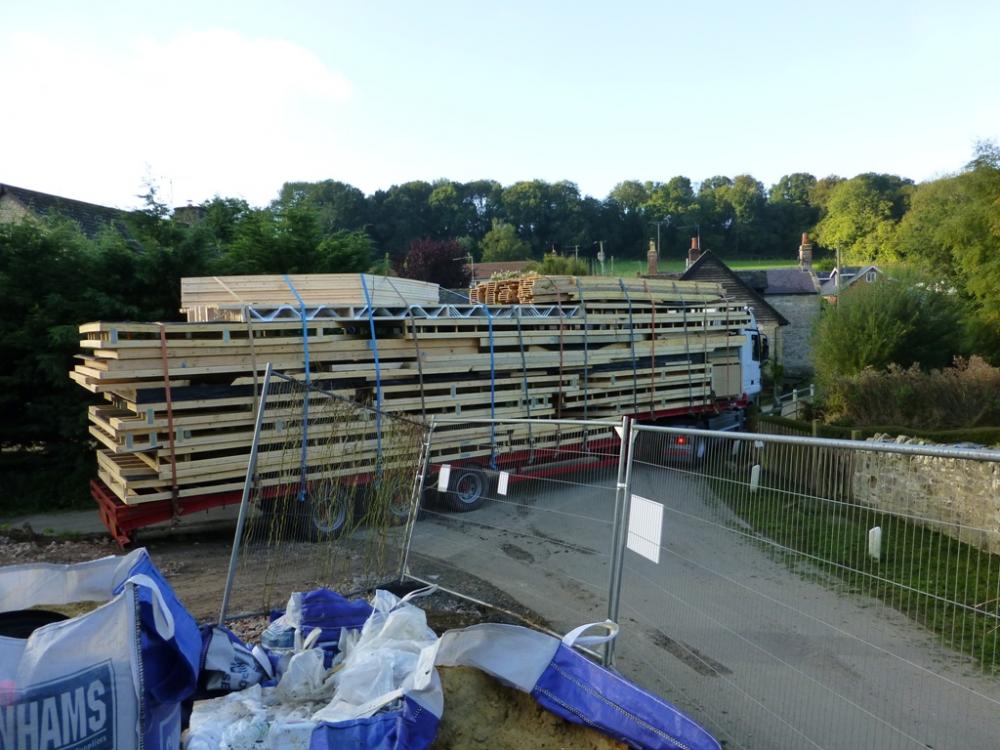
Here's our 300mm thick frame and garage being delivered to our site: That's a 38 tonne artic that had driven over from Ireland with our house and garage on it. This is it unloading, blocking the lane for around 6 hours or so: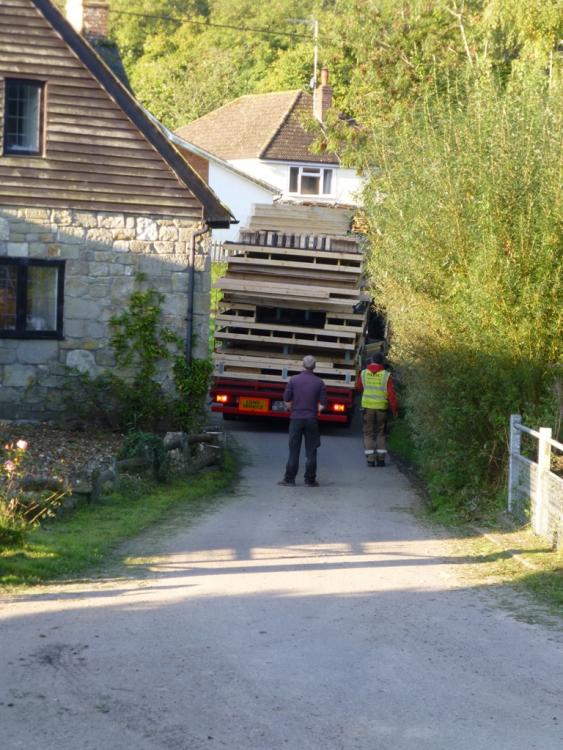
-
I did much the same as @PeterStarck, but I went around all the local builders merchant to set up trade accounts with them. One builders merchant (our local independent) told me that I didn't really want a trade account, as the discount on trade accounts is pretty small. Instead he offered me a cash account, which was cash (or card) with order and gave on average about 10% to 15% more discount than a standard 30 day credit trade account. Worth noting that trade accounts aren't about getting a discount, they are focussed on allowing tradespeople to buy materials on credit, before they get paid by their customers. As credit costs money, trade account discounts are generally nowhere near as good as cash account discounts. As it turned out, our local independent BM not only consistently gave me better prices than anyone else (and better prices than any of the tradespeople we used could buy from them for) but they also offered to try to price match, even with prices from the internet. There was only one product they couldn't price match, and that was pavers for the drive. I could buy those directly from Simply Paving for less than the price our local BM could buy them in at wholesale. Well worth asking around and letting your local BMs know that you're a self-builder, and want a cash account with the best discount they can offer, and ask if they can price match for bigger orders.
-
Yes, although you can use it either way. I found it easier to find leaks that were blowing into the house, as they create draughts you can feel with your hand, or hear if they are big ones.
-
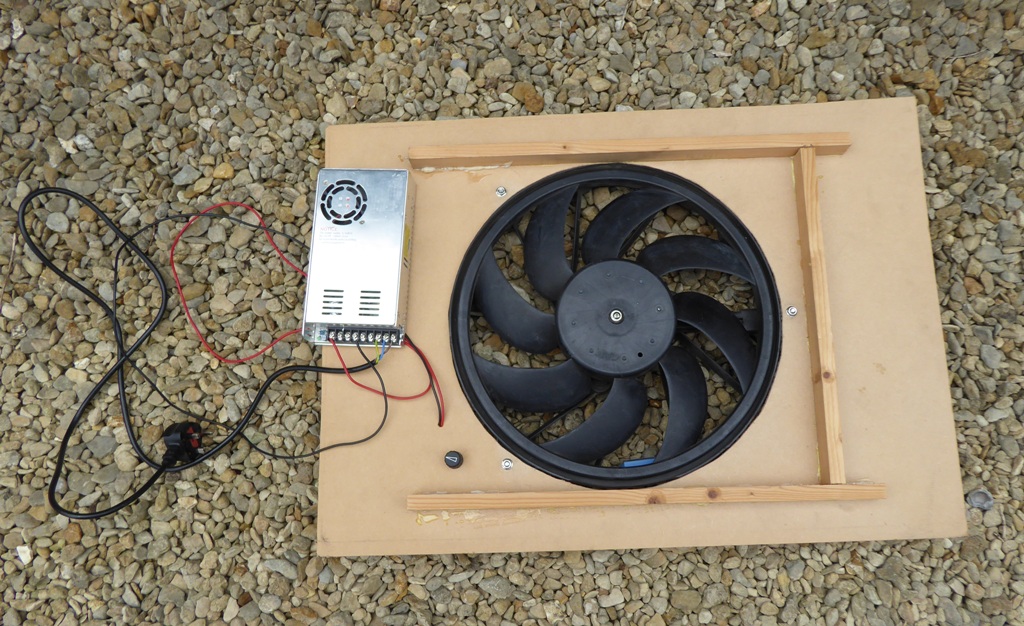
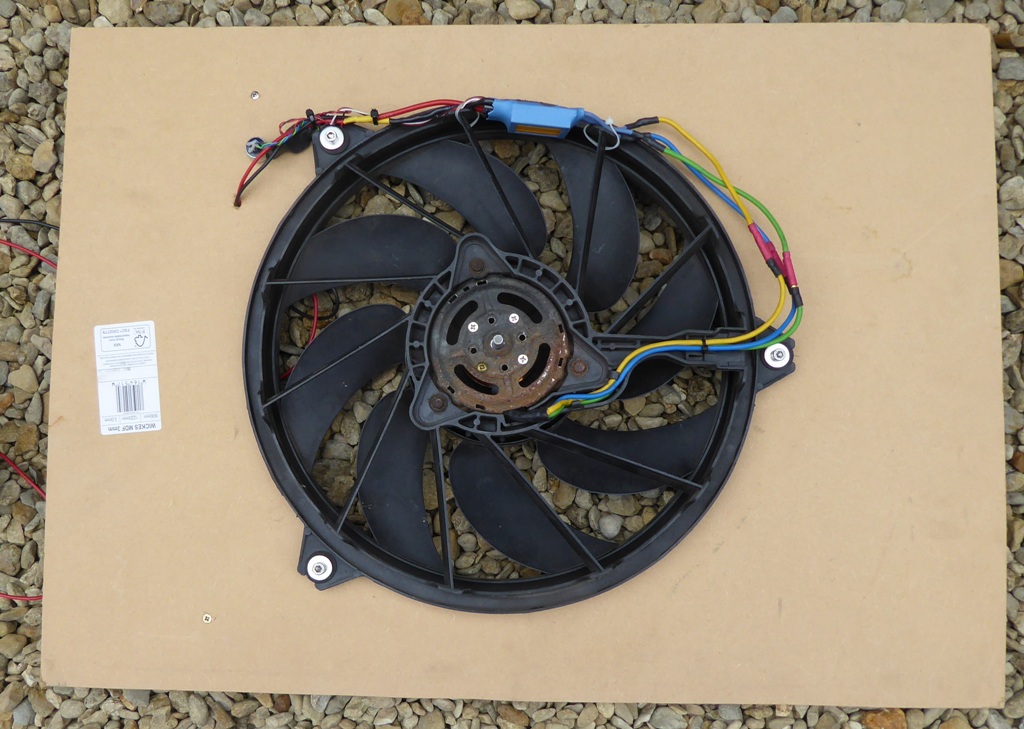
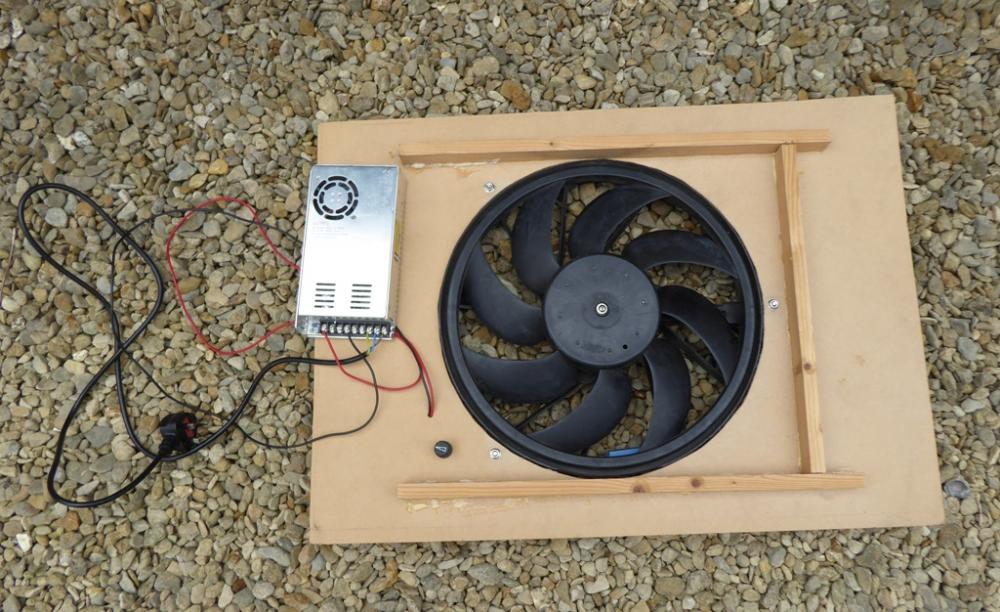
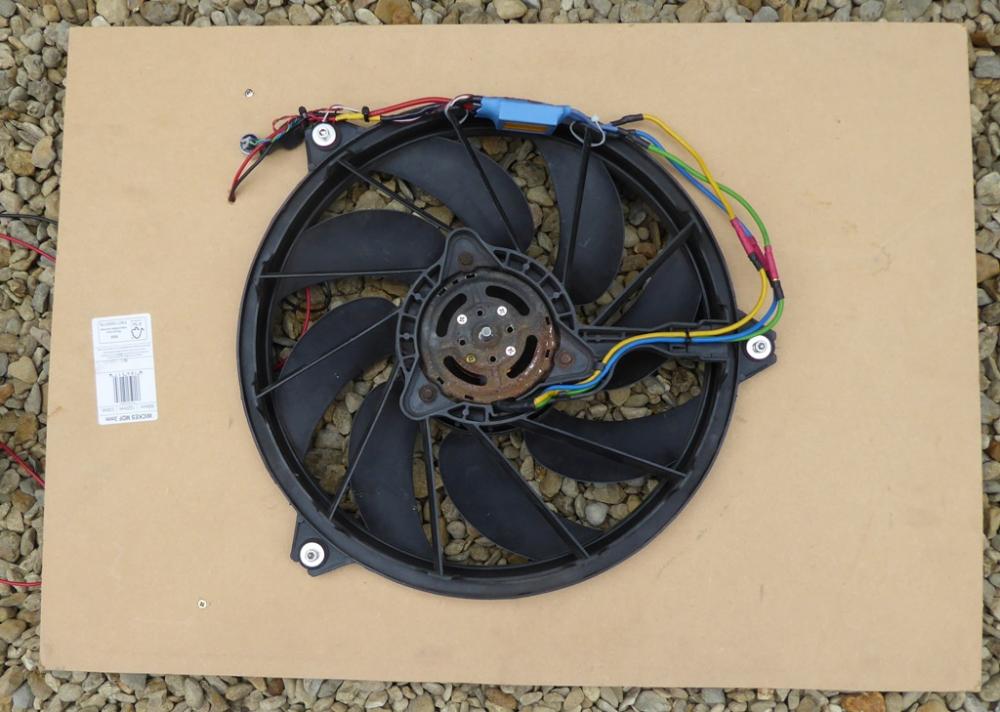
Here's a couple of photos of the unit I made up to find and try and seal air leaks up on our old house: It's pretty much exactly as @Ed Davies described above, a car radiator fan fitted into a bit of MDF that was cut to be a tight fit in an opened window. I swapped the original motor for a brushless DC one, mainly because I found that I could get better speed control this way, but also because the original brushed motor fitted to the fan was on its last legs, and made a heck of a noise. It was extremely effective at finding leaks, especially when set to depressurise the house. Many of the leaks could be found just from the loud noise they made; so no real need for anything fancy in the way of leak detection. Some of the worst leaks in that old house were where the ceiling met the internal plastered block walls (it was a bungalow). The gaps were tiny, too hard to see clearly, yet howled like banshees when the fan was running.
-
Anyone have the MBC open panel 140mm wall system?
Jeremy Harris replied to Dreadnaught's topic in Timber Frame
Exactly what I've done in our kitchen, replaced deep downlighters with very slim LED panel lights. The panel lights aren't much thicker than the plasterboard and give off a much brighter and more pleasantly diffused light. -
Anyone have the MBC open panel 140mm wall system?
Jeremy Harris replied to Dreadnaught's topic in Timber Frame
Our ceiling battens for the service void are 50mm, like the external wall service void battens, so plenty of room to fit slim panel lights. When our house was built 50mm x 50mm service void battens were the standard, so I doubt there would be any real hassle in changing to these. -
Anyone have the MBC open panel 140mm wall system?
Jeremy Harris replied to Dreadnaught's topic in Timber Frame
Sounds like a reasonable compromise. I can wholeheartedly echo @Nickfromwales comment about soundproofing. We are still amazed at how quiet our house is. It's spooky, in that we cannot hear anyone driving up the drive, even noisy diesel delivery vans, and have to rely on the CCTV motion sensor alarm to let us know someone has driven up. Nice during the night, though, as the house is completely silent - we don't even hear the noisy ducks/swans/pheasants outside in the morning. -
Just found this. I love technical solutions to simple problems:
-
Anyone have the MBC open panel 140mm wall system?
Jeremy Harris replied to Dreadnaught's topic in Timber Frame
Just to throw my usual observation into the debate, worth looking at the decrement delay for the various options. U value is, on its own, not a good indication of the comfort level that may be achieved. A low decrement delay build up, like the thinner foam panel lined walls, will have a much shorter decrement delay. This may not have a massive impact in winter, but it will almost certainly be noticeable in hot, sunny weather, where heat will be transmitted into the house more quickly than would be the case for walls with the same U value but a longer decrement delay. Not an issue if you have a relatively fast response heating/cooling system, though, as that should be able to adjust for the lower decrement delay OK, but may be an issue if, like us, you have a relatively slow to respond heating/cooling system. -
I wasn't for a moment suggesting otherwise. The confusion comes from seeing what to all intents and purposes in a photo appeared to be LV wiring that wasn't double insulated, that's all. Without being able to read what was on the boxes (assuming that they are labelled to indicate that the voltage on those wires is really ELV/SELV) then the only safe assumption anyone could make would be to assume they were LV; i.e. at mains potential. FWIW, I used to teach electrician apprentices years ago, and the golden rule was never, ever assume that anything is safe until you have positively identified and tested it to be so, and to always assume the worst case until you have proven beyond doubt otherwise.
-
Just realised I've been guilty of the over-use of acronyms... LV = Low Voltage, which in this specific context means 230 VAC nominal, i.e. normal mains voltage, where the line conductor is identified by being brown and the neutral conductor by being blue. The full LV voltage range is over 50 VAC up to 1000 VAC, over 120 VDC up to 1500 VDC. ELV = Extra Low Voltage, not greater than 50 VAC or 120 VDC, although the EU LV Directive applies to anything over 75 VDC SELV = Separated (or Safety) Extra Low Voltage, as for ELV but with isolation from any Protective Earth (PE).
-
That's the one that had me concerned, as it shows LV colour coded single insulated cable, with no second insulation layer, as required for any LV cabling. From what's been written above this isn't LV wiring, but is either ELV or SELV, with the wrong colours. As such, if it's really ELV/SELV then it doesn't need double insulation. However, it shouldn't really be using LV colour coding, as the chances are others will look at it and jump to the same conclusion I did.
-
clearfox Eating worm monster arrived
Jeremy Harris replied to readiescards's topic in Waste & Sewerage
Your architect is wrong, I'm afraid. I double checked this with building control and have it in writing that in order to comply with the building regs all that is needed is a form of external vent to the foul drain (just one) plus a means of allowing air into any vertical soil drain stack via an air admittance valve, or valves, if there is more than one soil pipe stack in the house). We have a single vertical soil pipe stack inside the house, and this extends up into the eaves space and is fitted with a 110mm air admittance valve at the top, inside the heated envelope of the house. This is the drawing I sent to building control in order to get approval for this: Elevation - Section showing foul drain stack - A4.pdf Building control agreed with me that the treatment plant vent was an adequate means of ventilating the whole foul drain run to atmosphere. -
Is there a cover over the top of all that exposed wiring? I hope so, as it looks to me as if there are exposed single insulated conductors to the right hand side of the modules there, and they need to be covered, or be double insulated, in order to comply with wiring regs, unless they are ELV/SELV compliant.
-
Yes, it seems so. I've confirmed that it's a dual rate E7 meter they are fitting, not a smart meter. As it happens they already knew that we couldn't have a smart meter, as our location is flagged as one with no mobile signal, it seems. The lady on the phone mentioned that there was no point in asking if we wanted a smart meter as her system was already telling her that one won't work here. Tricky one, as it's not very clear that it will make sense in terms of return on investment within its usable lifetime. I'm betting on energy prices rising over the ~10 year life of the battery system, allowing for some benefit we'll have from having some circuits powered from a big UPS, in effect (we get a lot of power cuts here) and some (fairly pessimistic) estimates of how much we may save from load shifting from peak to off peak using the battery system, plus storing excess PV generation during the summer. It's a bit chicken-and-egg, in that I won't know whether it makes sense until I've tried it over at least a year, to find out how accurate my estimates are. The idea at the moment is to always charge my car during the off peak time. To always use excess PV generation to charge the Sunamp first, then charge the battery system, and to use off peak to charge, or top-up, the battery system to avoid using peak rate energy. Only time will tell if it works out, but I am pretty sure I'll have fun playing around with it (perhaps I need to factor in the value of having fun with it, too?).
-
I guess it depends how long a life people expect out of something built in and an integral part of providing essential services for a home. My view is that anything that's controlling lights or power to any device or appliance has to be at least as reliable and long lived as a standard light switch or power outlet, so 25 to 30 years as a minimum expected life. It also has to be replaceable within 24 hours by any off-the-shelf product of the same spec, just like a standard light switch or power outlet. My experience with the longevity of operating systems and hardware used in control systems suggests that some may not last that long. Even the simple remote control box for the roller garage door we had installed 4 years ago is now obsolete. It has developed a fault with the automatic stop sensor, which disables door operation, and I've been advised that the only option is to replace the whole door as they no longer supply spares for this door. As it happens, I managed to take the thing apart, discovered it had a pretty standard Somfy motor inside, with a normal 4 core cable, so I've been able to buy a complete new control system for it, with a pair of new remotes, manual push buttons and an infrared safety sensor for a bit under £100 all in, so when the weather warms up I'm going to fit that (right now I can only move the damned door using the manual winder). I agree that big-brand systems like Loxone are likely to be around a fair time, because they've been in the market a long time and use standards that are also used by others, so the chances are that replacement components may well be around for a long time. I'm not at all convinced that some of the other "internet of things" systems that are springing up all over the place, including some that have been crowd funded as startups, will be around in even 5 years time, let alone 25 to 30 years time.
-
For info, my mean daily grid energy usage projections, before optimising for E7 are: Winter: Peak rate = 8.563 kWh Off peak rate = 10.583 kWh Summer: Peak rate = 3.650 kWh Off peak rate = 3.015 kWh I can shift a mean daily energy of around 1 kWh from peak to off peak without too much trouble, which will improve the off peak to peak rate ratio a fair bit, especially in summer. It also means that I can get the mean daily peak rate energy down to zero by fitting a reasonable size battery system; I'm looking at fitting a 9.6 kWh system which should be able to cover the ~7.5 kWh of winter peak rate usage, and would comfortably cover the summer peak rate usage. This may well result in us having no peak rate grid energy import at all a fair bit of the time, which would give a significant saving over the year, and would, incidentally, help the grid, by reducing peak demand. Bit of a win-win really, and all without the need for smart metering or 30 minute tariff changes...
-
Just phoned SSE to enquire about getting the meter changed to an E7 one. Apart from them trying to put me on a barking mad direct debit, on the basis that their data (which has to be less accurate than my data) seems to indicate that we use more than double the amount of electricity that they, and I, know we do, it was pretty painless. The chap's coming to swap the meter over next Monday afternoon and we'll switch straight over to E7 when that's done. The standing charge is just 0.08p/day higher, cheap rate is 6.6p/kWh cheaper, peak rate is 2.78p/kWh more expensive, but I can get a cheaper deal once we have the meter in by shopping around. No charge for the meter change, either, which was good news. Just need to work at shifting winter and long duration, high power loads, to the off peak period. Shouldn't be hard, I can change the heating programmer to charge the slab up from the ASHP mainly during the off peak rate, my car has the ability to only accept charge during the off peak rate and the DHW boost is already during the off peak period anyway. Looks like I can get well over 50% of our demand into the off peak period in winter. Just need to look at battery storage now, with a view to reducing peak rate demand to an even lower percentage. Not sure it will make sense in terms of the return on the investment, but having the ability to run some critical loads during a power cut will be useful, and add some value for us.
-
I think that building in the ability to completely change the control system is essential. Anything controlled by a 'phone app will most probably be obsolete within a few years - look at the number of "old" apps that are no longer supported on even a 5 year old device; we've direct experience of this with a five year old colour laser printer no longer working with a five year old iPad and have just run into exactly the same problem with my 4 year old Android tablet not being able to run apps to control some car charge points (meant I've had to go and buy a new 'phone just to do this - damned annoying). Being able to rip out any proprietary control system and replace it with a new one, without major redecoration work, would be high on my list of essentials. I regret not having put power in for electric blinds. We have blackout blinds in the bedrooms and several other sets of blinds around the house, and it seems far more tedious having to go around the house opening and closing them than it ever did when we had curtains. I'm looking at fitting battery powered motors and remotes to all the blinds, which will means having to charge them up two or three times a year, but seems likely the only easy option, given that getting power neatly to the top of the window apertures would make a heck of a mess to do now.
-
It would be interesting to see how big an impact on build costs bad weather has here in the UK. It must hit jobs like brick and block laying a fair bit (-2 deg C here this morning and yesterday morning, so I doubt much mortar got laid over the past two days anywhere nearby). The problem is that many of the additional costs incurred by delays in getting a house shell up and reasonably weathertight are hidden, and just assumed to be things that cannot be changed. Having had a house go up in 4 1/2 days to weathertight (8 1/2 days if you include the 4 days spent laying the foundations and UFH the week before) than I'm convinced there may well be a significant cost saving, as well as a potential improvement in build quality and thermal performance, by building house components under controlled conditions, under cover. I know that workflow on our build was barely impacted by the weather at all. The only weather related delay we had was with the roofing finish and PV panel installation, as that wasn't part of the pre-manufactured part of the build. All told that was delayed by around 4 weeks due to bad weather, not that it had any impact on work inside the house. Supplying ready-made roof panels, as well as all the wall panels, could have eliminated the roofing delays we had, and saved money had it been a commercial build.