


Jeremy Harris
-
Posts
26430 -
Joined
-
Last visited
-
Days Won
360
Everything posted by Jeremy Harris
-
Doesn't make a significant difference, as the throw from the fan pushes the cold exhaust air a fair way away. Might make a tiny fraction of a percent difference on a very still day with zero wind, but I doubt if anyone could measure it. No, ∆T in this context refers to the differential temperature between the ambient air from which heat is being extracted and the flow temperature of the water that is being heated. This is the main factor that determines how hard the heat pump is working. For our, pretty typical, (re-badged Carrier) inverter controlled ASHP as ∆T gets greater the COP reduces, as shown in the dry air curve earlier. Altering the power output, by adjusting the water flow rate, is an effective way of reducing the load on the heat pump, and so maintaining a higher COP, although there's no "free lunch" by doing this, as the power output is being reduced when it is most needed, so the running time will then increase for a given energy output. It does reduce the possibility of icing, though, by reducing the heat pump load for the prevailing outdoor conditions. I would guess that it also takes account of outdoor RH when doing this. Our's measure RH at the input to the evaporator, and seems to use that as a part of the fan speed control and defrosting system, as well as displaying RH on the indoor display.
-
Looks just like our passive slab, and pretty much every one I've seen, with reinforced beams for the load bearing areas.
-
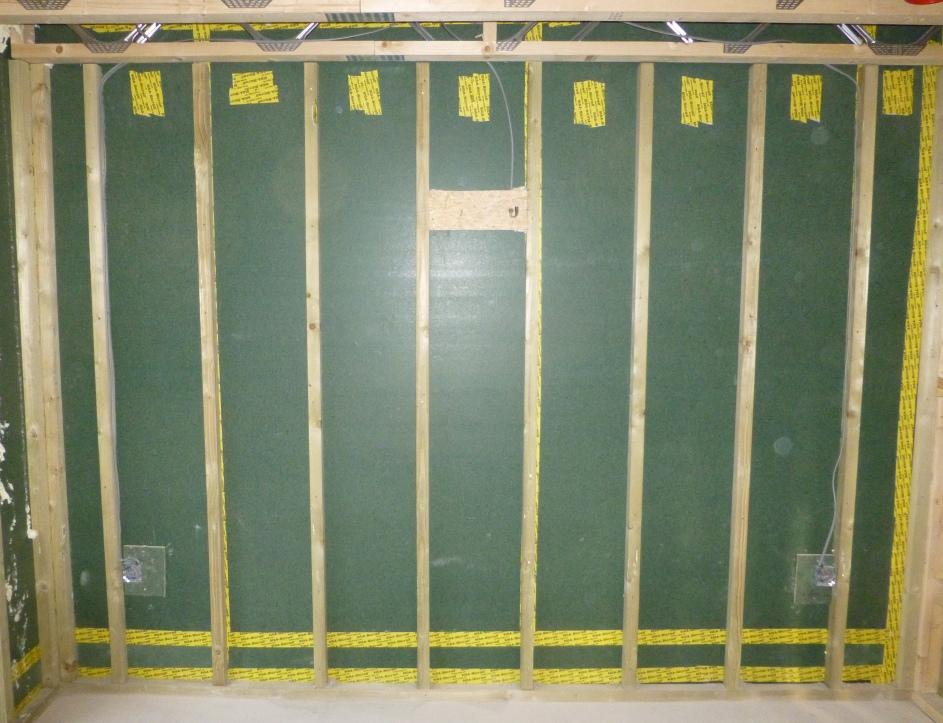
That's often not the case with the type of frame that I and @lizzie have, unfortunately. The studs are on 400mm centres in the main part of the panels, but they are often not 400mm from the corners, as they tend to set the stud pitch so that the "left over" dimension is equally spaced at either end of a cassette. This shows a typical frame cassette in our build (the service void battens are aligned with the frame cassette studs):
-

PV Self-Comsumption Model for sizing system + battery.
Jeremy Harris replied to Dan F's topic in Photovoltaics (PV)
I'm pretty sure Octopus is using this as a way of getting a bigger share of customers that have "smart" meters. They are the supplier offering the most enticing tariffs to customers who agree to have such a meter fitted, which suggests that my view as to why suppliers want most of their to have the things may be correct. -
Single Room Air Conditioner or similar
Jeremy Harris replied to Ferdinand's topic in Other Heating Systems
Would work OK with water from your burn, though! As an aside, how difficult would it be to plumb a plate heat exchanger into your UFH and feed it with water pumped to and from your burn? -
I think you're probably right. Since we've had the air con running upstairs, we've noticed that it has been feeling colder day on day, even though the air temperature has stayed much the same. An hour or so ago we were chatting about this and agreed that last night felt a bit too chilly, despite the air con having been set to 1° higher than the night before. Tonight we're going to increase the temperature by another 1° and see how that feels. My gut feeling is that it's just taken a long time for the walls, floor and ceiling to cool down a bit, and that we "feel cold" when we're surrounded by cool surfaces. The target bedroom temperature is now 21°C on the air con controller, which seems to over-read by about 1°, so with luck we should end up with a true room temperature of around 20°C. Downstairs has warmed up very slightly through the day, and is currently around 21.7°C, which feels fine. It does feel like walking into an oven going out though the (South facing) front door, though. Even the door handle inside is pretty hot, from heat conducted from outside.
-
I suspect that one reason that window suppliers may not be interested is that most of the profit in windows is in the frame, rather than the glazing. I can't see why there needs to be a frame with a modern glazing unit, if anything not having one halves the water ingress risk, I'd have thought. Back when we were thinking of building with an oak frame (long time ago now, and not for this plot) one place we looked at had 3G units that were fitted directly to openings, with no frames. Oak moves a lot more than masonry, so I can't see fitting glazing directly to the structure shouldn't work OK. It'd certainly give a nice clean look.
-
PV Self-Comsumption Model for sizing system + battery.
Jeremy Harris replied to Dan F's topic in Photovoltaics (PV)
Every supplier's intention is to move to 30 minute tariff changing on the fly, it's the primary objective behind rolling out "smart" meters. It is supported by suppliers as it reduces their business risk exposure dramatically, and so improves their profitability. At the moment, all suppliers buy electricity on a 30 minute slot buy-ahead daily auction. The wholesale price varies dramatically through the 24 hour buy-ahead period, from negative pricing during periods of high generation/low demand to pricing that may well exceed the highest retail price. Negative pricing seems odd, but is down to the rather distorted generation marketplace, where generators end up paying suppliers to take electricity that they are unable to stop generating (for practical reasons associated with the length of time it takes to ramp generating plant up and down, amongst other reasons). Suppliers work out what they think they will pay as an average wholesale price over a forthcoming time period, add on their operating costs, profit margin and a risk contingency and use that to set their tariffs. If they get their predictions as to how the wholesale prices will pan out wrong, they lose money and may well go bust (it has happened to a few of the smaller suppliers already). Much of the competitive edge between suppliers, once they have tuned their operating costs, is what they choose to use as a risk contingency. Set this too low and they may go bust, set it too high and they may not win new business because their tariffs aren't competitive. By switching to 30 minute variable pricing to the customer, they can win in two ways. Firstly, they remove the need to apply a pricing risk contingency, as they have passed the wholesale price variability risk on to their customers, so it is they that will carry that risk. Secondly, tariffs will become impenetrably difficult to compare, as prices will vary every 30 minutes. Comparing suppliers will be a bit of a nightmare for consumers, and most probably reduce the frequency with which they change supplier in order to get a better deal. Whenever customers stop switching to new suppliers, prices increase and supplier profitability increases. Right now we're seeing the leading edge of this change, with suppliers offering very attractive deals to entice more customers to have "smart" meters fitted. Once fitted a "smart" meter cannot be changed back. As soon as most customers have "smart" meters we will then see two things happen. Suppliers may well try to introduce punitive tariffs to those who don't yet have "smart" meters (but I would hope that OFGEM might try to regulate this) and suppliers will move away from the attractive tariffs, that were designed to entice customers to change meters, and we'll see something broadly similar to the way the mobile phone market operates, with complex tariffs that few have a hope of being able to understand or compare. -
No, it's not insignificant, but then reducing energy use in hot weather to 75% of that in cold weather doesn't make the energy use negligible in hot weather, either.
-
Yes, there will be a bit of additional heat available from the water vapour content, due to enthalpy. Might do a few sums later to see how big an effect it has.
-
Single Room Air Conditioner or similar
Jeremy Harris replied to Ferdinand's topic in Other Heating Systems
They would be daft not to, really. Bound to be a spike in demand during very hot weather, and if demand increases so can prices. It might smack a bit of profiteering (which it is, but all businesses have to make a profit) but with (presumably) a limited supply/stock of the things then it would seem to make business sense to take advantage now. I bet they don't sell many come December... -
Yes, that's what I was thinking sat here listening to the thing running all day.
-
I'll pop out later and take a look. I have a feeling it's an older JCB model from a brief look at it when it was unloaded a few weeks ago.
-
There will be a marked difference between winter and summer, but a fair bit of this will be due to relative humidity, rather than air temperature. The very worst operating conditions for an ASHP are when it's cool and wet, as the evaporator will tend to ice up and the ASHP will run reverse cycles to defrost it. For ours this happens most often when it's about 5°C ambient and wet, although I found (by experiment) that reducing the ∆T stopped it defrosting completely, which resulted in a significant improvement in real-world COP.
-
Not as far as I know, at least not directly. Most seem to operate on a combination of target conditions. Ours first tries to meet the target flow temperature, and will ramp up to it's maximum input power to try and get there. As soon as it reaches this flow temperature it will usually start to throttle back the input power (compressor speed mainly) until the output power is just enough to meet the required flow temperature. As the return temperature increases, the input power throttles back further, as output power is proportional to the ∆T and water flow rate (water flow rate tends to be constant, though). I measured the COP of ours by measuring the flow rate (which in our case stays constant all the time), monitoring the ∆T between flow and return and measuring the input power level. AFAIK, the ASHP itself cannot do this measurement directly, and seems to rely primarily on temperature sensors to adjust it's input power level. It's complicated by the way the fan works, in that the fan speed seems to be controlled by the evaporator temperature, so ramps up and down semi-independently of the compressor speed.
-
Good point, it is easy to overlook ignorance as a factor. Sometimes it's easy to forget that heat pumps are relatively new to the UK and the knowledge of the way they work isn't that widely understood yet.
-
All day today there's been a 15 tonne digger operating just over the road from me, digging up the old trout farm ponds. The guy's been at it non-stop, and frankly I don't know how he manages it.
-
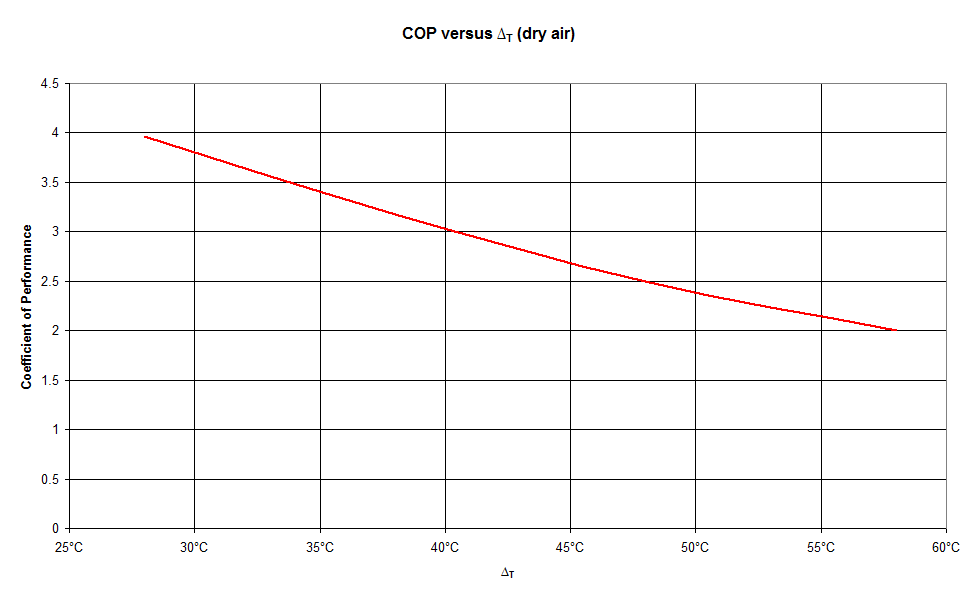
Not at all sure about the "negligible" bit, that doesn't really stand up to scrutiny at all well, and smacks of BS. There is certainly an efficiency difference between running an ASHP in warm weather versus cool weather, but not by a massive amount, and it certainly never gets anywhere near a state where the energy usage becomes negligible. Air at 30°C only contains about 3.4% more heat than air at 20°C, for example, and all heat pumps have a characteristic operating curve that gives the Coefficient of Performance (COP) versus the operating temperature differential (difference between the ambient air input temperature and the water flow temperature for an ASHP) for dry air (humidity has a couple of incidental effects on performance). This is the characteristic curve for our ASHP when operating with dry air, by way of example: There is clearly a reduction in the amount of electrical energy needed to heat a given volume of water as the COP increases, but it isn't as big a difference as to ever result in the amount of energy used being negligible. If you were heating a full tank of 300 litres of hot water to 55°C with an ASHP with the above efficiency curve and an incoming mains water temperature of 10°C, then the electrical energy usage for different ambient temperatures would be: At 10°C ambient = 5.2 kWh At 15°C ambient = 4.7 kWh At 20°C ambient = 4.2 kWh At 25°C ambient = 3.8 kWh It annoys me that suppliers think they can bamboozle customers like this, and it was exactly this sort of misrepresentation that resulted in there being so many unhappy ASHP owners in the early days of their introduction here. They were mis-sold on a fairly wide scale, enough for the Energy Saving Trust to recognise the problem when they conducted their first survey into the efficiently of heat pumps in the UK domestic sector.
-
Was it about the Defenestrations of Prague?
-
Yes, bypass will heat the house up, much like opening a door or window, if it's hotter outside than in. Best strategy for passive cooling is to keep the house shut up tight in the heat of the day, with the MVHR off, then night purge it as much as possible as soon as the temperature outside drops below the indoor temperature.
-
That would work well, as I bet your burn stays at that temperature most of the time. Our stream sits at about 8°C all year around, and when we were doing the groundworks (in very hot weather) one of the chaps suggested just piping water from the stream around the house and back again to cool it down.
-
Single Room Air Conditioner or similar
Jeremy Harris replied to Ferdinand's topic in Other Heating Systems
I have a spare portable unit, that sooner or later I will get around to semi-permanently installing in my workshop (maybe). The snag is that I'm a fair way away from you, and the thing is fairly heavy and bulky. It's nothing fancy, it was something I bought a few years ago from B&Q when we had a particularly hot spell. It also needs the condensate container emptying ever few hours, as it's not one of the ones that ejects the condensate out with the hot exhaust. It looks a bit like this unit: https://www.aircondirect.co.uk/p/1163189/electriq-12000-btu-quiet-air-conditioner-portable-for-rooms-up-to-30-sqm You're welcome to borrow it through this summer, though. -
We'd be pretty damned hot if I was to open any windows. Currently 21.4°C indoors (downstairs) and 31.3°C outside at the rear (North) side of the house. On the front (South) side the walls are currently at 41.6°C. I suspect the roof is a fair bit hotter.
-
PV Self-Comsumption Model for sizing system + battery.
Jeremy Harris replied to Dan F's topic in Photovoltaics (PV)
No, they won't. It's one reason that we couldn't have one even if we wanted one. When the chap turned up to fit our E7 meter I related the tale about being given the hard sell to fit a "smart" meter and his comment was "I could have told them that one of those won't work here". Until such time as they can 100% guarantee that the data and control of "smart" meters is secure then I refuse to have one. There are already people who have had their electricity cut off by remote control as a consequence of data handling errors. One thing that they don't publicise is that all "smart" meters have a remote disconnection capability, so that those who don't pay their bills can just be disconnected without anyone having to come out to the premises. They also use the remote disconnection for anyone that's on a credit tariff, equivalent to the old coin in the slot meters, so they can turn off the supply if the credit isn't topped up. This also means that anyone can be cut off if there is an error in, or malicious intervention to, the meter control network. -
Yes, the difference is roughly proportional to the absolute temperature, in K, rather than the relative temperature in °C. There's a bit more to it, as at lower temperatures the properties of the refrigerant used have an impact, but the difference in the heat contained in a given volume of air is proportional to the absolute temperature. So, 20°C is 293.15 K and 30°C is 303.15 K. Although 30°C is apparently 50% hotter than 20°C, in absolute terms it's only ~3.4% hotter, so there's only ~3.4% more heat in air at 30°C than there is in air at 20°C
