


Garald
-
Posts
1113 -
Joined
-
Last visited
Everything posted by Garald
-
Grrr! The installer we are talking about seems to have relented in his plans to make my bike shed into a fridge, *and* I convinced him to give me a quote for a Mitsubishi - his price does not too insane - but: while the Mitsubishi without DHW would be available immediately, there would be a wait of 3-4 months for the one with DHW! Arghh!! Hope I have better luck with the official Mitsubishi installer. Or is there a third alternative for DHW storage I haven't thought of? Can one have a device that accepts and stores water from a "heating-only" Mitsubishi heat pump? (Zubadan Silence 11 Duo 200L R410A)
-
Well, just wrote to the installer. If he accepts there's an issue, that's a point in his favour. If not, and he gets upset, I have an alternative - the Atlantic installer (who, however, did not see right away the problems with the arrangement proposed by the competitor). I really hope the Mitsubishi installer will finally visit...
-
3-speed. Sure, it's just a matter of adjusting speeds. But I'd like to know how much power I'd be producing!
-
Right. The Daikin unit that he's trying to sell me is a good product, with "quiet" and "very quiet" modes. (Well, those are just 3dB and 5dB less than the peak setting, but every dB helps.) Unfortunately, I can't seem to find online what the top wattage of a 11kW unit would be under those settings. How do I find that out? (Yes, 11kW is too much, but the next one in Daikin is 8kW (which is really 7kW under some conditions), and, while that should certainly be fine given my calculations (and he seemed inclined to agree in person), he's just not willing to run the risk. That's a pattern among all installers, btw; no exceptions. I should already be thankful that another installer wants to sell me an Atlantic 10 model (which is really 9kW, and yes, he's the first to say that).)
-
Yes, this is what I have been saying all along! In winter or mid-season, it's clearly superior to what the salesman was proposing. His argument for why this is an inferior solution in the summer: you'll have to run the heat pump even then, the neighbors will have their windows open because of the heat, they will be annoyed, come and vandalize your external unit...
-
Air-to-water heat pump.
-
Well, sure, but there's convection, so...
-
She's a ventilation specialist but has zero previous experience with heat pumps (and used to be highly skeptical of them for whatever reason). The contractor knows about radiators, and his dad has a heat pump somewhere in the countryside, so at least it's two against one.
-
Right, it might make particular sense to put such a device in the top floor (an attic that I'm afraid might get uncomfortably hot during heat waves) to be used in summer only, so as to kill two birds with one stone: (a) I wouldn't be bothering the neighbors by making the main heat pump work in the shared courtyard precisely in the season when they may want to have their windows open, (b) I would heat water at the same time that I cool my attic! If, however, I suggest such a change in plans at this point, when the attic is already partly redone, the architect may finally have reasons to want to kill me. This is more something to keep in mind if I ever have the roof in the attic raised - I can make this kind of reforms then. Should I talk it over with the head builder so that he takes this hypothetical plan into account now that he's working on the pipes? Or is that not necessary?
-
Well, I've already spent a pretty penny on making it quiet: new double-glazing on the street side (the old double-glazing was OK thermically, but you could hear every car going down the street), 18cm of cellulose-based-insulation (hemp/linen/cotton) with particularly good sonic properties (yes, it's also nice thermically, but I could have got away with using up less space by using a combination of cellulose and reflective materials as on the other side)... So I really don't want to sabotage myself in this way. The old garage (bike-shed-and-machine-room-to-be) is right below one end of my library/music room (which is also where I'll eat when I don't just deal with that necessity in the kitchen), so silence is important.
-
Well, it would make sense if the water heater were directly connected to outside air. Then in effect you would just have a second, smaller ASHP setup - dissociating the two can be useful. (The original rationale of the seller was: this way you will not run your main ASHP in the summer and annoy your neighbors. This may make sense, but (a) how noisy is this water heater? I could be annoying myself, (b) would the main ASHP be working that hard just for DHW, if programmed correctly? And if it isn't, shouldn't it be pretty quiet?)
-
Right - I suggested it (in fact venting directly from or to the street) and the installer advised against it. Can also happen, depending on volume and power. (700W is not *that* much.) Information in French suggests that water heater installers believe that this happens when the room volume is less than 20m3 (this is obviously an empirical rule, and very rough, even if it turns out to have any validity).
-
Right. Yes, this may be an issue, depending on the exact point at which the machine switches over to being a conventional electric water heater. That provides a bit of a safety mechanism: the garage won't get colder than the minimum of the outside temperature and the temperature at which that shift happens. Can also be a problem if one makes holes in the garage door or wall to keep things from happening (as then the garage would be about as cold as the outside world).
-
The temperature of the machine? I'm not sure how that would happen - the air in the garage could get cold (as cold as the minimum of the outside temperature and the temperature at which the water heater switches to being just a plain electrical water heater (5C perhaps?)) but the machine itself would be warmer on the inside, at least when running, no? Sorry...
-
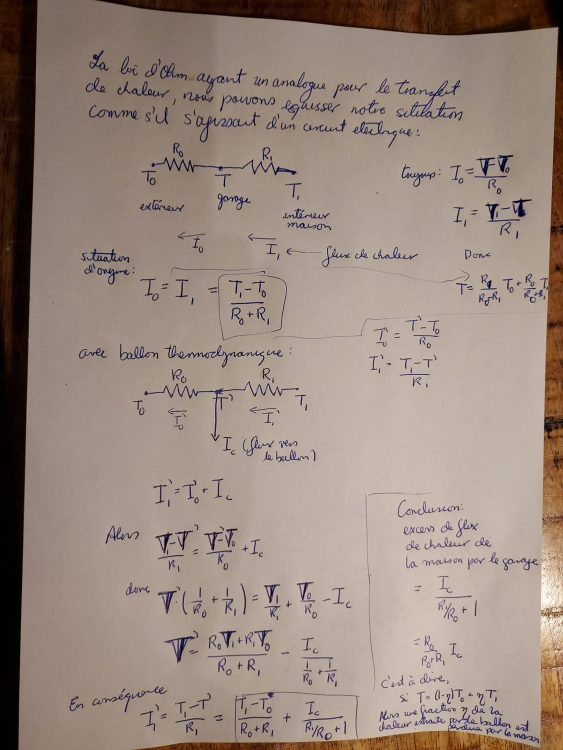
I mentioned the following issue yesterday. I just double-checked my calculations (and translated them into French, since I'll send them to the heat-pump installer who suggested the problematic setup; hope this isn't a problem - math is math). What situation do I have in mind? A garage like mine - it's in a rowhouse, so surrounded by house (mostly mine) on all sides except one, and the external wall will be mostly a solid wooden door (since the garage is becoming a bike shed/machine room). [OK, I'm neglecting the floor, which is a concrete slab, covered up a bit.] Even though I've already put some insulation between the rest of the house and the garage, the garage will presumably never get quite as cold as the street in winter - it will presumably get about as cold as a coop corridor with a wooden door. Let's say that, before the installation of a water heater, the temperature T of the garage is (1-eta) T_0 + eta T_1, where T_0 is the outside temperature and T_1 is the temperature inside the house. Then the calculation here shows that, if you install a fancy water heater with its own heat pump that extracts heat from the ambient air in the garage, then a proportion eta of the heat "gained" by the water heater is in fact being sucked from your house (yes, I mean it would not have been lost by the house if the heat pump were not there). Really not nice if eta is not so small! For example, if the temperature of the garage (with no water heater) is at midpoint between the outside and inside temperature (say, 9C when it's 20C indoors and -2 outdoors), then eta = 0.5, and so half of the heat "gained" is heat sucked from the house. Now, if the house is being heated by a good heat pump, this *may* still be better than a conventional electric water heater, but it is still ridiculous: it would be much better to just let the heat pump that heats the house produce domestic hot water! (If it's summer, though, you are happy, since you *want* to lose heat - but in that case, you'd be better off just letting the heat-pump extract heat directly from the inside of the house, instead of working on the other side of the garage-house separation wall.) Another concern was raised in the original thread: that the water heater could cause the garage to become extremely cold. The model here does show that the temperature could drop beneath the outside temperature. However, in practice, there's a limit to this, since the heat pump in the water heater is likely to be weak, and stop working at a certain temperature (5 C?), beneath which it just becomes a conventional electric water heater. Thus, the garage wouldn't get colder than 5C or the outside temperature, whichever is lower.
-
If only I could get an offer for a Mitsubishi Power Inverter Silence Duo 11 200L...
-
... and right, the problem is that I couldn't get the Daikin installer to offer me a Daikin 8kW, even though he agreed we had done a smashing job with the insulation, and that even at 9kW we would have much more wattage than we need. Nothing by Daikin between 8kW and 11kW.
-
People don't spend time in the courtyard as it is (though they might start to do so once I make it nicer). My concern is more what happens when it's the worst of summer and they keep their windows open - particularly when they sleep. How do I find out how programmable these units are?
-
So, I now have offers from two installers - one is for an Atlantic Extensa Duo 10 RS32 heat-pump (peak power closer to 9kW than to 10kW) and one is for a Daikin Altherma 3 R W 11 kW. The two units are very similar from the point of view of their technical specifications (for instance, essentially identical SCOP; should be about 3.9 at 45 C in both cases). Both are somewhat overpowered - not my choice; installers overestimate, in part because they don't want liability. (Even the 11kW installer agreed verbally that 9kW will give me plenty of elbow room, even with an integrated water heater.) Both produce a notch more noise than I had hoped for - I was aiming for 60dB, the Atlantic produces 62dB, Daikin produces 64dB. The external unit will go in a shared courtyard - I've got written authorisation from the coop, but I want to tread carefully. Question: what happens in summer, when (a) neighbors are more likely to have their windows open, (b) I won't need that much power (just DHW, and also cooling, not at the same time, obviously; cooling would be just a pittance (< 1kW), used by the PIV)? - Daikin has a quiet mode (-3dB) and a night mode (-5dB), but I can't find how much heat it produces then; - Atlantic does not have a quiet mode. If much less than full power is demanded from it, is it likely to just turn more slowly and be quieter? The technical specification sheets don't seem to clear these issues (but maybe I haven't looked hard enough). (Opinions on Daikin and Atlantic are also welcome. Old threads online (<2016) clearly favor Daikin; it's unclear to me what is the case now.)
-
Update: new bamboo floors!
-
Right, exactly. In defense of the second installer (who suggested this), the current garage door is a conventional metal garage door with holes in it, and he saw that; however, I explained that it would be replaced by a solid wooden door. I wish the first installer could at least agree that we are right, instead of offering "we will do it for 1000 eur more"! I meant "eventually" in the sense of "let us assume we have reached a stable state..." (i.e., I was being agnostic as to whether it would take a second or a day).
-
(This is a fun physics test - I think I'll use it to help me decide between installers.)
-
What I am getting is that, if V0 is the outside temperature and V1 is the inside temperature, and V0 + c (V1-V0) is what the temperature of the garage would be without the fancy water heater, then, once you install the water heater, a proportion c of the heat extracted by the fancy water heater from the garage is being sucked from the house. That is: if it would be 10 C in the garage when it's 0 C outside and 20 C indoors, then half of the heat "gained" by the water heater is being stolen from the house; if it would be 15 C in the garage when it's 0 C outside and 20 C indoors, then three-fourths is being stolen from the house; if it would be 5 C in the garage when it's 0 C outside and 20 C, then only one-fourth would be stolen from the house - but then it will certainly be colder than 5 C in the garage once you install the fancy water heater, meaning it will most likely stop working in fancy mode, and it will just become an old-fashioned electric water heater. Yes, I'm using the letter V for temperature because I drew an electric diagram :).
-
Well, of course I'll have another heat pump running, but it makes much more sense to let it produce DHW directly! Right. Somebody ought to get clever about it and market it. Not poison berries I hope? Is Atlantic known in the UK at all? (It's a French company.) Hitachi Yutaki seem to have a good quality/price ratio, but the external unit is too noisy for my purpose (67dB for the 8kW model - similar to Panasonic, also a good brand that is unfortunately not a silence leader).
-
Another self-comment: Why aren't there arrangements where the hot-water heater takes hot water produced by the main, central-heating heat-pump during the winter, and heats water using heat extracted from the ambient temperature (outside or, even better, inside) during the summer?

