Garald
-
Posts
1113 -
Joined
-
Last visited
Everything posted by Garald
-
Combining an air-water heat pump and solar thermal
Garald replied to Garald's topic in Solar Thermal (ST)
I was just talking a friend who has more experience than I of the practical side of things (well, same friend as above). He essentially said that he thinks of solar thermal as something for large families. Makes sense: who else needs lots of hot water during the summer? -
Combining an air-water heat pump and solar thermal
Garald replied to Garald's topic in Solar Thermal (ST)
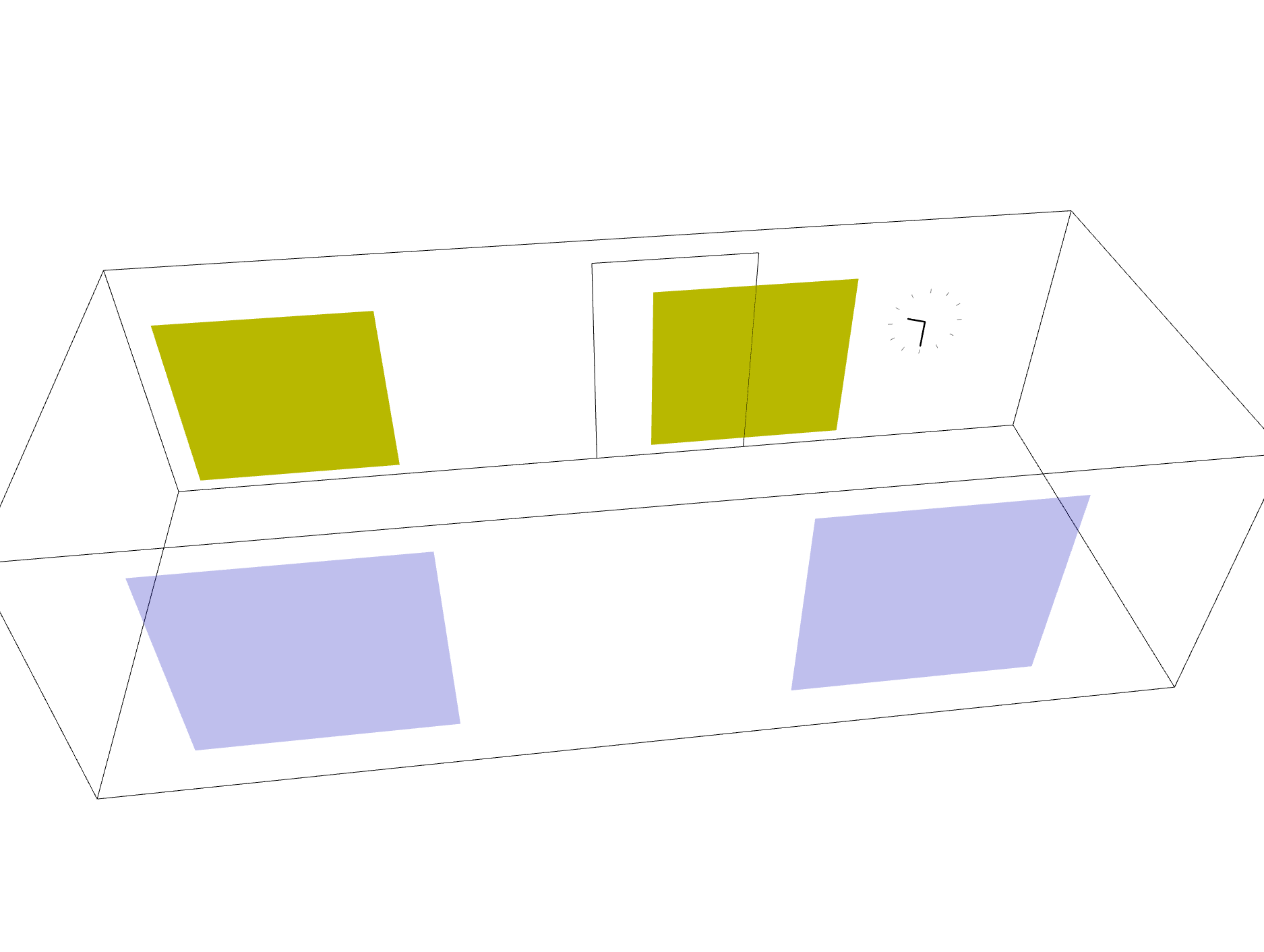
PS. Knowing how to program is good for something in this context. Here's a simulation I did last weekend of sun exposure in my new library (the largest and most important place in the house): https://webusers.imj-prg.fr/~harald.helfgott/simulcurie/21_6_2021.html (summer solstice) https://webusers.imj-prg.fr/~harald.helfgott/simulcurie/21_8_2021.html https://webusers.imj-prg.fr/~harald.helfgott/simulcurie/21_12_2021.html -
Combining an air-water heat pump and solar thermal
Garald replied to Garald's topic in Solar Thermal (ST)
a) I have no idea of who the radiator manufacturer was. b) Primitive solution: if only it were still cold outside, I suppose I could just run the radiators at full blast and see whether they overheat the place (that would be a good thing, since it would indicate a lower temperature might be sufficient). I suspect they will; the place was well-heated during the first visit in a cold day in January, and insulation was and is terrible, so, once I insulate the place well... (Of course sales in France take forever. My architect is hoping for the last cold wave of spring so that she can check for thermal bridges.) I'm in pure maths (not strictly speaking a science). Did a double degree in maths and computer science (which *really* is not a science) before doing my postgraduate studies in maths. I would like to believe I am not completely illiterate in physics, but I'm not quite sure that's true, and at any rate it depends on the subarea. I *think* I am a quick study in physics (well, you'd expect it it from someone in math, particularly analysis and allied areas) but that may just be Dunning-Kruger. -
Combining an air-water heat pump and solar thermal
Garald replied to Garald's topic in Solar Thermal (ST)
How *do* I calculate whether the existing radiators (used with the gas heater I will scrap) will work well with the heat pump? -
Combining an air-water heat pump and solar thermal
Garald replied to Garald's topic in Solar Thermal (ST)
Thanks. But what about the ecological costs of production? I was having a chat with a friend who was trying to convince me to install solar panels (but he was preaching to the converted). He was talking mainly about PV, and he mentioned that their weak point was that, once you took into account production footprint, they were only about as green as nuclear (the main conventional source of electricity in the area). Surely the production footprint of thermal panels must be low, as they are essentially just big, black flat tanks? Or am I being naive? -
Combining an air-water heat pump and solar thermal
Garald replied to Garald's topic in Solar Thermal (ST)
I should add that: a) the plan is to keep the old-style radiators in the heating system (because cost), not to install low-temperature heaters. b) we are talking about the Paris area, not a tropical desert. Hence my scratching my head as to how the temperature could ever get up to temp, at least during winter. -
Combining an air-water heat pump and solar thermal
Garald replied to Garald's topic in Solar Thermal (ST)
Thanks - I will need to learn about the terms that JohnMo used (immersion, etc.), as I am newbie - what would be a good resource? Here is what I am wondering (as someone with a background in pure science and no practical experience in this area). PV to heat involves two steps: solar power becomes electricity, which is then used to heat water. Solar Thermal involves just one step: solar power heats water. It seems completely counterintuitive (though not impossible) that the first process should be more efficient: it involves two steps. What is the efficiency of the two processes nowadays? (Also, when is the water ever up to temp? I may be eco-conscious, but I like hot showers!) -
I am about to start renovating my new place (which is most of an old rowhouse, attic included). Climate zone Cfb, latitude 49° N. I will almost certainly change the current heating source (an old gas-based water heater) for an air-to-water heat pump. Since the roof will probably be all available for my use (well, will need to talk about it the coop, but let us hope for the best), it seems logical to install solar. Obviously the energy from photovoltaic panels can be used for the heat pump (and other things), but wouldn't it be logical and efficient to use solar panels simply to heat water, which would then be heated further (at least in winter) by the heat pump? (That would be either in addition or instead of photovoltaic panels.) I imagine this sort of hybrid system must either - be very common or - not make any sense for some reason I am not seeing. It would be nice to get references in the first case, and a reason in the second one!
-
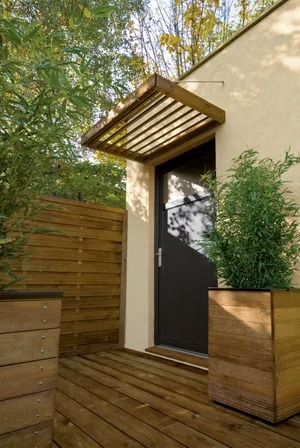
Yes, of course I will insulate, and yes, of course the entire idea is that the sun is higher in summer; the point of the simulation is to show the exact effect. See, e.g., https://webusers.imj-prg.fr/~harald.helfgott/simulcurie/21_6_2021.html https://webusers.imj-prg.fr/~harald.helfgott/simulcurie/21_12_2021.html for the difference at my place between the summer and winter solstices. (Thanks to the architect for taking the measurements.) To me, the entire idea of a roof overhang with slats is to let low-elevation sunrays in, even through the overhang. That is why I said that setting up one as the above seems completely backwards. This is even clearer in the following picture: I'd turn this around 180 degrees. Am I missing something?

-
Speaking of which, here is a picture of a brise-soleil - but obviously, if put on a window, I'd want to it install it the other way around, with the slabs going *inwards* as they go downwards.
-
I'm buying a new place in the northern hemisphere (49° N) with lots of southern (or rather SES) exposure. I'm putting quite a bit of thought (together with an architect) into how to improve its energy performance. I'm particularly interested in passive heating and cooling. I have actually just written a little simulation that lets me see where direct sunlight will fall at a particular date and time: That's my library (the largest and most important room) at 9:30am in the summer solstice. Further information: Climate zone Cfb. Heat waves during the summer are a thing; AC is not (and I have no interest in installing it). I'll keep the old radiators but exchange the gas heater for an air-water heat pump. So, we have (at least) two sets of problems: 1. Keeping cool during the summer If I understand correctly, once sunlight is in, it's in (except for the small fraction that would be reflect back out of the window - next to nothing during the summer, as I can see from the simulation, in that there will be no direct "bounce" back) and it will be eventually converted into heat. Other than pulling thick shutters all the way down and sitting in the dark (apparently the previous owners' solution), my best bet is some sort of Brise-Soleil or, alternatively, a retractable awning, no? (The idea, in a Brise-Soleil, would be to keep high-altitude-angle sun rays out, and let low-altitude-angle rays in.) Are there other possibilities? (A friend suggests something high-tech.) 2. Keeping warm during the winter. It can be rather cloudy during the winter, so it's unclear to me that I will be able to get much passive heating, but every bit is worth considering. Other than "don't have mirrors reflecting light right back out the windows", what would help? One think I can think of is installing reading nooks on the wall opposite the windows, where I would get direct light on winter mornings (see the snapshot above) but not during the summer. Perhaps one can design the surface of said nooks so that they can retain heat for a few hours and then release onto the occupier in the afternoon? What material/shape would be best for that? Anything else I am not think of? I am a newbie at this.