Garald
-
Posts
1113 -
Joined
-
Last visited
Everything posted by Garald
-
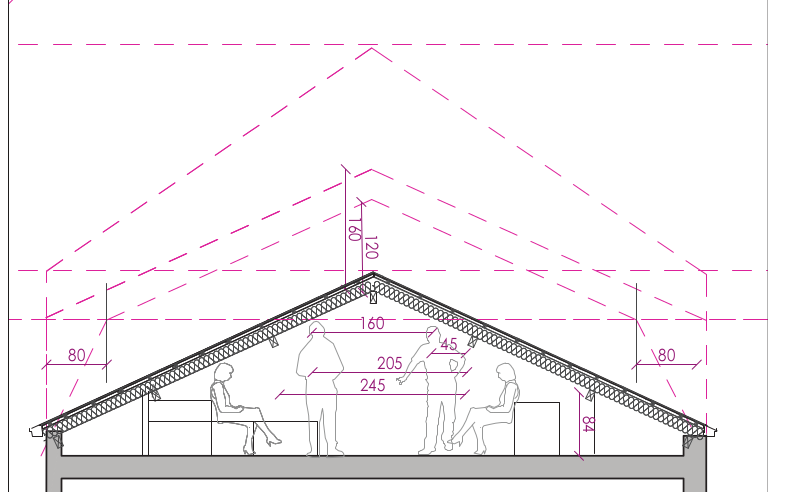
So, the contractor is willing to use cellulose-based insulation instead of rock-wool for the blow-in insulation of the combles perdus (the low-height end bits of the attic). 1. Does this product look all right? It's what the contractor proposes. https://www.soprema.fr/fr/product/isolation/toiture/toiture-en-pente/combles-perdus/univercell 2. The contractor and the architect assure me that I can view this as an investment, in that it won't be lost even if I raise the roof (provided I raise it following the lower red line in the diagram below; in the other two possibilities, we would not really be talking of roof-raising but of building an extra story). Does this make sense? (I suppose it will be lost if I follow one of the two other possibilities?)
-
Once you are at 6kVA, the unit charge does not change (as of now). Yes, when you go up 3kVA in the rating, you pay 35 eur per year. So, yes, going for 15kVA would not be exactly a financial tragedy, but I'm not sure of how I would use that much electricity. More to the point, as I've just found out, there may be a hard limit of 12kV on monophase (36kV on triphase): https://www.kelwatt.fr/guide/compteur/douze-kva I also learn from there that 70% of all residential properties in France have a 6kVA subscription. (3kVA is for bedsits.) Apparently, 12kVA is rare (op. cit.). I guess 12kVA makes sense? (Even then, I take this means I should not do my laundry while cooking for a large group of people in winter. I had never thought of it.)
-
Yet another instalment of the saga: renovation of a triplex (half of the ground-floor, all of the first floor and all of the attic of a house from 1930) in the Paris area. The previous owners had gas heating and also cooked with gas. They had a 6kVA electricity subscription. That will obviously not be enough now. While I'll go for either a 7kW or 8kW heat pump (meaning it will consume less than 3kW even at low temperatures, where its COP is far from best), the peak power that a standard induction stovetop can consume goes up to 7.4kW, and then of course there's the washer and the dryer (not to speak of lights and computers). Should I go for 9kVA or 12kVA? (I take 15kVA would be an extreme overcalculation?) One has to pay about 35 euros per year for each 3kVA by which one raises the limit; if there are other costs associated with a higher limite, I'm not aware of them. We are on monophasic.
-
My brother, and a framed picture of Bertrand Russell. Also: an ugly built-in bench.
-
What are the downsides of cellulose? (Its fire behavior when treated with boron salts (as is standard) seems reasonable - isn't it graded B? As for dampness, the rock-wool insulation put in by the owners from 10 years ago is a very striking demonstration of what can happen to rock wool when it's damp. I'll have to find a good solution for that in either case.) I know rock wool is much less of an issue than fiberglass, which is itself much, much less of an issue than asbestos, but (a touch of) asthma runs in the family, the bedrooms will be partly in the attic, and I'm not positive that things that are boxed in remain 100% boxed in when you have old construction (this is a house from 1930). I'm not anti-rock-wool, but, given that we managed to find a solution without it for the rest of the house, it seems like a bit of a pity to have to recur to it now.
-
[This is a very brief version of my rather long post from yesterday night, where I give much more context.] We have to insulate the low part of the rafters - the bit that is under 80cm ("combles perdus"). The contractor is proposing a rock-wool product: https://www.rockwool.com/fr/produits-et-applications/produits/combles-et-toitures-inclinees/combles-perdus/laine-de-roche-a-souffler/jetrock-2/ From what I'm reading now, there's an important alternative, applied in much the same way (i.e., by blowing it in): cellulose products, with boron salts as the fire retardant. An example: https://www.jrs.eu/jrs_en/fiber-solutions/bu-technical-applications/applications/insulation-cellulose/insulation-cellulose.php Questions: 0. Is blow-in insulation the way to go, in general? 1. What are the main factors for and against rock wool vs. cellulose? 2. Is the price point really similar? My architect seems to think that cellulose is more expensive. I can't find the price of the JRS product I've just referred to, but the following websites seem to claim that cellulose-based is actually less expensive: https://www.choisir.com/energie/articles/166828/ouate-de-cellulose-ou-laine-de-roche-quel-isolant-choisir https://conseils-thermiques.org/contenu/ouate-de-cellulose.php https://conseils-thermiques.org/contenu/laine-de-roche.php These links already contain a comparison and some useful data, but I thought I should ask here. (I am not using rock wool elsewhere.)
-
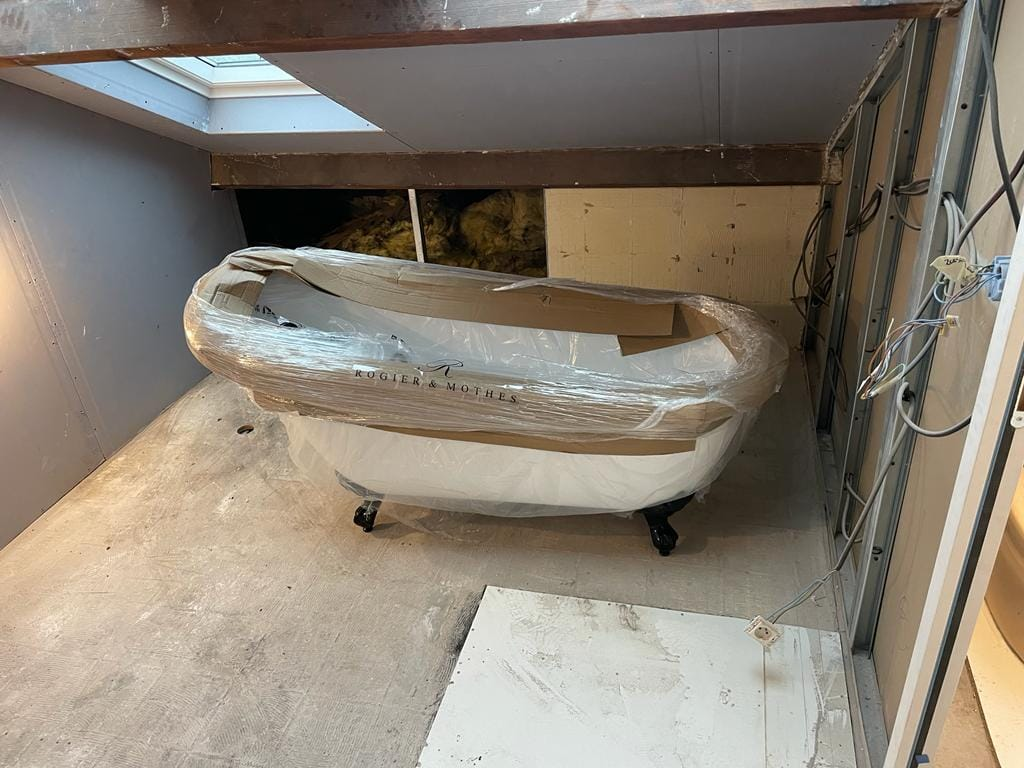
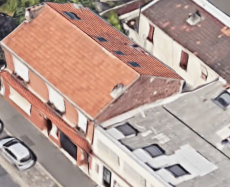
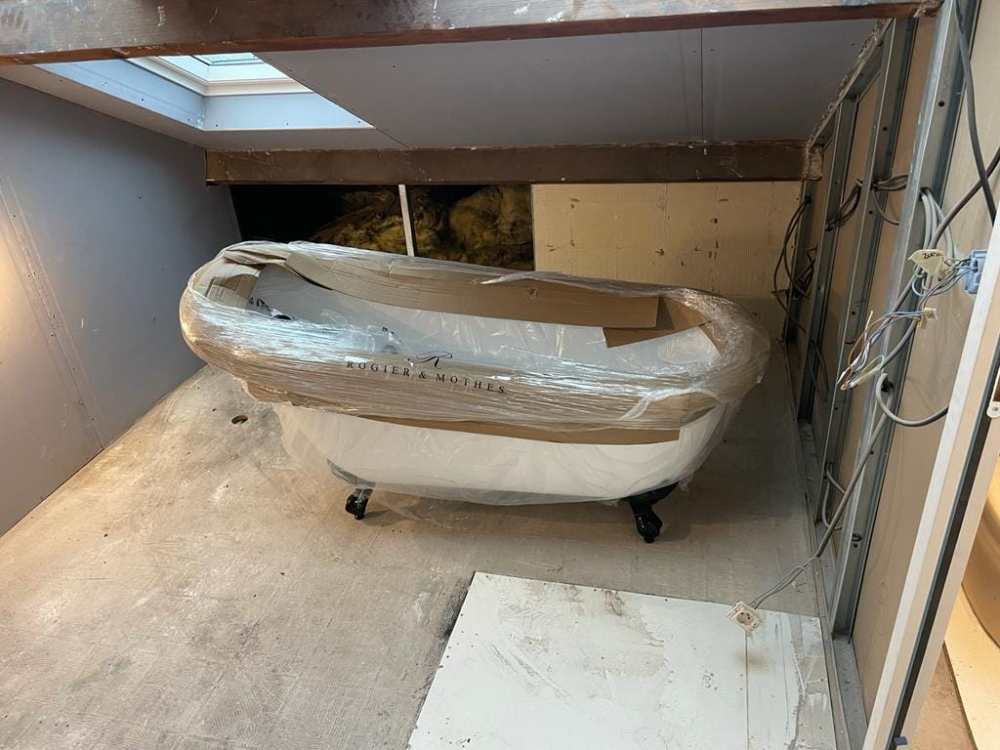
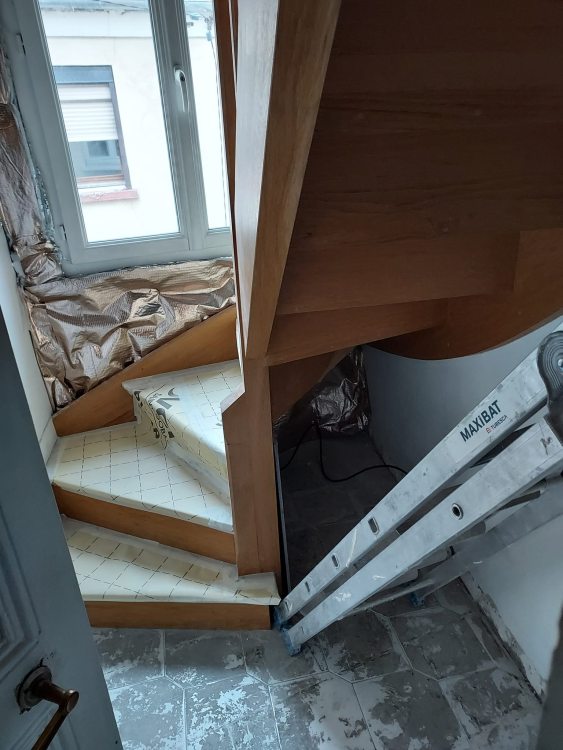
This chapter in the insulation saga: Originally, the plan was to (a) insulate the first floor and my part of the ground floor up to current standards or a bit beyond (estimated U = 0.23, once we count both the insulation and the walls as such), (b) make no radical changed in the attic, which was insulated some ten years ago - just fill out some gaps and replace some of the existing rock wool. However: - the staircase going up to the attic is a weakness. As you can see, the contractor has managed to insulate the short side of the stairwell in the same way that we've insulated the rest of the courtyard-facing wall (reflective material+cellulose based), but the long wall (2.25m) seemed at first impossible to isolate - not enough space. However, we just noticed that there's space behind the wall panel (about 5cm) and that behind that space there is... air. The lower part of the long wall adjoins the building next door, which may or may not be regularly heated, but the top part of the wall has nothing on the other side. (My house is the red one.) - the isolation in the attic turns out to be poor. On the gable walls, there a few centimetres of goodness knows what (well, my contractor and my architect know, but I either didn't ask or have forgotten). In the "combles perdus" (lost height) on the long sides, there is rock wool for the most part, but it's in poor condition. There are some voids that the contractor had agreed to fill. You can see this sort of thing behind my new bathtub: (You can also see that there is plenty of work left to be done.) --- Now, the question is what to fix and how. 1. The architect would apparently be happy leaving the long side of the staircase uninsulated. Now, that side is 2.25m long (more if you count the landing) and let us say that 2m of it lie above the neighbouring building (it may be a bit less on average, though it's more towards the middle of the gable walls). The brick walls are not particularly thick, and they date from 1930; let's say they have U = 2.2. Then, if we want to keep the stairwell at no less than 18C, and we are designing for an outside temperature of -2C, we are talking about a heat loss of at least 2.25*2*2.2*(18-(-2)) = 198W; compared to decent insulation (U=0.35, say), we are talking about a difference of 166W. The architect suggests just putting a small radiator there. Reason? The contractor estimates that the cost of insulating that wall properly (labor costs and so forth included, obvs) would be 2400eur. Let me do a back-of-the-envelope calculation (please check to see whether I have made an obvious mistake): assuming the heating is on half of the year, we are talking about 166*24*(365/2)/1000 = 727kWh, or that divided by the heat-pump's SCOP (about 3.5, say) if we actually manage to heat the stairwell entirely by means of a radiator. Let's say the radiators cover 70% of the heat loss, and the rest is electric heating. Then we are talking about 727kWh*(0.7/3.5+0.3) = 727/2 = about 364kWh per year, which, at 0.174eur/kwH, adds up to 63.3eur per year. In other words, it would take me 38 years to amortize the cost of insulating the staircase (probably less since energy prices won't stay constant, but still) . The architect is right (if the contractor's price can't be negotiated further, and she says she hasn't managed to). 2. Now, if we redid the entire insulation on the stairs _and_ the gable walls to the same standard as the rest of the house (U=0.23 for the most part - probably a bit worse on the staircase), and also redid the insulation on the combles perdus up to a reasonable but not sterling standard (see below from the contractor's suggestion), - the bill would be 5k eur, - the heat loss avoided would be on the order of 166W + 550W taking into account only the gable side walls (assuming the current insulation on the gable walls is negligible); if we also consider what we would gain from a better insulation of the combles perdus (compared to just filling out some gaps in a perfunctory fashion), we are probably at about 166 + 800W, at least. Thus, on top of the 63eur mentioned above, we would be saving 800*24*(365/2)/(SCOP*1000) = about 1000kwH per year, meaning 174eur per year, or about 240eur/year in total; the costs would then be amortized in about 21 years, which is... not great, but not terrible. Worth considering. ---------- On the other hand: (a) if I ever have money again, it would make sense for me to invest to raise the roof. The contractor thinks the work on the stair side and the gable walls would not be lost; the architect is not sure about the latter. Somewhat bafflingly, the architect tells me that the insulation of the combles perdus would not be lost if I raised the roof, at least not if I had it raised in a parallel way she has suggested - the lower red dashed line in the following: I 'll have to press her for ideas on how that would work, as I really don't see how that could be kept. The depth and height would not be the same. (b) While the contractor is proposing using the same insulation system that we have used on the courtyard-facing wall and the kitchen side wall (reflective + cellulose), he is suggesting something else for the combles perdus (won't someone tell me what the technical term is in English?): https://www.rockwool.com/syssiteassets/rw-f/telechargements/guides-de-pose-et-mise-en-oeuvre/combles-perdus/rockwool_mise_en_oeuvre_jetrock_2_combles_perdus_202001.pdf Reasons in favor: it's apparently cheap, and made for this purpose. Reasons against: a) well, we didn't use any rock-wool elsewhere - we have kept the rock-wool in the roof, and were going to leave the rockwool on the c....s p...s , with a mind to replacing them when and if I have the roof raised. If the insulation we'll put here in the c..s p...s can really be conserved if the roof is ever raised, then, does it make sense to go cheap? b) not very impressive lambda, though perhaps that doesn't matter because of all the depth we've got (c) one of the reasons we've avoided rock-wool is that it can be an irritant; its long-term effects are not fully known. And yet we are going to have it loose on the sides, separated from bedrooms by just a panel? If there's an opening somewhere, particles will go through. What do you think? What are some alternatives at a similar price-point? There are of course things like cork, but that's expensive. (A quick Internet search gives me: https://conseils-thermiques.org/contenu/ouate-de-cellulose.php . Does this sound like a plausible alternative?)
-
Right, as my architect says, PIR is a bit better than PUR. (This is a pun in French - "pire" means "worse". In fact, it also means "worst". Kind of makes you wonder what the PIR marketing folk were thinking") Still, both products would be at least slightly anxiety-inducing in a tiny corner staircase that is the only way to leave an attic where people work and sleep. (I suppose you can still jump from a second floor, but I definitely wouldn't recommend it under usual circumstances - knew somebody who did that while drunk - broke his jaw into three chunks. Actually, he fell from a first-floor balcony to a basement-flat landing while attempting to jump from one balcony to another, but you get the idea. Of course, if had been in a fire, that would have been a different story.)
-
We decided against PIR some time ago, as we couldn't get solid assurances about (a) toxic fumes when not on fire (b) toxic fumes when on fire. I think PUR would be roughly the same (though gypsum composite means it would be less likely to catch fire, presumably).
-
Grzegorz the Contractor just poked into the wall panel. It's an empty space of 4 to 5cm! Beyond that, there is the external wall, which may actually be single-width masonry, not double-width - the architect hasn't confirmed. Now the question is how to fill those 4 to 5cm. They are probably full of old rock wool at the level of the attic, but by the staircase they really are empty.
-
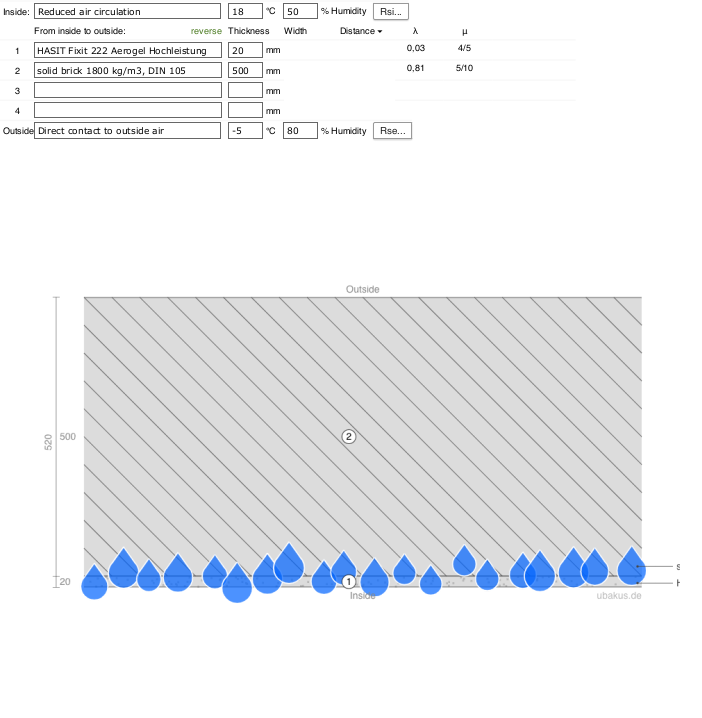
(Of course, the average temperature in Paris during winter months is around 3C, not -5C. Does this mean I should not worry?)
-
But when it's -5 C outside, I do get condensation: What to do?
-
That might have not been a bad idea, but we are so far along that my architect will quite possibly murder me if I suggest this. At any rate, we are going for an integrated heat pump+water tank model, and there isn't enough space for the combination there. (Also, even the internal elements of a heat pump produce some noise, and I prefer not to have them right there.)
-
I know. We won't be able to bring that piece of walls up to norms now; we are in harm-minimization mode.
-
[No, I won't use it myself, since I just got chided with "there's the lab and then there's practice" by my architect for mentioning Aerogel panels. I'm still trying to make her reconsider Aerogel plaster...] A friend was telling me about phase change insulation. Apparently this has been discussed for years, but fire safety is or was a problem - and now there's a product in the market with a fire safety rating. https://www.savepurenergy.com/?fbclid=IwAR0f2yozWkhglUGBYY1YjUvjWF8eI_gHRDkKPVS_8en844GMFiCbCTdXSKc Just out of curiosity, what do people think of this?
-
Yes, we did (Fixit, in fact). The architect said it does not have a good performance for the tiny space we have to work with, but that may just mean it's not up to norms. We are not going to be up to norms on that wall anyhow - we are just trying to get by. Good question. Let me ask.
-
Is this the sort of thing I should be looking into? It seems meant for industrial use. https://local.armacell.com/fileadmin/cms/corporate/en/onepager_armagel/Downloads/technical-datasheet/ArmaGelHT_Technical_Datasheet_French.pdf
-
Right, I know, I just reminded the architect of that. .... and yes, I've explained to her that a computer is basically a space heater that computes.
-
The problem with vacuum products is that one needs to protect them with a layer we don't have the space for. Besides, one definitely can't cut those to size, so they are not great for irregularly shaped spaces.
-
So, where can I get aerospace blankets cut to size, for a parallelogram that is about 2m tall and 2.5m wide? (At 5m^2, the cost will be non-trivial, so this better work.) And is it really not a good idea with positive-input ventilation?
-
20 degrees (= 18C - (-2)C). That's the old estimate, before I realised that Grzegorz/Grégoire had sneakily managed to insulate the short wall. We can also insulate under the staircase, though that's less important, since as you can see that adjoins a neighbouring building (which may or may not be heated regularly). Let me redo the computations: I was going for average height 3.8, total length of walls 3.5, and a U value of 2.11, with a U value of 1.4 for the windows (this is probably too low for this double-glazed windows - I should set this to a higher value for the double glazing that has remained from the previous renovation, and to the manufacturer's value (probably lower than 1.4) for the new double-glazing). I was getting about 650W, counting a ventilation loss of 41W and a roof loss of 30W. Let us assume the short wall to be properly insulated now (not sure the same thickness was applied as elsewhere, but let us say), and assume that the first meter or so of the long wall adjoins a properly heated space (not sure it's always properly heated, but then we could in fact insulate under the stairs, and at any rate it looks like a bit more than 1m). Also, the window is a bit smaller than I thought - it can't be more than 0.8*2 = 1.6m^2. The average height of the long wall is really at most 3+1.8/2 = 3.9, from which we subtract 1m. The long wall is 2.45m long. Then we have, assuming 2.20 for the window and 0.23 for the insulated part: (3*1.3-1.6)*0.23+1.6*2.20+(3.9-1)*2.45*2.11 = 19.040.. So, we really have a heat loss of 19.041*20 = about 380W, which once you add ventilation loss and roof loss, ends up being more like 450W. About 300W of it comes from the long wall.
-
There's another window up to a certain height, and then it stops: (Mine is the red-brick building.) At any rate, the architect says (I translate, summarise and paraphrase): *The fact that we have positive-input ventilation (PIV) and [thus] have hot fresh air means that the aerogel proposition is not really suitable for our case; [NB - I didn't quite understand why this is a reason] * Aerogel plaster does not have a good enough R; * Aerogel plaque is too risky for the workers (the resulting dust is very much an irritant and we don't know its toxicity). Its an option only if it comes precut to the exact dimensions. She says she's already thought of all options (displacing the staircase, insulating from outside, from the inside, with different materials...). In the end, she proposes two options: - "feutre de laine tendu" [NB: this is literally "stretched wool felt" - what would the technical term be?], which insulates and perspires, but is also expensive; - simply installing a small portable electric heater in that space in case of great cold.

-
The German book on heat-pumps I'm reading right now suggests installing closed stoves inside fireplaces (with the flue going up the chimney, obvs) as an emergemcy heating system. Can more experienced users tell me whether this sounds like a good idea?
-
Then the question arises: why do I have a window? (The answer is actually clear in this case: since the cat toilet will be here, I will presumablebe opening this window briefly on a daily basis! Because of PIV, that should help with humidity without being a total disaster as far as heat is concerned, no?)
-
How would I do that?