Garald
-
Posts
1113 -
Joined
-
Last visited
Everything posted by Garald
-
(I'm still trying to figure out what the "thermodynamic" water heater would be feeding off. We will have PIV, so it wouldn't be feeding off the PIV. Ambient temperature in the garage - well, there's no reason to have a warm garage, but wouldn't the garage eventually become so cold that the water heater would become inefficient, unless it is drawing heat from the rest of the house - which it will do, but really slowly (since we are insulating, obviously) so that the garage would become colder until the temperature difference with the house is large enough that it is sucking heat from the house rapidly enough? In the end, the architect's original drawing made more sense, in that there would have been a flow of air from the outside, and so the garage would never have got colder than the outside world. 700W is not so little: it's like a fairly large negative radiator. I wonder why anybody would ever have one of these devices running in a heated room. Also, is the installer's legit about noises in summer legit? You'd think the heat-pump would then be extremely efficient, and, being a contemporary heat pump, would modulate down far enough that it would be very quiet. Or am I too much of an optimist?)
-
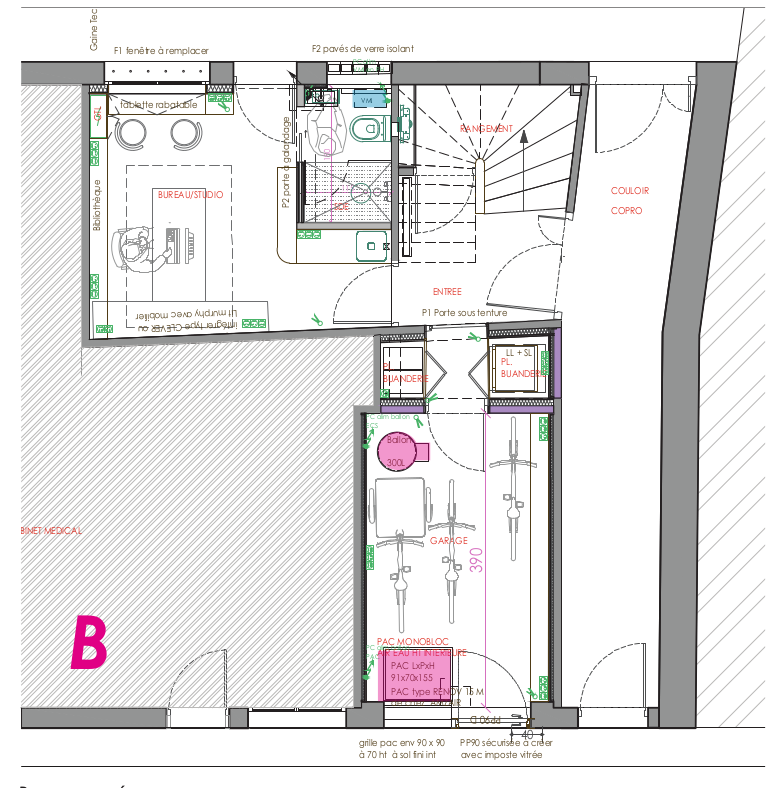
[Another chapter in the house saga!] So, two separate installers visited, agreed to take on the job and sent us quotes! Exciting. Company A works exclusively with Atlantic (due to some exclusivity contract, presumably). 5.0/5.0 rating in Google, with 44 reviews (but many must come from their experience with AC). Company B works with whatever it wants. 4.5/5.0 rating in Google, 12 reviews. They agree not only to install the external unit in the courtyard (I've got a signed agreement from the coop) but also to give the green light to the use of the heat-pump to do pre-heating and pre-cooling in the PIV (Hydro' R system). They seem mildly interested, in fact, since their experience with other cooling uses (fan-coil units?) has been disappointing, apparently. Company A is sending us what looks like a reasonable quote (ca. 15k EUR including taxes) for providing and installing an Atlantic Alféa Extensa DUO A.I. 10 R32 (actual power: 9kW). Its SCOP 35C/55 C is 4,53 / 3,33. Its external unit produces 62dB - bit higher than I was aiming for. (Most companies insist on overdimensioning, presumably to avoid liability. Heat loss according to our worksheet is only 5,3kW, but try to convince installers with their own software of that.) Company B offered to match the first company's quote (but didn't really; it offers an older, less effective, noisier Atlantic model for just 500 eur less). However, the installer said he preferred a different possibility. He said that (a) Daikin, Mitsubishi and Panasonic were high-range, and Atlantic only mid-range; (b) Panasonic was too focused on performance without improving noise levels - not great for my case - and Mitsubishi was hard to order and find parts for in France; Daikin, he said, is a world leader; it would be wise to spend a bit more on a Daikin; (c) since I do have a small garage and no intention of having a car, it would make more sense to have a hot-water tank with its own heat-pump ("thermodynamique") in the garage, feeding off the ambient heat in the garage. The internal unit of the main heat pump could go in the garage or in the cabinet of sorts we'd reserved for it (I pointed out having a machine in a place where the heat it inevitably produced would contribute to heating the place might be a good idea; besides, the garage will be my bike shed and storage space, so I can't take infinite space from it). He pointed out that an advantage of having the hot-water tank be separate is that the main heat-pump fan in the courtyard would not bother the neighbors during the summer, when their windows are open. (I'd still want to run it to provide a bit of cooling; I wonder whether it modulates nicely?) As you can see, there are really two different issues here. a. Daikin vs Atlantic (vs Mitsubishi) Do people agree with the general "Daikin is better than Atlantic" vibe? There are threads online supporting this, but they are from 2015 and before. The technical specifications of the Atlantic Alféa Extensa DUO A.I. 10 R32 unit seem to match very closely those of Daikin or Mitsubishi products. In fact, the Daikin 11kW device Company B proposes would produce 64dB, and those additional 2dB give me pause (they could put me above the regulation limits - and I had told the nice people at the coop I would get either Saunier-Duval (60dB) or something equivalent; 4dB is already a clearly perceptible difference). So, on the key parameter, courtyard noise, Atlantic seems to have an edge. (Is produced sound pressure what I should be looking at? All companies also give optimistic estimates of how loud the heat pump will be at 5m; it always seems to be 40dB.) b. Integrated hot-water unit or independent water heater with its own heat-pump Company B proposes: CHAUFFE-EAU THERMODYNAMIQUE THALEOS - PERFORMER 2 - 200L (for ca. 2k EUR) - Capacity : 200l - COP at 7°C : 2,78 - RENDEMENT ENERGETIQUE Eta wh : 116 % Now, Atlantic itself produces "thermodynamic" water heaters (which, if I understand correctly, have their own tiny heat pump somewhere inside) https://www.atlantic-comfort.com/Water-Heaters/Heat-pump-water-heaters/Explorer It seems to be a very similar product (200L, COP at 7C of 2,8 (that's probably as cold as the garage will ever get; it will have a solid wooden door), etc.). For comparison, the heat-pump has a domestic-hot-water COP of 3,1 (at what outside temperature, I do not know). It will produce a non-trivial amount of noise (the technical documentation says 53dB both for Thaleos and for Atlantic, and Thaleos specifies it was measured 2m away - this sounds about as noisy as the external unit) - we would have to insulate the ceiling of the garage very well (it's just under my library/dining room/music room). It would also inevitably cool the garage, just not very much (neither product absorbs more than 700W from ambient air). My summary: - it is something that would be interesting mainly to minimize sonic annoyance to the neighbors in summer, at the possible cost of causing year-round sonic disturbances for me. - since its heat pump is at a much smaller scale than the main heat pump, this wouldn't create some cold-vortex effect in the garage that I'd have to worry about. ------------- An old drawing of my architect's, showing what things would more or less look like if I got a separate hot-water heater and installed the PAC internal unit in the garage as well (ignore the garage door drawing - we are getting a solid wooden door). What is your take and your verdict?
-
What sort of material should I ask to be put inside the lining?
-
How does Karndean compare to Purline (ecuran), say?
-
Still trying to find an installer who will agree to an exterior installation (thpugh there are some good initial signs). On the roof - yes, I agree, but that's something the architect and I discussed in June, and she freaked out when I brought that up six weeks ago.
-
Also found one that works with Atlantic, but that's not so quiet (the external unit produces 60dB).
-
Was just on the phone with another installer (one who works with Mitsubishi). He may be able to do it, but, even though I've told him that total heat loss comes out at 5,3kW, he wants to install a 12kW system. I've started to try to convince him otherwise, but I suppose beggars can't be choosers. Still, as I was telling him, that compounds the other problem: the difference between the 8kW and the 12kW in the Mitsubishi models is 4dB (he said), and that, I told him, is actually a big difference (10^0.4 > 2.5, i.e., one is at least 2.5 times louder than the other).
-
This is an urban area, so major changes in outer appearance are very iffy. We'll have to ask for planning permission even for the change to the door, installing a grille, etc. The big problem is that (at least here in France) installers are still very concerned about noise, due to liability. The ideal thing from many points of view would really be to install a quiet (Saunier-Duval/Vaillant: much quieter than Aquarea) heat-pump in the back courtyard. However, we just got a second refusal from an installer, as they are concerned that they would be liable if neighbors complained. It is really a pity, since we are most likely going to get authorisation from the coop this Saturday to install a heat-pump in the courtyard.
-
Well, we have something more or less like that, in that the door between the garage Well, we have something more or less like that, in that the door between the garage and the laundry ("buanderie") is a secure metal door; thus, the entire garage is pretty much a larger version of what you have in mind. Is that not enough? Is that a bad idea for some other reason?
-
Yes, I was suggesting precisely to have 2 transfer grilles as you say. But what sort of partition section and "wind-tunnel" do you have in mind? Can you draw a sketch?
-
Paris is pretty much London up to a first-order approximation. I still need to be able to access the garage from the street (pretty much as in the plan above), since it will become a bike shed.
-
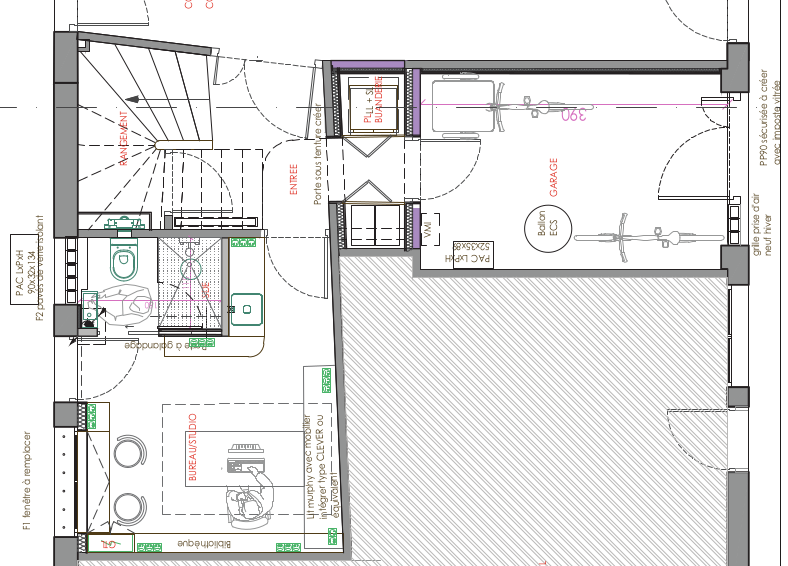
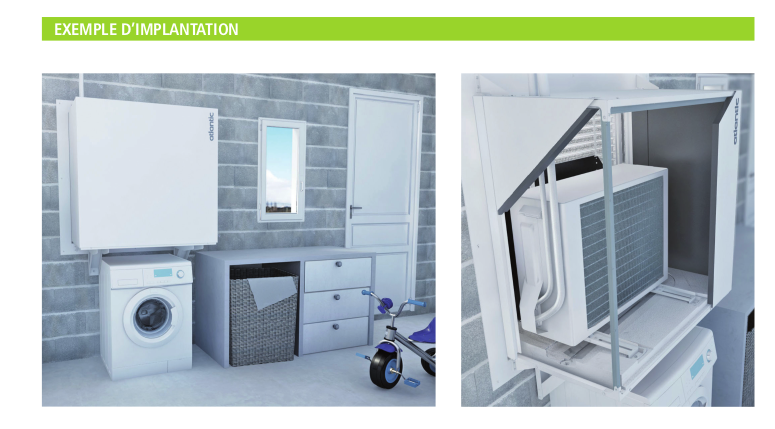
So, yet further heat-pump adventures. Last week, a technician visited - he seemed very reasonable. Unfortunately, we just got the same answer that we got a little earlier from another installer: his company will not install the external unit on the shared courtyard, to avoid liability due to noise. We could try to find yet another installer (as the company suggests) but we are already seeing a pattern here. It may be wise to reexamine our choices. We can't of course have a setup where input air and output air mix indoors - that's what the architect had in mind in October and November, but that is madness (as became clear as soon as I got precise information from her and I posted it here). The question is then whether we can have a setup where the heat-pump takes air directly from the exterior, and outputs colder air (in winter) to the interior. It seems wisest from many points of view to do this in the (small) garage (which is gradually becoming a bike shed/ex-garage, anyhow), which faces the street, rather than in some sort of closet facing the courtyard, as in the doomed October-November plan. It would be something more or less like this (from her old plans): Now, the version of the plan here shows an Amzair Monobloc (https://www.amzair.eu/nos-pompes-a-chaleur/pompe-a-chaleur-optim_duo-2/) which is not ideal from several perspectives (very expensive, COP not among the best, not among the quietest heat pumps - since the garage faces the street, that's no longer a concern for the neighbors, but it may be a concern for me, since my main room (library/piano room/...) sits right above the garage). The fact that it is a monobloc is also no advantage - it might make hooking it up to the VMI more complicated (should consult the architect again on that one). One alternative is to have a split heat-pump, and have the "outside" element attached to the opening of the garage, much as the above. That is possible, and in fact there is a (most likely overpriced) kit in the market for doing so: https://www.atlantic.fr/Chauffer-le-logement/Pompe-a-chaleur/Aerothermie/Aerothermie-Air-Eau/Wall-In As it says, it works up to 8kW, but that should be more than enough - the spreadsheet gives me a total heat loss of 5.3kW at outside temperature = -2C. Questions: (a) Should this work well? The input would come directly from the street (presumably as high up from the ground as possible), the output would go into the garage (which would presumably have to have a ventilation grille further down to allow cold air to come out, even though that's not shown on the website; in fact I'm having a hard time seeing where the air goes out of the box). The garage would presumably be very cold, so we would have to insulate the garage well (heat and sound), on the ceiling and on the "upper" and "left" walls of the garage on the plan (my laundry and the medical cabinet next door, respectively). Is performance likely to be affected? (b) This is a proprietary system fitted to work with the company's (Atlantic) own products. The technical specifications for the Alfea Extensa 8 R32 do not seem bad (https://idealheating.com/new-build/products/alfea-extensa-a-i-r32), though they do not seem to indicate how much indoors noise the unit produces when fitted in with the proprietary system. (I'd have to see as the total cost - notice it does not come with a hot water tank). At the same time, it would seem logical that there should be products that work with other heat pumps, including ones that are particularly quiet (Saunier-Duval aka Vaillant, for instance, or Mitsubishi Zubadan). Are there any? Thoughts?


-
Well, in any event, I went for bamboo flooring. No UFH - rather, radiators (which will now be run at 45 C). Good insulation, though (I'd say): the kitchen is about a common corridor, and we went and insulated its ceiling with a good, thick layer of cellulose-based insulation.
-
Ceramic tiles now come with a slippery rating, no? Is this an EU-only thing?
-
So, do you think something like this would combine well with the Passivhaus catflap? Would the combination give substantial sound protection? https://www.amazon.fr/Tunnel-Pliable-Grottes-Chatons-Cochons/dp/B09PBPK4WX/ref=d_pd_sbs_sccl_2_2/259-7799006-4956820?pd_rd_w=ue0hq&content-id=amzn1.sym.5dff3cad-8488-40d8-8f9f-5e2c7e20e67a&pf_rd_p=5dff3cad-8488-40d8-8f9f-5e2c7e20e67a&pf_rd_r=CK9CTTHKWX4ZK4Y40J41&pd_rd_wg=0n4nC&pd_rd_r=0608b7a4-ec8f-4c2c-9d4e-10710ddaa2a9&pd_rd_i=B09PBPK4WX&th=1
-
Someone on diy.stackexchange.com proposes a lined cat portico tunnel as the solution to combining sound insulation needs and cat needs. I had fantasized about the same. Would that really work (maybe in combination with the Passivhaus cat flap)? Is there anything like that being produced? I don't want to have to pay a fortune to a carpenter, but perhaps there's something that exists that can be hacked. The inside of the tunnel should probably be covered in washable material - the cat will often use the tunnel right after using the cat toilet.
-
Opposing needs: soundproofing a door, constructing a cat door!
Garald replied to Garald's topic in Sound Insulation
Would the following help? https://www.thepetflap.com/passivhaus-pet-door/ Can it be complemented with other measures? (A tunnel with drapes, say?) -
How to reduce noise from a small under-the-counter fridge?
Garald replied to Garald's topic in Kitchen & Household Appliances
The principle used by the fridge I linked to seems to be this one: https://en.m.wikipedia.org/wiki/Thermoelectric_cooling -
How to reduce noise from a small under-the-counter fridge?
Garald replied to Garald's topic in Kitchen & Household Appliances
Can you tell us the model? -
Opposing needs: soundproofing a door, constructing a cat door!
Garald replied to Garald's topic in Sound Insulation
That looks like a heavy thing to be put on an outside door. -
How to reduce noise from a small under-the-counter fridge?
Garald replied to Garald's topic in Kitchen & Household Appliances
(Is that the same as what some manufacturers call "thermoelectric cooling"?) Yes, that's the rub, they seem to use more energy than much larger under-the-counter fridges. The one you linked to (40L) uses 162kWh/year (and says it is the quietest in the market), the one I linked to uses 125kWh/year (it is 30L as opposed to 40L; funny how the vendor sells it as "pour les célibataires"). The best energy rating I've been able to find is F, for this one: https://www.amazon.de/-/en/gp/product/B07L6D9F1J/ref=ask_ql_qh_dp_hza?th=1 There also seem to be some very quiet (23dB) compressor fridges, but the one I've found (Klarstein Happy Hour minibar) seems to have even worse energy consumption, to judge from comments online (I can't even seem to get precise energy-consumption information from the manufacturer's website - surely a bad sign). -
How to reduce noise from a small under-the-counter fridge?
Garald replied to Garald's topic in Kitchen & Household Appliances
Example? (Google hasn't helped me.) You mean, one like this one? https://m.darty.com/m/achat/gros_electromenager/refrigerateurs/refrigerateur_bar/klarstein_refrigerateur_a_boissons_silent_cool_mini_frigo_mini_bar_silencieux_30l_classe_a_noir__MK619385856.html?dartycid=sea_shopping-marketplace-online_MP-PLA-Occasion-GEM_New_adgroup_GEM-Occasion&gclid=Cj0KCQiAt66eBhCnARIsAKf3ZNEO5Y5T7qiCroh8osYtOIQGkqSg-VasQgfMel4ujaOK39wIxx6yiScaAhotEALw_wcB&esl-k=sem-google|ng|c630963354220|m|kpla1789486426955|p|t|dm|a142860815236|g18718261849&gclsrc=aw.ds&ofmp=91691492 Odd how it uses more power than many fridges with twice its height and several times its volume - is that a common feature? -
(still a part of the house-renovation saga...) There is a space in the ground-floor (not so small: about 14m²; former laundry room + a broken toilet I bought from the coop) that we are turning into an independent studio of sorts; it will be my GF's home office when she is around, and my parents' room when they visit. Of course we'd like to install a (tiny) kitchenette, but we'd like it to be quiet. It is not hard to find an under-the-counter fridge having a noise level of 38dB or even 36dB in the technical specifications. (As to whether those are necessarily correct or tell the full story, well...) What can one do in order to bring the noise level further down, without, of course, keeping the fridge from working? One obviously can't put the fridge in an airtight enclosure. The fridge's back will go against an internal wall, with a WC/shower room on the other side.
-
There is a door we would like to soundproof, or at least insulate phonically to the extent possible: it leads to a narrow open staircase leading to the attic, which is currently a somewhat creaky place, and will probably remain so to some small extent, in spite of our determined efforts. The problem is that we also wish to install a cat door in the lower part of the doors. My architect says one cannot do both. Are there such a thing as a cat door that does not make sound insulation of the human door around it pointless?
-
Just outside Paris. The door was installed either by the previous owners or (more likely) the ones before them. I will ask.