


Garald
-
Posts
1113 -
Joined
-
Last visited
Everything posted by Garald
-
The main source of bother is heavy vehicles (buses mostly) but also motorcycles. One can't hear people talk on the street (where one can from the kitchen, which also got new, supposedly high-grade double-glazing, but where the insulation is much thinner - a few cm of BioFib + some cm of reflective insulation). So, does backing up the bookcases with cork make sense? Perhaps one continuous sheet? Or should I just get a solid wooden back for the bookcases (as opposed to some thin IKEA-style panel)? Or does it not matter much at all?
-
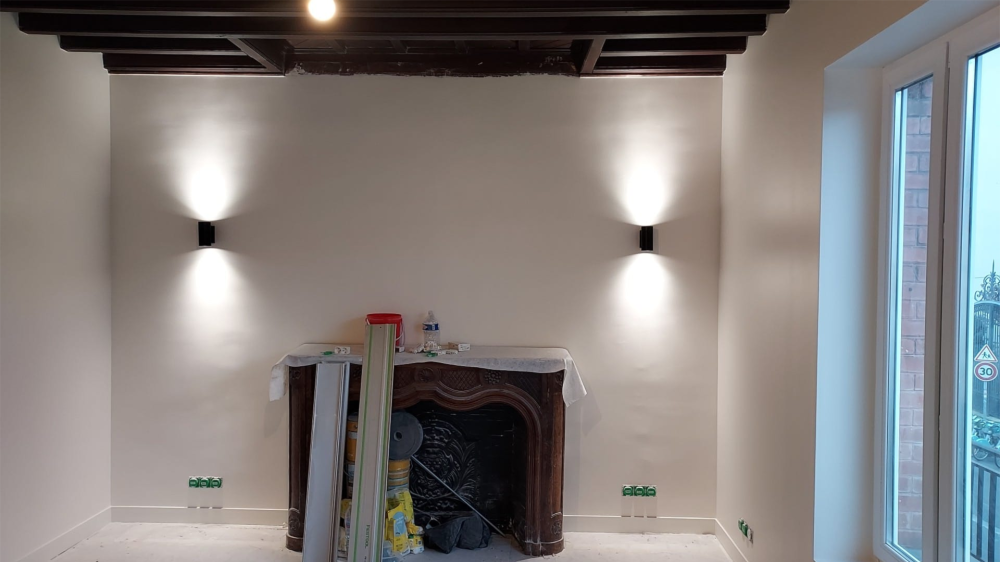
As some of you here may remember, what will be my library/piano room (the main room of the house, really) overlooks a fairly noisy two-way road. Newer double-glazing has helped, as has the heat insulation we chose (air + 14.5cm of BioFib Trio (hemp+cotton+linen) + air + 18mm plaster), but it's still not quite what I was hoping for. Now, that wall will have built-in bookcases - really my last line of defense at this point. What should I do in order to maximize how much the bookcases will help with sound reduction? 1. What material to use on the back? (Cork behind wood maybe?) 2. I take the further up the bookcases go, the better, but I can't go flush against the ceiling, as there is moulding (which I am very happy the workers managed to preserve). (Also, does it make sense to add sound-reduction drapes? I will have shutters on the outside. I'm a bit concerned about drapes gathering dust (I have allergies).) I'm not there right now, so this is the best I can do: It's the wall with the window here - it's on the double room's long side. The bookcases should go along the entire length. I am a little concerned that the contractor may have put the lights a little too close to the wall, though it is true that I am planning on rather shallow bookcases (about 22 or 23cm on the inside).
-
Work is proceeding, as in, the contractor is working and I'm keeping tabs on him, while the architect is seemingly in outer space. In particular, the PIV unit has been installed. Now the contractor tells me that the PIV technician told him that he'll need to file down the bottoms of all inside doors, so that air will circulate. The contractor points out that that will obviously scuttle any ideas we had towards sound insulation within the apartment (other than in the tiny laundry, presumably, which is one of the places where sound insulation is needed the most). Is this correct? Is there any way to deal with it?
-
Tiling the courtyard: having cement/concrete tiles made to order?
Garald replied to Garald's topic in Floor Tiles & Tiling
Is stoneware an option? -
Wind from ASHP on the neighbor's door - barrier?
Garald replied to Garald's topic in Air Source Heat Pumps (ASHP)
Just talked to the contractor directly. (I was getting his comments filtered through the architect, who has some sort of instinctive anti-heat-pump biased, besides almost messing things up majorly, as you may recall from a previous thread.) He says: - the heat-pump is very quiet (he sounded very pleasantly surprised) - the radiators are working correctly and heating up the place (well, spring has started and temperatures are staying above 0 C, so this is not exactly a test by fire (or ice)) - as for the wind, let's wait until some neighbor complains, and if that happens, we'll figure out something. Mounting it up the wall would surely decrease air intake, unless it's set up orthogonally or at the end of some sort of long protruding arm! If I had an easily accessible flat roof, then of course we would have put it up the roof. Not sure why it wasn't installed at a 90 degree angle. The only reason I can think of is "not creating a wind tunnel with dustbins in the input or output". I got permission to move said dustbins, but I can't think of a permutation that wouldn't have them getting in the way. -
Wind from ASHP on the neighbor's door - barrier?
Garald replied to Garald's topic in Air Source Heat Pumps (ASHP)
Just talked to the contractor directly. (I was getting his comments filtered through the architect, who has some sort of instinctive anti-heat-pump biased, besides almost messing things up majorly, as you may recall from a previous thread.) He says: - the heat-pump is very quiet (he sounded very pleasantly surprised) - the radiators are working correctly and heating up the place (well, spring has started and temperatures are staying above 0 C, so this is not exactly a test by fire (or ice)) - as for the wind, let's wait until some neighbor complains, and if that happens, we'll figure out something. If I had an easily accessible flat roof, then of course we would have put it up the roof. -
Wind from ASHP on the neighbor's door - barrier?
Garald replied to Garald's topic in Air Source Heat Pumps (ASHP)
Right, this seems so evident that I wonder why it wasn't done. I was trying to get to my head contractor today, without success. Of course he'll hate me when I suggest this, since apparently he stayed up until 9:30pm working on this with the heat-pump installer (that's a late hour for non-academics, or so I am told). -
Wind from ASHP on the neighbor's door - barrier?
Garald replied to Garald's topic in Air Source Heat Pumps (ASHP)
But how can efficiency be affected as *little* as they show once the unit is covered up? -
Wind from ASHP on the neighbor's door - barrier?
Garald replied to Garald's topic in Air Source Heat Pumps (ASHP)
But the result shown in the video is that a fence doesn't bring efficiency down perceptibly, even though one can see smoke recirculating! -
Wind from ASHP on the neighbor's door - barrier?
Garald replied to Garald's topic in Air Source Heat Pumps (ASHP)
(And yes, the door and all the windows you see in the picture (including the one that hasn't been set yet) are all mine.) -
Wind from ASHP on the neighbor's door - barrier?
Garald replied to Garald's topic in Air Source Heat Pumps (ASHP)
What about the ideas given here? Good or bad? https://www.decoclim.fr/content/27-comment-cacher-sa-pompe-a-chaleur-idees-solutions-conseils-et-diy -
Wind from ASHP on the neighbor's door - barrier?
Garald replied to Garald's topic in Air Source Heat Pumps (ASHP)
... so? The point being that we have to be very careful not to diminish the windspeed? I agree of course, but what would be a good distance? -
Should the shed (home of the heater) have its own radiator?
Garald replied to Garald's topic in Central Heating (Radiators)
So the answer is: - wait until it is a problem - if it is ever a problem, put a conventional heater in front of it at the worst of times, and insulate the door better? (And/or the wall with the unheated corridor, but I doubt that the corridor will ever get cold enough for the internal unit to stop operating. What is the minimal temperature of these things?) I'd rather get all work done, while the workers are still around, though. -
Wind from ASHP on the neighbor's door - barrier?
Garald replied to Garald's topic in Air Source Heat Pumps (ASHP)
Is there a distance starting at which the effect is slight? 1m? Not to repeat myself, but I am talking about putting a screen *in front* of it, not *around* it. -
Wind from ASHP on the neighbor's door - barrier?
Garald replied to Garald's topic in Air Source Heat Pumps (ASHP)
Well, I'd rather do it now that the workers and the architect are still around! Also, one side would be enough, wouldn't it be? What's the minimal distance so as not to interfere with anything? Does the material matter? -
The heat-pump from Mitsubishi has been installed - and guess what: the contractor tells me that noise is a non-issue. Hurray for Mitsubishi Ecodan Silence! ... but the wind from the machine (which would be very cold in the worst of winter) will blow right in the face of some of the neighbors as they go out of their front door. (Yes, this was the least bad place to put it.) I don't think Paris regulators remembered to forbid this (they just set strict noise limits), but obviously I don't want to be an arse. How to solve this? It would seem simpler, cheaper, more aesthetic and probably also more effective to set up some sort of solid fence or barrier (possibly homemade) rather than a sound-reducing capsule (which is meant for a different problem, is expensive, might decrease efficiency by a not completely trivial amount, and may not change the direction of the "wind" at all). Is this right? If so, at what distance should it be so as not to interfere with the operation? PS. Answers to my previous question are also appreciated:
-
Works proceeds apace. The heat-pump is being installed - no surprises so far. Question. The internal unit of the heat-pump (DHW included) will sit in the following space. Formerly a small garage, it will now be a bike shed/storage space/technical room; we'll replace the outside metal door by a wooden door. Should we also put a small radiator in that space? I imagine the heat-pump's internal unit and the water heater: - have a certain minimal ambient temperature they need to work (that being what? 5C? I can't find it in the documentation) - emit some heat to the ambient air (but perhaps not much). Given the solid wooden door, the fact that the garage is under a heated space (my living room), bounded by an inhabited space (a GP's office) on one side and the coop's corridor on the other, etc., it seems sensible to assume that its temperature will be very, very roughly the arithmetic mean of the inside temperature and the outside temperature. In other words, if I heat to 20 C, and the outside temperature is -10 C (a rarity; that happens only every few years - the Eurostar grinds to a halt, etc.) then this place will be ca. 5 C, which is roughly OK. On the other hand, if I am away on a trip and set the house to be heated to 10 C in my absence (sounds safe, right?) then the garage will be at around 0 C when it is -10 C outside. Then it does seem sensible to put a small radiator. Am I being naïve or estimating anything wrongly?
-
Murphy beds - what is reasonable? What is reliable?
Garald replied to Garald's topic in General Self Build & DIY Discussion
Right, I tried Horizontal Lucy. A satisfactory experience. -
Ah, here are my latest pictures of the main room (really a double room). What should I understand by "layering"? *Not* mixing lights of different warmth, but simply mixing directions - ceiling lamps, wall lamps, etc.? I assume reading lights can have a different warmth than the other ones (colder, usually, though reading lights next to a bed should be warm).
-
So, warm ambient light, neutral wall lights, cold desk lamps? This is not at all a heritage building, but it is a house from 1930 that has been improved in a somewhat haphazard way by successive owners. This will be a library-corridor with a reading took. I'll put white-blue moroccan lamps next to the two non-stained-glass skylights (you can see one here). Should I go for 4000K for the ambient light? Or 2500K (not that it will matter that much, given the color lamps)? This is the bedroom. Warm ambient light, I assume. The long main room (can't find the pictures I took just a few days ago!) will be a combination library/music room/dining room (who needs a "living room"?). I really don't know what to do there - one half warm, one half cold? Warm ambient lighting in both halves, with cold wall lights? Or the other way around?
-
I'm about to buy a Murphy bed. It's for my parents, who are well into their seventies, and will visit for several weeks at a time - so it better be comfortable. After trying out things in four showrooms, I settled for a choice that seemed to be a quality product (Italian, with a hydraulic system) and reasonably priced compared to the others - It comes with 5 years of warranty (they claim it's 10, but it's steeply graded after the 5th year) and I got 100eur off the price above. There's a reasonable charge for delivery including installation. The mattress is not included, but it's compatible with a good mattress I've found at IKEA. Yes, I know "Horizontal Lucy" sounds like some sort of famous 18th-century lady of the night, but that's not the issue. Apparently, one can find much less expensive things online - such as the following, which has reasonably good reviews on Amazon (and a few very bad ones): https://smartbett.eu/murphy_beds/murphy_bed_140x200h_white So, what is a reasonable price for a good Murphy bed, really? And how can I tell whether a Murphy bed is really good?
-
Two questions: - What are some sources for quality lamps on a budget? (Anything with stained glass for a reasonable price would be particularly welcome.) - Where can one get ceiling lamp cords that one can easily lengthen, so as to lower the lamp for cleaning?
-
I get only one kitchen ceiling light (plus under-the-counter LEDs, presumably - should check), unless I pull some sort of trick (obviously I could get one of those Cerberus-like combinations of three lights). This sound like a good choice for the main room, which will double as a library/music room and a dining room. (Living room? Whoever heard of a "living room"?) I'll ask the contractor whether we can put in dimmers. I was thinking of warm light pretty much everywhere, with perhaps some mixture of warm and cold wall lights to balance things out. For instance, the studio downstairs won't get a lot of direct sunlight - why not have a warm ceiling light, two warm wall lights and two cold wall lights? Of course, even if that's a mistake, changing the lightbulbs will be trivial. Also, cold light can be good for desk lamps or kitchen lights, no?
-
It's not the sort of thing that excites me. As I said, I tend to regard interior design as akin to feng shui - but then, if I like an idea and can implement on a budget, I may run with it. (But people who have been following my home renovation project here may already know that.) I'm concerned about proprietary electronics that may become obsolete if the company makes them goes belly-up. Some shade controls would be nice, but I think we've considered only off-on switches. I have a good general contractor who has been taking care of everything and will take care of the installation. I can trust him to put some extra LED lighting when appropriate - in fact he has already done so without asking, and did it well, I think:
-
Let me state my ground-floor ideas first, so that people can tell whether I'm completely wrong-headed. (It's a small surface - more than half of the house's ground floor is made up by a GP's office and the coop's corridor). Former garage, now a bike shed/storage space/technical room (internal part of the heat-pump, water tank, etc): a powerful naked LED lightbulb will do (ca. 2500 lumens) I'll also get a wall light. Tiny laundry room/coat room: https://www.ikea.com/fr/fr/p/tross-rail-plafond-3-spots-blanc-60262659/?fbclid=IwAR1m7kC1jn99yt_XHiWX01kRs8ueh19RqebMPpMIRr1I9dai-XES2gWLZw4 Entryway: https://www.casa-moro.fr/.../lampe-pendante.../blanche... Alternative (if the above seems too blue): https://www.casa-moro.fr/.../suspension-orientale-salma... (white) https://www.casa-moro.fr/.../lampe-pendante-houta.../blanche What kind of white light I'll get there doesn't matter much, since it will all be modified by the colored Moroccan lamp. Here's a photograph of the entryway as it used to be. The gray synthetic flooring has been removed and is being replaced by insulation + very convincing fake hardwood (Ecuran). I'll put a William-Morris thermal curtain on the grey metallic door. The wall on the right here now opens into the tiny laundry room/coat room. I'll also get two wall lights here. A friend was suggesting https://www.paul-neuhaus.de/arm-lampe-wand-halterung-holz-weiss/?gclid=EAIaIQobChMIycWd6ejW_QIVwevVCh3hiQ9XEAYYASABEgI05vD_BwE&fbclid=IwAR2FKl_trF4ShnbLHsesiD2AKxG2dxG-68XztAoGb0KYckdWtSqAKVRlKXw - with large, naked warm-light LEDs, presumably? Gf's home office/my parents' room when they visit/guest room (hencefort "studio"): for the ceiling lamp, I'd go for a neutral white light, since it will be both bedroom and office room, and for an intermediate power (at least 800 lumens, no more than 1600 lumens). GF says the IKEA student classic would be fine. Also, five wall lights - I guess I'll choose the wall lights to be warm when close to the Murphy bed and cold when close to gf's desk (by the window, which is NWN-facing). Oh, btw, we have chosen a colder white for the walls of the studio, so that it feels larger.
