PhilT
-
Posts
502 -
Joined
-
Last visited
Everything posted by PhilT
-
ASHP & UFH in these freezing temps
PhilT replied to ashthekid's topic in Air Source Heat Pumps (ASHP)
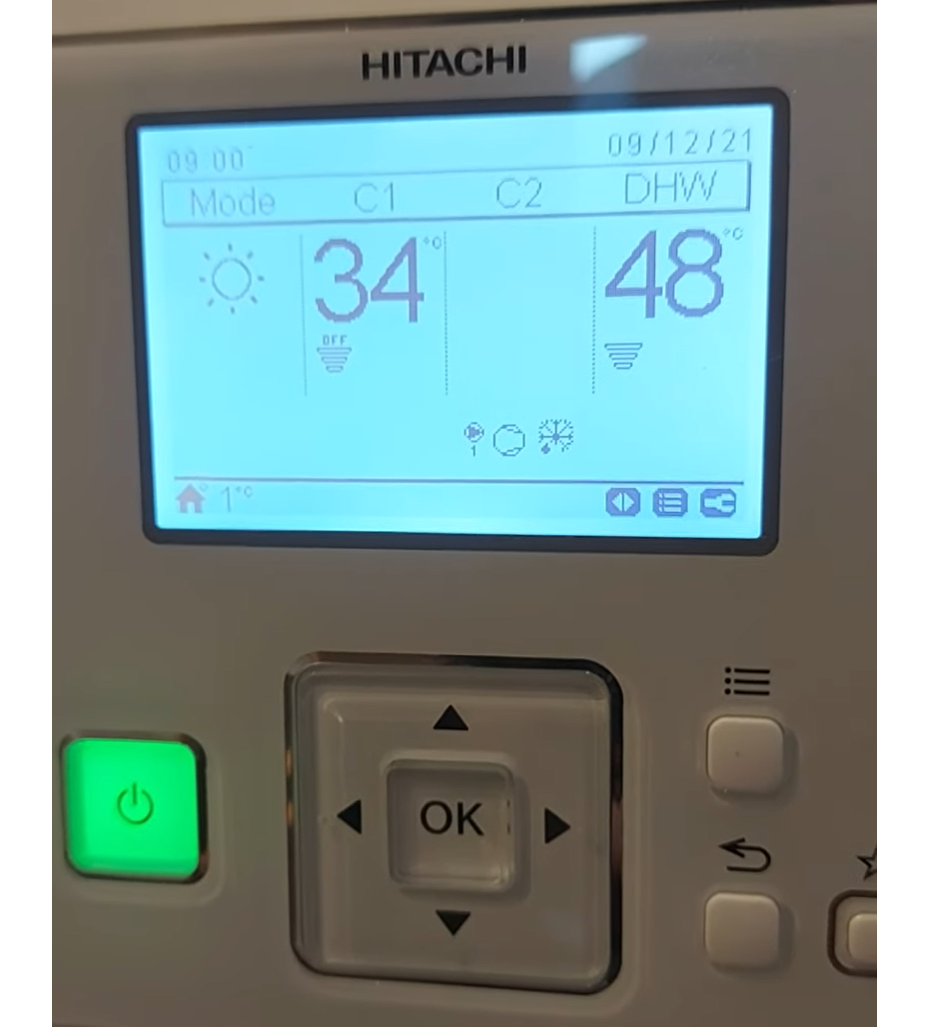
All the Youtube videos I can find about the Hitachi Yutaki show this control interface, featuring a big green button which is used to switch the heating or DHW on/off. Yours looks quite different but you should be able to switch your heating ON by simply pressing your on/off button while your screen is highlighting circuit one (47) (third screen above).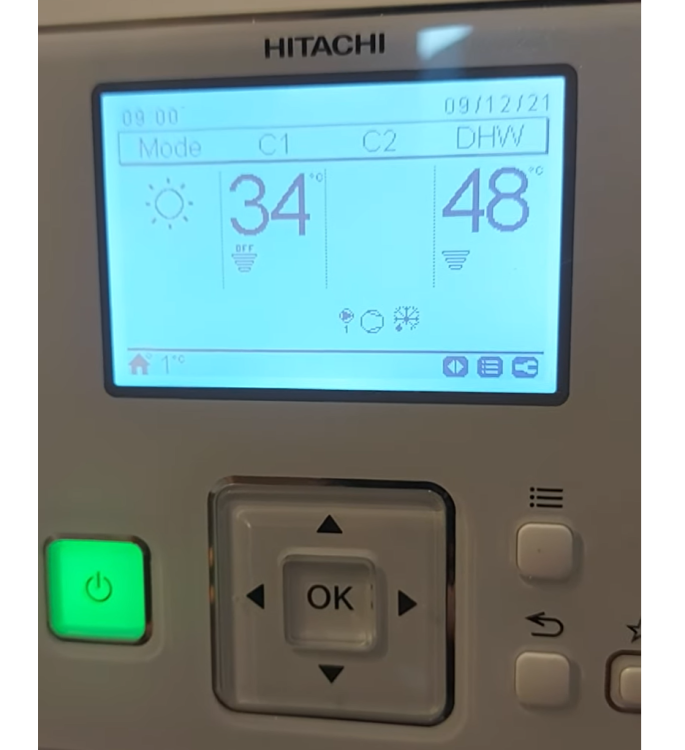
-
is your system still achieving your desired room temps despite the increased defrost cycling?
-
defrost cycle could be once or twice an hour in this damp cold air. You can watch it stop for a few minutes then a lot of steam comes out and blows away when it restarts
-
Weather Compensation and Defrosting
PhilT replied to ReedRichards's topic in Air Source Heat Pumps (ASHP)
Interesting question - a quick search suggests maybe not. I run my HP in target temp (auto adaptive) mode which I guess is a kind of workaround - if DHW and/or defrost cause a fall in room temp, the flow temp automatically compensates. -
Stretching the OP a bit but it is still relevant if location for an R290 is critical. The very first research paper I could find says this, maybe others say differently It may be worth finding out. 2016 - Performance Comparison of R32, R410A and R290 Refrigerant in Inverter Heat Pumps Application (extract from abstract) "From the results, R32 has better heating performance 6% for BTW and 12% in ATW application when compared with both R410A and R-290. Consider to the refrigerant properties, the changing of R410A to R32 can keep compressors stoke volume. Meanwhile 57% stoke volume increasing of R290 must be implemented to keep the same capacity level, Consequently R32 is the candidate refrigerant for heat pump application when DSH control has been applied"
-
does anyone use Bard? It suits a lazy git like me from having to wade through tons of confusing google sources... R32 is capable of higher heat pump flow temperature than R290. R32 has a maximum flow temperature of 65°C, while R290 has a maximum flow temperature of 60°C. This is because R32 has a higher critical temperature than R290. Critical temperature is the temperature above which a gas cannot be liquefied by increasing the pressure. A higher critical temperature means that a refrigerant can be used at higher temperatures. R32 is also a more efficient refrigerant than R290 at higher temperatures. This is because R32 has a higher latent heat of vaporization. Latent heat of vaporization is the amount of energy required to convert a liquid to a gas at a constant temperature. A higher latent heat of vaporization means that a refrigerant can absorb more heat from the surrounding environment. In general, R32 is a good choice for heat pumps that need to supply hot water at high temperatures, such as for radiant heating systems. R290 is a good choice for heat pumps that need to supply hot water at medium temperatures, such as for domestic hot water systems. However, it is important to note that R290 is a flammable refrigerant, while R32 is a mildly flammable refrigerant. This means that R290 heat pumps must be installed and serviced by qualified professionals. Is it right though?
-
All sources I can find say R32 has a higher overall coefficient of performance than R290. One source quotes 87% better. Some sources say R290 is better at very low temps but in Sweden, according to a report by the Swedish Energy Agency, R32 still accounted for 60% of all heat pump sales in 2022 whereas R290 accounted for only 10% of sales.
-
makes sense around this time of year but may become more expensive in the depths of winter. You could compare tariffs - wait till it gets a bit colder, make a note of a day's conditions, usage and cost at your current E7 for reference, switch to standard variable and wait for a similar day's conditions and see how usage and cost compares with your reference E7 day. It may be closer than you think given nigh time CoP, battery charging losses etc.
-
I cannot get a clear enough photo but I can see on mine the following are ON: SW1 - 2, 3, 7, 8 SW2 - 8 SW3 - 5 SW5 - 2
-
Mitsubishi settings for DHW and Home Heating
PhilT replied to roadrunnerAlgarve's topic in Air Source Heat Pumps (ASHP)
Is room temp reading 24 all the time? If you have no room stat connected to the controller that is probably just a dummy number. All of my parameters that have no device/connection read 25 all the time on MELCloud -
Which takes control Wireless or Timer
PhilT replied to graham1's topic in Air Source Heat Pumps (ASHP)
Both! You set the scheduler target and your wireless thermostat tells the controller when that target has been reached. However some systems are designed with one degree of "headroom", so if, for example, the scheduler target is 20, the wireless/controller will cut off heating at 21, then turn on again when it drops back to 20 -
Mitsubishi settings for DHW and Home Heating
PhilT replied to roadrunnerAlgarve's topic in Air Source Heat Pumps (ASHP)
how cold does it get in the Algarve approx? Are the TRV's connected to the Miitsu controller? Not sure I understand how that would work - I have just one room sensor connected to the controller -
Mitsubishi settings for DHW and Home Heating
PhilT replied to roadrunnerAlgarve's topic in Air Source Heat Pumps (ASHP)
Algarve presumably -
Mitsubishi settings for DHW and Home Heating
PhilT replied to roadrunnerAlgarve's topic in Air Source Heat Pumps (ASHP)
Yes the icon you mention is the dhw temp. 55 is very high. I use 42 but each household has different requirements. Your radiator heating circuit is set at target flow temp of 55 which is a test setting and generally not used for day to day space heating. It needs to be set with either a weather compensation curve or at target room temp mode. At this time of year a radiator circuit flow temp should read around 35 to 40 on Melcloud, rising to max 50 only when outside temps drop below zero. Room temp of 24 looks like a fixed dummy number presumably because you have no room stat connected? To get the most efficient operation you really need a Mitsu remote controller/room stat. -
You can find lots of photos online of this type of accident, which happens to all types of batteries for all sorts of different reasons, mainly to do with incorrect installation and use. So I'm not sure it's really justified to single out one particular make/model. On VAT clearly suppliers are interpreting the law as meaning 0% is applicable when installed as part of a (pre-existing) solar system, and VAT'able only when "stand alone"
-
Allowed placement, Under a kitchen window?
PhilT replied to Post and beam's topic in Air Source Heat Pumps (ASHP)
is it an R290 unit? -
My supplier sells solar storage retrofit with zero VAT and he'd better be right because the VAT inspectors are ruthless interrogators and punishers!!! I don't have a Pylontech battery but I would be shocked (forgive the pun) if they didn't have some form of balancing built into the BMS as it that would be a serious safety hazard.
-
The DNO letter has the MPAN in it already (well mine does anyway). Check your new smart meter - press the blue button 'A' until you get to the Export kWh. That's the reading Octopus use.
-
Highly commendable effort. Looking forward to hear how this and the new hp perform throughout the year. Wish I was still young enough to do all that kind of stuff again😒
-
Give them a call, they may say they know about it and it's not a mandatory requirement
-
you don't need a battery - apparently many people are on Flux without having a battery, they just fib when ticking that self certification statement which, unlike PV, doesn't require you to submit any DNO or MCS certificate. In my view a battery makes no financial sense with Flux (and I use both), but it might give you some "happy units".
-
What about the floor? That's where all the flaming debris will fall.
-
Is there a no-frills R290 heat pump?
PhilT replied to sharpener's topic in Air Source Heat Pumps (ASHP)
Seems like R454B may be the new best in class regrigerant for large scale commercial use -
So c. £1,700 for c. 4kWp, not bad. Nice to have that bit of land available. When you say "vertically" do you mean literally the faces will be pointing towards the horizon? Sounds like you would miss out on a huge amount of summer generation if that's the case, notwithstanding debris etc.
-
The only place my battery can go is in my extension loft, which raises a fire risk question, and that space gets pretty hot in the summer. For these reasons I went for an LiFePO4 battery. There are a number of references online talking about the inherent safety and stability of LiFePO4 - the fact that it is incombustible, has a safe operating temperature range of -20 to +60degC and longer life expectancy due to the chemistry's stability during charge/discharge cycles.