JamesPa
-
Posts
1899 -
Joined
-
Last visited
-
Days Won
2
Everything posted by JamesPa
-
Scientific sizing of a buffer tank
JamesPa replied to JamesPa's topic in Air Source Heat Pumps (ASHP)
Thanks to all for the ongoing discussion and for posting the report, which is certainly interesting. Some comments: Sometimes there is a manufacturers recommendation and 10 mins is often quoted. The graph on page 56 of the KIWA report helps, it shows (for the configuration tested) that COP flattens out around a min on time of 10 mins, and is about 10% down at a min on time of 5 mins. Lets face it all of central heating design is very approximate but that doesn't stop us or invalidate doing calculations, it just means that you have to be aware of the uncertainty on the result. Fair enough, I didn't want to make the formula too complicated (or iterative, which this refinement would make it) and hopefully the heat loss from the buffer is relatively small (particularly if its outside the insulated envelope). That's taken into account by defining Vs in the formula as 'the system volume when anything that can shut off (eg due to zone or thermostatic valves) has done so' Unless Im missing something fig 51 neglects any ability of the heat pump to modulate down and assumes that there is no zoning. Since most of the better heat pumps have at least 3 to 1 modulation, I would question its real-world value as a sizing tool unless very carefully interpreted. The 'Recommendations' (page 68) of the report are interesting, starting with 'Buffer tanks are unlikely to be required when the heat pump can modulate (i.e. if the heat pump is not fixed speed)' and the obvious one 'Buffer tanks should not be installed in unheated spaces'. All four of the 'MCS' quotes I have received violated both of these, which, in part, explains my interest in the science! Its worth bearing in mind that we are aiming for minimum energy consumption not maximum HP efficiency. A large buffer tank may improve efficiency at either end of the heating season, when the HP cant modulate down to match the (low) demand, but wont do anything for HP efficiency during the coldest months of the year, when the heat pump can precisely match the demand. If its in an unheated space (because there is nowhere else convenient) it will still be losing heat throughout the season, and that may well offset the efficiency gains at either end of the season. So far as I can see its best to design out if at all possible, or design small enough to put inside the house if not. -
Scientific sizing of a buffer tank
JamesPa replied to JamesPa's topic in Air Source Heat Pumps (ASHP)
Thanks for this. It is, I think, essentially the same (assuming that 500 is the specific heat capacity of water in some US units) but, unlike MCS, allows for a minimum load yet ignores the minimum system volume. That pretty much convinces me that my formula is correct, its just that MCS differs by choosing to ignore one factor and the 'American' one by choosing to ignore another. It strikes me that, at minimum load, one could possibly (in principle) be quite a bit more tolerant with flow temperature variation than when the demand is high so one could, again in principle, get away with a smaller (or no) buffer tank in more situations than any of the formulae indicate. However, so far as I know, there isn't a heat pump that allows you to vary the permitted deviation from 'ideal' flow temperature according to ambient. Further scope, perhaps, for smart control engineers to come up with heat pump controllers which simplify installation (like the self-learning ones we are beginning to hear about), thus driving down installed system cost and complexity particularly in retrofit applications. Its a pity that the heating market (and in particular the heating control market) moves at such a glacial pace - its going to need to move a lot faster if there are to be glaciers left to compare its speed of movement to! -
Scientific sizing of a buffer tank
JamesPa replied to JamesPa's topic in Air Source Heat Pumps (ASHP)
Having said what I said (perhaps hastily) - the MCS formula is in essence the same as that which wrote, just that MCS ignores the load (arguably justifiable, arguably not). Thanks therefore for confirming! -
Scientific sizing of a buffer tank
JamesPa replied to JamesPa's topic in Air Source Heat Pumps (ASHP)
Thanks for the MCS formula, but it ignores the load unless I am mistaken. So in the MCS world you still might need a buffer tank with a heat pump that can modulate continuously down to the minimum system demand. I suppose MCS is thinking that people might turn the heating on when the outside temperature is, say, 19C so that, in effect, the minimum system demand is (almost) zero, but in the real world most wouldn't. Or am I missing something? -
I know this general topic has been covered before, but I'm trying to understand the scientific formula for sizing a buffer tank, as opposed to various 'rules of thumb'. Assuming that the sole purpose of the buffer tank in question is to avoid short cycling (its obviously a different calculation if the objective is thermal storage) then I think that the requirement is that the volume of water in the system be able to absorb the excess power generated by the heat pump (relative to the demand) for at least the minimum time for which the heat pump should be on, and do so without heating up by more than the variation acceptable in flow temperature. This leads to Vb = (Pmin-Dmin)*Tmin/(Hmax*4.2)-Vs (or zero if this yields a negative number) Where Vb is the required buffer volume Pmin is the minimum output that the heat pump is capable of modulating down to at the temperature where the heat demand is lowest (most likely about 16C, ie just before you would switch off heating altogether) Dmin is the demand generated (at the same ambient temperature) by the rooms which are still heated when anything in the system that can shut off (eg due to zone or thermostatic valves) has done so. Tmax is the minimum time the heatpump should switch on before it should turn off again (generally about 10 mins) Hmax is the maximum variation you are prepared to permit in the output buffer temperature 4.2 is the specific heat capacity of water (in kJ/kgK) (substitute the appropriate lower value if the system is glycol filled) and Vs is the system volume when anything that can shut off (eg due to zone or thermostatic valves) has done so So for example if the heat pump can modulate down to 4kW, the minimum heat demand (eg at 16C) is 2kW, you allow a flow temp variation of 2C and the minimum system volume is 100l, and a min ‘on’ time of 10 minutes you need a buffer tank of 142-100=42l With the same system and an allowed flow temp variation of 3C, you don’t need a buffer at all (the formula yields a negative number) Is this formula correct? If it is correct then I think it points to design/control tweaks to avoid a buffer tank in cases where there isn't sufficient space or a buffer is not desired for some other reason.
-
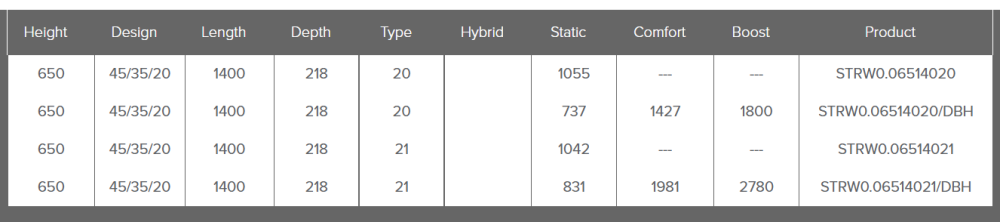
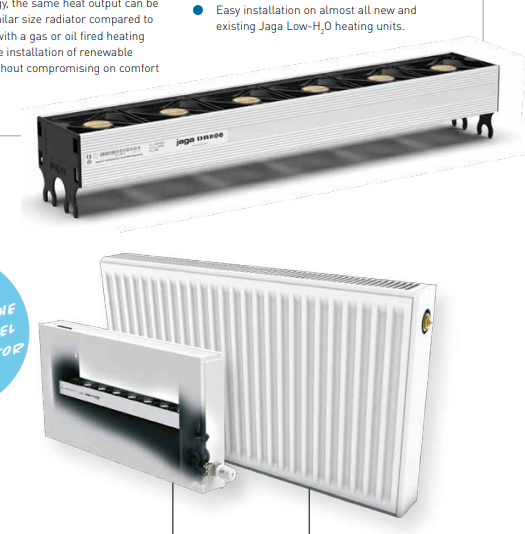
Thanks for this. Judging by the brochure the Jaga rads are interesting in themselves, but also as a case study. From the brochure it appears that the Jaga Strada 'Dynamic Boost Hybrid' radiator is a standard Strada radiator with a bunch of computer fans on top of the radiating element. The fans, if not operational, appear to reduce the output by about 30% (its not clear whether this is because they interrupt the convection or because the space taken up by the fans reduces the radiating area available within the casing) but if operating increase the output by 40%-80% (compared to the fanless version) dependent on speed (see the table extract below which is from the Jaga website for a 45/35 flow/return temps. They are also advertised for what they call 'light cooling' - by which they mean cooling where the flow temp is kept above the dew point. The rads themselves are a low water content design. Its plausible that this increases the effectiveness of the fan relative to doing the same on a conventional radiator, because of all the fins, but still suggests that adding the idea of adding computer fans to a standard radiator is likely to give a meaningful increase in output.
-
Postscript: https://www.ebay.co.uk/itm/254722117981 , also known as a 'fan 1248', seems to work well and comes complete with a temperature sensor, but you still need a 12V relay to shut the fan off completely. Contacts for the 12V relay are provided. Without a relay it turns the fan down very low at the programmed 'shut off' temperature, but not quite off. With one fan turned down to minimum the board plus fan draws 70mA at 12V, if I disconnect the fan it is 65mA, so the 'slow running' fan is drawing just 5mA=60mW and the board itself 65mA=0.8W. At this level Im not sure a relay is worth the bother, probably best just to leave the whole thing on and turn it off at the end of the heating season! The onboard fan connector is not conventional, but I eventually tracked it down - its a JST VH 3.96. Its currently too warm to try the fans on radiators, and anyway my central heating is drained down while I upgrade the rads in preparation for eventual fitting of an ASHP.
-
"Odd to use an E48 value with 1% tolerance but that's what makes it so special (not)." Odd, or deliberate strategy to make money? How can you not suspect that the engineers suggested a piece of copper wire or a 1k resistor, but the marketing/product management people vetoed that. They probably had to write completely pointless firmware specially to check that the correct value is used.
-
There is some evidence that the PUHZ (R410 - older) models perform differently to the PUZ (R32 - newer) models. Attached a document posted by another contributor with PUHZ data, purportedly from Mitsubishi (although Mitsubishi have subsequently denied it) and an extract from the Mitsubishi R32 ATW datasheet (for the 11.2kW model and others) which (for the 11.2kW model at least) is pretty consistent with measurements reported on this forum. Basically I think the overall conclusion is that its model and generation (in reality - presumably compressor and FTC model) dependent. Standby Power Consumption.pdf wm112xx_001_001_uk .pdf
-
Heat pumps: how much efficiency is enough?
JamesPa replied to Garald's topic in Air Source Heat Pumps (ASHP)
"As an aside - how cheap is it for you to replace radiators?" This resonates. Radiators, in the UK at least, are remarkably cheap. In planning my heat pump system I have gone from keeping as many as possible, to swapping out any I need to swap out to achieve my target flow of 45C, as I have come to realise how cheap they are, particularly of you can find a way to avoid less common sizes. Plumbers don't charge much to fit them either, although it's a simple enough job if you have the time. I definitely now have the impression that trying to avoid replacing radiators by increasing flow temp is a false economy. Having said that my design still has a couple of problem rads where I will probably take a risk on a slightly smaller one than ideal, so that the space impact is not too great, and add a homemade fan unit to boost the output by ?%. -
Your measurements are very plausibly consistent with the data Mitsubishi gave me and which I posted above. 1kWh/day is 40W. Mitsubishi says its 15W for the outdoor unit, leaving 25W unaccounted for. I cant find a spec for the controller, but Mitsubishi do state that the standby power of their cylinders (which include the controller) as 26-45W. Apart from the controller, the cylinders are mostly plumbing, so you would expect the standby power to be mostly the controller plus perhaps one or two solenoid valves thrown in (or something similar). Thus 25W for the controller seems a very likely (and anyway quite plausible) figure, albeit one that would probably make it feel quite warm to the touch. The controller is never really on 'standby' I suspect, its sitting there 'doing its thing' all the time. All in all I think your measurement plus the Mitsubishi product fiche convinces me that the PUZ-WM112VAA R32 is very likely ~15W, with the controller very likely ~25W. These are, to my mind, both reasonable figures and nowhere near the 200W that started this thread. There does seem to be evidence (from Mitsubishi and others) that some Mitsubishi models, particularly the PUHZ (R410) 3-phase models, have a significantly higher consumption. if anyone has any further figures for specified models then it would be interesting to aggregate them and check out further the various data Mitsubishi have provided.
-
I emailed Mitsubishi again about the standby consumption of the 11.2kW R32 model, as suggested by ST. They are still claiming 15W (0.36kWh per day) in any standby mode for the PUZ WM115VAA (or VAA-BS). See attached (the previous product fiche had an error on the rating sticker, which they corrected in response to my question). The PUZ WM115VAA (-BS) is the current R32 11.5kW single phase model ( (-BS) = with or without salt protection) and I think the figure certainly excludes the controller. Does anyone have evidence that they are wrong and that this model consumes a lot greater than 15W. Incidentally they confirm that PUHZ- is the R410 model, PUZ- the R32 model. wm112xx_001_001_uk.pdf
-
...or no crankcase heater mode.
-
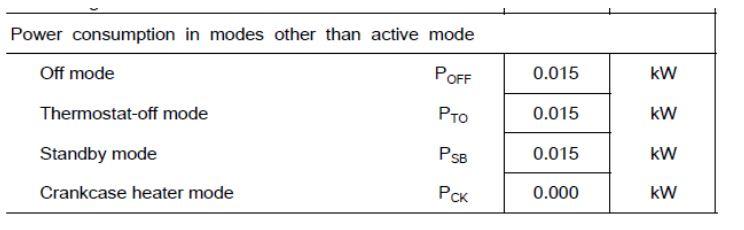
Here is Mitsubishi's response to the question ' what is the standby consumption of a PUZ-WM112VAA R32. Basically it says that the standby power is 15W. I expect this excludes the controller which is sold separately or combined with the cylinder. The reference to 'the document you sent' is the one posted earlier on this forum 'from Mitsubishi Tech Support'. Not sure what to say about this. Also, it looks from this page like the PUZ models are R32 and PUHZ are R410. https://library.mitsubishielectric.co.uk/pdf/directory/heating/technical_documents/current/service_manual/outdoor_unit From Mitsubishi: Hi James, I have attached the product fiche which gives details on the power consumption in other modes than active. The snapshot from below gives the details. The document you sent is not an official Mitsubishi Electric document so we wouldn’t be able to comment on this. Also, if you are interested to find the standby load for the cylinder units as well, this can be found in the Databook by clicking link here to relevant pages (Domestic Hot water tank row). The standby power input varies from cylinder to cylinder with the range being between 0.026-0.045kW. Kind regards, John wm112xx_001_001_uk.pdf
-
The Ecodan technical document posted earlier actually quotes the standby power for the "PUHZ-W85VHA". If the figures are to be believed the energy consumption would be 0.84kWh/day (35W*24h=0.84kWh or 28W*24=0.672kWh per day, depending on ambient. Now we don't know how similar your model, the PUZ-WM85VAA, is (does anyone know the taxonomy of Mitsubishi model numbering?). Furthermore, at least in some cases, they seem to use the same model number for R410 and R32 versions, just tagging the refrigerant on the end and they also have version numbers. This being the case we don't actually know exactly which model their technical document refers to. Since a change of refrigerant implies a change of compressor, and the standby consumption is largely due to the compressor, there is no reason at all to expect the R32 and R410 versions to have the same consumption. I emailed Mitsubishi yesterday about the PUZ-WM112VAA R32 (quoting the technical document), I am awaiting a reply. At the present time I don't think we have enough information to infer the consumption of any model that has not been specifically measured. It seems, for now, very much a case of Mitsubishi caveat emptor (with apologies to any Latin scholars if Latin word order differs). Having said that its also clear that the problem isn't unique to Mitsubishi though, albeit that there appears to be evidence that LG, at least, is better. I am now working on the assumption that turning off altogether and using a solar diverter is the summer solution (fortunately I already have the solar diverter), but I dont know the 'right' solution for the shoulder season!
-
You could crudely just switch between the two so you use oil on the coldest days and ASHP on the warmer days (or ASHP at night and Oil during the colder days). A couple of three way valves and either a manual switchover or one which is somehow temperature-controlled would do this. Essentially arranging the plumbing such that either the oil is connected or the ASHP is connected but never the two together. Not as efficient but far less complicated. Im thinking about doing exactly this (in preference to anything complex/expensive involving buffer tanks etc) so that I can retain my existing gas boiler as a backup to the ASHP I intend to install, just to cover failures. Bear in mind that the ASHP might take some time for the compressor to 'warm up' though (see the thread about ecodan standby consumption to understand why).
-
We have a Mitsubishi A2A unit in a domestic-sized office at work. Nice warm air in winter, nice cool air (if you switch it on) in summer, and well distributed throughout the office. Far superior in feel to the previous heating (night storage) heating. I cant really comment on the noise, the work environment is obviously inherently a bit noiser than a quite domestic one, but I certainly wouldn't rule out A2A on the grounds of comfort.
-
If we were using joules most practical measurements in the current context would be MJ or GJ so always upper case wherever in the sentence it occurs!🙂
-
Here are some excerpts from the 2019 and 2020 ecodan databooks showing some data for several models (but, sadly, still not the model number 'scheme'). Note that a variety of compressors are used, which could possibly explain the differences in standby consumption reported by the people posting. Also is it possible that the standby pattern is determined by the controller not the unit itself (unlikely I would think, but possible. I still cant work out the difference between the HA series and the AA series! I suspect we need collectively to get to the bottom of all this to make sense of the Mitsubishi data and, more importantly, to work out what to expect with a new model. Mitsubishi Models various.pdf R410 R32 Models from 2019_2020 databook.doc
-
The principal stated difference between the VAA and YAA models is single Vs 3 phase. I would imagine almost all domestic users have a single phase unit, unless they have some unusual need for 3phase! So most on here should have the VAA models. Presumably the three phase bit in the YAA version is the compressor, the electronics and any minor components will most likely run off one of the phases. However note that there are also V(Y)AA and V(Y)HA models, I can't work out the systematic difference between these (is it the refrigerant?) but this might matter!
-
If all that is true, and it sounds like you spoke to someone knowledgeable so there is a good chance it is, then its very helpful and gives the possibility to mitigate the effect in many cases. In the depths of winter its likely that the heating is running 24/7 anyway, so the 'standby' load is not relevant. In summer and much of the shoulder season, if you have solar pv (like I do) then the ashp can be switched off completely and the solar PV takes over. So that just leaves march-mid May and September/October as months when the standby power is a particular problem. But its warmer then so the compressor should heat up from cold quicker! Maybe a bit of thinking about times of use could resolve this? Im personally reluctant to rule out the Mitsubishi product yet, it seems to be generally well thought of, relatively attractive, not super heavy like the Vaillant, and has a different form factor to many others which, in some circumstances (including my own) matters!
-
OMG joth and ST are correct - CoolEnergy are in the energy business and they apparently don't know how to measure energy, and that's even before the Government thinks its sensible to have us go back to measuring energy in horsepower-hours (or whatever mad units you choose). I wonder if our Government has realised that all our 'imperial' units are now in fact legally defined in terms of SI units anyway. A yard is 0.9144 metres exactly, a pound is 0.45359237 kilos exactly and a second is... well a second. Thankfully TUV are German and so can presumably be trusted to do engineering properly. Neither 13W nor 312Wh appear in the excerpt from the TUV certificate so goodness knows what the figures Cool Energy quote are based on, but at least 38W + 9W is reasonably low as a (presumed) standby consumption. To be clear on units, for those who aren't (and add to STs explanation): - a watt (symbol W) is a unit of power = rate at which energy is consumed/produced - the amount of energy per unit of time. Think of it as how hard you have to work. A kilowatt (symbol kW) is 1000 watts (The most used imperial units of power is the horsepower or the British thermal unit per hour. To this day radiators are often quoted in Btu/h, goodness knows why. The average horse, incidentally, has a maximum output power of about 15 horsepower but an average over a day of about one horsepower) . - a kilowatt hour (symbol kWh) is a unit of energy and is what you pay for for when you buy electricity or gas. We also sometimes call this a 'unit'. Think of it as how hard you have to work multiplied by how long you have to work that hard. So if you use consume energy at the rate of 1kW for one hour, you will use 1kWh. Similarly if you consume energy at the rate of 0.5kW for two hours, you will also use 1kWh. (The most used imperial units of energy are the British thermal unit or, oddly enough, the kWh - because we have measured electricity in kWh for decades.) - A joule (symbol J) is also a unit of energy but its too small to be useful for most house-related purposes. 1 watt = 1 joule per second, so a kilowatt hour is 1000 joules per second for an hour, ie 3,600,000 joules. SI units are written with lowercase letters except when the unit is abbreviated and the unit is named after a person. So watt (W), pascal (Pa), second (s), metre (m), joule (J), kilogram (kg), ampere (A) ohm (upper case omega), volt (V). etc. Furthermore they all relate directly to each other in a logical and consistent fashion and are exactly the same worldwide. Imperial units - lets not go there!
-
Er - not what Tom said - see quote. 0.013kWh per day would be truly stunning at just over half a watt!
-
No offence intended, just cautious about statements made by manufacturers where they don't stack up. Like you I would guess that 0.013kW is what was intended, but I wouldn't want to rely on this given that most people would express 0.013kW as 13W.
-
Never presume - it makes an ass of u and me. If the units are wrong then why would you believe the statement?