JamesPa
-
Posts
1899 -
Joined
-
Last visited
-
Days Won
2
Everything posted by JamesPa
-
Well fair enough in principle, but doing this at grid scale where you have the right data makes more sense. So I think I will stick with the conclusion that there is no environmental case for local battery storage (other than in a car of course where the environmental argument is about air quality and reduced carbon overall).
-
If you haven't already You might want to read this thread in Energy Storage ' There is a fair amount of discussion on whether battery storage makes financial sense and the answer, in many cases, is no, particularly if you have or can get a reasonable export rate. Unless that is unless you have a source of dirt cheap batteries. Of course if the objective is autonomy that's a different consideration. I don't think there is an environmental case for battery storage, unless someone can make an argument to the contrary.
-
Actually the degree of modulation for most models seems (according to spec sheets) to be typically only about a factor of 3 (eg 12kW modulating down to 4kW or thereabouts). There are some exceptions of course, both worse and better. That's not enough, even if correctly sized, to cover say from 15C (5 deg C temp difference between outside and target temp) and -2C (22deg C temp diff between outside and target temp) without resorting to on/off modulation. Incidentally the useful measure of modulation for most sizing purposes is between maximum output at coldest ambient temperature (eg -2 down south) and minimum output at warmest ambient temperature at which you require heating (typically 15/16). That's a worse number than the manufacturers like to quote (if they quote it at all) because HPs are less efficient at low ambient and more efficient at high ambient. There is a separate thread on this subject and data is not easy to find. This is one reason why buffer tanks/volumisers are sometimes added to systems, to stop 'short cycling' (ie on/off modulation which happens too often in any time period). Oversizing the unit simply makes it more problematic.
-
Will energy storage be worth it if the energy price is capped?
JamesPa replied to George's topic in Energy Storage
Good point. As you say with a decent export rate and a decent heat pump it might well be worth using the HP to heat water (rather than a solar diverter) and accepting an increase in exported power. If your COP (at the ambient temp when you heat water and whatever flow temp you use for water heating) is greater than the ratio of import price to export price (plus a bit of margin for system losses), you are better off using the HP and disabling the solar diverter, even if you are importing while the water is heating. With a 15p export rate and capped import rate of ~34p it probably is greater most of the time when there is excess solar power (the possible exception being cold, sunny winter days where the COP will be low but the solar production high). At the more usual 5p export rate or if the cap on import rate is lifted without a corresponding uplift in export rate, then its less likely to work out in favour of using the HP. -
Will energy storage be worth it if the energy price is capped?
JamesPa replied to George's topic in Energy Storage
Yes, and makes the argument for a battery even weaker! -
Will energy storage be worth it if the energy price is capped?
JamesPa replied to George's topic in Energy Storage
I just did some back of the envelope calculations for myself. The rationale might interest others and the answer is a definite maybe, (ie yes if several factors work out in favour, but no by default). I have solar panels and a solar diverter to heat my hot water (doing this seems to be a no brainer financially). I don't have an electric car (yet). For about 6-8 months of the year I get more energy from the solar panels than I use in hot water heating and daytime electricity consumption. I know this because the hot water needs to be 'topped up' from sources other than solar between mid Oct & Mar. So let’s call it 200 days per year that I have excess generating capacity. The other days don't matter because there is no excess capacity to store, so the batteries will perform no useful function. The maximum I can store each day is the capacity of the battery, thus this becomes the limiting factor on the savings. Therefore my maximum annual import saving from battery storage is 200kWh per kWh battery capacity. With electricity at 34p/kWh import and about 5p/kWh export, this translates to just £58 per kWh of battery capacity. Since battery storage systems seem to be £500-£1000 per kWh and seem to last about 10 years, there is no viable business case with this simple calculation (and there isn’t an environmental case given that, without onsite storage, the excess energy is exported to the grid). I were to switch to a tariff with a cheap night time rate (and assuming AC coupled batteries so that I could charge from imported electricity), the numbers get a bit more favourable. Octopus offer a 10p/kWh night time tariff aimed at EV charging (so far as I am aware they aren’t fussy how its used). So for the 166 days of the year when I don’t have excess solar capacity, I could save 24p/kWh of battery storage capacity by charging them at night, a further £40 saving per year. This saving would be offset during periods of peak daytime usage, when I am forced to import at a higher rate than I otherwise would, but with a bit of clever shifting of loads that might be a fairly small given that the batteries would do some smoothing. So, generously, that gets me to £100 saving per year per kWh battery capacity. Based on £1000 per kWh battery system cost and a 10 year life it still doesn’t work out, because I only just cover the cost over its lifetime. However if the battery cost is only £500 per kWh there is a return of £500, roughly 10% per year, which isn’t a bad figure. If energy prices double or battery prices halve the calculations become more favourable. Of course if energy prices fall back to pre-war levels then the case is shot. I would have guessed that these calculations apply, more or less, to quite a large number of people assuming they have got a solar diverter (and if they haven't, then they should). -
I think its RED that have been purchased by Octopus energy, my guess, if I'm right, is that their capabilities may be in course of repurposing given the Octopus push into deploying heat pumps.
-
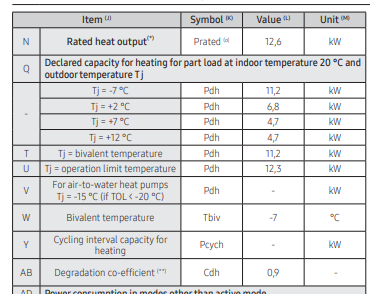
There is some info about part load performance here, but I don't know how to interpret this and whether or not it tells you the modulation ratio (but it does suggest that the 12kW unit modulates at least down to 4.7kW). Midsummer wholesale claim that 12-16kW Samsung heat pumps need min 50l system volume which is pretty good (see here page 3 https://midsummerwholesale.co.uk/pdfs/quick-start-guide-samsung-gen-6-kits.pdf) but I don't know the assumptions or authority for this claim. Perhaps someone on this forum knows how the parameters listed below are measured.
-
Some more specs now available at https://www.samsung.com/global/ecodesign_energy.
-
At 8kW I'd probably agree, but for the higher capacity models, size and appearance appear to be a big improvement. Granted that doesn't matter in some settings, but in others it does. Until we see the full specs of course its too early to judge fully, but if the location favours a single fan unit and the output requirement is in the 11-16kW range there are relatively few choices. This seems to add one more. I could imagine putting this in a visually prominent location, unlike most of the double fan (and a good many of the single fan) units on the market.
-
That's a lot cheaper than in Poland and Portugal. Let's hope they maintain these prices
-
Looks like these are priced around 7-10K Euro in Poland/Portugal (which are the only places I can find prices). Not cheap!
-
Pragmatically I'm sure you are right, but precision is needed in these matters, because they trigger planning conditions (= obstacles to becoming greener) often imposed by officials who don't fully understand these matters (no criticism, they haven't been properly trained). Until I read this thread I was pretty confident I'd found a solution for my retrofit which won't annoy the neighbours or violate likely planning conditions, now i'm not sure. I'm not 'blaming' anybody commenting on this thread, its merely an observation that we need more precision (or standards) in specs if ashp is to I be mainstream, which I'm sure all on this forum know needs to happen!
-
Indeed so, and its sound POWER level that feeds into the MCS calculations (and as you say is the absolute measure) to determine a pressure level at the 'reference points (basically your neighbours windows). Pressure level is dependent on distance, obstructions, and also on how many sides the unit has a surface that reflect the sound. My concern is your comment Thats open to manipulation by the marketeers. I had always assumed that the quoted sound power level (and the figures to be fed into the MCS calculations) was the max, not the 'typical'. Is this really the case and if so is there a 'standard' for 'average'? 71dB is loud.
-
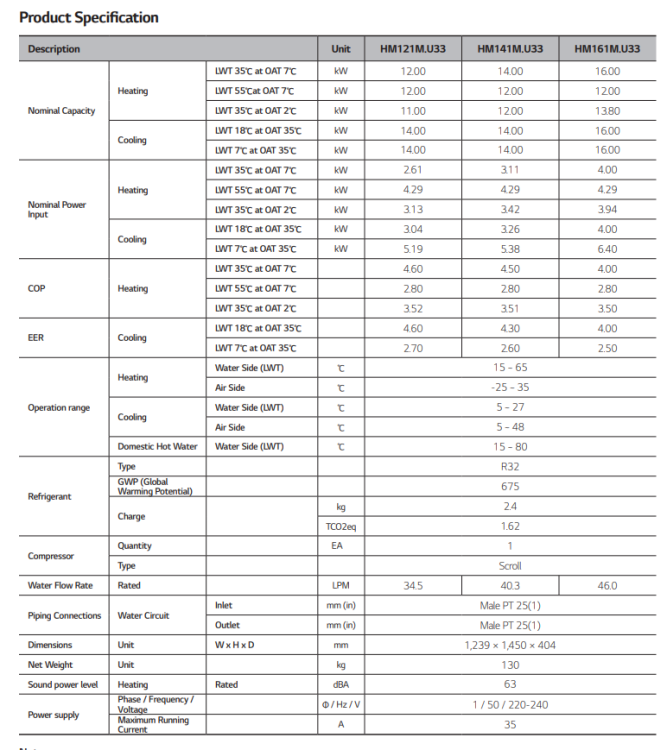
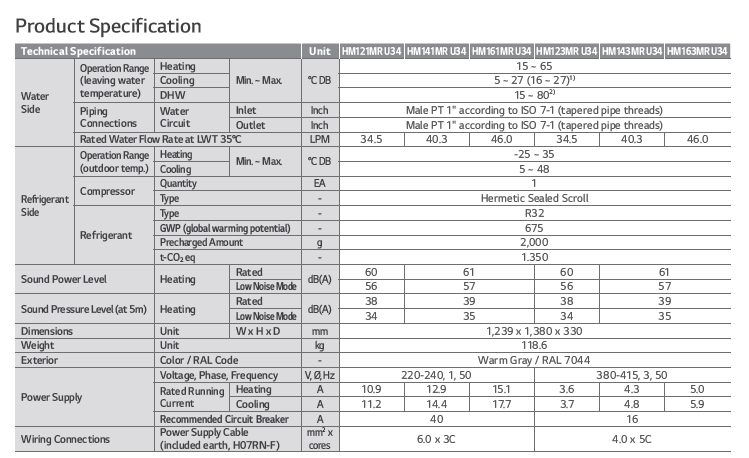
Yes...but the spec says something different or Depending on whether you look at the leaflet (which contains the graphic you posted) https://www.lg.com/gr/download/resources/CT32004443/CT32004443_1641.pdf or the 'Product Catalogue' (which I downloaded a while ago but now cant find online) LG speak with forked tongue.
-
Quite so, hence the thing to compare is PWL (sound power level) I had assumed that the quoted PWL was the maximum, are you saying its the 4C+ value?
-
This caught my eye as it seems low (most 12-16kW models seem to have a sound power level around 60dB(A)). According to the datasheet I have, from the 2021/2022 product catalog, the LG 16kW monobloc is 61dB(A). I dont know about the Stiebel Eltron, they make it too difficult to find information so I gave up. Incidentally many manufacturers make a bog song and dance about sound pressure at (1, 3, 5m). Its sound power that is the true comparison between models (and what is used in the MCS calculations), sound pressure depends on the physical conditions..
-
Air Source Heat Pump - general question
JamesPa replied to 0llie's topic in Air Source Heat Pumps (ASHP)
If your property is suitable and if the alternative is electric (resistance) heating, then ASHP may very well be a good choice. Properly set up it should use about a third to a quarter the electricity that electric resistance heating will use. However there is a substantial upfront cost, different behaviours to get used to and a poorly set up one will be expensive. If mains gas is possible then that will probably be your cheapest install, and likely about the same cost to run (with current prices) as a well set up ASHP, albeit that many (including myself) feel that that is bound to change in favour of ASHP in time. I don't know the prices of off-grid gas or oil so cant compare. Iyf you haven't got many rooms it might just be worth considering the solution often adopted in commercial properties namely 'air to air' ASHP. Basically you have a wall mounted fan unit in each room (or (instead of radiators) connected to an external unit. These are easier to set up, cheaper to install and by and large they just work. However fans make a noise and you might not find that tolerable, particularly in a bedroom. Its not a common configuration for a domestic situation, but probably shouldn't be ruled out. It really does depend on what you have, what sources of fuel you can get, and whether you can stomach/afford a large upfront cost. As others say, don't get sucked in by sales talk. Having said that, if someone else is funding it, they will have some set criteria and types of install and your concern is just to minimise the running costs (which presumably they aren't funding). Post some stuff here (including more information about the house/fuel availability) and I am sure you will get useful comments. -
Noise requirements and planning consent
JamesPa replied to JamesPa's topic in Air Source Heat Pumps (ASHP)
That's interesting, can it be heard inside when to he windows are closed? -
Noise requirements and planning consent
JamesPa replied to JamesPa's topic in Air Source Heat Pumps (ASHP)
'In the middle of a 9m wide garden' sounds potentially like a long external pipe run. I have been trying to avoid that (10m seems the generally accepted max). Can you elaborate on location, pipe run length etc and also what its like nearby and inside. -
Mitsubishi Ecodan Air Source Heat Pump - Low Efficiency
JamesPa replied to TimToos's topic in Air Source Heat Pumps (ASHP)
Different starting conditions, different climate (wetter!), different public and installer mentality. Perhaps I should have said 'Its clear that the underlying technology is mature, but its deployment in and adaption to a domestic situation in the UK is still relatively immature. -
Mitsubishi Ecodan Air Source Heat Pump - Low Efficiency
JamesPa replied to TimToos's topic in Air Source Heat Pumps (ASHP)
Having had 2 ASHP systems installed at work (with spectacular success – albeit that these are air to air not air to water) and wrestled for 9 months with a design for home, I think I am getting the measure of ASHP. Its clear that the underlying technology is mature, but its deployment in and adaption to a domestic situation is still relatively immature. Houses are complex systems and all different, and we are saddled with legacy installations and legacy practices (particularly sloppy here in the UK as compared to say, Germany) which are going to take time to shift and/or find ways to overcome. The fact is that it was just too easy to shove in a 28kW gas boiler, turn it up to 70/75C flow temperature (thus undermining the savings from condensing operation), put TRVs on each radiator without accurate balancing, and walk away. We, the general public, have got used to this way of operation and, from an installers point of view, this approach guarantees that the house is warm (thus avoiding call outs) even if efficiency is 10% less than it could be. As described elsewhere in this forum, ASHPs require a different way of operating, and crucially more care in design and setting up if they are to work efficiently. The latter, and quite possibly the former, should eventually be overcome with more intelligent controls and pumps with deeper modulation capabilities, but for the time being the tweaking to get the weather compensation and balancing right appears to be vital to system efficiency. Furthermore the physical constraints (size, positioning) are more challenging and, if mass adoption is to be achieved, we need a greater variety of form factors to fit more situations and, crucially, to dispense with the need for/obsession with buffer tanks. The ‘commercial’ ASHP industry is well geared up to the typical office installation, generally based on air to air systems, but the ‘domestic’ industry (principally air to water) is still immature, hence the need for government training subsidies - which in reality is what the BUS and its predecessor are. Hopefully ‘upscale’ initiatives like that being undertaken by Octopus will flesh out some practical ways of overcoming the practical challenges in many common situations. All this is inconvenient but, lets not kid ourselves, we don’t have a choice. If the hot summer in the UK, the wildfires in mainland Europe and America, the melting Antarctic shelf and the floods in Pakistan aren’t enough to remind us that the threat of global warming is real, then what is? Currently ASHP (or GSHP) is the only high efficiency low carbon heating technology available in any scale. Inevitably early adopters/environmental enthusiasts (probably a characteristic of many of those on this forum) will help ‘debug’ the way these are best designed, installed and operated in a real-world domestic environment. In five or ten years time things will hopefully look a lot different, but only because some people went first! As an aside, last winter I turned my current gas heating flow temperature down to 55C and left it on more or less 24x7, to simulate what an ASHP installation might ‘feel’ like. The result was a house that was considerably more comfortable, principally because the temperature gradients and temperature variations with time were much less as a result of a reduced radiator temperatures that were more constantly emitting rather than being constantly turned on and off by TRVs. So I’m pretty convinced that, when I do finally get a design I’m happy with, the result will be a more comfortable house. That’s something to look forward to, in addition to the feeling that I can feel less guilty about the devastating effect of my carbon footprint on others. As others have said, low flow temperature (swapping radiators is remarkably cheap!), system balancing and weather compensation appear to be the key factors to getting high system efficiency. Others on this forum report excellent results with the Ecodans, and the high standby power consumption appears to be a feature only of some of the older PUHZ (R410A) models. Can any of these be improved in your system without too much additional expenditure? -
Noise requirements and planning consent
JamesPa replied to JamesPa's topic in Air Source Heat Pumps (ASHP)
I did the calculations using the MCS downloadable spreadsheet! -
Has anyone had any experience of the noise considerations in relation to planning consents. The MCS 020 rules (and therefore the rules for 'deemed consent') appear to impose rather severe constraints on location unless one of the following apply you pretty isolated from your neighbour you are able to site the unit so there is only one reflective surface within a metre there is a physical barrier between the unit and the neighbour such that the relevant points in the neighbour's property are invisible For example, for a unit with a fairly typical sound power level of 60dBA (many units are more, some are less), where the unit is mounted on the ground within 1m of a wall (or on the wall within 1m of the ground) the minimum permissible distance (according to MCS 020) from the unit to the nearest 'assessment point' (basically a point 1m in front of the centre of your neighbours nearest, or most affected, window), is 8m unless the assessment point is invisible from the unit. That's quite an ask even in more spaced out residential areas, particularly where neighbours have extended to the max. So my question is - if you apply for planning consent as opposed to trying to sneak in with deemed consent, do more relaxed rules tend to apply, or is it really this difficult? Having completed most of the rest of my system design I'm now struggling to find a suitable location, and I live in a 1930s detached house in a leafy road (= well spaced properties). If this is truly the case I'm struggling to see how the current generation of ASHPs are going to work in many smaller, more densely packed properties. FYI the table below shows the figures I am using, the body shows the max permissible sound power level to meet MCS020 at various distances from the 'assessment point'. Any comments/experience welcome. ---------------------------------------- (example above in red) Max permissible sound power level (dBA) to meet MCS020 Visible 3m 4m 5m 6m 8m Q1 One reflective Surface 54 57 58 60 63 Q2 Two reflective surfaces 51 54 56 57 60 Q4 Three reflective surfaces 48 51 53 54 57 Partial View Q1 One reflective Surface 59 62 63 65 68 Q2 Two reflective surfaces 56 59 61 62 65 Q4 Three reflective surfaces 53 56 58 59 62 No view Q1 One reflective Surface 64 67 68 70 73 Q2 Two reflective surfaces 61 64 66 67 70 Q4 Three reflective surfaces 58 61 63 64 67
-
Wife has decided we need cooling next year
JamesPa replied to JohnMo's topic in Air Source Heat Pumps (ASHP)
We recently had our south-facing patio window re-glazed. The solar reflective coating (and a better grade of double glazing) definitely make a massive difference.