


JamesPa
-
Posts
1899 -
Joined
-
Last visited
-
Days Won
2
Everything posted by JamesPa
-
It would be good to know how much extra output fans produce from existing radiators. I think it should be possible to work out a %age increase by measuring the change in deltaT - can anyone see a better way (or any flaw in this)? I've just bought some bits to play including this https://www.ebay.co.uk/itm/254722117981 controller which I think combines the low temp shutdown function with the speed control. I will report back on the latter.
-
The boat is moored (in winter) pointing either North/South or South/North. There are various proprietary solutions for Narrowboats so that you can tilt the panels either one way or t'other. In this case I'm only looking to harvest enough energy to recharge domestic batteries in 2 weeks after they have had about 3 days of use - about 2kWh in total. heating and propulsion are both diesel. A couple of 120W panels should do this and narrowboats are also long, so with a modest number of panels shading isn't a problem even in winter. I think this branch of the discussion probably belongs in a boating forum however!
-
As well as a more favourable angle and longer days, there is probably less cloud here also. I'm in the South East so there are quite a few sunny days even in winter. The figures are from PVGIS, I haven't verified the figures by experiment. My panels are at 15degrees on a flat roof. However I'm now thinking that its a roof we only really look at during summer, so tilting them seasonally is by no means out of the question.
-
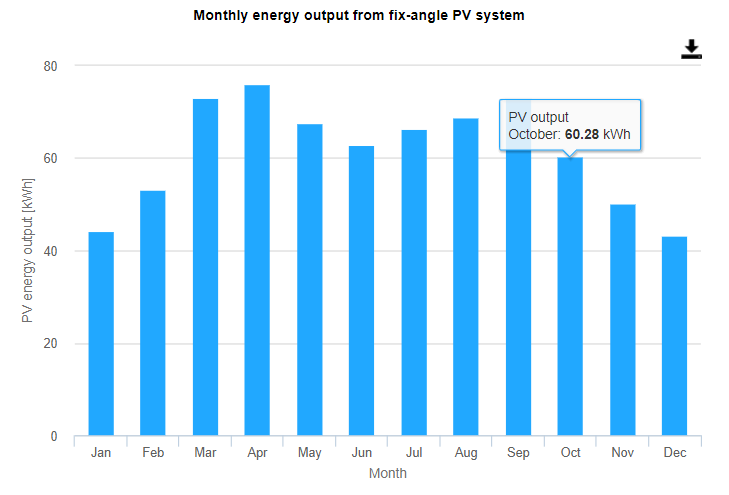
I have recently been working on PV for my (leisure) narrowboat. The requirement is essentially winter-only, because in summer the engine tops up the batteries when we are cruising. This led me to look more closely at the relationship between output and panel slope by month, and I come to the conclusion that, if we could somehow build to maximise winter output rather than maximising annual output, we might, in many cases, have a better trade off. Its often lamented that solar panels generate least when we need the energy most. This is true but it needn't be as bad as we assume... According to pvgis a south facing 1kWpeak array set at 75 degrees to the vertical generates (in the South of England) about 44kWh in the worst month, ie December. Interestingly its only marginally worse at 90degrees (ie vertical) - 43kWh - graph below. So a 4kWpeak array set at 75 deg or mounted on an unshaded wall will generate 5.7 kWh per day in December, more than enough (based on a CoP of 3 or better) to heat most houses, with energy left over for domestic use. The annual production at this angle is reduced by about 30%. There are of course practical considerations, roofs aren't at 90 degrees and many house walls are shaded, but perhaps, just perhaps, we should be spending more time looking for opportunities for vertical or near-vertical placement of solar panels rather than defaulting to roof angle? Unfortunately the output falls off quite rapidly north of the Wash, but that's no reason to ignore the opportunity if you live further South. Just a thought!
-
Thanks for sharing that Ian192744. I was beginning to wonder about something along similar lines but you have done the hard work. I need a 30-40% uplift on a couple of difficult radiators to make them practical in size, and I get the impression from what you say this might come close to that, certainly enough to be worth a try particularly given how cheap a 5 pack of fans is. ian192744 ian192744
-
Thinking around this topic, I wonder what the design characteristics are in terms of speed of airflow (and hence noise) vs extra emission. My thought is that the manufacturers probably tend to go for max emissions per unit area, but perhaps that's not what is needed in all applications. The Grant fancoils, which are 410mm high, do 2356W/1830W per metre length @DT50, respectively on 'High' and 'Low' speed. A 400mm high type 22 radiator is about 1200W per metre length, suggesting that a 'gain' of about 2 is possible. So if (say) only a 30-40% 'gain' is required in a particular application, (and presuming the fan is turned down accordingly) does this reduce the noise level to inaudible? There may be considerable room for 'playing around' here with the trade-offs. It would be nice if they had variable speed and an emission curve!
-
I also fear the bolt on units are too small. Fundamentally a small fan has to go faster to shift a given volume of air, so the fan noise will be greater than if a larger fan is used. Having said that some of the noise is clearly friction at the grilles, which is dependent only on flow rate not fan size. Cross flow fans seem to have quite narrow blades so I do wonder how efficient they are. It's not inconceivable that an array of computer fans with well designed blades could be less noisy. Unfortunately this is either a lot of 'suck (or rather blow) it and see' or a horrible problem in fluid- and thermo- dynamics to optimize. I sincerely doubt that the manufacturers of fancoil units employ fluid dynamicists to do their design, although it might make a good PhD topic. After all this is not an abstract question, there will be plenty of retrofit examples where conventional radiators are too big conveniently to fit and a properly designed fan would fix the problem. On another tack, looking at the specs of commercial units they all claim to be low water content and the grant ones at least have dire warnings about the perils of combining them with regular radiators. Does anyone know the reasoning behind this. For an ashp application it's far from clear that this is helpful.
-
You can buy add on gizmos using computer fans https://www.speedcomfort.com/ https://www.amazon.co.uk/4YourHome-Electric-Radiator-Fan-Power/dp/B0764HNSWM/ref=asc_df_B0764HNSWM/?tag=googshopuk-21&linkCode=df0&hvadid=344405143865&hvpos=&hvnetw=g&hvrand=16317663834846469275&hvpone=&hvptwo=&hvqmt=&hvdev=c&hvdvcmdl=&hvlocint=&hvlocphy=1007050&hvtargid=pla-716714793109&psc=1 and others. That's an option I was also considering particularly as my 'problem rads' are already behind radiator covers. I would prefer something 'properly built' but the impression I'm getting from the posts on this forum is that there is no such thing in which case DiY may well be the way to go.
-
Has anyone here tried/have any practical experience of fan assisted radiators. A couple of my rooms need about 1.2 1kW and Im trying to design for a flow temp of 45C. That makes for a large radiator for the free wall space available, and sadly type 33 is too thick to fit conveniently in the space. So I'm looking at alternatives (if only to rule them out). Fans seem the obvious one, but Im concerned about noise particularly as the bearings wear. Any practical experiences or recommendations?
-
Is the modbus connection active, I thought I had seen a post where the poster had reverse engineered the communication between the controller and the hp because he had found that the modbus connection was inactive.
-
Air source heat pump volumiser tank
JamesPa replied to blankton's topic in Air Source Heat Pumps (ASHP)
"To answer your question about where to find the data for other machines, it’s really a case of googling the part numbers and looking for pdfs" I've been doing that and reading data for about 3 months plus and still haven't found the figures for most models. It's almost like they don't want you to know! -
Air source heat pump volumiser tank
JamesPa replied to blankton's topic in Air Source Heat Pumps (ASHP)
Its so refreshing to read the science-based approach of this forum - a breath of fresh air compared to the mumbo-jumbo and/or marketing hyperbole of many installers and manufacturers literature. This topic does bring us back however to the vital importance of turndown/modulation ratio, the subject of a previous thread. So far as I can see its not easy to find the figure - I can get it for Mitsubishi (about 3:1 according to their specs) and someone has posted that the 12kW LG 2will turn down to 2.5kW - ie a much better 5:1, but finding this in the specs of others seems almost impossible. One proudly boasts that their inverter works (eg) from 10Hz to 130Hz - but unless there is a known relationship between inverter frequency and compressor output that information is totally useless. Has anybody found a way to get this key figure from the readily available data of the common (or not so common) models? -
In answer to the above Im thinking of the 11kW monobloc.
-
Another 'Cool Energy' heatpumps thread
JamesPa replied to HughF's topic in Air Source Heat Pumps (ASHP)
Interrupting the outdoor sensor and switching in a fixed resistor on a timer is cheap and easy, albeit a 'kludge'. A friend of mine did this with a gas boiler to fix up a problem with weather compensation (basically his stupid Worcester Bosch boiler supports weather compensation but applies it even when heating the DHW, so he has switched in a fixed resistor to defeat the weather comp during the times DHW is being heated) It's better to find a more elegant way though if there is one! -
"Rs485 based flow temp setting, from home assistant, based on time of day and who is home (with each family member preferring a certain house temperature)?" HughF - have you actually implemented that or is it just an idea. If somehow the controller (or aspects of the controller) and the hardware could be separated, then at least some of the limitations of current combinations could be overcome more elegantly (and more to the point more efficiently) than using other, totally disconnected, bolt-ons.
-
Has anybody got any further info on this. I had pretty much settled on the 11.2kW ecodan for my installation but I'm now really not sure and the thread isn't yet conclusive. There doesn't seem to be any reliable way to get at the information other than from the experience of others. Has anybody on here got any inside influence on the industry; standby consumption is clearly a parameter which should be declared, or as a minimum included in the declared (S)COP otherwise the manufacturers with high consumption are being allowed to get away with a serious misrepresentation.
-
Another 'Cool Energy' heatpumps thread
JamesPa replied to HughF's topic in Air Source Heat Pumps (ASHP)
A philosophical question here - having gone to the trouble of getting weather compensation right, isn't it better (ie more efficient) to set back the flow temperature at night rather than using a roomstat to effect night time set back. The latter just causes the HP to switch on and off periodically but keeps the flow temp high, whereas reducing the flow temp achieves the same result as far as the house is concerned but improves COP. Of course not all controllers implement this function (see incomplete discussion here): but I have heard of people faking the behaviour (admittedly in a different context) by switching a fixed resistor in and out of the outdoor temperature sensor circuit, to fool the unit into thinking the outdoor temperature is different than it actually is. -
So given the challenges with the politics we probably do need ashps with a high turndown ratio so they can manage without a buffer tank, self learning controllers so that relatively untrained installers can fit and forget and the controller will sort itself out with sensible weather compensation etc. without the (untrained) customer having to intervene. Plus a solution to the dhw problem which doesn't involve the major disruption of retro-fitting a uvc caused by the tundish/drain arrangement. If these problems can be cracked an ashp becomes no more difficult to fit than a gas boiler at which point (if we can also get the price right) we don't need politicians to make unpopular decisions for change to happen. The good news is that none of that seems technologically difficult, but the industry seems to innovate at a snails pace so sadly it could be a long time unless a disruptor emerges.
-
I really hope you are right. But it is going to take some significant compulsion and/or incentives to convince people given the practical challenges, neither of which are vote winners. Let's all hope our politicians have the staying power and conviction to lose votes by introducing unpopular policies for the long term benefit, or alternatively that technology improves to the point where the choice is easier.
-
For big houses with plenty of outside space losing space to buffer tank and dhw cylinder isn't much of an issue. But most of the population don't live in such luxury, and we are building ever smaller boxes at a rate of knots.
-
Sorry Im getting a bit lost on this important topic. Is there a conclusion emerging yet? It looks like some measurements show relatively modest standby power consumption but I'm unclear whether the conclusion is that OP has a rogue machine, the measurement failed to take into account power factor so its not as much a problem as first thought, or (some) ecodans are particularly bad.
-
There is an interesting article here about compressor modulation technologies https://climate.emerson.com/documents/understanding-compressor-modulation-en-us-3844210.pdf The best technology - 'variable speed' - which is more or less what it says on the tin - is claimed to be capable of a 7:1 turndown ratio ie probably good enough. The article speaks quite a lot about the challenges this presents with oil management. Another (which involves PWM of a solenoid valve) is simpler, but achieves only a 3:1 turndown ratio - definitely not good enough. Both are described in terms of scroll compressors. Multiple compressors is indeed a third option discussed. I don't know which technolog(ies) are used in domestic ashps, Obviously having 2 small heatpumps to increase the turndown ratio is indeed an option, and also gives an element of system redundancy, but yet again its making the system significantly more complex and expensive to circumvent a technological/design limitation. One off custom engineered solutions, or solutions with large buffer tanks, are fine for early adopters and enthusiasts like me and others on this forum, but for your average person in a 3 bed, moderately insulated, semi who is replacing a gas combi which delivers instant heating and hot water whilst taking up less than the space of a kitchen cabinet, they are, for the most part, a non starter. Unless gas prices increase significantly compared to electricity prices, so that a much lower CoP (say 2) than those of us on this forum aspire to still delivers savings or at least parity, ASHP will remain a niche market. I'm getting concerned for the planet! We need to build a shedload more wind farms to drive down electricity prices fast!
-
Responses to various comments above Yes, heat loss is dependent on temp diff not absolute temp Yes its true that buffers are a kludge largely to make up for short fall in modulation albeit all they can do is extend the on/off times not change the on/off ratio. But buffer tanks are lossy, take up lots of space and cost money thereby contributing to reasons not to have ASHP. Most on here are probably in an 'early adopter' mindset, but if ASHP is to solve the massive retrofit problem we have then they need to be easy to use! I am personally an early adopter but really don't want a buffer tank if I can possibly avoid it precisely for the reasons above and because it is a kludge. Heating at 16C outside - maybe not, but a degree or so lower and definitely less. 16C is often suggested to be the 'switch off' temp for heating. Its sounding from the above like 3:1/4:1 might be the norm, which is better than nothing, but not sufficient by some margin to work across the temp range without on/off modulation in addition. I wonder if any are radically different or whether it depends eg on compressor type.
-
Triggered by the discussion of standby power consumption (an important spec not often quoted) - what about modulation ratio (ratio of max to min output) which I have never seen quoted. They all tell you that they have inverter driven compressors, but the point of this is so that they can be turned up or down depending on the load so the real question after getting over the marketing hype is how low will they go? Older or less sophisticated boilers have a modulation ratio of about 3:1 (or don't modulate at all). Modern/good boilers have a modulation ratio of up to 10 to 1. Delving into the ecodan specs (which, to be fair, are very comprehensive indeed) the min output at 15C from the 11.2kW monoblock is about 4kW, so an effective modulation ratio of 3:1 (the interesting comparison is max o/p when the outside temp is low to min o/p when the outside temp is just below the point where you switch the heating off altogether.). I cant find any comparable figures for other makes so I have no idea whether the Ecodan is good or poor in this respect. We know that the ideal system just ticks along supplying constantly the same heat as the building loses. To work like this from an outdoor temp of (say) +16C to (say) -2C with a target room temp of 20C, requires a factor of 5.5 modulation ratio at least, probably a bit more if the unit is 'oversized'. So a 3:1 modulation ratio is insufficient without forcing the unit into on/off mode. Do any others do better? Does anyone else publish the data to work it out? 10:1 would be a good target.
-
Apologies for my skim reading!
