JamesPa
-
Posts
1899 -
Joined
-
Last visited
-
Days Won
2
Everything posted by JamesPa
-
Best thermostat hysteresis for ASHP
JamesPa replied to smart51's topic in Air Source Heat Pumps (ASHP)
If one room is always warmer the starting point for a solution is a smaller emitter or throttling the flow to that room (turn down the lockshield). Basically balance for equal room temp not equal dt. -
Water is cheaper than batteries, just much bulkier. If you have somewhere for a large, well insulated tank, it's a good option. The control will need a bit of thought though including stratification (or not).
-
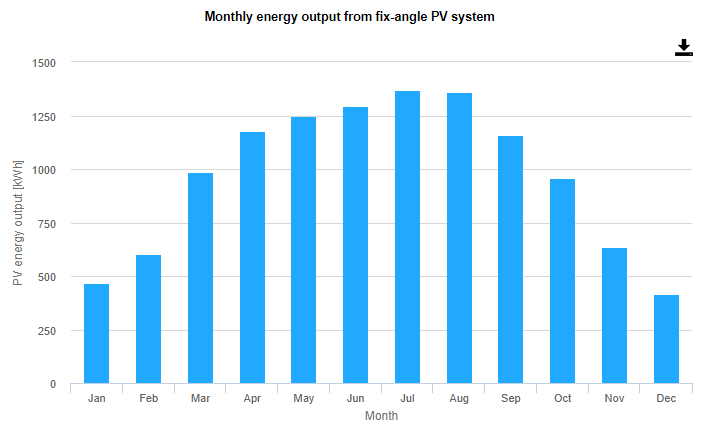
Thats is not enough to sustain the heat pump in the winter months - Its nigh on impossible in a domestic setting, unless you have a very large array, to do this. Here is the plot from PVGIS of the monthly energy from 10kWp solar panels in Romania. In December and January thats about 400kWh/month, 15kWh per day, whereas you say you use 25kWh 'per night'. Do you know have any measure of how much of the energy being produced by your solar panels is currently being returned to the grid during the heating season. Except on mild, sunny days I wouldn't have thought it was a lot if any in the peak heating months, but perhaps it would be significant in the shoulder season. But as those above have suggested, if you do actually have surplus energy (which its likely you do in the shoulder season) you need either to change your pattern of heating so that the ASHP does more work during the day, or store energy. To work out how to store it first work out how much you need to store. Then its either a battery (expensive) or a big water tank. 1l of water heated by say 10C stores about 0.01kWh, so to store 10kWh by heating about 10C you need about 1cu m (1000l) of water. If you accept a low COP of 1, you could use an immersion to do the heating, with a solar diverter, get the temp up to 80C, which brings the volume required down to say 250l for 10kWh, assuming you need water at 40C for your emitters. You need some rough numbers to work out the right solution and, as @SteamyTea says, you musn't mix up energy (kWh) with power (kW). The latter is just energy per unit time thus power * time = energy so 2.5kW for 10 hrs = 25kWh. Same as kilometers per hour (distance per unit time - like power) * time = kilometers (distance - like energy)
-
Probably the only 'safe' (in the sense that installers are unlikely to object) tank is one where the coil is at least 3 sq m and the size is at least 45l* (greater of number of bedrooms +1 or actual occupancy). Unfortunately you may also get installers who insist on 28mm primaries to the tank, or using a pre-plumbed tank, so even this is not absolutely guaranteed (incidentally I would run a mile from any installer that wanted to use a pre plumbed tank unless it makes sense in terms of the layout of your house. if they are shoehorning a pre plumbed tank in where it doesn't fit its because they use rookie plumbers and there is less chance of cock-up with a pre-plumbed cylinder ). If you want to get a feel for it you could play with the simulation in the DHW tab in the attached workbook With all the usual warnings that its a theoretical simulation only etc... WC Simulation.xls One of the more rational reasons for large coil size is the risk of cycling towards the end of the heating period if the coil is too small. This is of course a particular problem if you have a high capacity, oversized, heat pump that doesn't modulate down well (as fitted by a fair few installers). Cycling will extend the reheat time quite dramatically. You say you are looking at around 6kW however - at that level you are very unlikely to have a problem with a 'Vaillant' coil size in practice, but of course that wont necessarily convince an installer.
-
All true but... Many, if not most, installers oversize heat pumps The loss of a couple of hours heating time matters only in the very coldest weather you could always supplement using the immersion on those couple of days per year and its rare that a whole tank is reheated anyway. We dont have to engineer everything for the six-sigma (or even three sigma) circumstance, and the industry has no right to force us to do so. Its another one of those things where the homeowner should be allowed to make an informed choice, not installers allowed to force a particular solution down their throat! Why shouldn't the OP be able to fit a reasonably specified cylinder now, provided he /she is happy to live with the consequences when he subsequently comes to install a heat pump?
-
Unfortunately I have to agree with @sharpener here, I have encountered some pretty obstinate installers in my attempts to get a heat pump installed. This the question is effectively not a technical one, its about installer/heat pump manufacturer obstinacy & preference. Oh, and the argument 'well its my house' doesn't work. There is always the work-around of fitting an external plate heat exchanger/circulation pump in place of or in addition to the coil (as fitted by Mixergy, Mitsubishi and at least one other heat pump manufacturer). There are actually some arguments that such an arrangement is anyway preferable, but I fear many installers wont play ball because its not in their book. That said, the installer I am hoping to use (if I eventually beat my LPA into submission) actually does this pretty much by default, combining a PHE plus pump with a bog standard cylinder, but he is in the minority Vaillant tanks look suspiciously similar to OSO ones. Also, like OSO, they have an o/d of 600mm not 550mm which means that they are shorter from any given volume, an advantage in some circumstances (including my own).
-
It was ever thus. Why do you think most condensing boilers, the advantages of which were much hailed when they first came out, are adjusted when installed so they don't condense most of the time?
-
Possible increase to BUS grant - anyone heard anything?
JamesPa replied to sharpener's topic in Air Source Heat Pumps (ASHP)
The problem is simple, you have the wrong house for their way of doing things. Solution - change the house. Ignoring this though it sounds like progress. -
ASHP with RHI - Restrictions on Other Heat Sources?
JamesPa replied to Barnacles's topic in Air Source Heat Pumps (ASHP)
-
probably a silly question but... I will hopefully be replacing my vented cylinder with a UVC as part of a heat pump installation (if, as I sincerely hope I will, I can eventually beat my cloth-eared LPA into submission). I have good water pressure. Currently I have to run off 6l of water into the kitchen sink before I get hot water, which is quite a lot. I can probably replumb about half the length of the current 22mm DHW pipework with 15mm, but the rest is inaccessible - unless I rip up solid flooring which isn't going to happen). There isn't an alternative route which can be accessed without major disruption. I could fit a point of use heater, but that would result in COP of 1, as opposed to about 2*9/15 =1.2 (which is what I effectively get if I run say 9l of hot and 6l to waste with a HP COP of 2). Is there any known way to reduce the effective volume of 22mm pipework without replacing it. I suppose I could feed a sealed length of 10mm pipe in from places that are accessible, until I hit a stop? I think there may be only one 90 deg bend 'in the way' but I cant see plastic pipe going round that. Comments on that, and other off the wall (or well established) ideas, appreciated. My gut tells me that the best answer is 'don't bother' but in case I have missed something its worth asking.
-
All fair enough, but we could still do with some more flexibility for uvc placement etc that provide options to the rigid way G3 is interpreted. As it happens I think I have finally found a viable route for the vent for mine (other than putting it the loft, which is wasted energy). This is perhaps the only upside of the delay caused my lpa!
-
I agree where the proportions are as you say and there is no reasonably viable alternative. That and be more flexible over alternative options for achieving the g3 requirements rather than slavishly insisting that the non-mandatory guidance is followed. The industry needs to start serving its customers, currently it seems to be the other way round.
-
Radiators, not sure the source of the hot water for the rads. It's not mine, I'm just staying there. I posted it to point out that there other ways to deal with one of the current disincentives to ashp retrofits, if only we would get out of our box and learn from others.
-
In a retrofit for a small house or flat: locating the tank, running the primary feeds to the tank and most problematic of all, the (totally ott) g3 vent which is a real problem even in my much larger retrofit, even more so if you follow the building regs as regards notching and drilling (which I guess many dont). Easy in a 200 sq m newbuild, a real pita in a retrofit which is >90 percent of the market that we need to tackle. More to the point the dhw is a significant part of the ashp retrofit cost and disruption because of how difficult the industry has choosen to make it.
-
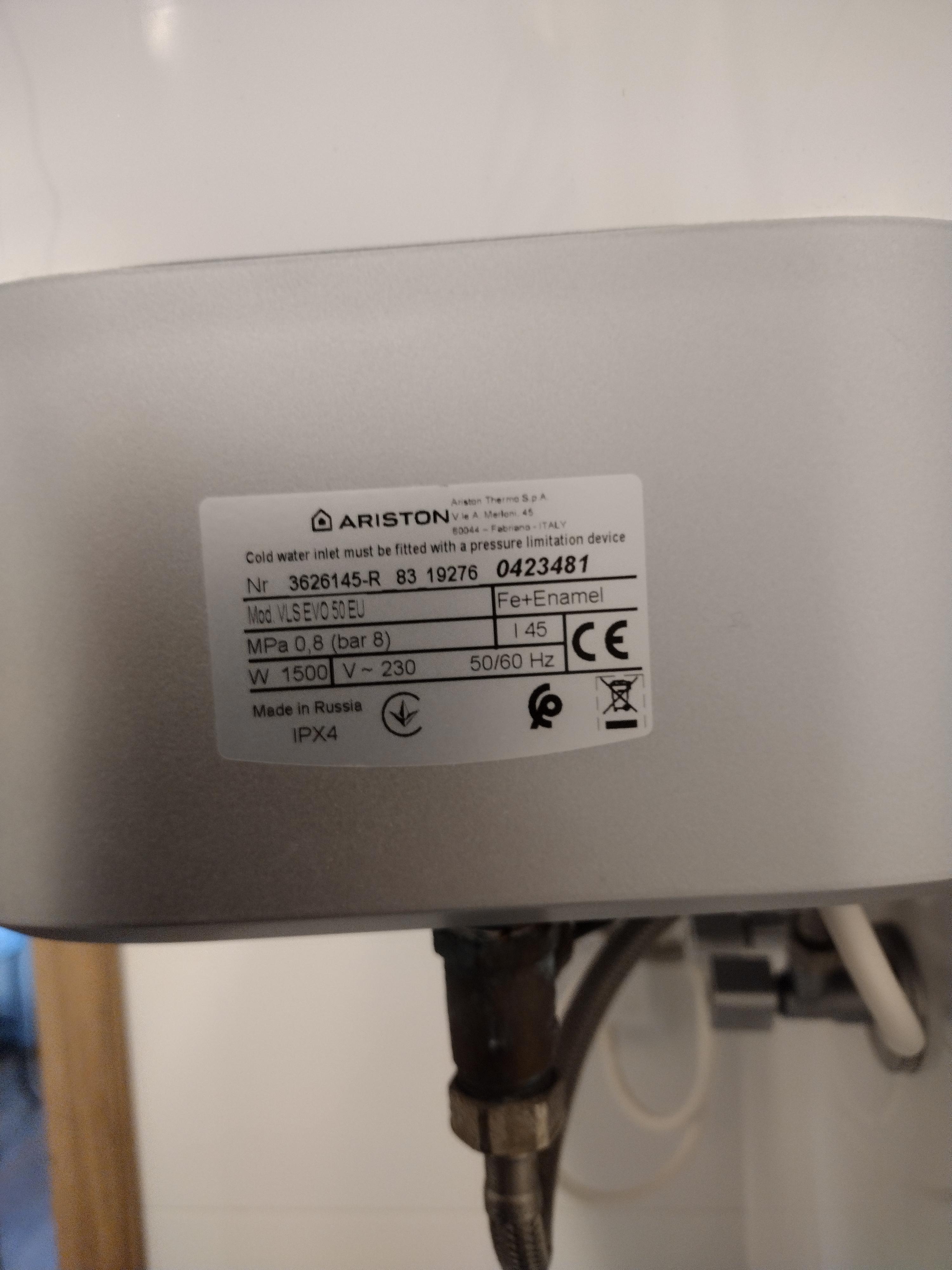
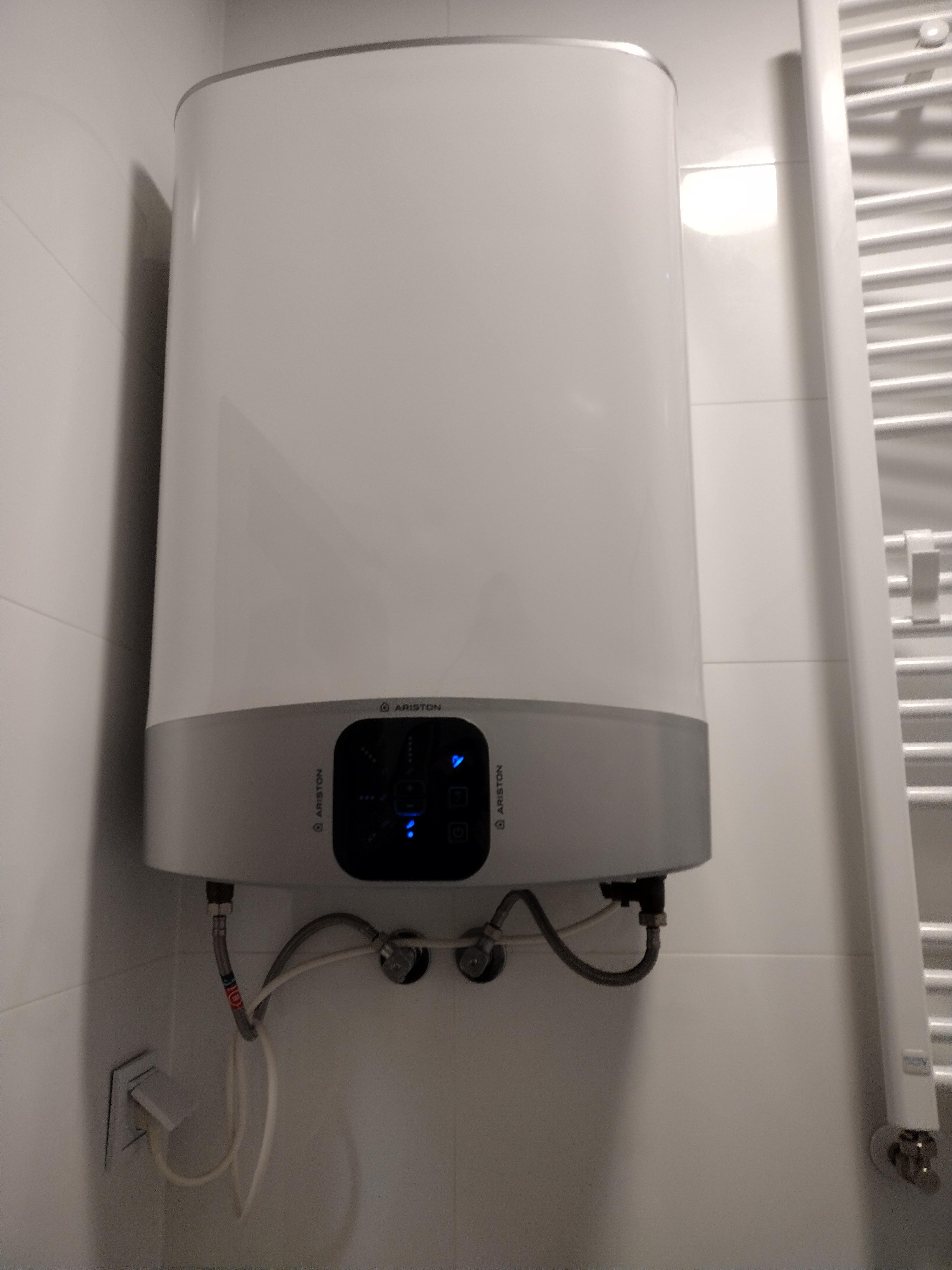
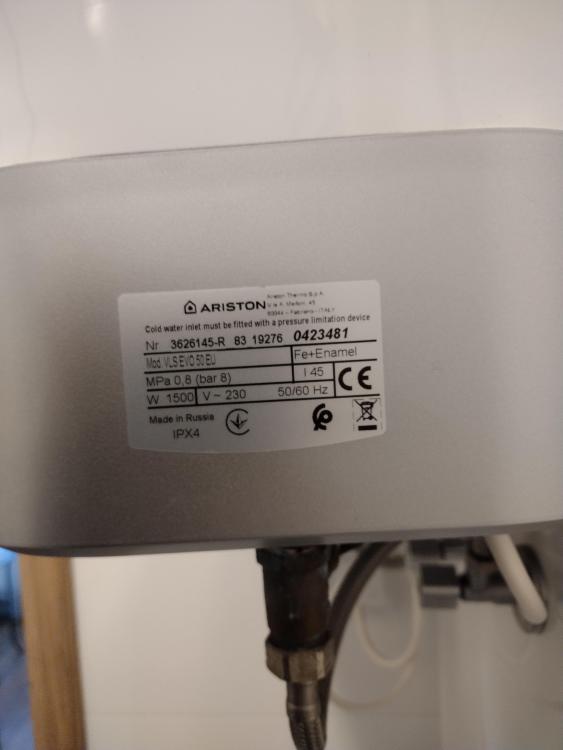
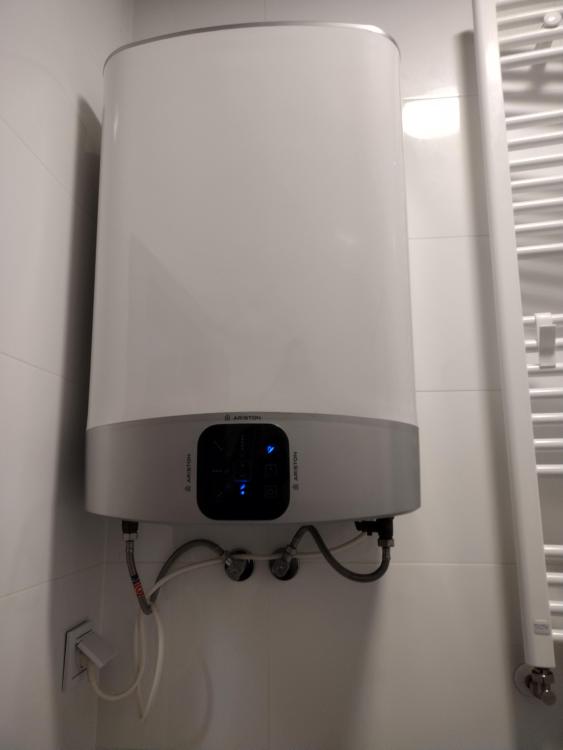
The model pictured is actually 50l which I believe would require G3 in the UK. There is what looks like a prv on the cw inlet (just about visible in the photo), which vents to the tiled floor of the bathroom. Ariston do bigger ones as well, the one in the picture is the size of a combi. I guess my point is that others seem to be able to find solutions to things we make extraordinarily difficult.
-
As fitted in an an apartment in Poland. Perfect surely for a 1-2 person flat. I'm posting this in view of the many discussions about the challenges of dhw with ashp. Sometimes I think we make things too complex!
-
MCS consultation on amendments to PD rules
JamesPa replied to JamesPa's topic in Air Source Heat Pumps (ASHP)
https://www.omegawestdocuments.com/media/documents/43/43.20 BS 82332014 Guidance on Sound Insulation and Noise Reduction for Buildings. London BSi.pdf at page 70 of the PDF (numbered 64 on the actual document). Basically (as I read it) its saying that a solid facade with a window in will have an attenuation of ~15dB. I guess the window alone is less, the solid bit more. Elsewhere in the doc there is more detail but I have seen this used as a rule of thumb elsewhere. Thinking about it I would say that, experimentally, the background noise where I live, which daytime is 40-45dB(A) is fully attenuated to below 30dB(A) if I put the window in the master bedroom to either vent (slightly ajar) or closed, so Im prepared to believe that a facade with window is at least 10dB. This assumes I don't stand right next to the window inline with the opening. If I do I would say that the attenuation is only 0-5dB). In a car your ear is level with and only 30cm from the chink in the window, so you get a rather distorted situation relative to a typical domestic scenario). At some point, with a window that is just slightly ajar, its like a solid but finite barrier, which we know does attenuate quite significantly. -
MCS consultation on amendments to PD rules
JamesPa replied to JamesPa's topic in Air Source Heat Pumps (ASHP)
I was also surprised but it is what bs8233 says, at least on my reading. Perhaps it means window in vent mode (ie nearly closed), or perhaps I'm misreading (but I don't think so). -
MCS consultation on amendments to PD rules
JamesPa replied to JamesPa's topic in Air Source Heat Pumps (ASHP)
Yes, but not than oil boilers from what I am told. We have to remember that an ASHP condenser is the new gas flue. There is NO alternative mass market domestic heating solution which materially reduces carbon emissions. Thus it has to be simple and cheap to get permission otherwise we cant fix climate change. Its important to keep one eye on the objective! 25dBA is pointlessly low. According to BS8233 a window closed or ajar attenuates by 15dB. So the interior noise level corresponding to 25dB(A) at the nearest assessment point would be 10dB(A). Also according to BS8233 an interior night time noise level of 30dB(A) is 'desirable' in a bedroom. So 10dB(A) is a ridiculous target in relation to established methodology for assessing noise in buildings. This is yet another reason why the planning rules should be in planning law not written by a third party that doesn't have a legal mindset and is paid for by the industry. Law needs to be precise not woolly, MCS wording is too often woolly. I had a 'woolliness' discussion with them over insulation to DHW pipework in retrofits. Their rules, if read straightforwardly, simply don't make practical sense. In the end they conceded that and came up with a circuitous way to interpret them so that they do make sense (which I have in writing in case of need). -
MCS consultation on amendments to PD rules
JamesPa replied to JamesPa's topic in Air Source Heat Pumps (ASHP)
It does belong in a different discussion and its another crazy rule. For example If I were to cantilever my heat pump out from the garage flat roof, which is perfectly practical and actually quite convenient, the noise level at the nearest assessment point would be 29dB(A), because solid brick walls are in the way. Its actually technically a good solution and, properly done, wouldn't look too out of place and is anyway hardly visible either from the public realm or the neighbours garden. As it is the best I can do is 34dB(A) (still not good enough for my LPA) and that depends on an 'added' barrier which I guarantee wont be as good as a brick wall. However the cantilever solution violates both the 1m boundary rule and the 1m from edge of flat roof rule. -
MCS consultation on amendments to PD rules
JamesPa replied to JamesPa's topic in Air Source Heat Pumps (ASHP)
I am not sure what the intention is with the background noise thing. It could be that the 42dB(A) total limit stays in which case an ASHP in a quiet area could be noiser than in a noisy area (there is actually some logic to this). Alternatively it could be that 42dB(A) applies to urban and a different limit (and different background) in rural. It makes a big difference which they choose and it isnt specified. I asked MCS in a separate communication where 42dB(A) came from and what the rationale was. They said DLUHC, and that they didn't know what the rationale was! This being the case I really don't see how they can propose changing anything, but they have My LPA now asks for a BS4142 assessment for a domestic heat pump installation even if its only for heating and one external condenser. This is ridiculous overkill and totally disproportionate IMHO, would they do that for a gas or oil flue?. I got my application in just before they adopted this as a policy, but currently they want me to achieve 25dB(A) at the most affected assessment point, which is essentially impossible (and wholly unreasonable). If I find myself having to submit again I will probably fight the policy of requiring BS4142. The law says that LPA document requirements must be both reasonable in proportion to the application and likely to have a material effect on the outcome. It is certainly the latter but not the former, given that there is a simple spreadsheet available from MCS and from the Institute of Acoustics/Chartered Institute of Environmental health https://www.ioa.org.uk/heat-pump-briefing-notes-calculation-sheet-ioa-cieh There is an external dispute resolution process if you think your LPA is unreasonably demanding documentation, and I think there would be a good chance that a case put to that would come out in favour of the applicant not the LPA particularly given what IofA says. -
Possible increase to BUS grant - anyone heard anything?
JamesPa replied to sharpener's topic in Air Source Heat Pumps (ASHP)
That was also my first thought. I'm clearly also a cynic. -
Well that's sort of the point. Skins would be a good idea. There are a couple of companies that will print this sort of thing on magnetic plastic
-
Ture, but if you dont use MCS you need express planning consent and cant do it under permitted development. Madness and shameful.
-
It would make sense to sell alternative covers wouldn't it. As you say the glass (which I actually quite like from the pictures) front suits a swanky flat or ultra modern house, but less so a 1930s house.