


JamesPa
-
Posts
1899 -
Joined
-
Last visited
-
Days Won
2
Everything posted by JamesPa
-
Agree. Time will eventually fix this, batteries will become cheaper and the fact that EVs are fundamentally simpler (much simpler) will eventually win out and once range anxiety is fixed (which will likely happen first) the choice will be a no brainer for most. The Chinese are driving down costs of production big-time. The history of new technology is that it starts expensive and gets cheap. Take Digital Cameras as the obvious recent example. As to your comment about the politics, what can I say? The politicians in charge talk the (climate change) talk but don't walk the walk. Just on Tuesday the (very controversial) Offshore Petroleum Licencing Bill got its third reading in the Commons (as it happens I was in the public gallery when the division took place). The bill places the North Sea Licencing Authority under a duty to run annual licencing rounds for new fossil fuel exploration (currently they do not have to do so).
-
If they replace existing double glazing then I suspect yes, judging by how much difference simply replacing the glass made to my house.
-
You might be surprised how much difference it makes, at least to comfort. I certainly was. Not really true. Many older houses (mine included) can be effectively insulated. Not to the absolute best standards sure, but enough to make them much more comfortable. Its a job for when you are otherwise refurbishing or at least decorating. We have heard a lot about what you are against. Whats more interesting in many ways is what are you in favour of? What do you believe we should be doing about climate change, both individually and collectively?
-
All very balanced if I may say so. Regarding using e-cars to support the grid, its clear that the major challenge is ensuring that the car is charged when required. However electricity is generally cheap and plentiful overnight so for most people, who only very rarely make long journeys overnight, it might be possible to design the problem out. Some carefully calculated financial incentives (which is the only way its going to work) and some guarantees about minimum charge at say 7am will likely persuade many that, so long as they have an easy to use 'just charge me and sod the cost' button that they can push when they have to do a long journey, the exchange is worthwhile. Of course some will have a pattern of journeys that doesn't fit, thats fine its not necessary for everyone to take part. Batteries are also of course interesting. It seems that e-car batteries have turned out to be much more resilient than was initially thought/feared, but we probably wont know for certain what effect V2G has until its been tried for a fair few years. That's a good reason for it to start early with those who, for whatever reason, it suits, so some actual data can be collected.
-
Indeed so, representing yet a further complication in an already difficult calculation, with the unknowns of 'when will the car be scrapped' and 'how many miles does the new owner do compared to me?' It all comes down to - "where do you draw the boundaries for the purpose of the calculation?" Ideally (for the climate) those people who do large numbers of miles should have the relatively few electric cars that are on the road, whilst those like me who do fewer miles, should keep the fossil fuel ones going until a natural point of replacement, and then buy electric. But of course the real world doesn't work that way. This article https://www.zerocarbonguildford.org/post/should-i-buy-an-electric-car attempts to do some calculations in several scenarios and gives values for embodied energy which are at least plausible. On balance I think I can probably justify the vehicle upgrade environmentally, albeit that its a fine balance. So my intent is to indulge myself in a (secondhand) electric car within the next year, quite possible sooner. Fortunately the calculation for domestic heating is much more straightforward. The embodied carbon in a heat pump is order 1 tonne https://library.mitsubishielectric.co.uk/pdf/book/PUZ-WZ80VAA_TM65_Embodied_Carbon_Calculation#page-1), which means that it pays back environmentally in less than a year.
-
Its worth considering hitting parts only, you don't need to do the whole thing in one go or achieve passivhaus standards. There are bits of my house where, when I redecorated (room by room), it was easy to add IWI, so I did so. Other bits less so, and I didn't. Extra loft insulation is cheap and extremely effective. As the glass in my 1980s double glazing has started 'blowing' I have progressively been replacing the sealed units with low E argon filled. Together these save about 3kW at -2, on a house which is now 7.5kW at -2. That's quite a saving in energy and money. Obviously whether it 'pays back' 'financially' depends on life expectancy. It probably will for me, I did most of it 10 years ago and I should, according to the stats, live more than another 10 years. There is also however the comfort factor, better insulation = better comfort and that's not to be ignored as one gets older. Of course I accept that some people cant afford these upgrades, and would be willing to pay a bit more tax to support more aggressive climate policies at the national level.
-
No I don't think its hypocritical because (a) I will and have a plan to adopt them very soon and (b) I am not arguing that I wont do so. And my comments referred specifically to some people who wont change not those who cant. I recognise that many cant afford to make the change, and I made no comment on this circumstance. Im currently prevented from adopting an ASHP by my local planning authority. I've been fighting for 2 years, and continue to fight, the battle with my LPA and, once I win, an ASHP will be in. So I don't see how I can possibly be accused of being hypocritical on that front when the law prevents me from making the switch - many wouldn't bother with the fight! Re the car, its a fine ecological balance so far as I understand it. I dearly want (out of what I suppose could be considered avarice) to replace my 13 year old car. However there is a very sound ecological argument, as I do only about 5k miles a year, that the embodied carbon in an EV to replace a functional fossil fuel car does not make ecological sense. To be honest I don't know where the balance lies here, its quite possible that it lies with keeping the old motor until it is no longer functional, which I wont do because even I do occasionally like new (it will be second hand actually). Perhaps that's the hypocrisy - buying anything new when I have a functioning old model, but for sure I wont be buying another fossil fuel powered car. The CO2 emissions from my domestic heating (about 4 tonnes per annum) significantly outweighs the contribution from the car (about 1.3 tonnes per annum) and the embodied carbon in a car far outweighs that in a boiler, so prioritizing the heating also makes ecological sense (although in reality Im pursuing them in parallel). I should add that I have had solar PV since 2011. Finally, neither of these technologies are 'my favoured technologies'. They are just the only ones we currently have to mitigate two major contributions we each make to carbon emissions, without completely changing the way we live. If there are better technologies available to do this please name them.
-
More or less all agreed. My main point is that there are a large number of people who wont (not cant) make any change that causes (or which they perceive may cause) them personal inconvenience or cost, even if it benefits society at large or their children/grandchildren. Putting it bluntly, they don't care about (or can't see) anything beyond their own small world as it is today. They are egged-on by the the fossil fuel industry, the Daily Mail and the Daily Telegraph, GB News, Donald Trump, several British politicians (including but not limited to the Honourable member for the eighteenth century and his cronies), and the other people and organs of those who benefit from the status quo, don't understand or care to understand the science, and who are prepared to tell lies or half-truths to advance their own cause. However like you I am optimistic and believe things are changing. I don't yet have an electric car but it wont be long. I too want to wait until there is a natural replacement point; my annual mileage is about 5000 per year so it is probably environmentally more friendly to run my diesel car until it is a few years older anyway. But I definitely will NOT be buying another fossil fuel car, as well as being environmentally more friendly electric cars are just better in many ways (arguably every way except range) than ICE cars - simpler, faster acceleration, you charge them up at home so leave every day with a full tank, and you will eventually be able to use them to optimise your electricity bills. Nor do I yet have a heat pump That's not for the want of trying, I have not got one solely because of my LPA, which (even though it has formally declared a climate emergency) is obstructing every attempt, has its head in the sand, and believes that insisting on a noise level of 25dBA at the most affected assessment point makes sense. Eventually I will win this battle of course, its just taking more time and stress than I had hoped or even expected!
-
I don’t think the incentives are artificial, grant towards heat pumps because of people power wanting to tackle climate change. Artificial in the sense market-distorting I think it’s the changes the majority of the public wants (stop burning fossil fuels) In principle the majority may want this, but in many, probably most cases, only if it doesn't cause them any personal inconvenience or additional cost (and never mind about the (grand) children.
-
Sadly there are people out there, perhaps the majority, who care only about themselves and think that any problem that isn't specifically theirs is, by definition, the responsibility of some else. The odd thing is many of those people apparently don't care about their children or grandchildren either, because if they did then they would be a lot more proactive in relation to climate change. That's why governments have to create artificial incentives and compulsion to make the changes that society needs.
-
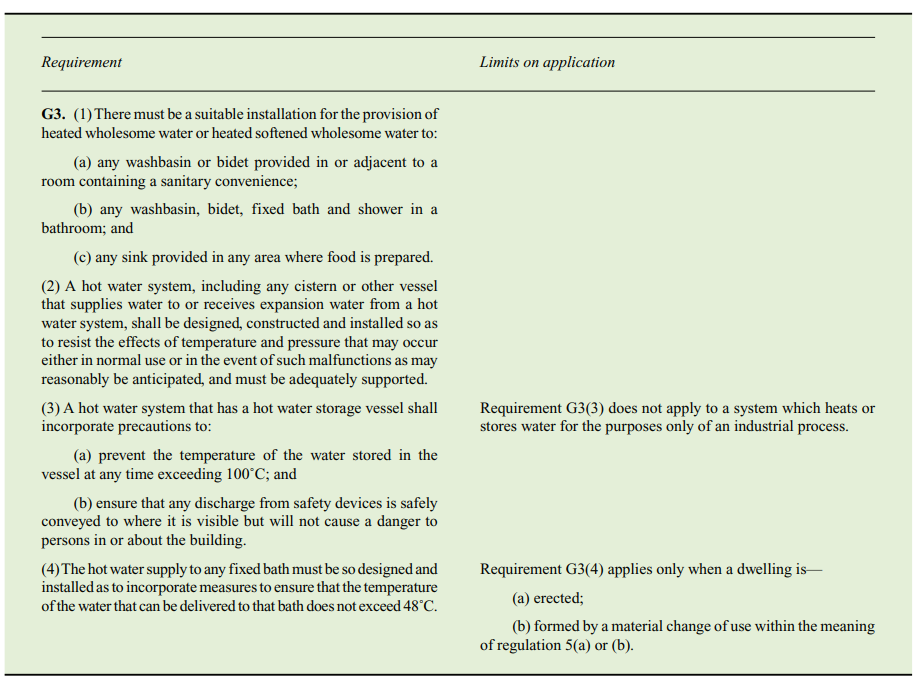
@JohnMo @sharpener I read the Building Regulations 2010 (England) (as amended by subsequent enactments) end to end (except the bits specific to types of building other than DHW). I confirm that the only requirements I could find are (a) that the works conform to the specified requirements (reproduced below) and (b) to notify the local authority of the works (which, in England anyway, attracts a fee) unless the works are carried out by someone who is a member of a competent persons scheme. Some might argue that the 'safest' way to achieve this (if you are yourself fairly capable) is to have the qualification and do the work yourself, working strictly to the guidance document and manufacturer instructions, with the next safest way (or safest if you are not yourself fairly capable) being to employ someone who has the qualification . In the latter case, if they are also a member of a competent persons scheme, building control don't have to be notified. However none of this is an actual requirement in the regulations, unless I have missed something*. Its rather interesting how the law has been drafted, even more so since @JohnMo tells us that his building control weren't interested. (*there may have been something additional which applies if you are doing the work as a business for another person - I wasn't looking for that) Additionally there may be guarantee/insurance issues as you point out, although I do wonder how valuable this is - i.e. how many DHW cylinders fail within the guarantee period I wonder - other than the immersion heater?) For an individual keen on DiY there might be a good case for simply doing it, and getting building control to inspect and issue a completion certificate or tell you what was wrong. Regulations related specifically to DHW reproduced below
-
Fascinating, you might think it was easy money for building control!
-
Note that V2L and V2G are not the same thing. V2L is not grid-synchronised whereas V2G is. Be careful to check that anything you do choose can actually do what you want. Its clearly possible in principle to separate your house from the grid, but I don't know what, if any, equipment offers it in a way that is permitted. One underlying issue here is that the grid operator needs to be absolutely sure that, when it cuts the power so its employees can work safely, someone isn't feeding power in from downstream. That results in tight regulation.
-
Agreed. We all have a part to play in making the world work well, we cannot just say 'its someone else's problem'. Once we get to the point where a large number of people (eventually it will be most) have one or more 60kWh batteries sitting on their front drive doing nothing most of the time, its a bit of a no-brainer that these should, if reasonably possible, be used for grid balancing. The principal challenges are working out how to ensure that they are charged when needed for transport, and incentivising users to make them available to the grid. Octopus are at least having a go. Its very, very early days for this technology but it clearly hat the potential to sort out a significant part of our (shared) grid balancing challenge.
-
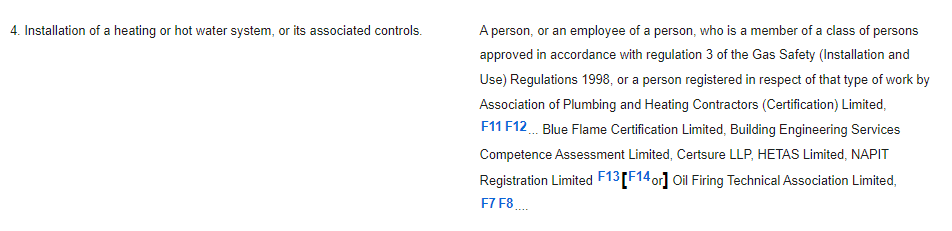
Thanks for looking this up. Its particularly interesting that they use 'should' for the installation and 'shall' for the maintenance. One might expect it to be either the same or the other way round. Poor drafting? The 'competent person' chestnut is as you say an old and frequent one. Its obvious that a way to 'prove' competence is to have a relevant certificate (notwithstanding all the evidence that many HP installers are not very competent), but its not clear its the only way. A key point (as I understand it*) seems to be, however, that even if you have the qualification (proving 'competence') you still need to notify building control (and thus pay the notification fee) unless you are also a member of a competent persons scheme. I guess that if you do notify and also present your certificate of competence they may be less likely to inspect, but since you have paid the fee anyway its unclear whether this is to your advantage. All a bit confusing! *The closest I have found in the actual regulations (applying to England) is reproduced below Building Regs 2010 Article 12 And from Schedule 3

-
If that's correct then it's a long way from what the industry tells us, ie that you _must_ have the qualification to install a UVC (with a strong implication that it's a legal requirement). I think I will do some more reading of the building regs!
-
I'm am also a bit puzzled to be honest. I'm trying to find the regulation that requires a certification to install a uvc, requires annual maintenance and requires a certification to maintain. So far I haven't found it in English law (but I admit I haven't read the building regs 2010 end to end - yet). What I have found is a requirement to notify the local building control unless you are a member of a self certification scheme. I'm not suggesting its not there, but I would like to find it.
-
You have very helpfully made this suggestion several times. Round here (Southeast England) it seems very difficult/impossible to do a G3 course without having a plumbing certificate (I havent actually checked that they enforce this mind you, I have only checked the 'course preprequsites'). Also what exactly does it allow you to do (or mean you dont have to do). So far as I understand it you can install and maintain, but the requirement to notify building control remains unless you are also a member of a self certification scheme. Is that correct? (Of course this may differ between England and Scotland so please answer, if you are prepared to, for whichever you know)
-
Octopus have just launched a use your car as a battery tarrif https://octopus.energy/power-pack/ At present its more or less only the Leaf which is compatible, and you need a specific wall charger, so its pretty limited, albeit (in my view) the inevitable future. I have a feeling (but someone please correct me if Im wrong) that only CHAdeMO currently supports V2G (hence pretty much leaf only), I think the CCS and Tesla charging protocols are both promising it in 2025, although Elon musk is apparently on record as saying that V2G isn't useful (presumably because he prefers to sell powerwalls).
-
Possible increase to BUS grant - anyone heard anything?
JamesPa replied to sharpener's topic in Air Source Heat Pumps (ASHP)
That all makes sense. Unfortunately probably too much for some plumbers used to installation by numbers (but not ones they calculate). I wonder what happens if you just insist and offer to sign a contract of indemnity? -
Possible increase to BUS grant - anyone heard anything?
JamesPa replied to sharpener's topic in Air Source Heat Pumps (ASHP)
Sorry to hear about your plumber! At DT5 and 1m/s 15mm is good for 3kW. At 1.5m/s (which may be a bit noisy but is in spec for the pipework itself) 4.5kW. https://www.heatgeek.com/does-my-pipework-need-upgrading-for-a-heat-pump-with-cheat-sheet/ That is, in fairness, a bit low by normal standards. However if your heat pump will modulate down to this value and you are happy with a slower re-heat (but still faster than an immersion), what's the logical objection (other than the cylinders instructions which probably say 22mm)? If I recall correctly you are having a Vaillant pump fitted which is capable of a flow temp of 70. Assuming you are heating to 48 that's potentially a DT of up to perhaps 15 (assuming say 5C between water and flow) 20 in which case 15mm is plenty. Then use the immersion for legionella (or don't bother which seems to an increasingly common approach) Unfortunately most plumbers seem not to do design, they just follow incoherent rules! -
So is this just the 'i' in a pi or pid control system, the gain of which they have made adjustable to account for the varying system inertia. (How many installers could cope with that?)
-
Depends on your objective. Remember 70kWh oil = 25kWh with an ashp. Its unlikely you will get this amount from solar in deepest winter, but in the shoulder season you may well do so. Presumably the barn has a large roof?
-
I confess the optimum arrangement isnt obvious to me, particularly if you plan to heat the water to a high temperature. In this case you might be best treating the tank like a thermal store and varying the speed with which energy is transferred from the store to the heating water to get it at the right temperature. Some sort of heat exchanger with a variable speed pump and feedback might do the job. Others may have alternative suggestions. Batteries are simpler, and of course will also be useful in summer, but significantly more expensive. Depending on how your feed in tarrifs work they may not make financial sense.
-
Best thermostat hysteresis for ASHP
JamesPa replied to smart51's topic in Air Source Heat Pumps (ASHP)
Only if the temperature of other rooms doesn't matter. If you throttle the hp output to all rooms the one with the solar gain will still be hotter. So the requirement if this room is always hotter (which is what we are told is the case) is to make this room cooler without affecting other rooms. Obviously this depends on whether it's really the case that the room in question is always warmer, but that's what we have been told. Logically it makes sense (as heat geek advocate) to balance for room temp not for equal dt. Balancing for equal dt assumes that the emitters are correctly sized, which is not the case (ever). But of course it's more difficult so installers are unlikely to do it and balancing for DT is often good enough. But homeowners can!
