


Rishard
-
Posts
181 -
Joined
-
Last visited
Everything posted by Rishard
-
Oak doesn’t ‘need’ finishing. It’s often an aesthetic choice. The lovely golden colour of milled oak soon goes when exposed to the elements. If you oil it, generally it stays golden for 5 or more years but you set yourself up for a life time of maintenance to try keep that golden colour. Osmo is good for this but I have found it is useless on any surface which isn’t vertical. Horizontal weather bars seem to flake, peel and start the greying process.
-
Battening - getting them flat and true - how?
Rishard replied to Dreadnaught's topic in General Self Build & DIY Discussion
All of the above is good advice on fixings, especially if your lats are wet as they are likely to dry out and lose that initial bite they have on a screw . I typically start by finding the furthest out bulge. Once this is established I set up a string line horizontally from the furthest points. Practically impossible on your own as you need a person at each end of the string and someone eye’ing the string so it is just off touching the lat at the bulge point. You now have a straight line to pack and fix your lats to. I use plastic shims as they don’t compress. From here you can plumb up your vertical lats and pack at the fixing points. Sadly in your case it might mean starting again, or finding the bulge point and packing everything else. 2mm tolerance would be fine for most claddings but with a nice long straight edge and plenty of time you could get it perfect! Hope this makes sense. -
Siberian larch vs sweet chestnut cladding
Rishard replied to PeachyBeechy's topic in General Construction Issues
Thanks @SteamyTea is there a feature somewhere to do that? -
Siberian larch vs sweet chestnut cladding
Rishard replied to PeachyBeechy's topic in General Construction Issues
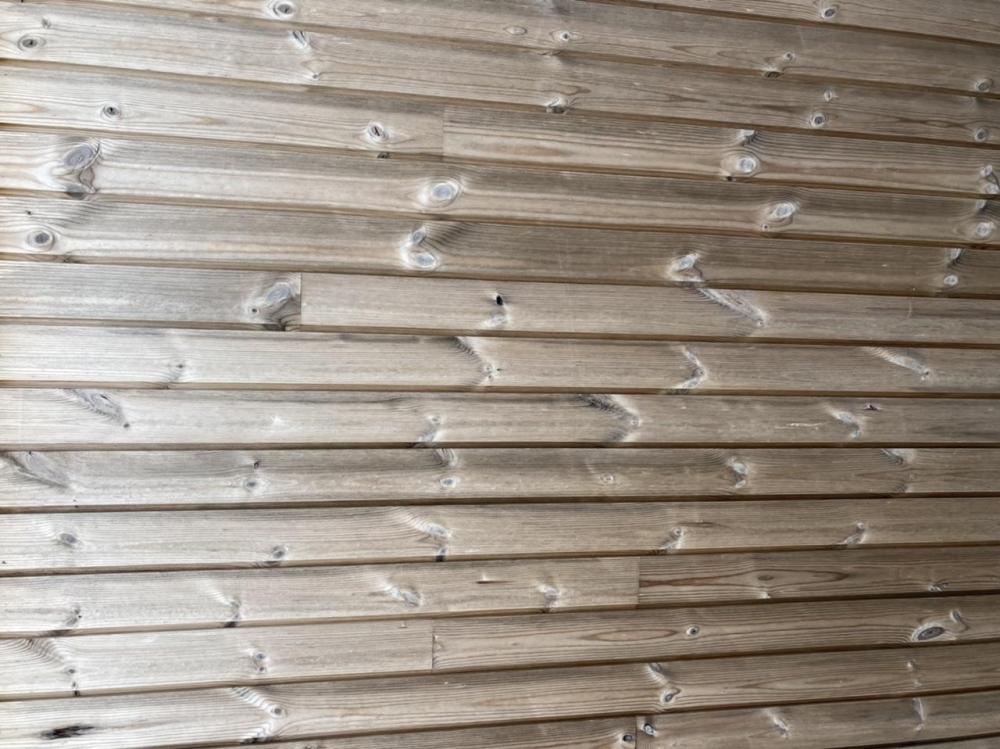
I’ve only really used Siberian larch and never Scottish. Mainly due to the supplier I use but they do produce good quality profiles. Duffields timber in North Yorkshire if you wanted to check them out. They might not come in the cheapest but always good to compare costs. I recently re-clad a clients gable with thermowood ( radiata pine) I’ve done plenty of jobs with it now. What I will say is it is super stable… I did some vertical shadow gap cladding for a shed 3 years ago with some square cut butt joints meeting on the counter batons and the stuff hasn’t moved 1mm. It works really well for contemporary looking finishes I would say. When I used it with a more traditional feather edge profile, I was a bit shocked at the grain or more the knot quality of the wood. It’s not particularly attractive when looking at such wide boards I don’t think. One good thing is it stays where you fix it. The initial colour is quite soft unlike fresh larch but un-treated they all end up that lovely silver colour. Not sure why I can’t turn these pictures the right way round. But this is 3 years apart. Thermowood. I have tons of pictures of western red cedar jobs, thermowood and larch if I can find a way to turn them the right way round on here?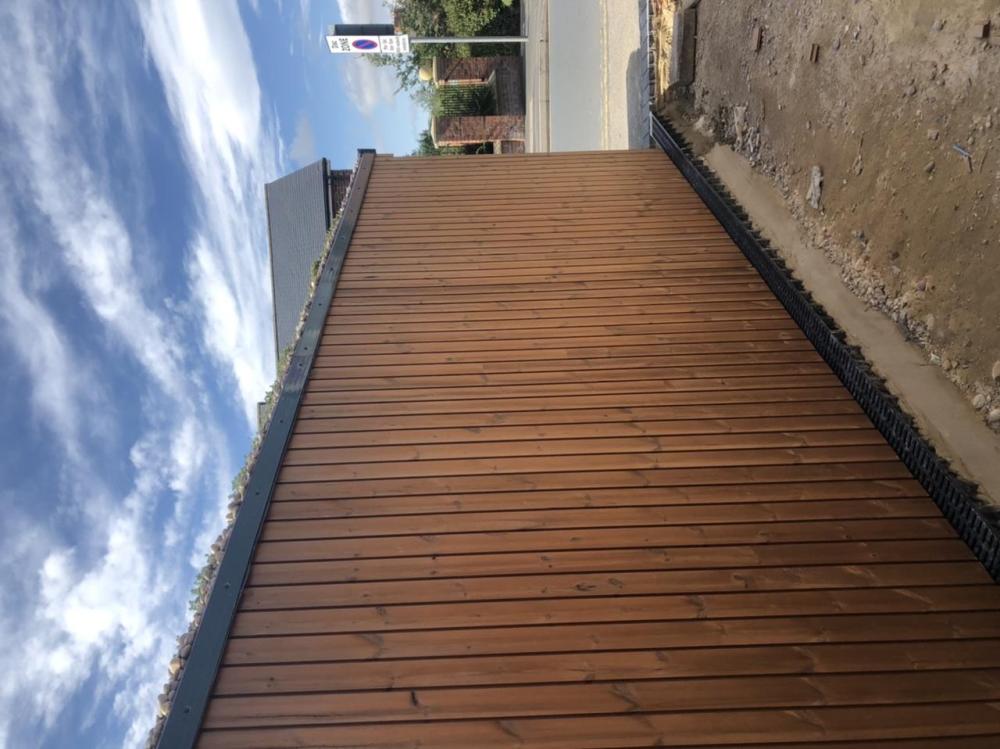
-
I would say the same for a wood floor or a carpet… Don’t drop wine on it, it’ll stain. I imagine it probably does stain the concrete over years of family abuse but that’s an aesthetic choice surely? Personally if I had an industrial looking floor like the one in the video, if it had a few dings and scratches in it, all the better. If I wanted a mirror flat finish, I would either have to pay a specialist or choose not to do it.
-
I’ve just listened to this podcast which touches on their experience with polished concrete in a passive build. The end results look great. It isn’t ufheated but I think if your willing to except some defects then it could be done as a cost effective use of the structural slab as finnished floor. He did spend 90 hours grinding it which would have cost a fortune for a specialist company to do but in the spirit of self build I would say don’t rule it out, just lower your expectations… If it’s that bad, allow for a thin engineered flooring to cover it up. https://www.houseplanninghelp.com/hph310-important-takeaways-from-an-exemplar-straw-panel-passivhaus/
-
From my short experience with this, our written description of current flora and fauna on site plus our plans to introduce specific varieties of plants for nesting birds and insects and wasn’t well received. They wanted to know a number. I’ve sent the completed matrix which puts a huge percentage gain on the site. It doesn’t go far in representing the original layman’s description of habitats we aim to increase. It looks and acts more like an agricultural claim form for subsidies. arbtech will do your survey, starting at £496. As you would expect. My planning officer admits he doesn’t know what this should look like. I guess a headed letter with 15 pages of descriptions and small graphs would no doubt tick their box.
-
Just to note, the concrete drive is as existing and is to be removed as part of the build. Hence the large gains.
-
I am using the small sites matrix yes. Have you filled it out? Where there is less to fill out than the larger site matrix it is still rather vague in terms of describing what I have. Like I said earlier, with my concrete drive I was able to increase diversity 400% with hedges and grass. Sub headings consist of, lakes, costal lagoons, rocky shore, coastal salt marsh, intertidal sediment, heathland and shrub, cropland. They all have slightly better options once you narrow them down but doesn’t go very close to describing the rose bush and rotten pear tree I have. I’m very much in favour of improving the diversity of the plot.
-
Your right, the section stated as ‘off site post development’ basically falls into bio-diversity offsetting…
-
When I use ‘the matrix’ which natural England have clearly spent a lot of time developing… I got a 400% net gain turning my concrete drive with no vegetation into shrubs and wildflower grass totalling 0.002 hectares. Slightly confused with the hectare metric used for a site which is not even half a hectare! Que the helpful ecologist surveyor who wants £400 + vat for a 1 hour report, no doubt.
-
Has anyone come up against submitting a net gain for bio-diversity for their build? It can be submitted by non ecologists but the current ‘matrix’ system in place seems far to broad in terms of describing a garden. The current planning officer has no working examples. Reaching out to see if other self builders have had to submit something similar.
-
@Thorfun- your right. My architect was quick to fill these out having suffered some hefty fines in the past for previous clients. Ours are already applied for, saying that we had to put a ‘start date’ on the form. The start date arrived and the local planner came to site to check we hadn’t started! Thankfully we hadn’t as were still arranging our planning conditions. Keen is an understatement.
-
We’re in the process of contacting all our mains gas,electric,water& telephone connections. They all seem to start with scared figures but after finding alternative competent sub contractors we have managed to slash costs by 50%. We have a list of planning conditions we need to finalise as part of our planning agreement too. Once these paper tasks are done we will start on the demo of the old building to clear the site.
-
Passivhaus window suppliers to UK - recommendations
Rishard replied to markharro's topic in Windows & Glazing
@Chanmenie- did you get quotes back from the above? Cheers -
UVC prep for ASHP recommendations
Rishard replied to SuperPav's topic in Air Source Heat Pumps (ASHP)
I’m also working to a similar plan to yourself. Just waiting on a price for a mains gas reconnection which may answer the future of my ashp vs gas dilemma. -
The Economics of our SunAmps
Rishard commented on TerryE's blog entry in The House at the Bottom of the Garden
Apologies. I will delve into the archive. -
The Economics of our SunAmps
Rishard commented on TerryE's blog entry in The House at the Bottom of the Garden
I will do just this. Was looking for a direct link maybe to the question as some people have discussed this in depth and may already know or have a link. There is a vast amount of content on here. Which is great. Not enough hours in my day clearly… -
The Economics of our SunAmps
Rishard commented on TerryE's blog entry in The House at the Bottom of the Garden
Did anyone pic up on this cost comparison? It would be interesting to know. This seems like a relatively cost effective system to install. Are people able to charge their sunamp using the Willis heater as well as their ufh or would this not be the correct application? -
MVHR system in new build
Rishard replied to deuce22's topic in Mechanical Ventilation with Heat Recovery (MVHR)
Are all your ceilings vaulted? Did you go for a warm roof design with insulation over your rafters or are you blowing in insulation? -
MVHR system in new build
Rishard replied to deuce22's topic in Mechanical Ventilation with Heat Recovery (MVHR)
There certainly is plenty to think about. I may have been foolish to think the suppliers ‘free’ design service would be enough to produce the plan! Hearing others experience on here, the system is relatively diy, however it may be worth starting this process earlier than planned. I allowed for a reasonable space for plant and have flexibility within internal walls to make alterations if more space is needed. Maybe I should post up a floor plan to hear opinions on system location ect. (Possibly on a new thread?) -
MVHR system in new build
Rishard replied to deuce22's topic in Mechanical Ventilation with Heat Recovery (MVHR)
So from outside to inside it’s. Atmosphere-mvhr box- manifold- smaller ducting to plenums in each room. One manifold serving exhaust one manifold serving supply? In a 2 story building is the main unit better on ground or first floor. We plan to have vaulted ceilings so probably won’t have attic space. A small space could be created above a bedroom ceiling if this is a preferable location. -
MVHR system in new build
Rishard replied to deuce22's topic in Mechanical Ventilation with Heat Recovery (MVHR)
Ok great. Semi rigid looks straightforward enough. What’s the difference between radial and other designs? I’ve not read into this part much. -
MVHR system in new build
Rishard replied to deuce22's topic in Mechanical Ventilation with Heat Recovery (MVHR)
@SteamyTea- is there a simple calculation I can do? Happy to send of my plans to several suppliers to see what their workings look like. One thing I did think was, is the mvhr system ducting something which needs to go in to first floor during the build, if say I was to use rigid ducting. I appreciate this opens up another can of worms regarding duct design. From reading peoples experiences on here a combination of rigid spiral duct twinned with semi rigid /flexible is popular with plenty of silencers along the way. -
MVHR system in new build
Rishard replied to deuce22's topic in Mechanical Ventilation with Heat Recovery (MVHR)
Ah I see so it’s more a case of yet again inadequate understanding from bc rather than a fault of a supplier selling you an under spec system. Gottcha



